
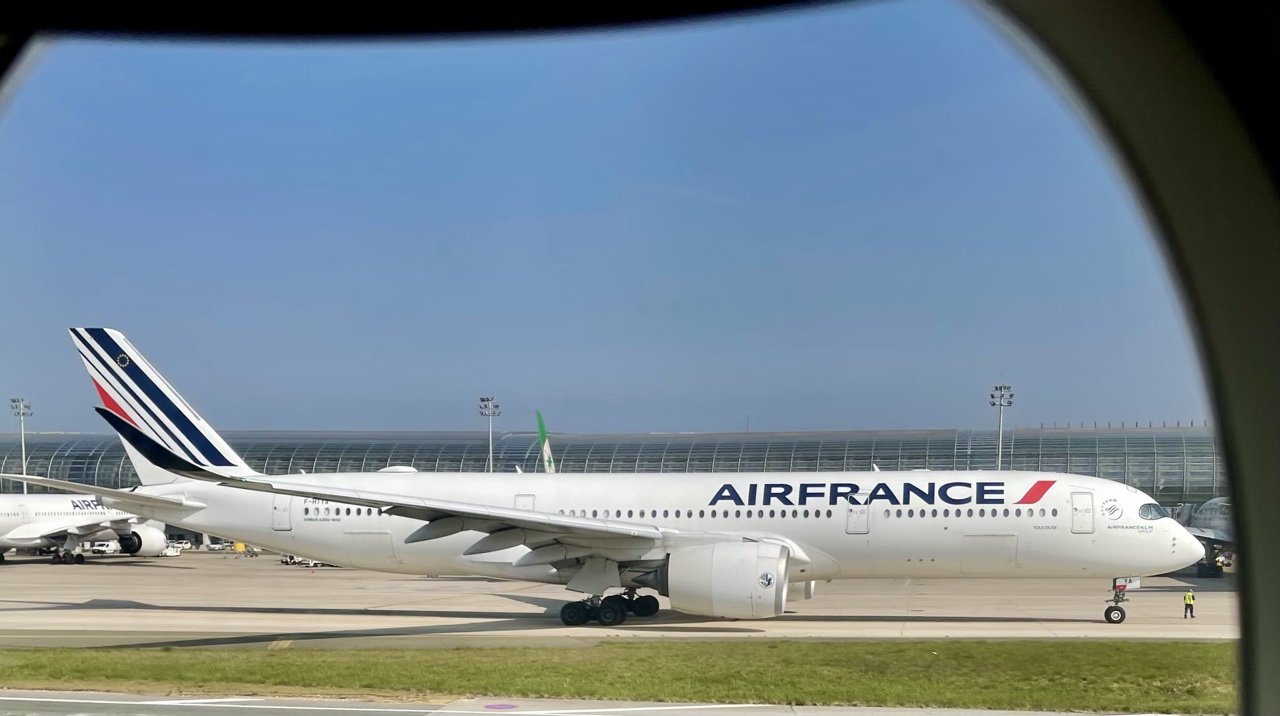
Airbus is openly studying a stretched A350-2000 to match Boeing’s 777X. Here is why Emirates and other giants suddenly care about a few extra rows.
Background: From Superjumbos To Stretched Twins
Once upon a time, airlines that wanted serious capacity bought four engines and did not ask many questions. The Airbus A380 and Boeing 747 handled the peak banks at slot constrained hubs, and everyone else filled in around them. That chapter is closing fast, with both types out of production and airlines now leaning hard into big twins instead.
Boeing moved first into that space with the 777X family, anchored by the 777-9. Emirates has doubled down on that bet. At the 2025 Dubai Airshow the carrier added 65 more 777-9s, taking its total 777X order book to 270 jets according to Boeing and multiple financial reports.
Against that backdrop Airbus walked into Dubai with a strong A350 order book and a welcome tailwind from continuing 777X delays. The 777-9 is now not expected to enter service before the second half of this decade, which leaves time and room for a competitive response.
That response may now have a tentative name again: A350-2000.
What Airbus Is Actually Studying
Talk of a stretched A350 is not new. Years ago Airbus floated an A350-8000 or A350-1100 that would add roughly 45 seats over the base airframe and sit right in 747-400 replacement territory. Concerns about market size and cannibalizing the A350-1000 killed that idea before it left the whiteboard.
Fast forward to Dubai 2025 and the mood is very different. Airbus commercial chief Christian Scherer has now gone on record that the company is actively studying a larger A350 variant and that customer interest is coming from “everywhere,” not just one or two noisy airlines. The concept would build on the A350-1000 with a stretch and a more powerful version of the Rolls-Royce Trent XWB-97.
A Facebook post from enthusiast page “FlightDrama” captured the gist of what was being whispered around the chalets in Dubai. In short, Airbus and Emirates have revisited the idea of a bigger A350, Airbus has confirmed that the concept is under study, and airlines see it as a way to claw back some of the capacity that disappeared when the A380 and 747 lines shut down.
So this is not a random internet fantasy. Airbus is openly running the numbers.
The A350-2000 Concept: What We Think It Looks Like
YouTube channel The Avid Aviator laid out a plausible version of how an A350-2000 could look, and it lines up with what Airbus insiders have hinted at. Think of it as an A350-1000 that has spent some extra time in the gym.
Key ingredients:
-
More seats
The A350-1000 already seats about 369 passengers in a typical two class layout. A stretch of several frames could push the cabin toward roughly 440 seats in high-density configurations, which puts it squarely in 777-9 territory.
-
More metal, more thrust
To make that work you are looking at fuselage plugs fore and aft of the wing, a modest bump in maximum takeoff weight, and engines with extra headroom. Scherer has already talked about an uprated Trent XWB variant to support a stretch.
-
More doors
Once you cross certain seat thresholds, certification rules push you toward another set of exits. That likely means at least one additional pair of doors, which is exactly the kind of detail Airbus has wrestled with in earlier A350 stretch studies.
On paper this is a classic Airbus move. Take an existing, mature airframe, stretch it, lean on incremental engine upgrades, and go hunting for a segment Boeing currently calls its own.
Emirates: The Airline Stirring The Pot
If you want to know why this is happening now, follow the heat, not just the thrust.
Emirates is the launch customer that made the 777X real in 2013 and it is still the program’s anchor tenant. Today it holds 270 777X orders and just spent another 38 billion dollars on 65 more 777-9s at Dubai.
At the same time Emirates has been very vocal about the capacity gap that will open as it eventually retires its A380s. The carrier is refurbishing and even expanding its active A380 fleet in the short term, but executives have been clear that they want Boeing to study a further stretch called the 777-10 and want Airbus to meet them with an A350-2000 on the other side.
This is not just about bragging rights at the home airport either. Emirates lives in a world of slot limited gateways at both ends of many routes. If you can move more people per movement, without going back to four engines, you get a real strategic advantage. That is especially true on trunk routes like London, Sydney, New York, and future growth markets in Asia and Africa.
So when Tim Clark says his phone is full of messages with Scherer about an A350-2000, you can safely assume the concept is getting more than a casual look.
A350-2000 vs 777-9: How The Matchup Shapes Up
We are still very much in the “study” phase for the A350-2000, but the broad outlines of the matchup are already visible.
-
Capacity
Boeing pitches the 777-9 at around 400 seats in a standard configuration and up to the mid 400s if you are willing to squeeze. A stretched A350 with tighter layouts would fall into a similar neighborhood, with the Avid Aviator estimate of roughly 440 seats on the upper end.
-
Weight and efficiency
Airbus has long claimed that the A350-1000 is lighter and cheaper to operate per trip than the current 777-300ER, while keeping seat mile costs very competitive. Extend that logic to a stretch and Airbus will likely pitch the A350-2000 as the more efficient way to move a 400 seat crowd.
-
Engines and climate
The sticking point in past Emirates talks has been hot and high performance in the Gulf, and specifically the robustness of the Trent XWB-97. Rolls-Royce and Airbus say upgrades are on the way, which is a prerequisite for any serious stretch.
Boeing’s counter is simpler. Stretching the 777-9 into a 777-10 is mostly a fuselage job. The GE9X already has plenty of thrust, and much of the underlying structure is sized for very heavy freighters. That could make it easier and faster for Boeing to add a bit more capacity compared to Airbus designing an engine and airframe package that climbs into new territory.
In other words, both sides have a credible path to “more seats,” but the engineering lift is not identical.
Who Else Would Actually Want An A350-2000?
Emirates may be the loudest voice in this conversation, but it is not the only one.
Airbus says interest in a larger A350 is coming from multiple regions as long haul traffic continues to grow and slot constrained airports get tighter. Think Heathrow, Hong Kong, Tokyo, Singapore, and the major hubs in continental Europe.
There is also a cohort of airlines that never bought the A380, but now find themselves bumping up against terminal and airspace constraints with 777-300ERs and A350s. For them a stretch provides the same crew type rating, similar maintenance infrastructure, and a familiar passenger product, just in a longer tube.
Even at Emirates the story is evolving. The airline is reportedly in advanced talks to order at least 30 A350-1000s, a move that would add the current largest A350 to its fleet and potentially set up an easy path to a stretched derivative later.
So while the A350-2000 is not a launched product today, you can see a shortlist of likely candidates just by looking at who already operates big twins in and out of the most congested hubs.
What Could Still Kill The Stretch
For all the excitement, there is a reason Airbus shelved an A350 stretch once before.
The 400 seat segment has always been tricky. It is big enough that you need a specialized aircraft, but small enough that only a handful of airlines can truly use it year round without either dumping fares or flying a lot of empty seats in the off season. That economic math has not suddenly become easy.
Then there is the engine issue. A more powerful Trent XWB costs real money to develop and certify. Airbus and Rolls-Royce have to believe there is a firm customer base and reasonable pricing power before they invest. Boeing faces its own cost challenges on the 777X program and may prefer to keep its engineers focused on getting the 777-9 certified and delivered before it commits to a 777-10.
Finally, you have the elephant in the hangar. Many airlines have found that a mix of smaller long range twins and high frequency operations gives them more flexibility than a fleet heavy with very large aircraft. Convincing them to go bigger again will take more than a glossy brochure from Dubai.
Where This Leaves Travelers
For now the A350-2000 is still a PowerPoint airplane. Airbus has confirmed only that it is studying a larger variant and listening carefully to customers that want more seats out of an A350. Boeing is being nudged just as hard to stretch the 777-9 into a 777-10. Emirates is at the center of both conversations, with 270 777X jets already on the books and a growing interest in the A350-1000 and beyond.
If even one of these stretch projects gets a green light, the next generation of “super twins” will finally give airlines a modern replacement for the capacity once handled by four engine giants. For passengers it probably will not feel dramatic. A stretched A350 or 777X will still look like a very long twinjet with mood lighting and lie flat seats up front. The difference is that there will be a few more rows behind the curtain, a little more revenue for the airline on each slot constrained departure, and one more round in the never ending Airbus versus Boeing rivalry playing out at 35,000 feet.
What do you think?



Short answer: No.
Longer answer: 350-1000 is enough; 777x is so delayed and odd that it’s not even really ‘competing’ these days.
I’m uncomfortable with the extended stretch body as it is. Too prone to tail strikes. Gimme the old fuel guzzling 4 engine 747 s as they fly off into the sunset. Best planes ever
How long would an a350-2000 be? At some point this cannot be safe.
Neither the A380 nor any other Boeing jet has yet filled the gap left by the magnificent and efficient B747. This appears to be one of the main reasons for the potential future competition between the B777X and the A350-2000. We’ll have to wait and see how things unfold.
“The gap held by the magnificent 747” now I know you are my friend!
The push will be for faster, better economics, greater reliability, and with it more frequency. As airports catch up in expanding slots and growing capacity the need for large 500 seat aircraft like the A380 will become less and less. There will be a few niche markets but most will be structuring their airports around fast turnaround aircraft approaching or surpassing supersonic speeds and carrying 200 passengers.
The next evolution is not size. It’s speed and efficiency.
It will be years before LHR has the third runway. Amsterdam is stuck in its current format with Green Party pressure to throttle back. For De Gaulle, the terminals are the hindrance if not for the persistent strikes. The Pacific basin continues to grow, especially China.
The real issue is the offset in range for the 2000 vs the 1000.
For most jet ranges, there is a sweet spot (B727-200 vs 100; A320 vs 319 or 318; B767-300ER vs 400; B747-400 vs 8I; etc). Airbus fell into the “bigger is better” rabbit hole with the A380 with diminished financial return. Do they want to do this again with a A350-2000. I would think LR & XLR versions are more important.