
Although I am not a theologian or pastor, I like to offer an annual Christmas reflection. This year, I focus on how obedience is at the heart of the Christmas story and should be part of our story, especially when we properly understand what it is.
2025 Christmas Reflection
Christmas arrives each year at a strange intersection of joy and fragility. We sing about peace on earth while watching wars expand. We celebrate light while feeling how close the darkness always seems. The older I get, the more Christmas feels less like a triumphal moment and more like a pause on the edge of something breaking.
That feeling is not new.
The Christian story begins not in serenity, but in rupture. A woman stands at the beginning of the story and the world fractures. Another woman stands at its turning point, and restoration begins.
Eve reaches for what is forbidden, believing autonomy will bring fulfillment. Mary receives what she never sought, bearing a promise she did not design, and simply says, “Let it be to me according to your word.” In Eve, humanity grasps. In Mary, humanity listens. One act of disobedience ushers in exile; one act of obedience quietly opens the door to redemption.
Eve and Mary are often set against one another in Christian thought, and for good reason. Eve sees what is desirable, reaches for it, and takes what was not given. Mary hears something impossible, frightening, and costly, and responds not with grasping, but with surrender.
“Behold, I am the servant of the Lord; let it be to me according to your word.”
-Luke 1:38
That sentence changes everything.
Mary does not negotiate. She does not ask for guarantees. She does not demand clarity about how this will affect her reputation, her safety, or her future. She does not claim moral superiority. She simply obeys.
That obedience does not earn salvation. Christianity is clear about that. Redemption is God’s work, not ours. But Mary’s obedience becomes the means through which salvation enters the world. God chooses to work through a human.
This is where many modern readers struggle. Obedience sounds regressive. It conjures images of control, repression, or blind submission. In a Western culture built on self-definition and autonomy, obedience feels like weakness.
Yet the biblical story insists on something counterintuitive: obedience is not the enemy of freedom, but its proper orientation.
Eve’s disobedience is framed as liberation. “You will be like God,” she is told. But it results in alienation, shame, and exile. Mary’s obedience appears restrictive. “Your life will not be your own.” And yet it becomes the doorway to joy, meaning, and redemption.
This pattern plays out repeatedly in our own lives. We chase self-actualization and end up restless. We resist surrender and discover anxiety. We grasp for control and find ourselves more constrained than before. Meanwhile, the moments that shape us most deeply often come when we stop insisting on our own way and trust something beyond ourselves.
Obedience, rightly understood, is not about earning God’s favor. It is also not about suppressing the self. It is about ordering the self rightly, choosing to live in step with what is true rather than exhausting ourselves by resisting it. It is acknowledging that we are not the center of the universe and discovering that this is, paradoxically, a relief. We are not the master of our fate or the captain of our souls, even as we have the capacity to obey or disobey.
Mary’s obedience did not spare her suffering. It did not shield her from misunderstanding or loss. Christmas is inseparable from the cross. The child born in a manger was born to die. But obedience gave Mary a place within a story far larger than herself, a story that still speaks hope into a world perpetually on the brink.
And perhaps that is why her example resonates even beyond Christian belief. Every human life faces moments where obedience takes the form of trust: trusting a calling, a responsibility, a truth we did not choose but cannot deny. We all stand, in our own way, on the eve of destruction or restoration, faced with the question of whether we will grasp or receive.
This Christmas, I find myself less interested in grand resolutions and more attentive to small acts of obedience. Listening instead of reacting. Choosing humility over certainty. Saying “yes” where fear would prefer silence. These are not dramatic gestures. They will never go viral. But they shape a life.
Eve’s choice shows us how easily the world fractures. Mary’s response shows us how quietly it can begin to heal.
Christmas reminds us that God’s answer to a broken world did not arrive through force, spectacle, or domination, but through obedience, vulnerability, and trust. A young woman said yes. And everything changed.
That is still how change begins.
Merry Christmas.
What Child is this, who, laid to rest,
On Mary’s lap is sleeping?
Whom angels greet with anthems sweet,
While shepherds watch are keeping?
This, this is Christ, the King,
Whom shepherds guard and angels sing:
Haste, haste to bring Him laud,
The Babe, the Son of Mary!
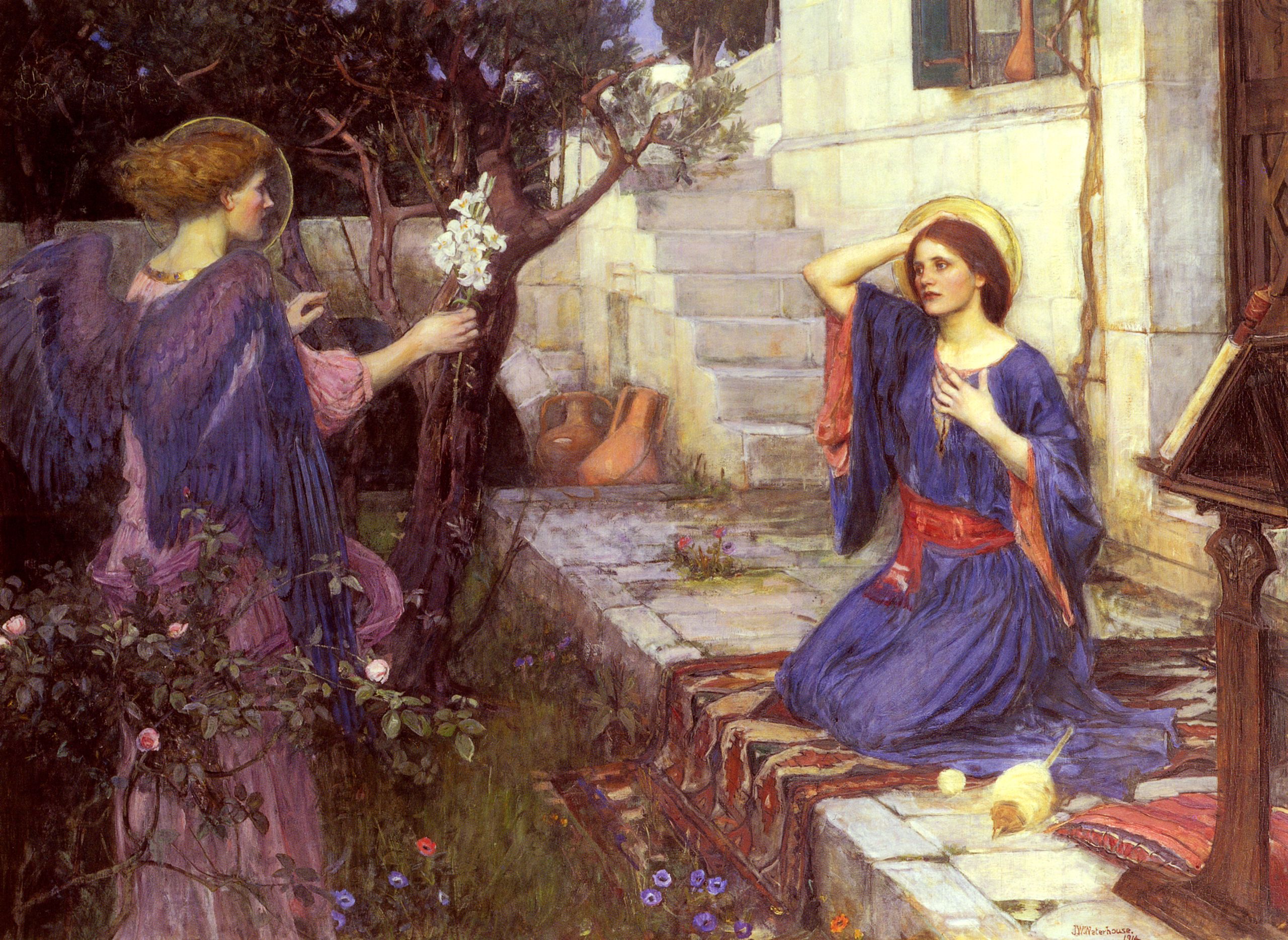
top image: John William Waterhouse’s The Annunciation (1914)
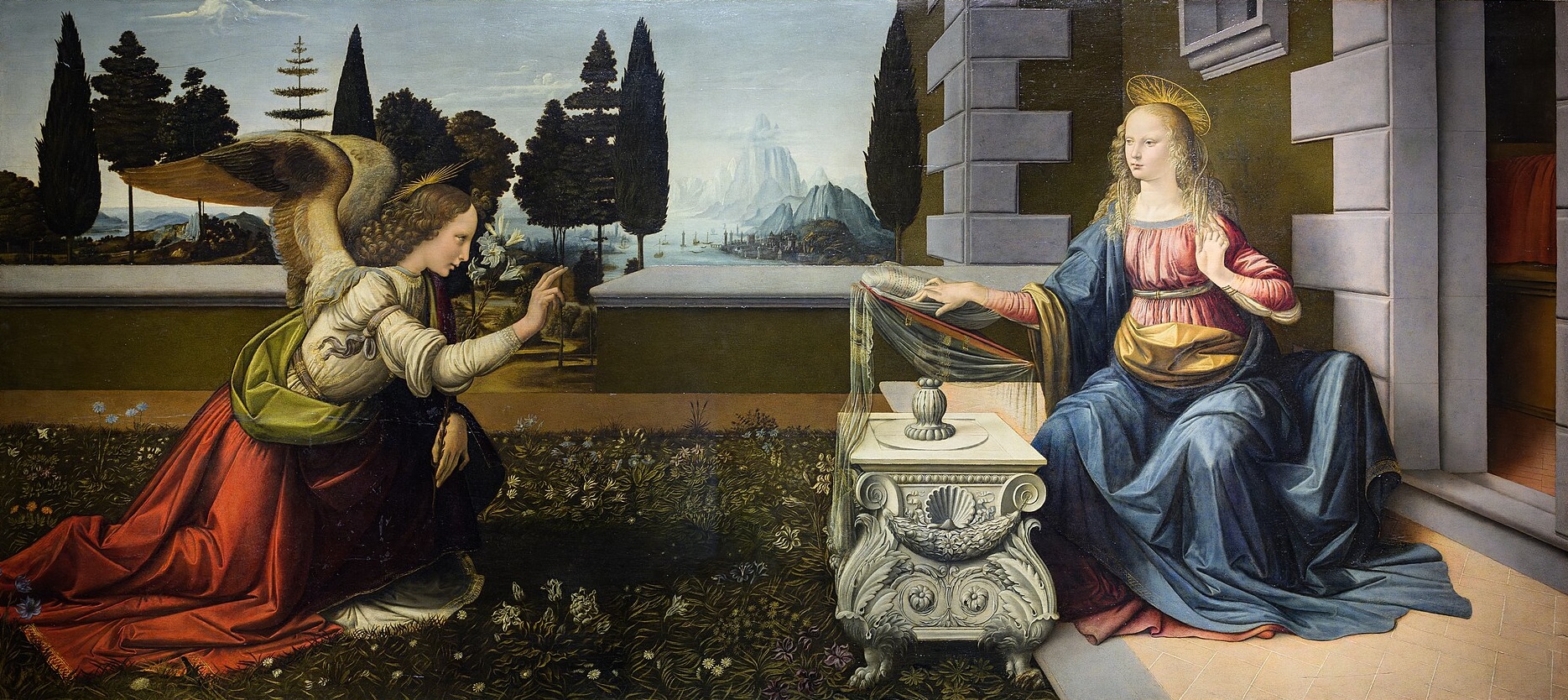
bottom image: Leonardo da Vinci’s The Annunciation (1472-75)






Interesting take. It sounds a bit to my non-theologically inclined mind like you’re treading fairly close to the basic premise of Islam, which means surrender.
Do not advocate raising taxes, particularly on other people except yourself, which is akin to Eve’s taking. Instead, work smart with the current tax base. Take care of your family and relatives.
Similarly, be meek to the airline enhancement of miles and peso but you are free to change airlines.
The Eastern world, it is explodin’
Violence flarin’, bullets loadin’
You’re old enough to kill but not for votin’
You don’t believe in war, but what’s that gun you’re totin’?
– Barry McGuire, 1965
Interesting comparison of Eve and Mary.
Thanks for sharing.
Merry CHRISTmas!
You are a theologian….we all need to remember that one part of that is the generosity that all faiths expect of their adherents…
Thank you, Matt.
LALF was the first website I went to over my Christmas coffee and I was concerned that it looked like you had forgone your annual reflection. It was worth being patient.
Beautiful post, Matthew. As you say, we are saved not by our own means, but by God, who chose to make Himself one of us and die so that our sins may be forgiven.
Another way to contrast Eve and Mary is saying that Eve was of the world and Mary was of God. Eve was tempted and chose to eat from the fruit for short-term pleasure, seeing it as “good for food and pleasing to the eyes”, ignoring what God had told her and bringing forth sin, death, and all kinds of suffering. Meanwhile, Mary, as you say, simply accepted God’s will (despite being troubled and full of questions) and through her Jesus was brought into the world to suffer and die for our sins in order to redeem us.
I see this all the time. God may not seem like the most appealing choice (at least in the eyes of this world), but choosing Him is what is ultimately most fulfilling and freeing. The way I see it, we are made in God’s image and likeness, so choosing to follow Him makes us more us, if that makes any sense.
Merry Christmas! “The Grace of the Lord Jesus be with God’s people. Amen.”
Matt,
Merry Christmas. LALF was the first website I visited over my Christmas morning coffee and I was concerned that you might have foregone your annual reflection. It was worth the wait.
What a very well written opinion on the CHRISTmas story. I cant imagine what life would be like if Mary chose not to believe, and told the Angel – No! OMG! Merry CHRISTmas!
Thank you, Matt!
I’m less into the mysticism of any and all religions, and more into the practical life guidance and positive community outreach that each can and often does produce. That said, I respect that you care deeply about your faith, Matt, and appreciate you sharing with us all. Hope everyone is enjoying their holidays.
Merry Christmas and Happy Holidays to all!
Interesting contrast between Mary and Eve. God’s word has so much depth, much like His love for us and His desire to see us surrender to Him and His offer of Grace.
I too wondered where your annual Christmas reflection was yesterday and am glad it is available today.
You are correct that age brings an ability to put things in perspective, including recognizing what really matters.
As younger people, it seems like big resolutions and changing institutions matter the most but later we learn that doing our little part in the lives of people one at a time, often unseen to much of the rest of the world, IS what changes the world.
Merry Christmas to you and yours, Matthew.
Merry Christmas to you, Matthew.