
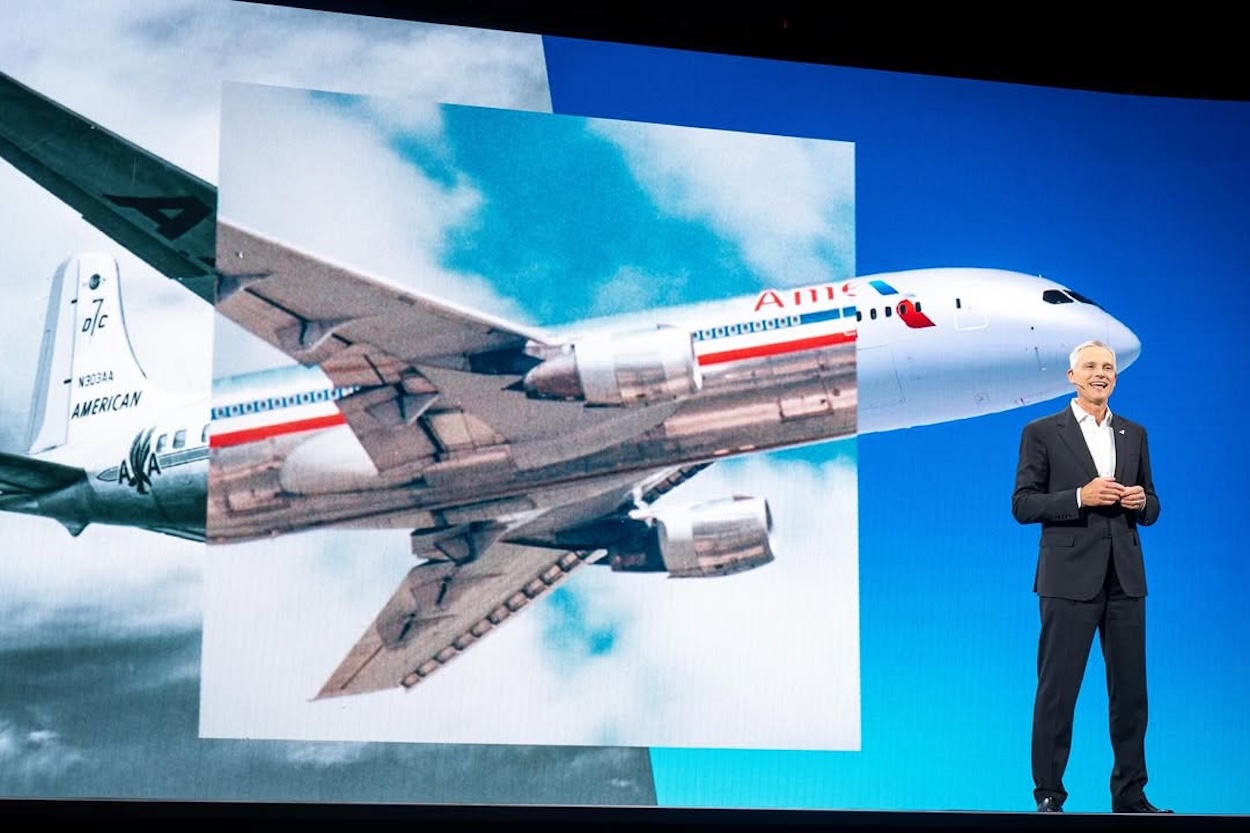
American Airlines CEO Robert Isom recently issued a video response to mounting internal pressure following a historic no-confidence vote by the flight attendant union and similar frustration expressed by the pilots’ union. The speech was intended to outline a turnaround plan for the airline in 2026, but what came through in tone and substance was a mix of reassurance and ambiguity.
American Airlines CEO Robert Isom Responds To Union Revolt With Broad Turnaround Plan
In a message to employees and frontline leaders, Isom sought to project confidence in American’s ability to improve its operational and financial performance in 2026. He touched on customer experience, network growth, fleet modernization, loyalty programs, and operational reliability. Delivered against the backdrop of union no-confidence votes and intense criticism of leadership, the remarks were notable both for what was said and what was left unsaid.
Here is Isom’s message in full, transcribed by aviation insider JonNYC:
Good afternoon, everyone. Given all that’s going on with our airline right now, I wanted to share more about where we’re heading in 2026. Last year was a tough year, no doubt about it. And I know some of you are still recovering from the winter storms just a couple of weeks ago.
As we look forward to 2026, it’s with a lot of excitement and confidence. I know we’re going to do better financially and operationally. We have a plan to be solidly profitable this year, which will mean good things for our customers, our shareholders, and all of you, especially in regard to future profit sharing to go along with our industry-leading contracts. We will reclaim American’s reputation as the world’s premium global airline.
And we shared how we’ll do that with our 6,000 frontline leaders last week at our Journey Leadership Conference.
Here’s what we’re doing:
- First, we’ll continue to improve the customer experience. We’re following through on this commitment with free Wi-Fi, new lounges, better food and beverage offerings, and even more advanced technology to help our customers along their journeys, especially when it comes to recovering from disruptions.
- On top of this, we’re making significant investment in facilities at several of our hubs, including DFW, Los Angeles, and Miami. Customers are noticing, and their approval is showing up in our net promoter scores. We need to execute on these improvements every day, and we are.
- Second, in 2026, we have a plan to maximize the power of our network and our fleet. The US is the most important aviation market in the world, and no one serves it better than American. This year, we’re excited to grow the airline at its fastest rate in years. You’ll see this in Philadelphia, Miami, Phoenix, and of course Chicago, and throughout the rest of the system.
- And you’ve heard about some of the new routes that we’ve announced for the summer and beyond. We’ve added thousands of frontline team members over the past few years to support this growth, including more than 7,500 flight attendants and more than 5,000 pilots and thousands of airport and tech ops team members. All of this is great news for our team.
- And to further support all this, we’ve taken delivery of hundreds of new aircraft over the past few years, with another 55 expected to join our fleet this year, including the premium Boeing 787-9 and Airbus A321 XLR, both of which include our flagship suites. We’re also retrofitting hundreds of additional aircraft across our existing widebody and narrowbody fleets. And all of this is the culmination of work that began years ago.
- Third, our AAdvantage program, the first and still the largest airline loyalty program, offers tremendous opportunities to strengthen ties with our customers and our partners. We invented airline loyalty, and Advantage is the best and most valuable loyalty program in the industry. Our new card partnership with Citi, which started in January, is key to unlocking future growth and revenue, and that’s a big deal.
- Finally, we’re doing a much better job of selling our product, and we must do more. We’ve regained our share of corporate revenue, and the next step is to push it even further. We’ve brought on resources and tools to make sure our products are easier and more accessible for customers, and I know that will make all of our products, especially our premium products, more appealing to our customers and ultimately drive more revenue.
Now, we all know that to accomplish these goals and take care of our customers, we need to run a fantastic operation, much better than our customers experienced over the last year. Disruptions are going to happen, and I commit to you that we will do everything possible to make recovery go more smoothly and painlessly for you and for our customers.
You’ll notice that we’re rebanking DFW beginning in April to pull down peaks. And in addition, we’ve buffered the system with spare resources, including people and time. Just know this: we’re committed to setting up our team for success, no matter the conditions they face, to meet the needs of our customers. And that’s why we’re in this business—to care for people on life’s journey.
The better we take care of our customers and team, the better off our company will be. To accomplish all this, it’ll take all of us working as one team. And please know this: I’m always open to meeting with our union partners. And to you, as you know, I always look forward to our interactions, whether it’s at the gate, on the flight deck, in the cabin, in your break rooms, or here at the Skyview campus.
Leading American is a privilege and a great responsibility. I’m proud to work with all of you, and I’m more confident than ever in our future and what we’ll accomplish this year. It starts with leadership at the top, with me. And it’ll take all of us focused on our future. And I know we can do it together. Thank you for everything you do.
(the video has not yet been made public)
Analysis
Isom’s remarks lay out a broad set of initiatives, but they lack the kind of specificity that frontline employees and vocal union leaders are demanding, though he is in between a rock and hard place right now. He emphasizes improved customer experience, investments in lounges and Wi-Fi, hub facility upgrades, network growth in key domestic markets, fleet additions, and loyalty program strength. Yet he only indirectly addresses the union’s central grievances: deteriorating operational reliability, lagging profitability compared to competing carriers, or the deeply negative perception among crew members themselves.
The tone of the speech is optimistic, but it reads as a list of ongoing efforts rather than a coherent turnaround strategy with measurable targets and timelines. Moreover, in the context of a historic no-confidence vote and escalating demands from both flight attendants and pilots to engage directly with the board, it is reasonable to ask whether this message will satisfy those constituencies or further entrench frustration.
In short, Isom’s speech presents a roadmap for incremental improvement, but it lacks the clarity and urgency necessary to convincingly reset the narrative or address the structural issues highlighted by American’s unions. And yet I’m not sure he could have done any better. Absent that context, it’s a good speech and he raises several key points that should, all else equal and absent any so-called “black swan” events, help move AA toward profitability.
My biggest question is whether the pie is big enough for American, Delta, and United. Because Delta first, then United have invested years in building up a loyal premium clientele, an investment that takes years even if AA now does everything right. As we see demand to Europe potentially waning, I’m not convinced there is enough premium demand for AA to re-style itself as a third premium carrier in the USA.
I also know that chasing the Frontier/Spirit model, which flummoxed AA for years, was certainly the wrong approach with AA’s high built-in cost structure.
Thus, I find the AA strategy issue so difficult because I don’t whether we are at a “too little, too late point” or whether AA can create additional demand or siphon demand from Delta or United.
CONCLUSION
Isom’s speech wasn’t bad. In fact, it was good. Even so, it still lacked the specificity that is necessary to “rally the troops” to step in and do more to assist in AA’s turnaround. As View From The Wing aptly stated, “What a CEO of American Airlines needs to do is lay out what the carrier’s north star is. What’s their mission, what are try working to deliver to customers, so that each of the improvements they’re making fits into a context and can be understood by employees and passengers as a step on a journey rather than a disparate effort.” A lot of us are still waiting.
image: Robert Isom / Instagram // hat tip: View From The Wing




well said Matthew.
Isom’s strategy – which appears to be supported by the board – is at best incremental.
It doesn’t matter if it pleases labor or not; it would be great if they could support AA mgmt but that hasn’t happened in decades – other than Parker for as long as it took him to grab control of AA from AMR mgmt.
Kirby would love to believe there is only room for 2 legacy/global carriers that are premium positioned – but the real question is not as much what AA is able to do but whether WN pushes up into that territory which is a very real possibility.
Add in a potential AS-B6 merger which makes far more sense than AA-B6 or B6-UA and the US could be looking at 5 legacy/somewhat global carriers even if the rest of the LCC and ULCC segment is obliterated.
DL, UA and WN seem to have a clear shot at where they are going and WN has lots of room for further strategic growth. AS is still too small to matter on a true nationwide and global basis – but that could change.
AA needs a true path forward and AA labor and mgmt need to get on the same page together.
2026 could be one of the most significant years in the US airline industry; I suspect that AA’s future will be either even more cloudy by the end of the year or much more defined.
Barely skimming above the water – which is what AA has been doing for 2 decades – is not working and will be even harder to sustain.
Yes they need a North Star but Isom’s generalities are almost laughably vague.
They’ve got new planes but how is the actual flying experience on them?
They want to lean into AAdvantage. That’s great but how? Reverse some of the plethora of devaluations? Make it so a normal person can reasonably use SWU certificates effectively? Guarantee a certain number of saver seats on every cabin on every flight? Restore elite upgrades rather than selling seats to infrequent travelers at very low rates?
How does Isom reconcile an improved customer experience with less legroom and removing existing IFE rather than adding it where it’s missing?
All told, this sounds like a bunch of bs cotton candy corporate speak: It sounds good on the surface but lacks substance.
The unions will do AA in
dee, you don’t need to have Fox News/OAN/Newsmax on at full volume 24/7.
Unions built the middle class, and remain a strength, not a weakness, in aviation and other industries.
Unions are not the problem here or elsewhere.
+1.
It ain’t the unions – and certainly not the FA union. American’s inept management team has been doing wonders at wrecking the airline since the merger. Management (not leadership as there’s no leadership evident) just can’t wrap their tiny heads around the fact that AA is a giant non-ULCC airline and they need to adapt accordingly.
The “storm warning” for AA is not over yet… Experienced Robert Isom and seasoned AA board members should recall that “a lack of structure won’t kill a company, but a lack of vision/mission will.”
He’s trying to run an American icon on a woke agenda and woke proposals while bragging about customer improvements that don’t meet the needs or expectations.
Dave, that comes across as a monumentally stupid statement. What exactly are the things that make Isom’s inept agenda “woke”? That’s a term the uneducated use when they don’t have any viable reason to dislike something, generally because they’re wrong. Please give us the long list of “woke” things…
At this stage, for the AA CEO, speech is gold, and silence is silver…
It seems to me that Management has it half assed backwards. Isom stated “ The better we take care of our customers and team, the better off our company will be.” Maybe He should have changed the order and said … the better we take care of our Team, the better they’ll take care of our Customers. Every Husband knows and has experienced … Happy Wife/Happy life. I’ll never forget the first day of the semester in Med School what the Dean said to us … “M.D. dies not stand for most divine. R.N. does not stand for right now. Treat your Nurses with kindness and respect because they will make you or break you. (Boy is that TRUE! As a young Resident, Nurses taught me a lot and saved me from being stupid). Delta Airlines isn’t where it is by happenstance and their Employees, by and large, aren’t happy by osmosis. AA should maybe take a page from the Delta playbook.
You’ve been the CEO of how many airlines?
i would love to be able to be this bad at my job and still have it, especially for that pay
the social compact is broken. this generation is gonna run the planet into the ground and leave our futures in tatters
The pie is definitely big enough. Planes are full and airports are busy.
What his speech glaringly leaves out of the “improving customer experience” is that it is the EMPLOYEES who make that experience. A great attitude, help, service can make even the roughest day better. An attempt to empathize and do what they can to help, can minimize an issue. Without the front line employees invested in the customer experience, none of the bells and whistles will matter in bringing them back into the game
He’s standing solo on a melting iceberg.