
Ahead of the 2028 Olympics, Brightline West is spending $21 billion to build high-speed rail between Los Angeles and Las Vegas. What happens to flights when it launches?
Everyone’s Covering the Infrastructure Story
The aviation and travel press has done what it always does: treated this as an infrastructure milestone. “Look, rail is coming to America. California is building the future.” It’s a legitimate story. Brightline West is a genuine achievement for the US and a rebuke to decades of American underinvestment in passenger rail – if its federal loans materialize. It’s less of a response to vast European networks and more of the most pointed American solution possible.
But the infrastructure story is boring compared to the actual story, which is that the economics of sub-500-mile airline routes in America just fundamentally shifted.
Few in the aviation blogosphere is writing about what happens to Southwest’s Vegas strategy. Or how Spirit and Frontier lose a major revenue segment, one that they both desperately need to retain. What happens to Las Vegas tourism when the LA-to-Vegas corridor converts from mostly air traffic to mostly rail?
The Route That Prints Money
Las Vegas from Los Angeles is approximately 270 miles. Currently, it takes about an hour to fly, plus two hours of airport time (parking, TSA, boarding, deplaning, baggage claim). That’s three hours total, door-to-door, and you pay somewhere between $80 and $250 depending on carrier and time. Scant savings over a four hour and fifteen minute drive.
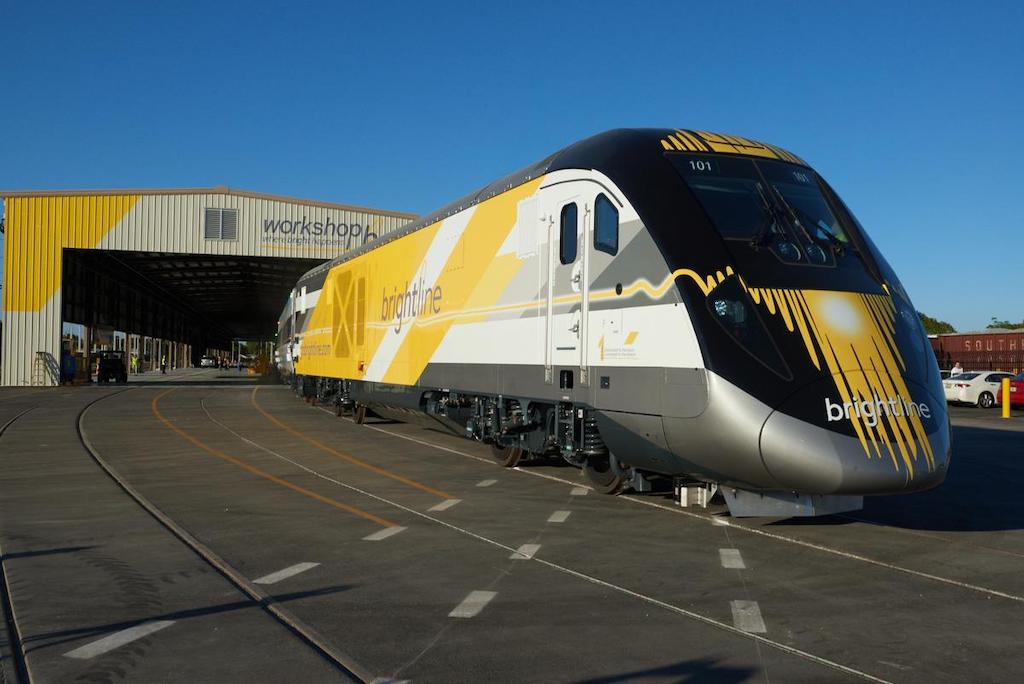
Brightline’s train: 2 hours, Union Station to downtown Vegas (no airport hassle), with a starting price expected to be competitive with or cheaper than flying.
The math changes immediately.
The LA-to-Vegas air corridor handles nearly two million passengers each year, and California alone delivers more than 20% of annual visitors. This is one of the highest-frequency short-haul routes in North America. Southwest alone operates about 4,000 seats per day from the four greater Los Angeles airports. Focusing on the LCCs (or former LCCs in Southwest’s case) is one piece of the puzzle but American (3x), Delta (5x), and United (5x.) It’s not a major long-haul hub for any carrier, it’s a volume game. Low-cost, high-frequency, profitable-on-margin.
The Cascading Effect
Once Brightline proves the model works on LA-Vegas, the dominoes could start falling. But what market is next?
- Dallas-Houston. 240 miles. Southwest’s bread-and-butter route. $80-120 fares. If you can take a 1.5-hour train from downtown Dallas to downtown Houston for $60, why would you fly?
- Chicago-Detroit. 280 miles. Similar profile. Regional hub with high frequency. Current flight time: 1 hour. Train time: 2-2.5 hours. Cheaper. No airport hassle. This is a dead route for airlines once rail infrastructure exists.
- Chicago-St. Louis. Boston-New York. San Francisco-Sacramento. Every sub-500-mile corridor in a developed state is now vulnerable.
This is potentially 5-10% of all commercial air traffic becoming rail-oriented in the next 10-15 years. That’s not a marginal impact. That’s structural.
But each of those faces challenges that southern California to Las Vegas does not. Dallas to Houston has a ton of traffic, especially from the oil & gas segment but also a planned Hyperloop (that may be stalling before it gets rolling.) Detroit and Chicago could work mostly for business travelers, but both St. Louis and Detroit have struggled as of late. Boston and New York can’t simply lay line through the desert but must navigate a far more difficult and populated geography. And California as of July 2025 had yet to lay any actual track despite a 16-year development and a $15 billion investment of a now $135 billion budget, so even the most hopeful should temper their expectations.
What Changes For Airlines
Southwest’s core business model is built on frequency on short-haul routes. If those some of those routes convert to rail, Southwest’s competitive advantage shrinks. It’s impossible compete on frequency in a market where someone already won on speed and convenience.
Spirit and Frontier don’t have the same problem, they’re not frequency-dependent, but they are margin-dependent. Losing Los Angeles to Las Vegas won’t be the death knell for the carriers, but Brightline has proven its case in Florida by carrying 10,000 passengers daily. Some of that has reduced frequencies between Orlando and southern Florida.
Legacy carriers (Delta, United, American) are less exposed because they don’t depend on short-haul frequency. But they lose the profitable connecting passengers if they reduce frequency too much. That could have a broader effect and for Las Vegas residents, it doesn’t just reduce frequencies but pushes prices up too.
However, if Brightline is fully successful the two could operate (in time) as co-terminals. Florida has this ability. Smaller airports with routes into Orlando (which is nearly every airport) can take the train right from the airport and disembark in Fort Lauderdale, West Palm Beach, Miami, and soon, Tampa.
Bigger Than Brightline
Brightline isn’t trying to kill airline routes. They’re building transportation infrastructure. But infrastructure shapes behavior, and behavior shapes business models. The genius of Brightline is that they’re not competing with airlines on their terms. They’re competing on ground transportation speed and less hassle. That’s a different value proposition than price or frequency. Some will pay more for the speed and ease.
Flight prices can’t really drop to counter Brightline West either. A search for May showed almost every day with $25-46 one-way fares (just one day at $53), and when given the choice, people will choose the train because the total travel experience is better. Airlines have spent 20 years building a business model around hub-and-spoke connectivity and frequent short-haul feed. Brightline will challenge that in a new market.
What do you think?






Geographically, Chicago-Detroit is more challenging (with Lake Michigan in the way). It’s not a straight line like LA-LAS.
But agree that there are a lot of corridor opportunities for high speed rail that should kill point to point flying.
Chicago-STL is already a state-run higher speed corridor, but still can’t quite beat flying. IMO, the biggest missing piece currently is NY-BOS, where the track ownership situation is a mess, and the Acela can’t run at its full speed. Getting all those points to point BOS-NYC flights out of the sky would be great for the NYC ATC situation.
I like where your head is at. Revitalize the Midwest with high speed rail! NYC to BOS or DC is Acela for me; no driving, no shuttle flights (too frequently delayed, canceled). Brightline in FL is a cool concept, though everyone has a car down there already, so I’d assume it’s mostly tourists. Wish California would finally get it done. Texas corridor would be cool, too. I love me some choochoos.
@Will – The foothills will pose different challenges than Lake Michigan, but maybe go around it? 🙂
NYC-BOS is difficult given how valuable and dense all the real estate is between them. Note how the EU high speed rail is mainly through farmland, which, like the desert out west, is easier to put straight rail through. I’ve also wondered how much Houston-Dallas traffic would really be to the downtowns. Both metro areas are pretty spread out these days, like with the Woodlands in Houston and Frisco near Dallas.
Chicago to Minneapolis would be a logical next line, it’s a mostly rural route and you pick up MKE and MSN along the way (especially if they actually stop in MSN, which Amtrak doesn’t do).
@Lance – Minneapolis is growing more than Detroit, it could make sense.
Clearly written by someone who doesn’t understand the economics and market potential associated with intercity passenger rail.
BLW is a textbook example of two major factors associated with new greenfield HSR: 1) available right of way and 2) stations with the CBD. Having mostly “free” ROW is key, as BLW is being built mostly within the I15 ROW – which is not always available for some ODs. Regarding stations to the CBD, you failed to include the most limiting factor of BLW- the corridor is between Vegas and Rancho Cucamunga and requires a transfer on commuter rail operator Metrolink to get to LA Union Station. Thus limiting the potential competitiveness, with the most substantial market BLW serving is the Inland Empire and not LA County. For most travelers, a flight out of LAX, BUR, or SNA might be more competitive than at least the hour plus to get to RC to get on the train. The market share loss the airlines may face here is minimal (maybe no flights from ONT to LAS).
If you think Dallas-Houston on a high-speed train will only cost $60, I have a bridge to sell you.
@Dave – You may be right.
This article is 10 years too early at best.
@Jay – It wouldn’t be the first time an article here was ahead of its time.
Absolutely no sympathy for any US airline, the more they get squeezed, the better.
What upsets you about an airline’s economics?
The cost of aircraft?
The cost of fuel?
The cost of labor?
The cost of ATC?
The cost of pax facility charges?
Please explain.
This thing should start and end in Disney because it’s pure Fantasyland.
@Kyle Prescott – This could be true. But Brightline in Florida suggests that it’s possible.
You mean the company that’s around 6 months from going into bankruptcy?
https://www.fitchratings.com/research/infrastructure-project-finance/fitch-downgrades-brightline-trains-florida-sr-pabs-to-ccc-brightline-east-notes-to-cc-16-01-2026
https://www.railway.supply/liquidity-crisis-drives-brightline-florida-debt-restructuring/
Like HKG-CAN. Flights solely exist for connecting passengers.
I’m not from SoCal so maybe I’m missing something, but how in the world are you getting 2 hours from Union Station to Vegas?
My understanding is Brightline is promising 2 hours from Vegas to Rancho Cucamonga, but then you’d still need to take Metrolink from there to Union Station which is over an hour even ignoring connection time.
This feels like some odd AI generated analysis.
Sacramento to San Francisco a major air corridor??? There’s no major air corridor. It is a popular rail route.
Overall the detail here is “off” – I come to BoardingArea because writers really get their details right in a way no other expert does.
@Greg – Thank you for your support, always great to meet a fan. Here’s the Sacramento-San Francisco piece, though Seattle-Portland might have been a better example. For one, California can’t seem to make large scale projects happen in rail despite decades and tens of billions of dollars (cited in the post) but there’s only two markets outside of San Francisco to Los Angeles that make sense. This is one of them because of the lobbying efforts (at least between those on the boondoggle project) more so than the other market, Los Angeles to San Diego. Why? San Diego and LA would be a far larger population center, San Diego has walk across access to Tijuana, Mexico too. But the distance is too short for HSR to make any meaningful advances. As I noted in the Boston-New York segment, areas that are too congested won’t make sense, but perhaps I should have filled in that shorter distances also don’t make sense because there’s not enough useful time savings to justify the expense.
The assumption here is SOOO not correct. Does the author even know the geography of the LA Basin? This train will not be more convenient at all….have you tried to get to RC in the afternoon for a quick trip to vegas….the majority of the time is to jsut escape LA….not the desert….
This train will be good for the desperate housewives in the inland empire wanting to drink on the train for a girls trip to Vegas….
@isaac – I agree that most of the time by car is spent getting out of LA, maybe rail solves that maybe partially, or maybe not at all – though it has to be better than the 405, right? But the majority of this journey is, in fact, through low inhabited areas of the Sierra Nevada mountain range and the desert. Of the 240 miles from Los Angeles International to the Las Vegas Strip, 204 of those miles are between Sloan, NV and North Fontana, CA both on the edge of their respective metropolitan areas. Whether mountain, or desert, it’s easier to build without roads, buildings, and people. But in Brightline’s analysis, and it does now have some experience with this, that time is factored in. If it solves the problem from RC to North Fontana alone, it would have to win your support and that of many Angelenos. And this is also not a uniquely California problem. Just a few weeks ago I was attending a work dinner in Sunny Isles, Florida (the northern part of Miami Beach) and transited to South Beach (less than seven miles) and it took an hour. But Brightline blows right through from Palm Beach to Fort Lauderdale to Miami. It’s a solvable problem.
Kyle, covering something that has zero chance of ever getting built! Get all these poor peoples hopes up. Also if it relies on billions of dollars of federal funding it tells you it aint economically viable on its own.
What about all the billions the Federal government invests in highways and airports? Are they economically viable?
It’s still a waste of money and not viable. See the article I posted on another comment.
Jets made HSR obsolete. I can’t think of anything more ludicrous than an HSR line from Chicago to Detroit or St Louis.
We are going to have self driving cars soon at the very least supervised if not completely autonomous.
@Rail – Yet in Florida, the effect has been opposite, HSR made some flights irrelevant.
Brightline is Florida is not high speed rail. It doesn’t go 155+. 125 is not true high speed rail. There can’t be too many people flying from Orlando to Miami or the other way who have those as the final destination. Maybe someone flies from Orland to Miami to catch a flight to South America.
@Rail – There were more than you might think (maybe international traffic) that was flying between MCO and MIA, but I’d rather board a train at MCO and arive at MIA (you can’t yet, but in the future, probably) and then switch to an international flight than waste time in the airport. And that comes from someone who loves airports.
Also, it has road crossings. True HSR does not have that. It’s a glorified commuter line.
Arguably not, but road and air travel interests are entrenched, the money and land were already allocated, and the infrastructure is already there.
@Your Daddy – We can’t use California’s boondoggle as the case study here for a number of reasons. Florida’s high speed rail got built, is operational, and has been a runaway success. If we use your second statement as gospel, all airports that have received federal funding to revamp them couldn’t be profitable on their own, but that is not categorically true. That said, this is an ambitious project to be sure.
It’s not even close to high speed and it’s losing money faster than OpenAI.
Did this author do any research on this subject at all? The most recent Brightline bond filing projects fares over $100 each way, and that’s from Rancho Cucamonga, a 1.5 hour ride on a different train from LA Union Station. So it’s really not competitive with air travel except on the busiest holiday weekends without a lot more subsidization. This assumes this actually gets built at all, as it’s been discussed for about 40 years. Meanwhile, according to a recent TheAtlantic.com article from October 22, 2025, the Brightline train in Florida is causing more fatalities than any other train route, because it’s high speed rail with ground level crossings, a deadly combination.
I love train travel and its benefits of ease and comfort of travel and lower environmental impact, but not at these costs.
@Doug B – I don’t trust the filings as much as I do the market. Florida has to be case study and flights were also incredibly cheap from Orlando to Fort Lauderdale/Miami but people will pay more to avoid the hassle. And with fewer flights, prices for the airlines will rise, not fall.
Hmmm. I agree that the market is more reliable than a pro forma business plan, but if anything, it seems odd that Brightline would overestimate their costs, unless they are trying to pull a fast one on their investors. If anything I would expect them to underestimate their costs. Also I don’t really follow your logic that additional competition to airlines would, ceteris paribus, result in higher airfares, or your implication that this benefits consumers and society.
Accroding to this article HSR is obselete technology. The High Speed Rail money Sink.
https://www.cato.org/policy-analysis/high-speed-money-sink-why-united-states-should-not-spend-trillions-obsolete#high-speed-rail-too-expensive
Building high speed rail from Chicago to Detroit or St Louis would be a big waste of money. They would not be used. It would cost way too much to build and it would not be convenient. Also, HSR is very disrupting to the landscape. It also cost a lot to keep the rails in working order.
Why do measure everything from Union Staion? Almost nobody lives near theire. Southern California is a huge area with people living in OC, San Diego etc. Even if you live in LA city or country you don’t live very close to Union Station. It’s the same with the Chicago area. More people live in the suburbs than Chicago proper.
@Rail – I agree that Union station is not a meaningful starting nor ending point. In calculating the distance by car, I actually used LAX and think that the station at Orlando International Airport is far smarter.
I used to live in Santa Fe and was there for the inauguration of train service from Santa Fe to Albuquerque. It never did as well as it was projected, for 2 main reasons.
1. Usually you needed to drive from the train stations to your destination. Neither city has great bus or other ground transportation in the cities themselves.
2. We’re NOT Europe, where cities are closer together and there is usually good inner city transportation.
As much as I love taking trains and fully recognize the good reasons for having the system, but it’s not “if you build it they will come.”
A fantastic initiative in the context of rail-air transport fraternity… More power and best of good luck to Brightline!
Siemens Mobility must be eagerly awaiting the completion of this project.
For well-known reasons, the United States still lags far behind Japan, China, and Europe in terms of high-speed rail passenger service… But better late than never!
Better never. Read the article I linked above.
And meanwhile, California has spent $15 billion on high speed rail between two valley cities, Merced and Bakersfield, which collectively have a population of less than one million people. Good going California!
Remember that rail industry veteran and former Eurostar CEO, Nicolas Petrovic was named Chief Executive Officer of Brightline Holdings in January.
The writer is living in rainbow land. The Brightline in Florida is operating at 50% of ridership and 30% of revenue expected. $500,000,000 in annual losses. The $2,200,000,000 in debt and continued losses have the bonds all rated as junk bonds by every major financial institution. And finally the Florida route has the highest rate of deaths associated with a US passenger rail system. The Brightline was able to get built and it runs, but it is not being used by the number of people expected and it is a financial failure. The LA to Vegas route will likely be an even bigger failure using these measures, with higher fatalities and will face security threats not associated with the Florida line.
Orlando-Atlanta, where Delta has a stronghold and keeps fares $150-$300.
Airlines can gawk all they want; deploy those planes elsewhere!
Having experienced many HSR products globally, I follow Brightline’s developments religiously. In one country, HSR has eliminated domestic air travel completely. The LA/Vegas route will yield immediate dividends. If the US had the appetite to fully support HSR, Florida, Texas, California and Massachusetts would be prime locations.
Regardless of whether you advocate for train travel or not, it’s worth remembering that there’s one important fact to consider. High-speed passenger rail services provide a strong alternative to short-haul air travel, typically within 500–1,500 km distances, by offering better city-center access, higher frequency, and lower carbon emissions. They provide reliable, competitive-price, and comfortable travel, often matching air travel times on journeys under 4 hours.
Living in Las Vegas. I cannot see anyone paying more than the cost of a plane ticket to use the train $238-$400 just for the round trip ticket, not to mention the ridiculous taxes and fees from our states. The stations are so far outside of the Las Vegas that you still will have to take a $30-$50+ Uber/Lyft ride from there each way. If the train cost was $50 to the Strip then maybe… but unfortunately the station is slated to be nearly 6 miles from the Strip. This will be dead on arrival.
Kyle- If the existing Miami to Orlando Brightline service is a barometer for their success or failure, I think that LOS-LAS venture will encounter huge obstacles. Brightline is not making money on this route. It is mainly European tourists that use the service and these days, their numbers has decreased substantially due to the political environment here. Many are just afraid to come here.
Very few locals take the train between south Florida and Orlando especially families going to Disney and other attractions. If there are more than 2 people traveling together, the cost is much higher by train. In addition, they still have to get from the train station to the attractions which becomes more inconvenient and adds cost. I guess this would be less of an issue between LOS-LAS.
Another obstacle that you might not have thought about is a phenomenon that here in south Florida, we refer to “Florida man”. Look it up but all I can say is that at least 2-3 times per week, someone tries to go around the barriers or jumps in front of the train to commit suicide. Death investigations hold up the train and they are often late.
I personally like this train but only if I’m traveling alone. The seats are much wider and have a lot more legroom than any economy or premium economy airplane seat. They have lounges and great service on board.
However, I just don’t see it happening in California. Other than my stated reasons, the cost is absurd. I still can’t understand why they can build train routes in Europe for about 1/4 the cost of the USA. This becomes even more of a puzzle when labor costs are so much higher in Europe.
Finally on a related note..I wish you and all other bloggers would stop destroying the English language!. DEPLANING is and American invented word. I know this may sound petty but it’s a direct result of our declining education system and the power of the internet It used be be and still is in the rest of the English speaking world- DISEMBARKING not deplaning. (sorry but I had to throw that one in.
The challenge with Brightline West will be getting people to trek to Rancho Cucamonga or Union Station to start the journey. Those are hardly central to the 10 million people who call LA County home or 25 million in greater SoCal. Even the Metrolink train from Union Station to Rancho would take most of an hour, adding more time to the journey.