
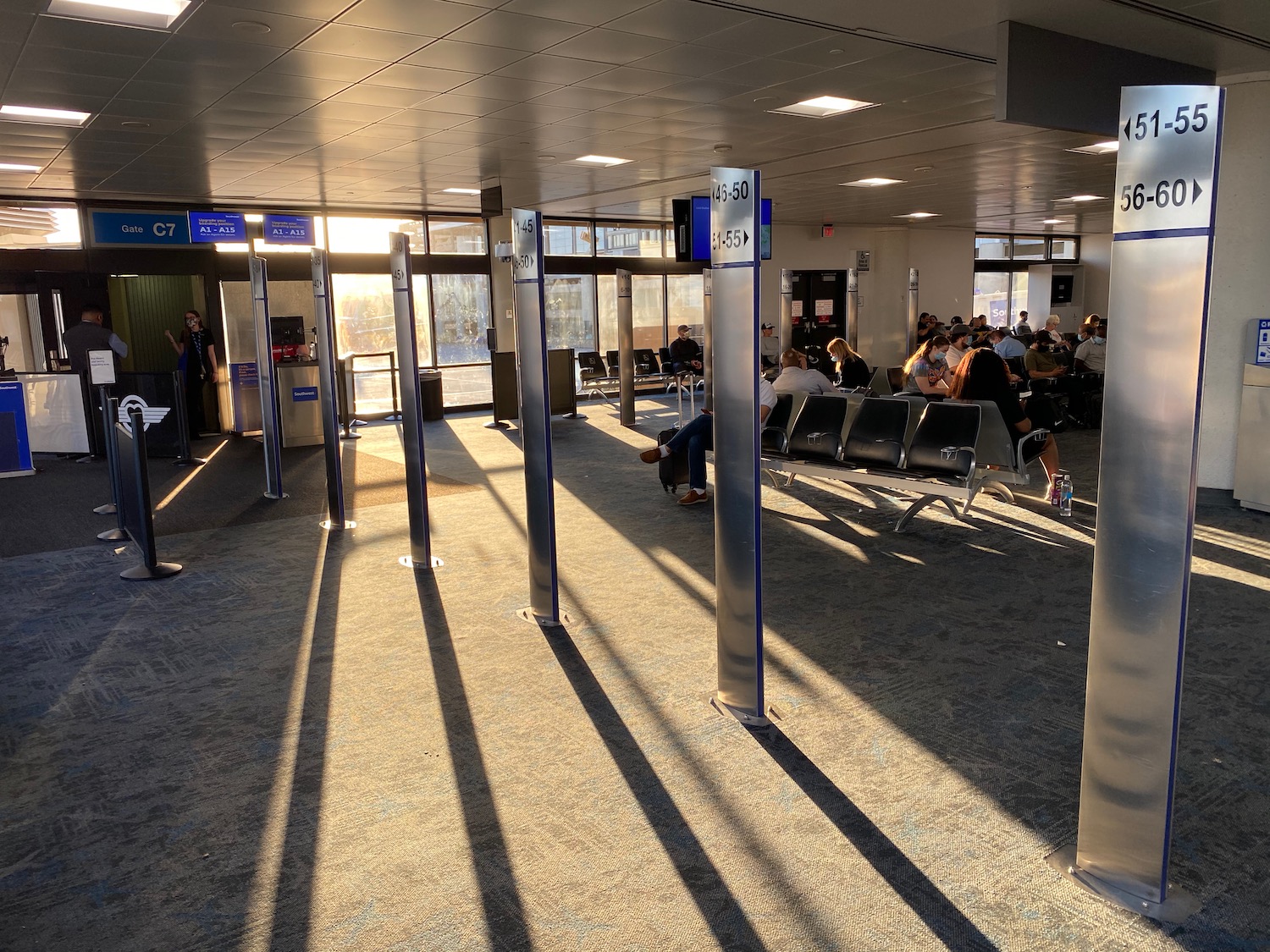
After more than 50 years of the most distinctive boarding process in U.S. aviation, Southwest Airlines is finally ending open seating and rolling out assigned seats and a new boarding structure that looks nothing like the airline most of us grew up flying with.
Southwest Ends Open Seating, Introduces Assigned Seats And New Boarding Groups
Today marks the end of an era. Southwest Airlines has officially retired its iconic open seating policy, the 50+ year tradition where passengers rushed to check in exactly 24 hours before departure to obtain a preferential boarding number, queued by A, B, or C groups, and then chose any seat on the aircraft.
Instead, Southwest is moving to assigned seating and a structured boarding process that looks much more like what you will find at American, Delta, or United, complete with boarding groups numbered 1 through 8 and fare based priority. Digital displays will replace the old gate stanchions, and boarding passes will now show both a seat assignment and a boarding group.
Monetization Of Seating Behind This Change
Southwest first announced plans to end open seating back in 2024 as part of a broader effort to modernize its product and improve profitability. Surveys conducted by the airline suggested that most passengers, both current and potential, preferred knowing their seat ahead of time rather than racing to check in early. In fact, Southwest cited data showing that open seating was a top reason some travelers chose competitors.
But this is not just a nod to convenience. Assigned seating allows Southwest to introduce premium seating products such as extra legroom seats and preferred forward cabin positions. Under open seating, those products were impossible to monetize. With assigned seats, Southwest can now segment its cabin and generate incremental revenue from customers willing to pay for better placement. It also allows the airline to introduce differentiated fare bundles from Basic to Choice Extra that come with different boarding and seating perks.
How The New Boarding Process Works
Under the old system, passengers were clustered into A, B, or C buckets based on check in time and assigned a number (1-50) within that bucket. Passengers then lined up (finding their place in line, not always perfectly) to board, but it was a free-for-all once onboard. That method was not just quirky, but efficient: for years, Southwest claimed it outperformed more traditional boarding styles. But Southwest says that assigned seated will be more efficient.
Now, Southwest’s boarding process will look more familiar to travelers from other airlines:
- Passengers are assigned to Boarding Groups 1 through 8 based primarily on seat location, fare class, loyalty tier and credit card benefits.
- Passengers with Extra Legroom seats or top tier loyalty status will board earlier in the sequence, Groups 1 to 2.
- Passengers with standard or basic fares will board later, Groups 6 to 8.
- Families traveling together, up to nine people, will be assigned to the same boarding group.
- Gate areas will have new digital signage showing boarding order rather than the old numbered stanchions.
This new process also eliminates the legacy A, B, C boarding queue…I thought Southwest might keep the letters and do something like A-G boarding groups, but the numbers require less thought…
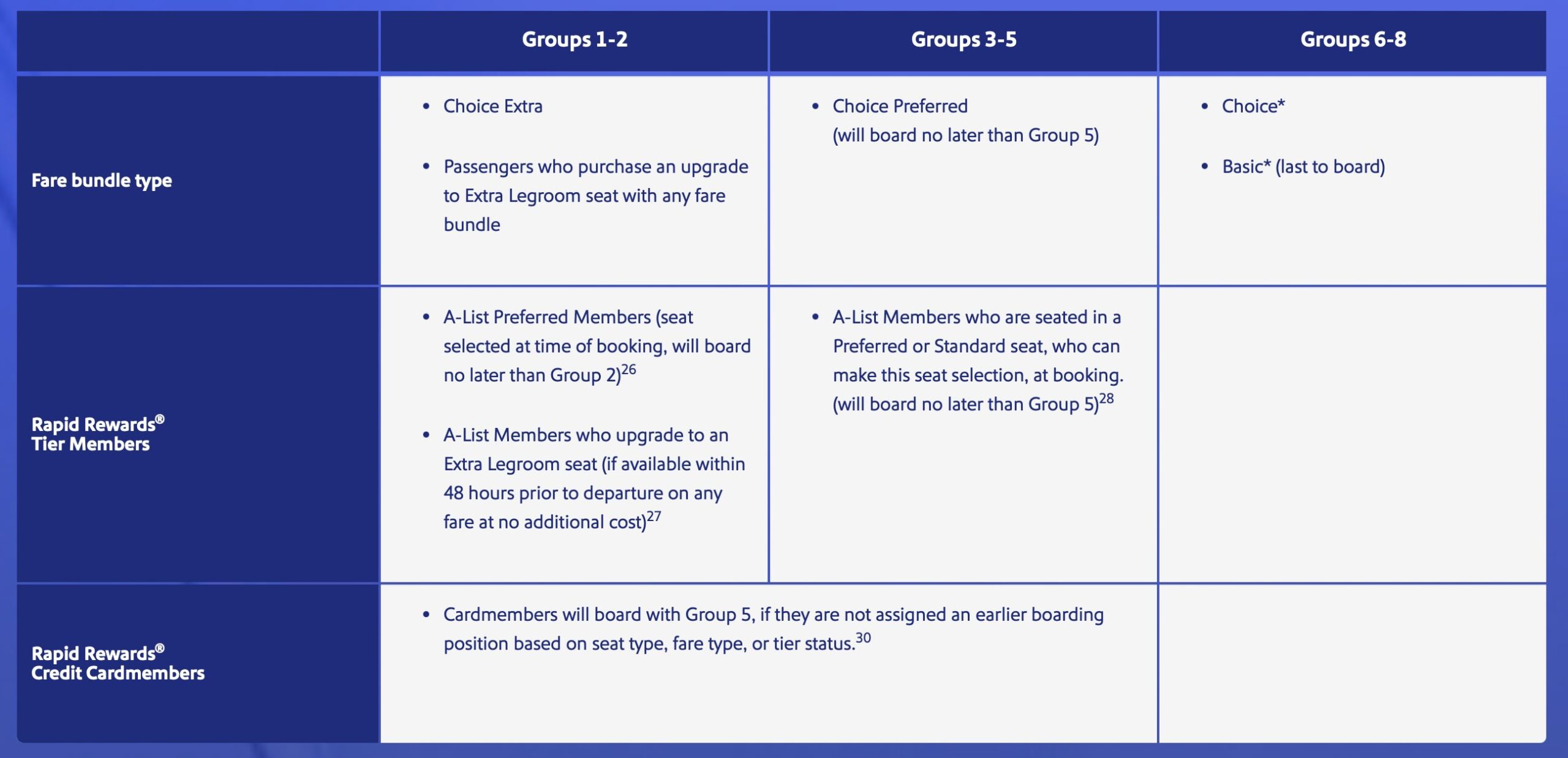
With assigned seating, Southwest customers will now select seats either at the time of booking or at check in, depending on fare type and loyalty status. Premium seats such as Extra Legroom positions can be purchased or earned through fare upgrades, and these selections directly influence boarding group placement.
Southwest’s legacy perks like EarlyBird Check In and Upgraded Boarding will be retired in favor of this new structure, though it will continue sell what it calls “Priority Boarding.” Families and loyalty members retain certain protections, for example families travel together in the same group regardless of fare, but the free for all scramble that defined Southwest for generations is now in the past.
Wheelchairs and wheelchair abusers can still board first, but the incentive to feign injury without first-come, first-served open seating should speed up the process.
Here’s a video explaining the changes:
CONCLUSION
For decades, Southwest’s open seating was more than a boarding method, it was a brand statement. It was egalitarian, efficient, and a little chaotic in a way Southwest loyalists came to embrace. Now, Southwest will look and feel more like its competitors…and Wall Street seems to love it.
Some flyers will welcome the predictability of knowing exactly where they will sit. Others will mourn the loss of the strategic check in scramble and the egalitarian ethos it represented (despite the wheelchair cheats). Regardless, this change marks one of the most fundamental shifts in Southwest’s passenger experience since the airline’s founding. But in doing so, it also closes the book on one of the most beloved quirks of U.S. aviation.
Do you welcome assigned seating on Southwest, or will you miss the old open seating scramble?
> Read More: My Final Fling With Open Seating On Southwest Airlines
> Read More: Southwest Airlines Faces Lawsuit Over Open Seating Policy





No doubt increasing revenue was the reasoning behind this but the reduction in wheelchair scammers makes this a good move for most.
I’m not degrading those who truly need them to board and exit but reality was the Southwest system encouraged the scammers and allowed them to benefit from a truly low class move. And affected others playing by the rules far more than any other airline.
Yup. It’s always about money. Griping about scammers is a distraction.
The airline can call itself whatever it wants to, but without open seating, there is no Southwest. Cranky may as well put WN on the 2026 airlines we lost list.
For me, the dealbreaker was the end of the free checked bags. They went from an airline with a solid product differentiator (2 free checked bags for everyone) to a worse overall product than the Big 3/4 (crap wifi, limited charging capability, limited snacks/beverage options on longer flights, etc).
Perhaps the time for a radical change had come…
With the new system, I *might* fly Southwest (if I can’t get wherever I’m going on UA (where I’m almost 2MM) or Delta (my second choice) or AA (my third choice). Which makes it more likely that I might fly Southwest (it was “I’d rather walk before this).
I hope they make the wheelchair data available after a year or so of making this change. I would be fascinated to know what percentage drop in usage they have.
I wonder if they will also price in airports like BUR where you can exit from the back of the plane. My favorite move from my old SWA days was grabbing the second to last row in the back and being one of the first to get off.