

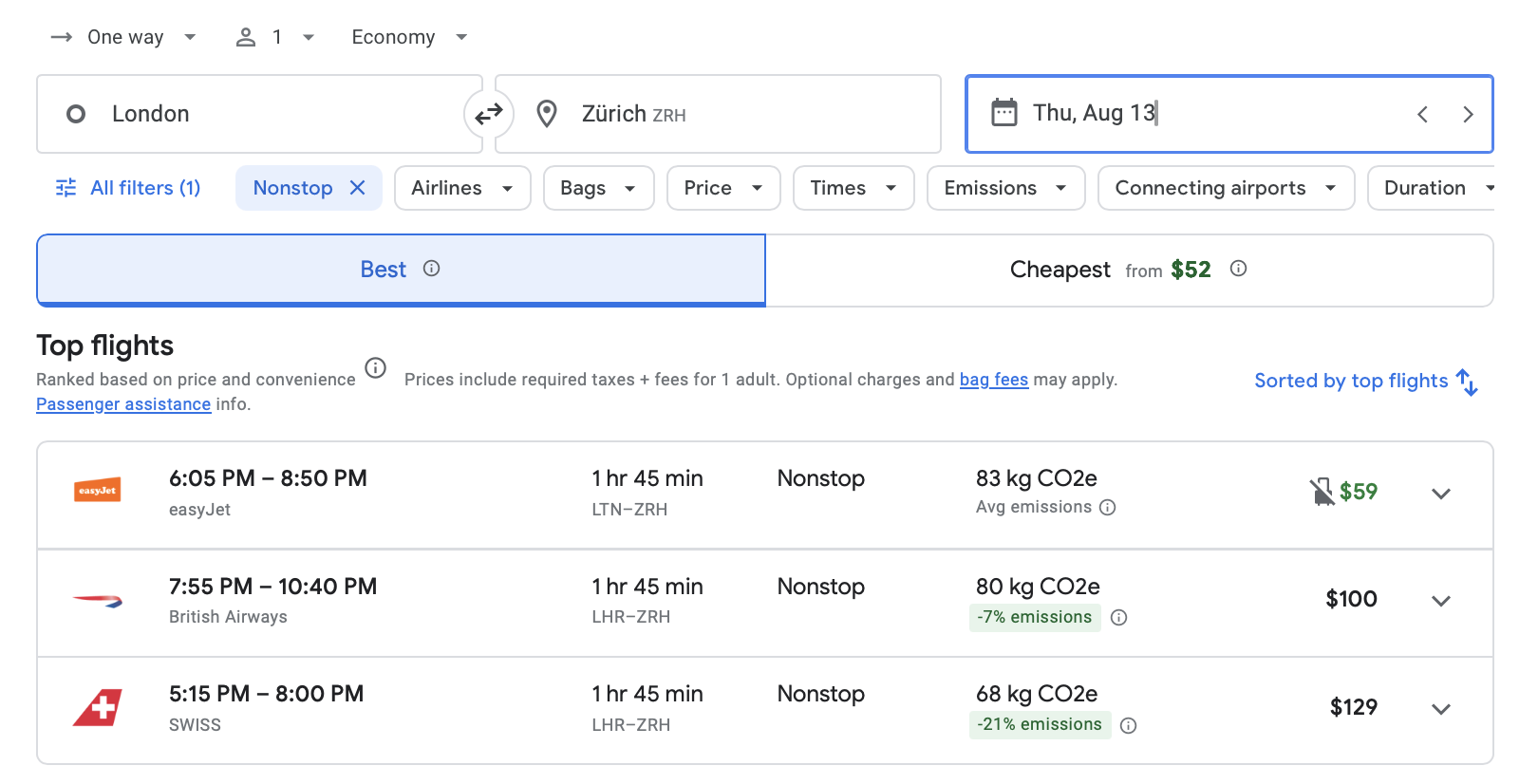
My SWISS Airbus A220-300 flight from London to Zurich was pleasant enough, but it left me asking a simple question: what exactly are you paying a premium for to fly SWISS versus a budget carrier?
SWISS Vs EasyJet: What Are You Actually Paying For In Europe?
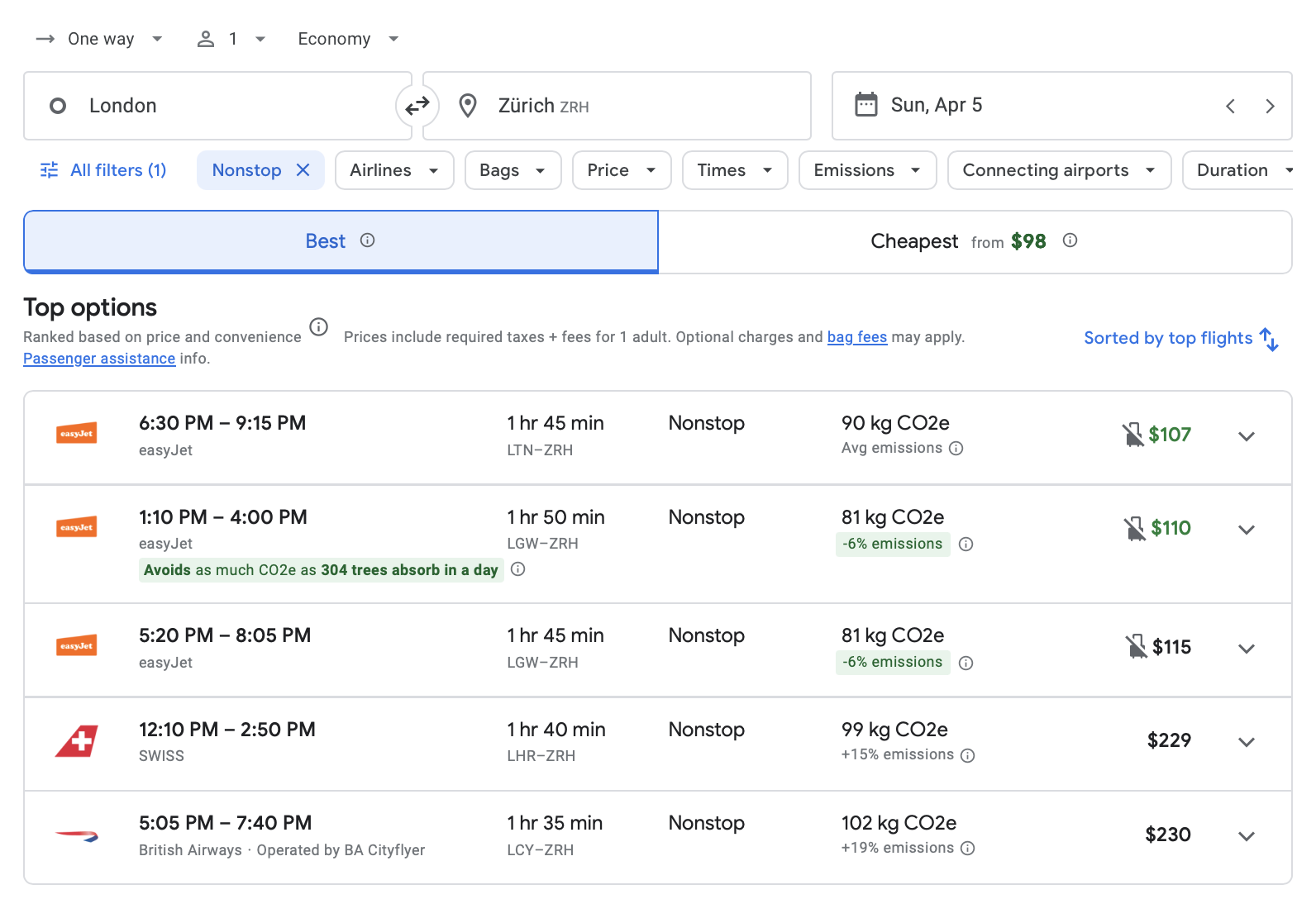
On a short European flight like this, SWISS is charging a full-service premium without delivering a full-service experience…and that raises an uncomfortable question: is it really worth it?
Budget Vs “Full Service” In Europe
I love the SWISS brand and I love the A220 jet. But this flight blurred the line between “full-service” and low-cost carrier in a way that is hard to ignore.
There was no Wi-Fi or in-seat power, two things that should be standard on a so-called full-service airline in 2026.
By contrast, British Airways manages to offer both on similar routes, with USB outlets and reasonably-priced Wi-Fi (and Starlink on the way).
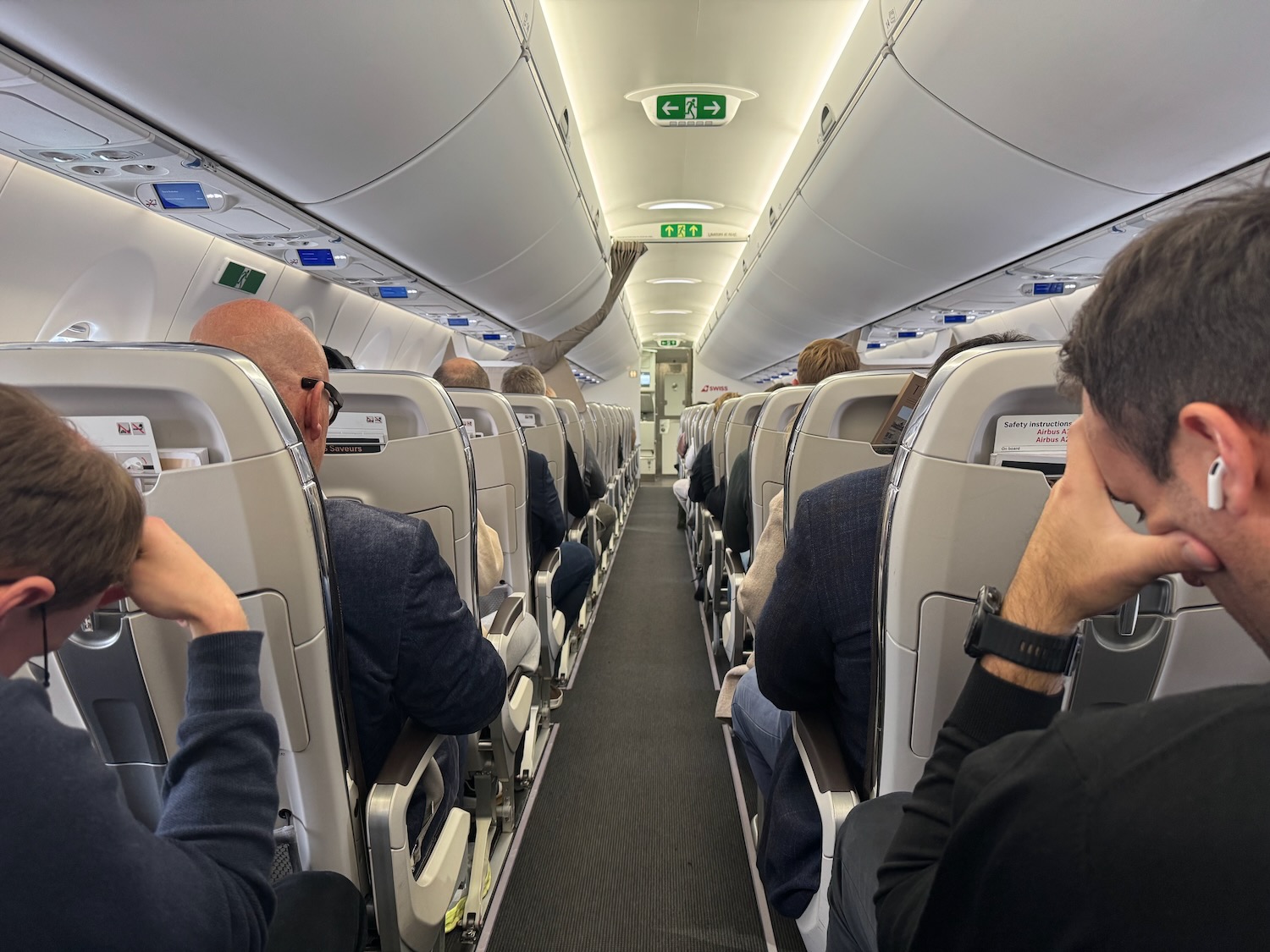
Legroom? About an inch more than EasyJet.
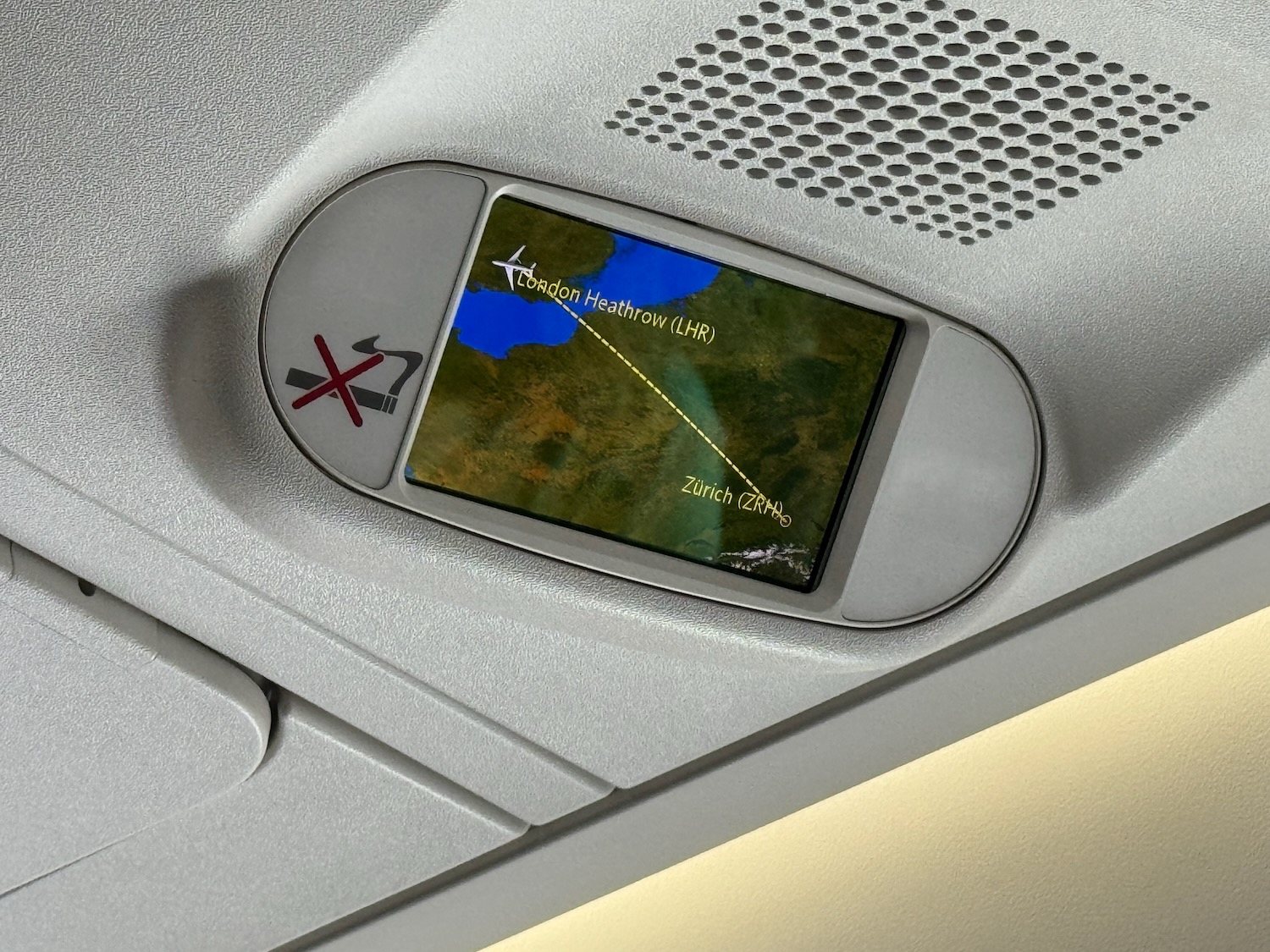
Entertainment? None, unless you count the overhead moving map.
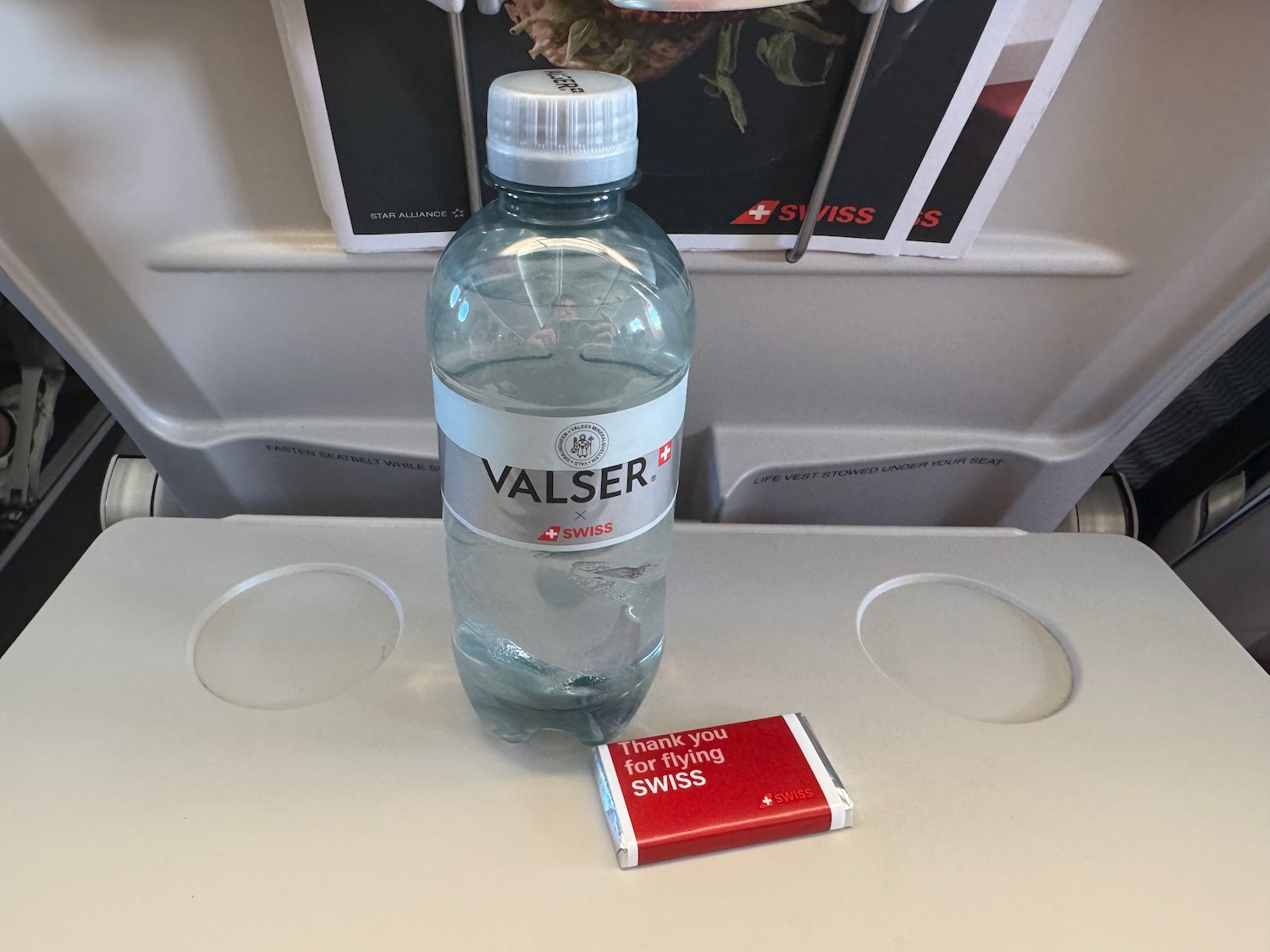
Food? SWISS offers a buy-on-board menu…just like EasyJet and Ryanair. Yes, you get a free bottle of water and a piece of chocolate, but does that justify a significantly higher fare?
What Are You Actually Paying For?
I suppose the answer is that you not paying more for any of those things. Instead, you’re primarily paying for three things: brand, network, and airport convenience.
If this flight were blindfolded and you didn’t know the airline, you’d be hard-pressed to distinguish it from a budget carrier.
The strongest argument in SWISS’ favor has nothing to do with the onboard experience.
It’s Heathrow.
Flying from Heathrow instead of Gatwick or Luton is objectively more convenient for many travelers. Add in Star Alliance connectivity, through-ticketing, and lounge access for elite flyers, and the value proposition starts to make more sense.
But strip those factors away and the equation changes quickly. If you are simply flying point-to-point, the premium becomes much harder to justify.
CONCLUSION
For longer flights or complex itineraries, SWISS still makes a compelling case.
But on short European hops, the gap between full-service and low-cost carriers has narrowed to the point where the premium is increasingly difficult to justify. That’s not just a SWISS problem. It’s a broader issue for legacy carriers across Europe including the entire Lufthansa Group, British Airways, and even Air France-KLM (that still offer free food and drinks onboard).
Unless the onboard experience improves, more travelers are going to start asking the same question I did on this flight: What exactly are you paying for?
What do you think? For my European readers, is there a certain threshold where you are unwilling to pay more for a full-service carrier over a budget airline?





I think it really comes down to two things. First is the airport itself—like if you’re flying out of LHR, that already feels more “full service” compared to a smaller airport.
Second is the overall airport experience tied to your ticket, like lounge access, boarding order, baggage allowance, etc. That’s usually what people mean by full service vs low-cost. Some fares include all that, while cheaper ones strip most of it out.
So yeah, it’s not just the airline—it’s the combo of the airport + what’s actually included in your ticket that makes it feel “full service.”
And yet, you can purchase all those extras on top of your LCC ticket—even priority lanes, lounge access and early boarding. On the other hand, baggage allowance is already very restricted on ‘full-service’ carriers, so the difference really is negligible.
I used to strongly prefer legacies over the likes Ryanair, Easyjet or Wizzair. But once they started emulating the LCCs in every single aspect but the fare, there’s really no point in being loyal to them.
I find it pretty shocking that BA doesn’t have WiFi on routes out of LCY and has no plans announced to add it.
Because, you know, Canary Wharf bankers wouldn’t dream of working on board…
LCY is a dream compared to LHR for quick hops though. Arrive on the DLR and you’re at a gate in 10 minutes. You’re not doing that at Heathrow…
LCY is indeed awesome. Maybe BA just needs more E2s with upgraded tech, including WiFi. KLM has decent Cityhopper flights.
Delta is better with wifi (not fast, though, but good enough for ordinary webpages) and IFE and free Biscoff or Sunchips. Decades ago, Delta was very ordinary, nothing special.
And perhaps many are still hopefully waiting for the day when there will be a large-scale direct HST service between London and Zurich… They wonder from which spring this will become a reality?
It would still be a 5-6 hour journey. Not so many people choose train over plane at that journey length
Although there is currently no direct service, the journey from London to Zurich by HST at present takes approximately 7.5 to 8.5 hours. If this time could be reduced to a direct HST service lasting a maximum of 4 hours, train travel from London to Zurich could be a good alternative to flying.
Not sure. That’s what London Amsterdam is now, and there’s no big shift to trains. Unless some new technology comes, London Zurich won’t be anywhere near 4 hours.
Pigs will fly before London-Zurich can be done in 4 hours by train.
It’s 1119km by rail via Strasbourg. Based on the 129mph start to stop average speed of the London-Paris Eurostar (which runs along 200mph high speed lines for virtually its entire duration) that would imply a journey time of around 5.5 hours even if there were a high speed lines the entire way.
You would have to increase the train’s average speed to 174mph to manage it in 4 hours. That would mean running at 250mph+ for sustained sections (considering the time lost through station stops) which is simply not on the cards anytime soon.
It’s too expensive both in terms of energy used and the maximum curve radius on the tracks. Even the Shanghai airport maglev only runs at 200mph now to save money.
There is a decent chance of a direct train to Geneva materialising in the next 10 years, but I doubt we will ever see a direct train to Zurich unless the UK joins the Schengen area (i.e. also when pigs fly).
Let’s add that, as of April 4, 2026, LX has 21 A220-300 aircraft in its fleet with an average age of 8 years.
Frankly, paying more for “brand, network, and airport convenience” on short European flights doesn’t seem very appealing…
I travel between London and Switzerland a lot. I have pretty much stopped using EZY because:
– the fare difference narrows a lot when you add cabin bags
– I rarely find that EZY is materially cheaper, and LTN and LGW just aren’t great experiences compared to LHR and LCY
– sometimes Swiss is the price leader, but it’s rare. BA is more often better.
– BA’s mileage availability on all Swiss routes is really really good.
What are you paying for on Swiss?
Your dignity.
“So many roads, so much at stake
So many dead ends, I’m at the edge of the lake
Sometimes I wonder what it’s gonna take
To find dignity.”
– Bob Dylan –
Swiss actually tends to be cheaper than LH for intra-Europe travel- the only real premium is the pricing of food and drink onboard and at ZRH.
I think part of the issue for you was thame fact that the Lufthansa Group still charges more for one-ways than for return tickets. If you want to fly LHR-ZRH on 15.05, you’ll pay £137 for the classic fare (which includes luggage). The very same flight will cost you £121 as part of a round-trip itinerary. You may think that the differential isn’t huge, but it can be a lot bigger than that depending on dates and routes.