
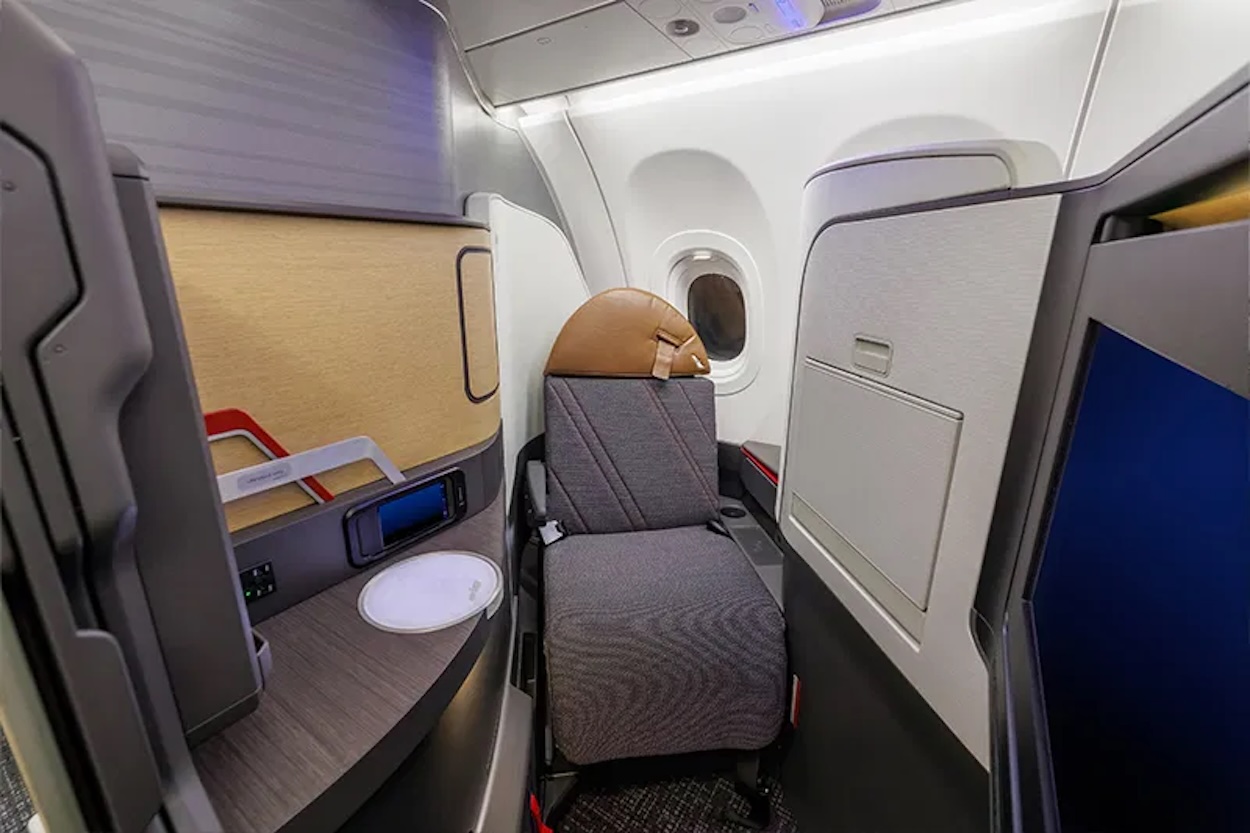
American Airlines has a fixable screen problem with its new A321XLR Flagship Business Class suites, and it has nothing to do with redesigning the seat.
How American Airlines Can Quickly Solve Its A321XLR Flagship Business Class Screen Issue
American Airlines’ swanky new Flagship Business Class suite on the A321XLR has entered commercial service, but generated negative attention for an odd reason: under current policy, passengers are required to retract their in-flight entertainment screens in order to receive meal service. Indeed, aviation insider Jon NYC reports this is official policy:
“For your safety and the safety of our customers, do not serve over or under the BC video screen if it is pulled out. Kindly ask the customer to close it while serving them.”
That restriction has understandably irritated travelers, as I see it, this is not a fundamental design flaw with the seat. It is a service policy problem.
As One Mile At A Time correctly notes, the issue stems from how American has chosen to structure service around the seat rather than from any inherent inability to serve passengers while screens are deployed. The screen, when extended, can make access or visibility more awkward for flight attendants, and American’s current guidance appears to err on the side of caution by requiring screens to be stowed for service.
That policy is needlessly aggravating.
Other airlines have already solved this problem without drama. JetBlue’s Mint product, which uses the same business class seat, is the clearest example. Flight attendants routinely hand trays over deployed screens or briefly and gently adjust the screen themselves during service, then return it to its prior position. There is no confrontation, no interruption, and no sense that the passenger is being asked to stop enjoying the product in order to be served.
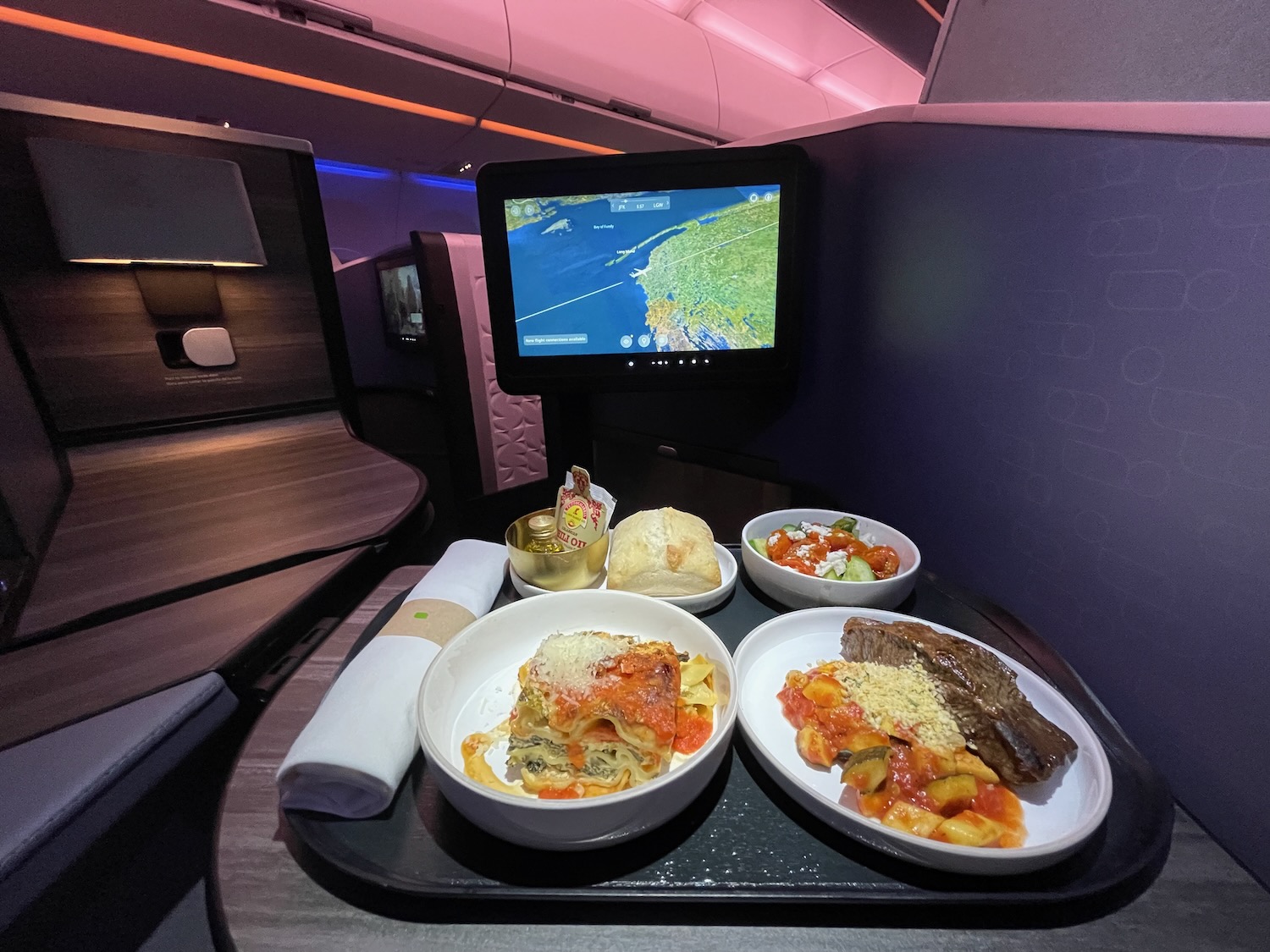
American can do the same.
The solution here is not engineering. It is operational. American should simply empower flight attendants to manage service around deployed screens, rather than forcing passengers to fully retract them. A brief tilt forward, a handoff of the tray, and the screen goes back. That is it. This approach preserves passenger comfort, avoids awkward interactions, and keeps service moving efficiently.
The current policy creates friction where none needs to exist. It interrupts passengers mid-movie, adds unnecessary steps to service flow, and places flight attendants in the uncomfortable position of enforcing a rule that feels arbitrary to customers. None of that aligns with AA’s push to be more premium.
CONCLUSION
American Airlines does not need to redesign its A321XLR Flagship suite to fix this issue. It simply needs to adapt its service philosophy. Let flight attendants work around deployed screens, as other airlines already do, and this entire controversy disappears. It’s really quite simple.
This change in policy would turn a needless annoyance into a non-issue and allow the seat to be judged on its actual merits, not based on arbitrary policy.
top image: American Airlines



Matt, you’ve found a reasonable solution (updating its training and safety guidelines, which is exactly what’ll happen, eventually). Many of the bloggers ‘losing their minds’ over this is just silly… Like, fellas, if you wanna revert back to Oasis recliners and prefer a 1-stop itinerary in ORD or DFW on your way from LAX-JFK, that’s on you. I’ll take this lovely new 1-1 config. lie-flat with the screens, herringbone, etc. regardless of where the screen or window is. It’s very similar to B6 newer Mint on TATL and JFK-LAX, which is a wonderful product for J on narrowbodies.
Isn’t “needlessly aggravating” AA’s core operational competency?
Do I get this right, they charge a premium for business and you can’t watch a movie while eating dinner?
That is crazy. While I agree that your solution is fine, this appears to be a bad design of these Business Class suites. What were they thinking? Or apparently not thinking?
Another reason to avoid flying on AA.
You said it right Matthew. Virgin is my airline of choice. Their herringbone seats have the same issue and I’ve never had an issue with an FA refusing to serve me when my screen is out. They just work around the screen or briefly move it a little.
To the attention of American Airlines management!
Let’s remember that American Airlines was the first of the U.S. carriers to place an order for the A321XLRs in 2019. The company ordered 50 of the A321XLR jets and it expects to have 40 XLRs by the end of the decade. The game-changing jetliners have an extra fuel tank that gives them longer range, ushering in an era of leaner flying for long routes that can easily top eight hours, and testing passengers’ willingness to take a smaller jet.
I’d be willing to bet management agrees with you but the union does not. Typically these nuances are used as bargaining chips. It’s similar to flying by the book to cause delays.
They found a way to aggravate AA’s most valued customers and will most certainly get something out of it, even if a small bump in pay for the Business Class flight attendants to serve seats that require more reach/motion.
And as they should be compensated higher considering how much revenue business class seats bring in. Smart move on the unions part
I’m not so sure. Corporations are so risk-averse these days that the fear of a lawsuit about, for instances, a piping-hot lasagna slipping from a tray into a customer’s lap during meal service is probably sufficient to generate this policy. To the frequent traveller and casual reader it may seem like overkill, but to the eggheads in Risk Management, it’s a no-brainer. The innovation of the neee product is thus stifled. Commerical aviation is not the only industry in which this occurs. My spouse is an ER Attending. I could give examples of this phenomenon in medicine until the cows come home…
I really hope United doesn’t mandate this same policy when they start using the A321 on transatlantic. I hope they are smarter
As a FA for American and having just worked the XLR I will say that this is not a big deal for FA,s. The screen can be gently and easily moved enough to safely lay down the tray and then let the screen move back to the deployed position without interfering with viewing the screen. FA’s are encouraged to write reports on the XLR and I expect the majority of us who fly the transcons will agree with my thoughts on this issue.
As with any new aircraft to the fleet the kinks usually and in most cases work themselves out.
Let me get this correct. Passengers are having an issue with passengers moving their screens to hand them a meal? How is that even remotely annoying? When utilizing your tray table to view your laptop doesnt the same principle apply. You have to close or reposition your laptop in order yo place the meal on the table.whags the big deal? Retract the screen, place the meal down. Then open it up again. People complain way to much thats why no one is very happy