
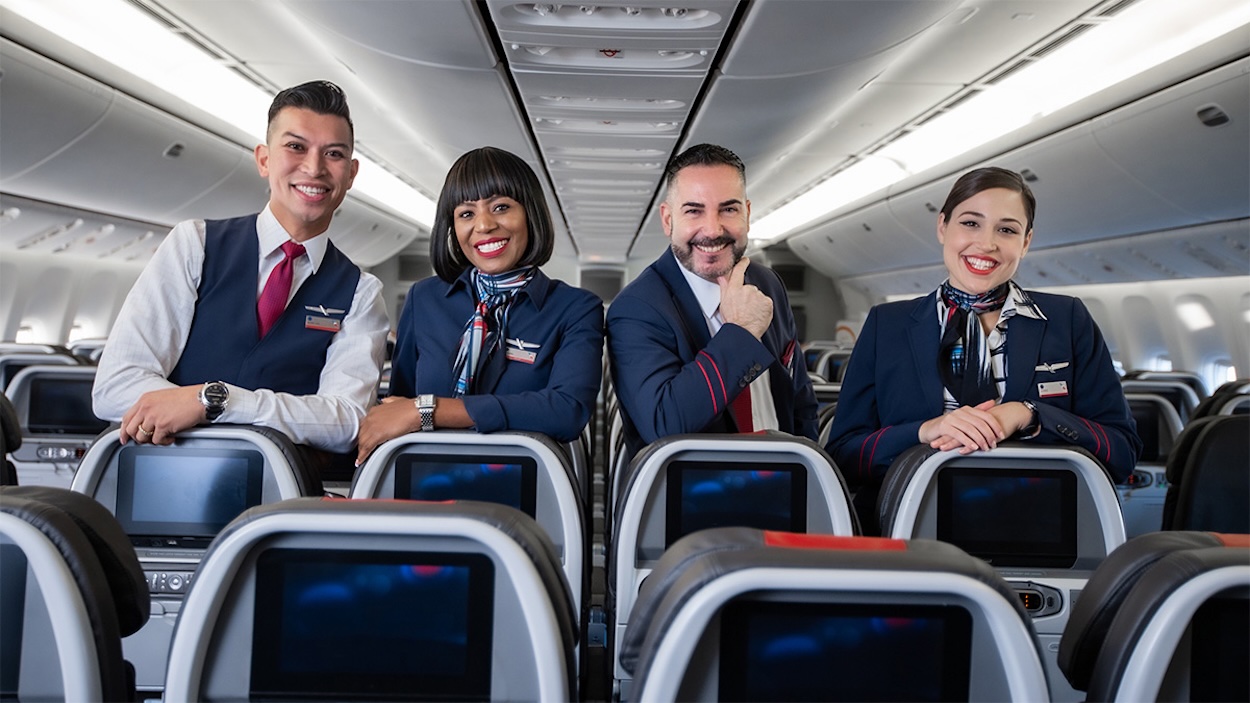
The turbulence at American Airlines is not just operational or financial, it is internal. A scathing letter from the union representing flight attendants exposes a deep credibility problem that AA’s currently leadership likely will not be able to overcome.
American Flight Attendants Demand Management Change As Competitors Surge Ahead
Days after American Airlines reported its 2025 earnings, the airline’s flight attendants have made their frustration clear: they believe leadership has failed and that American has fallen further behind its competitors. Rather than grumbling quietly, the union representing flight attendants has gone public with a sharp critique of management’s strategy and a call for change.
The Association of Professional Flight Attendants (APFA), which represents American’s cabin crew, released a statement shortly after the earnings that juxtaposes the airline’s results against operational performance and competitive positioning. APFA framed the 2025 financial results not as a success, but as a symptom of deeper, structural problems.
APFA’s message was unambiguous:
“While we are pleased American achieved a small profit, our airline continues to lag its competitors by a significant margin. This is no longer an anomaly, but rather a pattern of failure under the leadership of CEO Robert Isom and the American Airlines Board of Directors.”
(you can read the full letter here)
The union pointed specifically to American’s position relative to Delta Air Lines and United Airlines, noting that the carrier remains a distant third and “at or near the bottom of the industry.” Those comments echo wider industry rankings that have placed American near the bottom in customer satisfaction metrics, an issue flight attendants see as tied to management decisions.
That complaint gets at a broader labor tension that has been building for years. Flight attendants have repeatedly raised concerns about staffing levels, scheduling pressures, workload expectations, and how management has prioritized resources. These frustrations are not new, but they have taken on renewed urgency as other carriers have seemingly improved operational performance and passenger satisfaction more rapidly. This week, as AA has approached an operational meltdown, it was only more exacerbated with reports that some flight attendants were sleeping on floors at airports after spending hours on hold trying to reach the crew scheduling desk:
While American ratified a new multi-year contract for its flight attendants in 2024, many crew members feel that those gains have not translated into any sort of quality of life improvements. I put more blame on the APFA than the management for that, but the bad blood is undeniable.
But that’s not really the source of the public battle to topple Isom. Their critique is tied not primarily to wages and conditions but to what they see as a lack of clarity from management about the airline’s identity and direction. In their view, American’s competitors have executed their strategies more effectively, refining service, strengthening performance, and earning better customer perception (which I don’t think anyone would disagree with).
“Lack of investment in the product has left American years behind its competitors, forcing employees to absorb the consequences and apologize for management’s inaction as leadership delivers the same lackluster results, quarter after quarter.”
Compounding those workplace concerns are the optics of an airline that, despite record revenue, has continued to struggle operationally and lag competitors on key measures. That gap in performance fuels resentment and provides fertile ground for the union’s critique.
But What Is The Solution To AA’s Woes?
AA is at critical juncture and with the Board failing to hold the C-Suite accountable, it is reaonsable to ask whether we are just entering another year of status quo. That’s not a winning solution, but my biggest concern is what AA can actually do differently in the short term that will rally employees and juice up profits.
The investments that Delta and later United have made to their fleet, product, and technology were years in the making, not something that happened overnight. AA already is at a significant disadvantage in this race and even a “Great Leap Forward” will be virtually impossible to pull off just because it takes so much time to invest in things like refreshed passengers cabins, new aircraft, or industry-leading technology.
Ideally, a new leader would “rally the troops” but that doesn’t solve AA’s operational woes or its hard product that remains quite uncompetitive when compared to its peers. I just don’t see any near-term fix for AA, even though it is (finally) doing several things right, things that will help bring it in line with Delta and United, but not surpass it.
That said, it is fast becoming clear to me (and maybe should have been for months) that AA’s frontline has lost all confidence in management.
CONCLUSION
Yes, American’s current situation reflects a tension inherent in legacy carriers today: balancing rising expectations for premium experience and operational excellence while managing the realities of labor costs, workforce satisfaction, and competitive pressure from peers who appear more nimbly positioned. But the problem is very unique to AA: it is AA that claims to be premium already but it deeply lagging behind its premium peers (with the gap only widening significantly in 2025).
The union wants change in leadership at the top, but this seems more than the tired, boilerplate grievances that unions must stoke to remain relevant and fund their existence…this is the sort of damning indictment that underscores that management has lost credibility with front-line workers.
As for the solution, that’s a much more difficult question…
image: American Airlines





And, they’re right. Leadership is the problem. Crews are not getting the support they deserve.
Agree 100%. Flying AA, all employees seem grouchy, unhappy, miserable, like they hate their jobs and just want outta there. It’s a really bad look for an airline (or any business). If front-line employees are that consistently unhappy, the leadership is to blame.
I wouldn’t say that at all. I’ve been through JFK T8 multiple times this month, and AA employees are doing just fine, trying their best under difficult circumstances. They are relatively perseverant. Were you being sarcastic?
I would say about 12 years ago, AA was in a much better place than united from a customer experience standpoint. If AA commits to improving this now, maybe as we approach 2040 they can be in that position again
AA has been lAAging behind for years. WhAAt is the matter with AA? It’s not just leadership but cabin crew and gate agents are sometimes cranky and dictators. I have 6 figures of miles that I am trying to burn. These are from when I had no choice but to fly on AA.
Feels like astroturf the way some online commenters bash AA frontline employees; they’re not the problem.
You can’t burn 100,000 AA points? You must not be trying hard. Here’s an idea, book transcon F or J, often 40K/way when there’s a deal. Great way to enjoy Chelsea or Soho at JFK, or Flagship lounge at LAX. Get creative. Stop whining.
They’re not wrong, but let’s not forget, it’s these same unions that conspired with Doug Parker back in 2013 to depose Tom Horton and install the America West regime that started AA down this sordid path. Considering all of what we’re seeing now was completely predictable based on that crew’s history, forgive me if my sympathy is somewhat lacking.
It’s unfortunate if the current meltdown ends up being the straw that breaks the camel’s back, but maybe this will finally persuade the board to once and for all send the Tempe Boys to the dustbin of aviation history. New blood is what’s needed to fix the malaise AA is stuck in.
The union is basically right on this one, as is @MeanMeosh. I’m frankly amazed that the Board has consistently backed inept bunglers who have no history of running full service airlines with any degree of competence.
As to what to do, Gary at VFTW has posted about how of the Big 3 American would actually have the easiest time making big improvements, not purely because they are starting at the bottom but also because they do possess some inherent advantages.
Doug Parker will drink to that!
“Intellectuals solve problems, geniuses prevent them.” – Albert Einstein –
This is simply another manifestation of the typical human mantra: Always blame others. Never accept responsibility.
How can they see the incompetence of AA’s leadership, but never their union’s?
Flying AA was once a pleasure, I used to wing my way to South America and Europe at least once a month and even Y was a good experience and F was terrific. Recently took a domestic AA flight and the crew was very professional and pleasant but clearly struggling with a cabin crowded beyond comfort, late departure and anxious passengers making connections. I sat next to an FA connecting to an overseas gig and he told me that after 28+ years he was retiring because it “just wasn’t fun anymore, not for me, not for you, not for the guys up front”. Sad when a seasoned professional walks away because there is no sense of purpose or pride or, yes, fun, in the job.