
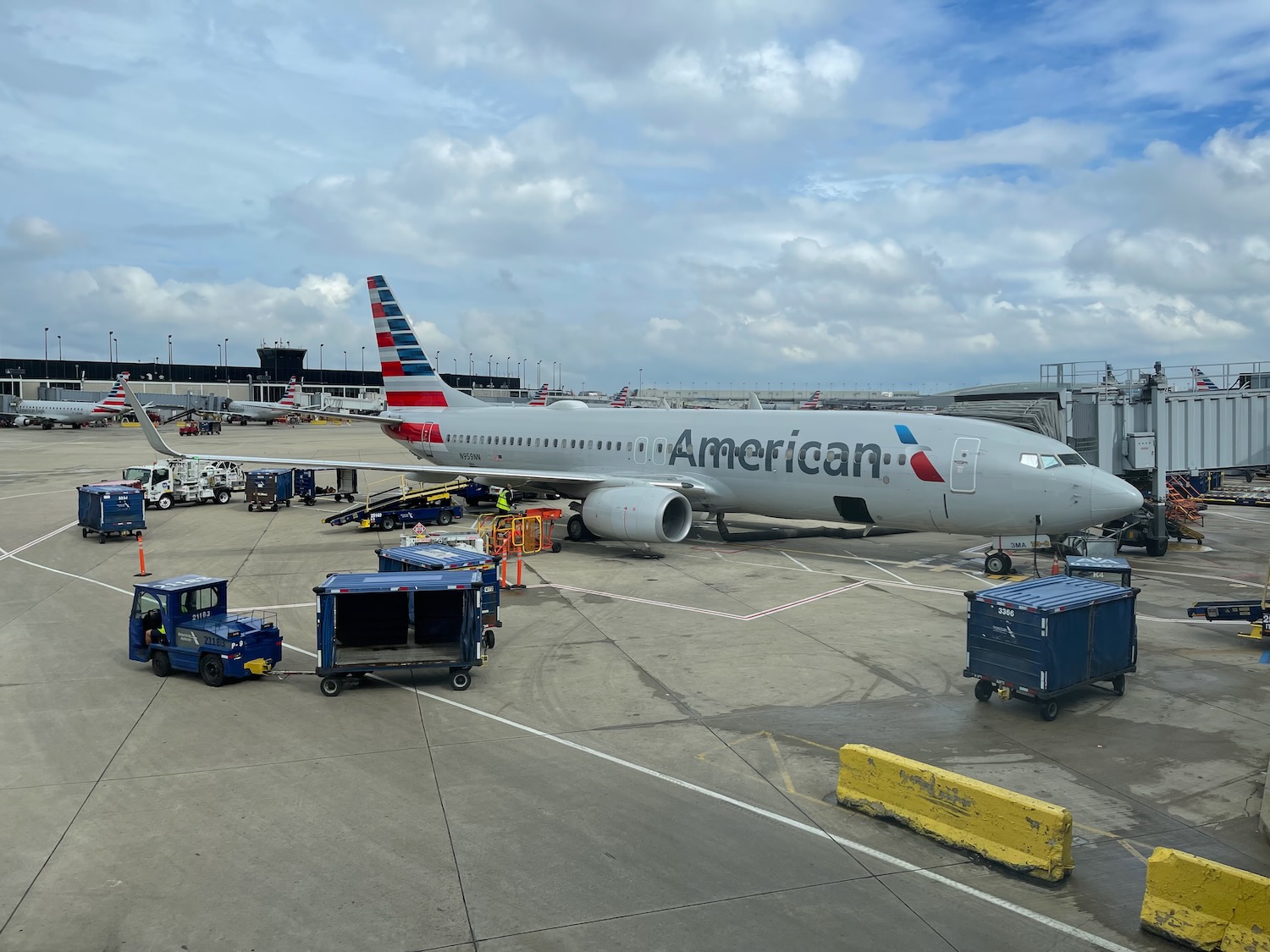
American Airlines is explicitly and publicly accusing United Airlines of intentionally overscheduling flights at Chicago O’Hare in order to block it from gaining additional gates, a strategy that it hopes the Federal Aviation Administration will put a stop to.
American Airlines Accuses United Of Overscheduling O’Hare To Block Competition
An internal memo sent to American Airlines employees reveals a growing dispute between the two largest carriers at Chicago O’Hare International Airport (ORD), with American claiming that United has dramatically increased its summer schedule in an attempt to manipulate gate allocation rules at the airport (this is hardly breaking news).
> Read More: United Draws A Line In The Sand At O’Hare, But American Is Already Stepping Over It
The memo notes that the Federal Aviation Administration (FAA) has called airlines to Washington, DC for a “schedule reduction meeting” aimed at addressing overscheduling at O’Hare before the busy summer travel season begins. That meeting was held yesterday, though we have not heard any FAA decision concerning the meeting.
> Analysis: FAA Flight Cuts At Chicago O’Hare Will Benefit American, United, And Travelers
American claims the airport’s published schedules for summer 2026 exceed what ORD can realistically handle operationally, even on good weather days, raising the risk of widespread delays similar to those experienced at Newark Liberty International Airport last summer.
But the most pointed criticism in the memo is directed squarely at United Airlines.
American Claims United Added Flights To Protect Gate Control
At the center of the dispute is a unique provision in O’Hare’s gate lease structure that allocates gates based partly on how much flying each airline operates in the prior year.
American alleges United is attempting to exploit that rule.
(Of course United is…)
According to the memo, United declared it would “draw a line in the sand” to prevent American from gaining additional gates at O’Hare. The airline then added roughly 130 daily flights to its summer schedule, representing a 34% year-over-year increase and pushing its operation well beyond pre-pandemic levels.
American argues that the additional flying is not intended to meet demand but instead to protect United’s gate share at the airport.
(Of course it is…)
In the memo, American describes the move as a deliberate effort to overschedule the airport:
This is not meaningful growth – it was a ploy to overschedule the airport to manipulate a provision which was meant to promote competition, seemingly without regard for ORD customers, team members or airport partners. United’s reactive overcapacity is meant to undermine ORD’s status as a dual hub, and one of the most well-served, competitive airports in the world. We don’t need to speculate about United’s intentions. Its senior leaders have been clear about their motivations as far back as 2017, and as recently as last month.
American further claims that at several points during the day, United alone has scheduled more departures than the FAA’s published departure rate allows for the entire airport.
If true, that would all but guarantee delays across the system.
American says its plan was also (and always) to grow at ORD, but it had to do so more slowly:
Coming out of the pandemic, we had fewer resources than planned due to regional pilot supportability challenges and new aircraft delivery delays, so we rebuilt first in parts of the country where demand returned fastest. But we were always clear about the end game: we would restore our Chicago operation back to prepandemic levels responsibly.
Interestingly, the memo is not signed by CEO Robert Isom but by Chief Operating Officer David Seymour and Chief Commercial Officer Nat Pieper. Make of that what you will…
The Real Fight: Control Of Chicago
AA, of course, is operating form the weaker position. It says it has “helped shape ORD into the leading global airport it is today and the nation’s largest dual hub, defined by healthy competition that strengthens global connectivity and brings more tourism, events and business development to the city. For customers, it means lower fares and more flexibility –
and importantly, it gives them more choice.”
Even behind closed doors, AA is not trying to drive United out and create a fortress hub in ORD. That’s simply not in the cards for AA (meanwhile, United seems to think it can drive AA out of ORD).
No airline wants “healthy competition” versus no competition at all, but AA wants to continue to be able to offer healthy competition (that’s the best it can hope for) and that’s why I’m not opposed to the FAA stepping in to regulate ORD traffic.
Consumers may lose out on slightly cheaper fares in the short-term, but by ensuring a healthy competition between AA and UA, it will certainly keep fares lower in the long-term.
CONCLUSION
Overscheduling airports is not new. Airlines have long used aggressive schedules to protect gates, slots, and competitive positioning. What makes the O’Hare situation unique is that the FAA appears ready to intervene before the summer travel season begins.
If the agency forces airlines to trim schedules at ORD, it could prevent a repeat of the operational meltdown seen at Newark last year. In any case, the underlying rivalry between American and United in Chicago is unlikely to fade anytime soon. Live And Let’s Fly has asked United Airlines to respond to this memo and we will provide updates if United chooses to offer a rebuttal.






Every since ORD completed the new runways, the only time ATC has issues at the airport is when the FAA isn’t funded. Now, having an open gate for the plane…. plenty of AA and UA people have stories about that….
This is going to be an issue of open gates and not ATC being maxed out. Ironically, all the new terminals and gates would be open if AA and UA hadn’t fought the terms for 15+ years.
Exactly.
Joe the reason why UA and AA fought the new terminals being built was because mayor Daley said that he wanted all the gates to go to everyone but AA and UA. So of course AA and UA would fight that tooth and nail and I can’t blame them.
The ‘astro-turf’ war continues… wake me up when fares actually decrease, because until then, it’s all hype.
The real issue here is the gate allocation policy set by ORD and the CDA. They’ve literally set up a structure that incentivizes carriers to game the system. Give the airlines long term leases on gates and enforce an MUR (minimum-use requirement) threshold that encourages efficient use of the gates while allowing the airport to operate under an acceptable amount of stress. This annual reallocation of gates is idiotic and the airport did it to themselves.