
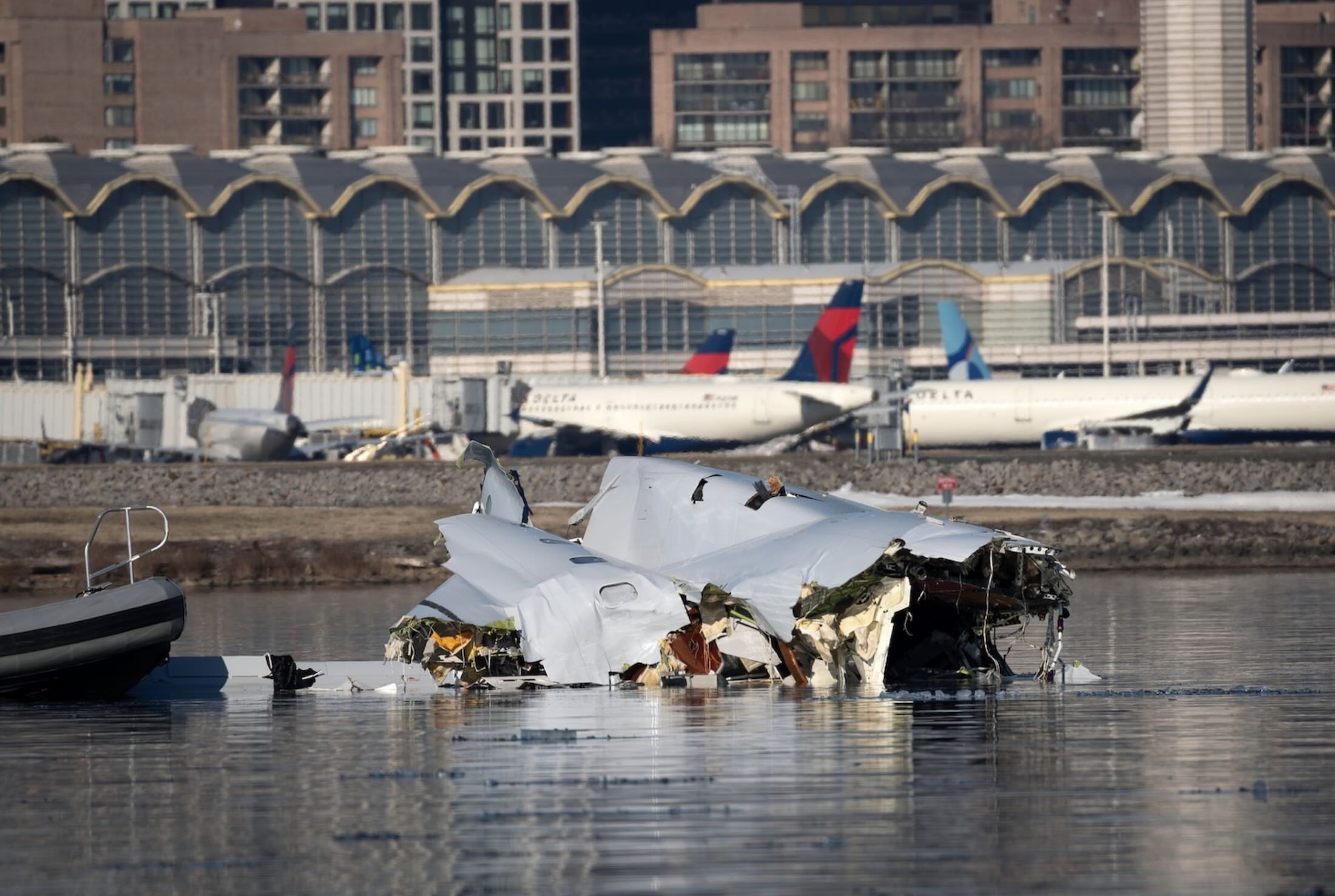
The failure of a bipartisan aviation safety bill following a deadly midair collision over Washington, D.C. highlights how difficult it remains to turn tragedy into even basic reform.
Aviation Safety Bill Fails After Pentagon Objections Months After D.C. Midair Crash
On Tuesday, the U.S. House of Representatives failed to pass a high-profile aviation safety bill aimed at preventing another disaster like the midair collision over Washington, D.C., in January 2025, when an American Airlines regional jet and a U.S. Army Black Hawk helicopter collided over the Potomac River, killing 67 people.
> Read More: Irregularities Emerge In Aftermath Of American Airlines 5342 Crash
The bipartisan measure, known as the ROTOR Act, had already cleared the Senate unanimously last December but fell short in the House under rules that required a two-thirds majority. The final vote was 264 in favor and 133 against, leaving the bill just a handful of votes shy of passage.
The legislation was crafted in the wake of the D.C. tragedy with the support of families of the victims, aviation safety advocates, pilots’ unions, and former investigators who argued that basic technological improvements could significantly reduce the risk of midair collisions in congested airspace.
At its core, the ROTOR Act would have mandated that both civilian and military aircraft operating in busy U.S. airspace be equipped with enhanced tracking technology, specifically ADS-B In systems, which allow pilots to see real-time position information of nearby aircraft in the cockpit. Existing ADS-B Out transponders broadcast an aircraft’s position, but without ADS-B In, crews cannot receive that data from others, a limitation that investigators say contributed to the 2025 crash.
National Transportation Safety Board Chair Jennifer Homendy and other safety experts have pointed out that ADS-B In technology was already recommended more than a decade ago and that it could have given pilots crucial seconds of warning before the collision.
Despite broad bipartisan backing, the political calculus shifted when the Department of War Defense withdrew its support for the bill shortly before the vote, citing concerns about “budgetary burdens and operational security risks” associated with equipping military aircraft with additional tracking systems. The Pentagon’s reversal was seen as a key factor in persuading enough lawmakers to withhold the two-thirds majority needed for passage.
Supporters of the bill, including Senate Commerce Committee leadership, pushed back strongly against the Pentagon’s rationale, noting that the legislation included exemptions for sensitive missions and that the technology in question is mature and widely used in civilian aviation.
What The Pols Are Saying
Mike Rogers (R-AL) is chairman of the House Armed Services Committee and reasoned:
“This bill will undermine our national security. Requiring our fighters and bombers and highly classified assets to regularly broadcast their location puts our men and women in uniform at risk.”
But Senator Ted Cruz (R-TX) expressed confidence the bill would eventually pass:
“Only the ROTOR Act ensures that all airplanes and helicopters flying in U.S. airspace play by the same set of rules. Today’s result was just a temporary delay. We will succeed, and ROTOR Act will become the law of the land. The families and the flying public deserve nothing less.”
All but one House Democrat voted for the ROTOR Act, making this a GOP-on-GOP battle.
A Weaker Alternative Bill
Adding complexity to the debate, House Transportation and Infrastructure Committee leadership has been promoting an alternative safety bill, the ALERT Act, which its sponsors argue addresses all of the National Transportation Safety Board’s recommendations tied to the D.C. crash, not just the specific tracking requirement in the ROTOR Act. Critics of that proposal, however, say it lacks the clear focus on collision-avoidance technology that the ROTOR Act embodied.
For example, Homendy said the ALERT Act failed to require key safeguards:
Unsurprisingly, families of those killed in the crash expressed deep disappointment after the vote. Many had traveled to Washington to advocate for the bill’s passage, arguing that relatively simple changes in aircraft signaling could have prevented the accident.
CONCLUSION
The failure of the ROTOR Act does not mean an end to aviation safety reform efforts or even the ROTOR Act itself. Lawmakers are already considering how to proceed with alternative legislation or revisions that might win broader support. But for now, the narrowly missed vote marks a pause in what had been a rare moment of bipartisan momentum for aviation safety reforms rooted directly in the hard lessons of a devastating accident. Rather than get into the political side of this issue, I’ll just leave it at that…
image: Petty Officer 1st Class Brandon Giles/ U.S. Coast Guard




Jennifer Homendy is one of the US’ greatest assets. DC airspace should have been fixed years ago. May she and the accident victims get what the US needs
For real, Tim. NTSB Chair Homendy is a true, non-partisan public servant and actual patriot. We need the truth when it comes to these incidents, and she and her team have been fighting for that the entire time. It’s impressive.
This is truly sickening. The Pentagon (but, let’s be real, it’s incompetent Hegseth, and this corrupt administration) is defying what are reasonable recommendations to prevent further tragedy. It already cost lives; could happen again. We know better; we deserve better.
Why does it require a 2/3 vote? Was Trump threatening to veto it?
aside from Cloture in the senate requiring 60 votes, I wasn’t aware of any legislation that requires 2/3 short of overcoming a veto?
Because the bill was brought to the House floor under a suspension of the rules procedure.
In theory, House leadership could still bring the ROTOR Act back under regular order, where it would only need a simple majority.
thanks!
Pentagon has ” budgetary and operational safety concerns ” ? A 1.5 trillion dollar budget and Hegseth cannot figure out how to protect the public?
“Budgetary concerns.” How about letting air safety concerns be the primary driver? This is disgraceful and beyond insulting to the families of those who perished in that tragedy.
I 100% agree.
Let’s heed the words of the wise old men: “He/She who stops learning from mistakes has no future.”