
Will Guidara’s rise through the restaurant elite offers excellent insights into the service industry and has applications throughout travel.

A Rare Book Review
It’s not often that Live And Let’s Fly features a book review nestled amongst our hard-hitting and breaking travel news, yet sometimes products simply compel us to act. Unreasonable Hospitality is as compelling as it gets. It’s not just required reading, it’s a manual.
At the International Luxury Travel Market (ILTM), the world’s largest event in the space, I spoke with two leaders for which this book came up. I had dinner with the global president of a luxury cruise line and mentioned that I had just completed an excellent book and ordered copies for some colleagues; and then I said the title. She had just ordered and shipped 30 copies for staff ahead of an internal leadership conference in the coming weeks. On a separate occasion, the topic came up with Matthew Upchurch, the founder and CEO of Virtuoso, the network my travel agency recently joined. Unbeknownst to me, he invited Will Guidara to speak at their annual conference the prior year and the author had become a personal friend.
Some of the leading minds in luxury travel (and myself) have found profound value in the book and it warrants sharing with our readership.

Unreasonable Hospitality
Will Guidara chronicles his journey from a small café in the Museum of Modern Art (MOMA) to running Eleven Madison Park, ultimately achieving three Michelin Stars and the title of the Best Restaurant in the World which he later bought.
The concept is driven by the notion that service is empathy and effort. In pursuit of excellence, the team looked not only at the food it was serving but its approach. There was a general avoidance of stuffy service just for the sake of it instead qualifying each approach with a client.
Management staff would create “legends”, small but incredibly memorable service experiences that last far beyond the meal. This expanded into a dedicated team who would go as far as Googling upcoming diners and checking their social media accounts to create crafted experiences.
In one example, staff found some drivers continually leaving the table during the meal to feed the parking meter so they began asking where a guest parked and would feed the meter for the diner so they didn’t have to get up. Another diner had an upcoming redeye flight so the team put together a to-go snack basket “better than pretzels” for her onward journey and a kit to deal with jet lag.
Guidara examined his process when he wasn’t getting the results he wanted or climbing fast enough up the Best restaurant charts. He counted that during one service there would be 90 planned table touches by staff from crumb clearing to drink service and revised it far lower to let guests enjoy their meal and limit interruptions.
He was also candid about a bad (unofficial) review he took to heart. He’d crafted a communication style for servers to explain aspects of the service to diners but the New York Times reviewer had bemoaned the “speeches.” He was honest with himself and his staff and did away with them.
At its heart, Guidara defines luxury as “getting more than you expect” and this is perhaps the most insightful approach. The service wrap that goes into a single purchase is all part of that experience. This is why a new handbag from a luxury retailer might come in a cloth bag, underneath tissue paper, in a designer box, wrapped with a bow, and slid into an easy carrying shopper bag. It’s more than just the transaction, it’s the entire experience from the moment a guest walks in, to the moment they depart.
The author states that the opposite of unreasonable hospitality is not bad service but rather reasonable hospitality which is to say, service that’s entirely acceptable, just not exceptional.
The Bear
Viewers of the FX television show, The Bear, will recognize aspects of the book because it was, in part, based on Eleven Madison Park (EMP) and fictionalized as a Chicago three Michelin-star restaurant.
In one scene in the TV show, a table is overheard mentioning that the only Chicago culinary failure was that they had not had a chance to try a deep dish pizza. A principal character on the show is seen running to a local favorite spot, Pequod’s, to pick up a deep dish and races it back to the restaurant where the chef artfully plates it, one portion for each guest as a surprise and delight event. This is based on something Guidara discussed in Unreasonable Hospitality, but instead of a deep dish pizza, it was a New York “dirty water hot dog.”
The Bear highlights not only the service aspects we see, but those we do not like seasoned professionals visiting as “stages” (stah-zhez), spending hours cleaning forks by hand to insure they are spotless. It highlights the maniacal efficiency, and sign language usage that allows co-workers to relay important information without saying a word.
View this post on Instagram
Applying The Book To Travel
Restaurants may be a part of the travel experience, but how does this apply more broadly to travel? As the definition of luxury, premium, and the broader travel experience itself change, Unreasonable Hospitality demonstrates that service can be personalized and create lasting memories without adding exorbitant costs.
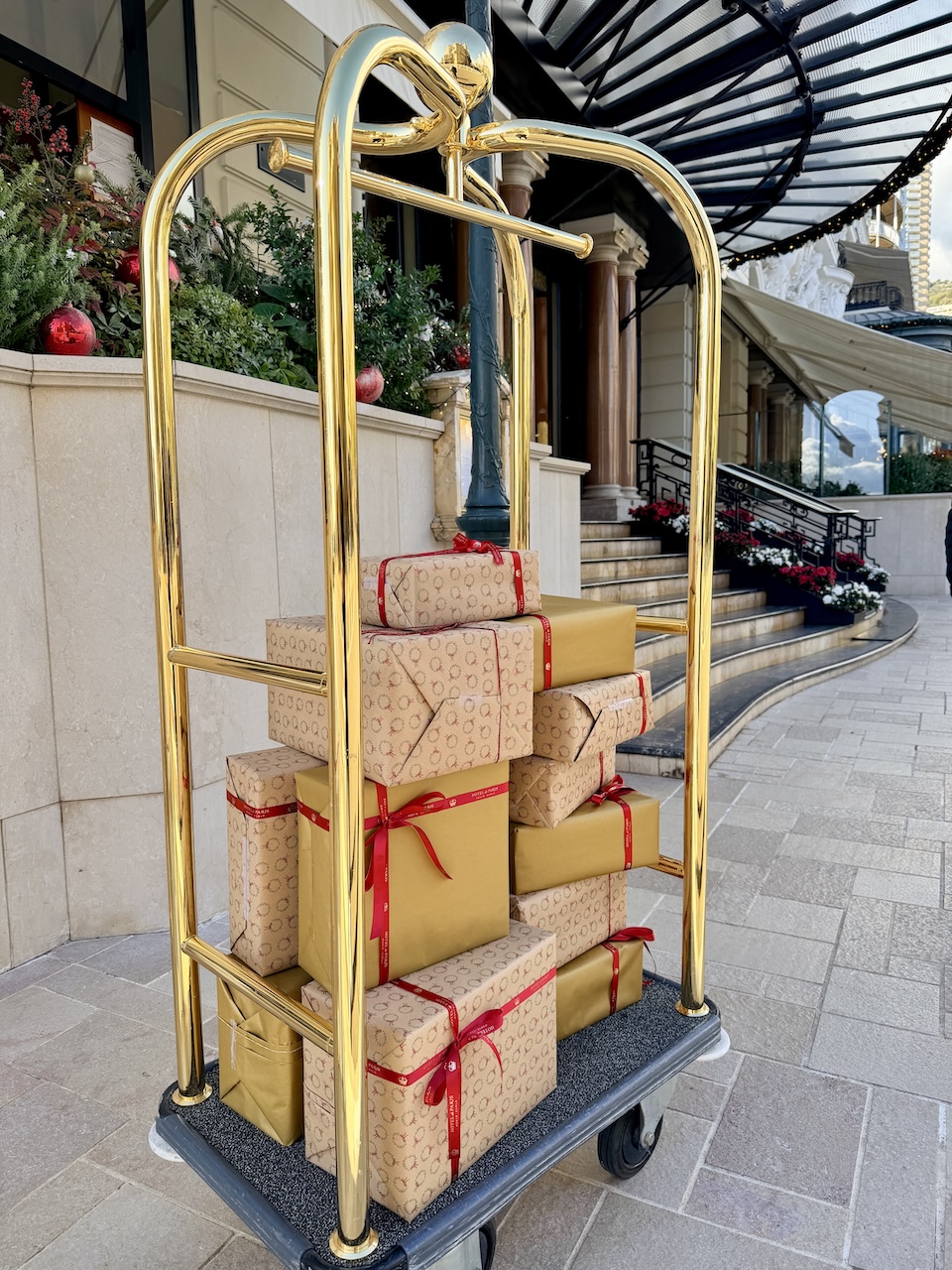
On a recent trip to the French Riviera, I spent a day in Monaco. Across from the famed Monte Carlo Casino, the five-star Hotel De Paris added one decoration that stood out more than the others. It had wrapped a handful of Christmas presents, placed them on a luggage cart, and parked it outside of the bell hop station. This small effort cost almost no money to produce, took no time at all to make, yet demonstrated the hotel’s commitment to detail. It personalized the holidays for the property. Every hotel had garland outside of the property, lights, a decorated tree but this was the only I came across (or have before) where the luggage cart was its own decoration element. It’s a thoughtful extra effort even if it’s not directly a service.
While an airline won’t be able to research each of its guests and tailor a legend, it can leave a lasting impression for a select few. We find evidence of these online when United saved the day for a girl who lost her hearing aid, but rarely do we see the proactive steps of placing a to-go bag together for hurried travelers with children.
For frequent flyers and frequent hotel visitors especially, the wealth of data the airline and hoteliers have is substantial. In some cases detailed transaction data can make it easy to deliver desirable amenities or customize a visit. Our favorite chain, Hyatt, will often leave a bottle of wine in the room – but we don’t drink – and surely they have to know this by now, we’ve even told them so. A cold can of Coca-Cola would be far more appreciated and yet, this is never adopted.
Crafting legends for a 100,000 employee airline would be nothing less than Sisyphean. But if providers wanted to apply the effort and give clients legends that would make them incredibly loyal, help to absorb premium prices, and opt for even more services they could start at their very best clients and most lucrative tickets sold.
Hotels have a far easier opportunity with the microcosms that are each location. Chains can utilize massive networks to transfer data and information and personalize visits. But doing this on a global level still feels too big. Smaller chains within a chain, like Kimpton inside IHG could make this work. It starts with the desire to deliver exceptional experiences, the practicality can be resolved if the desire is there first.
More than anything else, it’s a service attitude. It’s an investment in travelers, but also in the staff that will engage and look for opportunities to make experiences memorable.
Conclusion
I can’t say enough good things about Unreasonable Hospitality, and I can’t wait to try Guidara’s (and Danny Meyers) restaurants. For those that prefer listening rather than reading, the audio book is narrated by the author and is on sale at Audible at the time of publication.
What do you think? Have you tried Eleven Madison Park or experienced a legend?






Nice review, Kyle.
Service is empathy and effort (and atitude). Seems about right. Of course, when owners and management actually support their teams, that goes a long way. Gotta pay people at least a living wage; ideally, a thriving wage or equity.
Also, I gotta catch up on The Bear. Thanks for the reminder.
Hotel de Paris in Monte Carlo is a beautiful and I have had the good fortune to be a guest. Nothing is out of place. Not one petal on flower arrangements is overlooked. le Louis XV ( Alain Ducasse restaurant in the hotel is stuffy a bit overpriced ) but they delivered a gift box of house made sweets upon leaving for my children. Also for those interested, they operate a direct seafront Monte Carlo beach resort. 5 minutes from the hotel & casino that is family friendly, with a more relaxed atmosphere, and 2 star Michelin restaurants. They will shuttle you about day & night. An arm & a leg it may cost but worth a few days in Monte Carlo.
Let’s recall that Eleven Madison Park is a fine dining restaurant in the heart of New York City, owned and operated by Chef Daniel Humm. Overlooking Madison Square Park, one of Manhattan’s most beautiful green spaces, the classy property sits at the base of a historic Art Deco building on the corner of East 24th Street and Madison Avenue. In 2022 EMP became the first restaurant in the world to earn *** Michelin stars for an entirely plant-based menu.
“Anyone who stops learning is old, whether at twenty or eighty. Anyone who keeps learning stays young.”
– Henry Ford –
Note that the iconic 5* Hôtel de Paris Monte-Carlo’s Le Louis XV – Alain Ducasse at the Hôtel de Paris restaurant has *** Michelin stars… French-born Monégasque chef Alain Ducasse was just 33 years old, and Le Louis XV – Alain Ducasse had been open for just 33 months when it became the first hotel restaurant to receive three Michelin stars.
Respectfully, 11 Madison is a Vegan restaurant. ( currently with 3 stars). And I am happy you enjoy this. However Patrick O’Connell ( inn at little Washington) as held 3 stars for 40 years. It’s a terrific place, they accommodate all , including vegans. They grow their own fruits and vegetables. Try expanding your horizons, open your
purse and try something new
Correction! That was to be 4 years, not 40!
Note that the iconic Inn at Little Washington recently lost one of its three Michelin stars…
Oh yeah. I will buy the book.
I experienced “unreasonable hospitality” once on a flight with American Airlines from CLT-LAX. I was seated in the exit row on the A321 where you face the flight attendant directly. She took what could have been an awkward experience and learned that my wife and I were meeting up in LAX to fly onward to Hawaii, where I had grown up but my wife had never been.
She decided to craft two gift bags (in sick bags LOL). Imagine my surprise when I had a bag full of mini-bottles to enjoy on our vacation and another with extra snacks (including a couple nicer ones from first class) for the long trip the next day onward to LIH. Just before landing, they then heard that we were actually meeting our best friends for one day in LA and as I stepped off the plane, she thrust another bag into my arms and said “to give your friends”..it was a first class wine bottle (retailed at just $7).
This lovely flight attendant though, had to beg me not to mention any of this in a flight review. Can you imagine how much better the travel experience could be if service members who WANT to provide service above and beyond were empowered and encouraged to do so and didn’t fear getting in trouble for making a passenger’s day!?