
Some airline perks are generous. Others are so extravagant they eventually become too difficult to defend, as past and present executives at Qantas are now finding out.
Qantas Quietly Ends First Class Flights For Retired Executives On New A350s
For decades, Qantas has offered some of the most lavish executive travel perks in the airline industry, including unlimited international first class and domestic business class flights for senior executives and board members, plus their spouses and children. In many cases, those benefits extended well into retirement, effectively providing lifetime premium travel at shareholder expense.
As detailed in The Chairman’s Lounge, any Qantas director who fully utilized those entitlements could easily fly more than $500,000 worth of premium travel each year. Children remained eligible until age 26, and retirees continued to receive free flights for as many years after leaving the airline as they had served. In practical terms, that meant former directors and executives could enjoy pointy-end travel for a decade or more after stepping away.
One example cited is Maxine Brenner, who served on the Qantas board from 2013 until 2024. Under the rules, Qantas shareholders would continue subsidizing first and business class flights for her husband, Jodee Rich, until 2034.
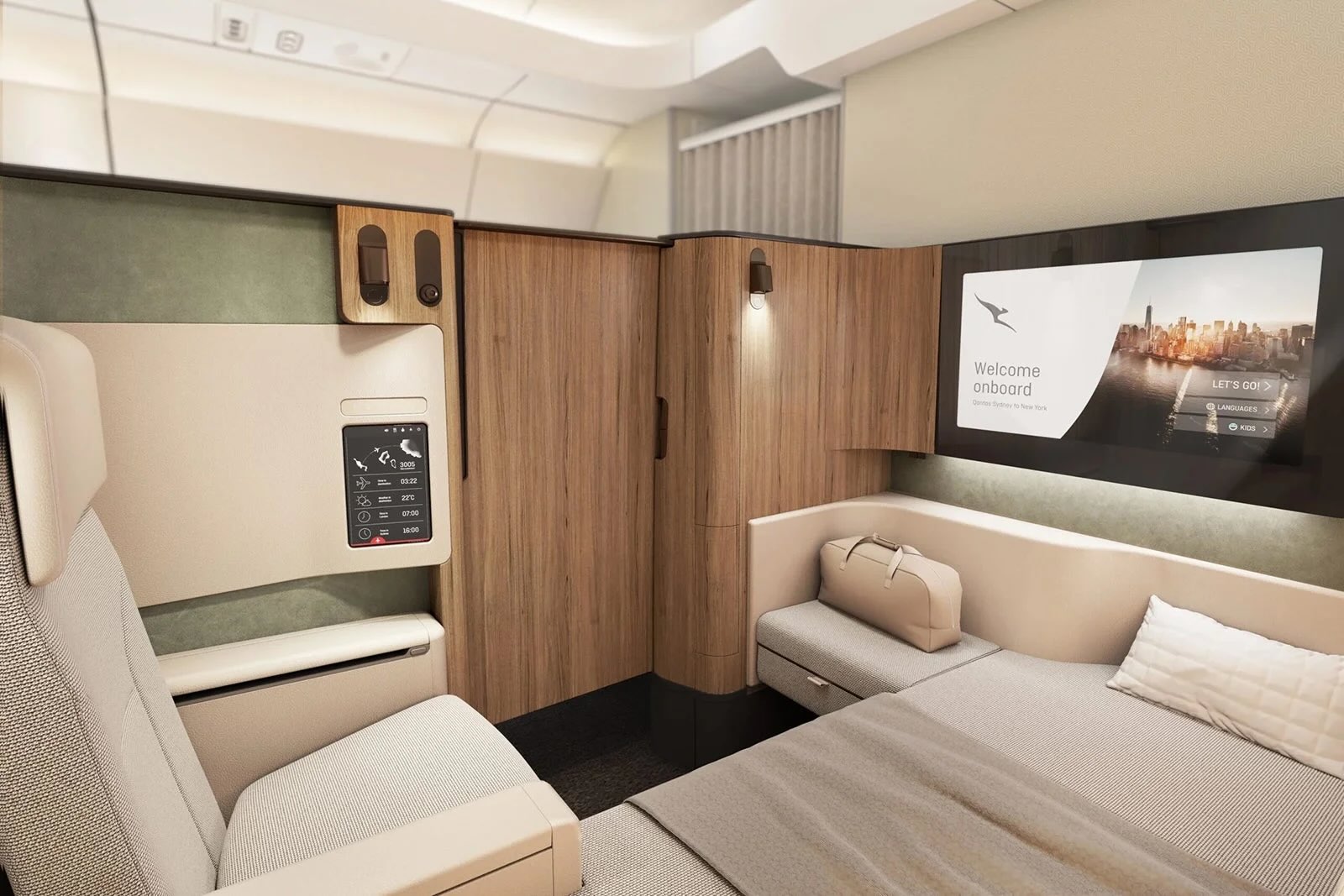
That backdrop helps explain why the arrival of Project Sunrise has been so eagerly anticipated in executive retirement circles. Beginning in early 2027, Qantas plans to operate nonstop flights from Sydney to London and New York using new Airbus A350 aircraft fitted with just six ultra-premium first class suites. The product is based on the highly regarded A350 first class seats introduced by Japan Airlines and SWISS, and represents the most ambitious cabin Qantas has ever offered.
But last month, that anticipation reportedly turned to disappointment.
Cam Wallace, head of Qantas’ international division, wrote to former directors and members of the executive leadership team, including former CEO Alan Joyce and former chairmen Richard Goyder and Leigh Clifford, informing them they will not be eligible to travel in first class on the new A350 aircraft. Business class, yes. First class, no.
“Retired Qantas bigwigs have undoubtedly been salivating at the prospect of the airline’s Project Sunrise product coming online in early 2027: non-stop flights from Sydney to London and New York on new A350 aircraft sporting six first class suites of destiny…But their anticipation became dejection when they opened the mail last month.”
That’s good news for the rest of the flying public, like you and me. Fewer non-revenue travelers occupying first class seats means slightly better upgrade or award space odds for customers actually paying fares or redeeming points. I wouldn’t count on any space either way, but at least this policy change makes it a bit more likely.
(As an aside, I’m not sure how this unilateral policy change is contractually possible…if someone knows, please leave a comment below)
CONCLUSION
This policy change addresses an optics problem that has lingered for years. Unlimited lifetime first class travel for retired executives was always hard to justify, particularly at an airline that routinely tells customers it must cut costs elsewhere.
Being denied first class on Project Sunrise is a long-overdue recalibration. And if some former executives are now forced to “endure” business class on a 20-hour flight, well, there are worse fates in aviation…



Business class is plenty good enough for nearly everyone. For long-haul, to get a bed (lie-flat) and a nicer meal, is still a treat. Reminds me of that later season of the Crown where Prince Charles flies BA business class to Hong Kong while Prime Minister Blair is up in First… yeah, retired executives and future kings can handle it, just fine.
A little off topic, but I wonder if they have to pay Fringe Benefit Taxes on these generous perks? Was thinking that alone would be a deterrent for abuse. Curious.
This is an interesting question as it raises the difficult question of valuation. If someone flew long-haul first class 3-4 times per year, the variation in how those flights were valued could mean the difference in tens of thousands of dollars in taxes.
in the US, yes they do. it counts as imputed income.
My understanding is that FBT is also payable in Australia. Since the beneficiaries of this corporate largesse are all quite wealthy, I doubt they notice the extra amounts on their tax bills.
At 47% , when it’s not OPM, even the fat cats might hesitate.
Devaluations for everyone!
This decision is good business sense. Why have they been throwing revenue away by accommodating these corporate moochers who are well and truly able to afford to buy their own tickets? I still wouldn’t hold out much hope of getting an upgrade or an award seat in first class, though. Even with the leeches detached, I think there’s going to be considerable demand for the big chairs up-front.
One should never forget the sometimes overlooked value of being able to fly Business Class permanently…
I’d much prefer they get F on none of the widebodies, just J. And, if there are empty seats in F, upgrade those pax who paid first. (I am well aware QF calls the seats at the front of narrowbodies business not first, though the are like US F on narrowbodies other than planes like AA A321xlr, in case someone thinks they have a “gotcha.”)