
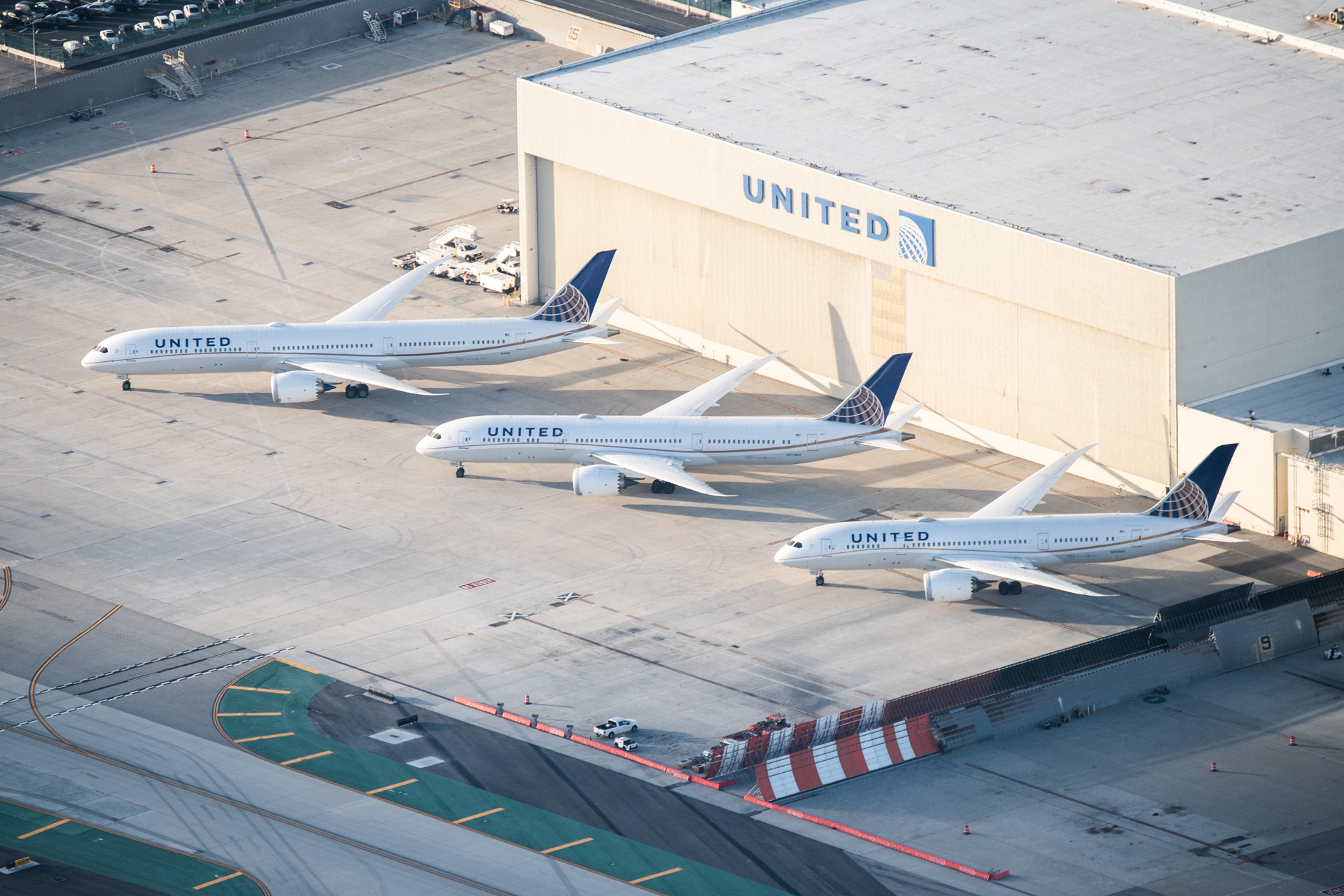
United’s reported decision to swap dozens of Boeing 787-9 orders for larger 787-10s looks like a quiet fleet move with loud implications for the future of the 777-200ER.
United Converts 56 787-9 Orders To 787-10. Are The Days Of The 777-200ER Numbered?
United Airlines has confirmed it is converting 56 Boeing 787-9 orders to the larger 787-10, a move first reported by The Air Current. That is a telling shift, not just because it changes the shape of United’s future widebody fleet, but because it hints at which airplane United wants doing the heavy lifting in the future on high-volume routes: the 787-10, not the 777-200ER.
The Boeing 787-10 is the biggest Dreamliner variant, and it is built for capacity and efficiency over absolute range. The FAA’s certification documents for the 787-10 cite a maximum takeoff weight of 560,000 pounds, which places it firmly in longhaul-capable territory even before you get into airline-specific cabin configurations and performance assumptions.
Why United Might Prefer The 787-10 Over The 787-9
The 787-9 is the more versatile, and United already knows that well. It is the Dreamliner variant that can cover deep South America, ultra-longhaul routes to Asia, and also thinner longhaul routes where frequency matters more than sheer size.
But the 787-10 does something airlines love: it spreads costs over more seats while keeping operating economics very attractive. If you have a route that is consistently full, you do not necessarily need more range. You need lower unit costs and a widebody that is efficient.
That is the 787-10’s sweet spot. It is the modern widebody equivalent of a workhorse, especially as it has evolved, and for an airline like United that runs huge banks across multiple hubs, a bigger Dreamliner is a very logical way to upgauge without jumping into a much larger, heavier airplane.
So Does This Mean The 787-10 Replaces The 777-200ER?
Not overnight, but conceptually, yes, this is exactly the kind of fleet move that puts the 777-200ER on the clock.
United’s 777-200ERs are big, capable airplanes, but they are also older and less efficient than what is coming behind them. Even with cabin refreshes, the underlying math has not changed. New-generation twinjets have redefined fuel burn, maintenance, and reliability expectations.
The 787-10 cannot be a replacement for the 777-200ER on every route, because the 777-200ER can do some things the 787-10 cannot both in terms of range and cargo. But on a surprisingly large chunk of real-world flying, the 787-10 can absolutely substitute and United is not maximizing the range of the 777-200 on most routes they are deployed on.
I find it telling that United has 55 777-200ERs in operation and this conversion is for 56 787-10s.
And there is also a scheduling advantage: if United can standardize more of its high-capacity flying around the 787-10, it simplifies fleet planning. A bigger Dreamliner also gives United more room to densify premium-heavy routes.
The IGW Angle: Range And Payload Are Not Static
Airframes evolve. Manufacturers and regulators certify incremental changes that improve performance, including increased gross weight (IGW) variants and related improvements that can translate into more payload, more fuel, or more operational flexibility. In plain English, the airplane delivered in now is often not identical in capability to the airplane delivered a decade ago, even if the nameplate is the same.
That matters for the 787-10, because its main drawback has always been range. If United believes the -10’s capability is effectively “enough” for the missions it wants to fly, especially as the type matures and performance options improve, then the -10 becomes much more than a high-density regional widebody. It becomes a practical longhaul tool for a large slice of the network. And referring to the 787-10, United CEO Scott Kirby has said:
“They are a phenomenal European airplane. They have the lowest seat mile costs in the industry, and are the right size for many of our markets. That’s why you see them flying a lot from Chicago and Newark.”
There is no -ER or -LR variant of the 787-10, but as this aircraft has revolved, Boeing now offers more payload (cargo and passenger capacity), about 14,000 pounds, and more range, about 430 nautical miles. It has gotten better with time and this is now standard on the aircraft.
What This Says About United’s Bigger Fleet Puzzle
The Air Current’s reporting also folds in the broader backdrop: United’s widebody strategy is in motion, and it is not just about Boeing, necessarily. The same report touches on A350 dynamics, engine considerations, and the constant reality that aircraft programs and deliveries rarely go exactly as planned.
United does not need one airplane to do everything. It needs a fleet mix that covers:
- Long, thin routes (787-9)
- High-demand routes with great economics (787-10)
- Very long and premium flagship routes (where the eventual answer may differ by market)
If United is indeed shifting materially toward the 787-10, it is a signal that the airline sees a lot of its future growth as “bigger, more efficient, and frequent,” rather than “maximum range.”
With the 777X facing extended delays, I’m wondering if United will eventually move to an all-Dreamliner widebody fleet, with the 787-8 still operating to leisure destinations, the 787-9 operating to longhaul destinations, and the 787-10 replacing the 777-200 (and maybe even the 777-300 eventually) plus the 767-300/400 as the “workhorse” of the longhaul fleet to Europe and South America, where range is not an issue. Throw in A321XLR and the potentially the 737-10 for smaller transatlantic destinations and we might well see a post-777 fleet sooner than we think.
I still don’t think United will ever take delivery of its A350 order.
CONCLUSION
United’s conversion of 56 787-9s to 787-10s is a directional bet: more seats, lower unit costs, and a modern widebody designed to replace the 777 fleet, at least eventually.
And if the 787-10 can cover more of United’s real-world longhaul flying than many assume, especially as performance options mature, then yes, the 777-200ER’s role shrinks. The -200ER will still have niches where it makes sense for many years to come, but the future at United appears to be the Dreamliner.
image: United Airlines






Add to that the 3-3-3 configuration in economy and the lower altitude cabin pressure make the 787-10 a much better choice than the 777.
I’d argue 339 is the best medium-sized moderately-long-haul with its 2-4-2 configuration in the back.
The versatile and handy A330-900…
not sure the 737-10 will ever fly transatlantic
UA made it very clear that the 737-8 would be the variant to fly transatlantic. Of course, that means no J on those routes
UA always had the ability to pick from any of the three 787 variants for deliveries further than two years or so out so it is more a matter of designating than converting orders.
Airbus A350-1000 would be a good replacement for UAL’s Boeing 777-300ER, which primary flies trans-pacific routes.
Let’s recall that UA originally placed a firm order for 25 A350-900s in 2009. That commitment then changed to 35 A350-1000s in 2013, and later to 45 A350-900s in 2017. Despite these several deferrals, the type remains on United’s books but with first deliveries not expected until well into the 2030s.
One very important thing you didn’t bring up here- the age of United’s 777-200s. They were the launch customer and some are now 30 years old. It’s a natural point to turn over this part of the fleet.
Let’s add that UA’s current fleet includes 74 B777-200 jets with an average age of 26.7 years.
The groundbreaking B787-10 Dreamliner reigns supreme.
“They are a phenomenal European airplane.”
I think Kirby needs to stop day drinking. Airbus makes European airplanes. Boeing is made in the USA.
Geez I hope you were kidding. The routes…the routes.
Pretty much joking. The guy spouts so much BS that sometimes it takes actual effort to separate fact from Kirby’s pronouncements. On first reading it really looked like Kirby was saying Boeing was European. I guess he keeps you on your toes at any rate.
I think the pre-merger legacy UA 777-200s with the Pratt and Whitney PW4000s will be the first to go. The ex CO GE90 birds will hang on longer.
UA has almost as many 789s and 78Xs on order as they have old widebodies (767 and 777). Add in the 35Ms, if they do eventually take delivery, and one has to think the path is clear.
Hello Matthew….do you know the difference between Direct and Nonstop flights
Yes, I do. How about you?
All nonstop flights are direct. Not all direct flights are nonstop.
Today, United chose the superior engine option for their latest 787-10 order – the option with the carbon fiber composite fan blades.