
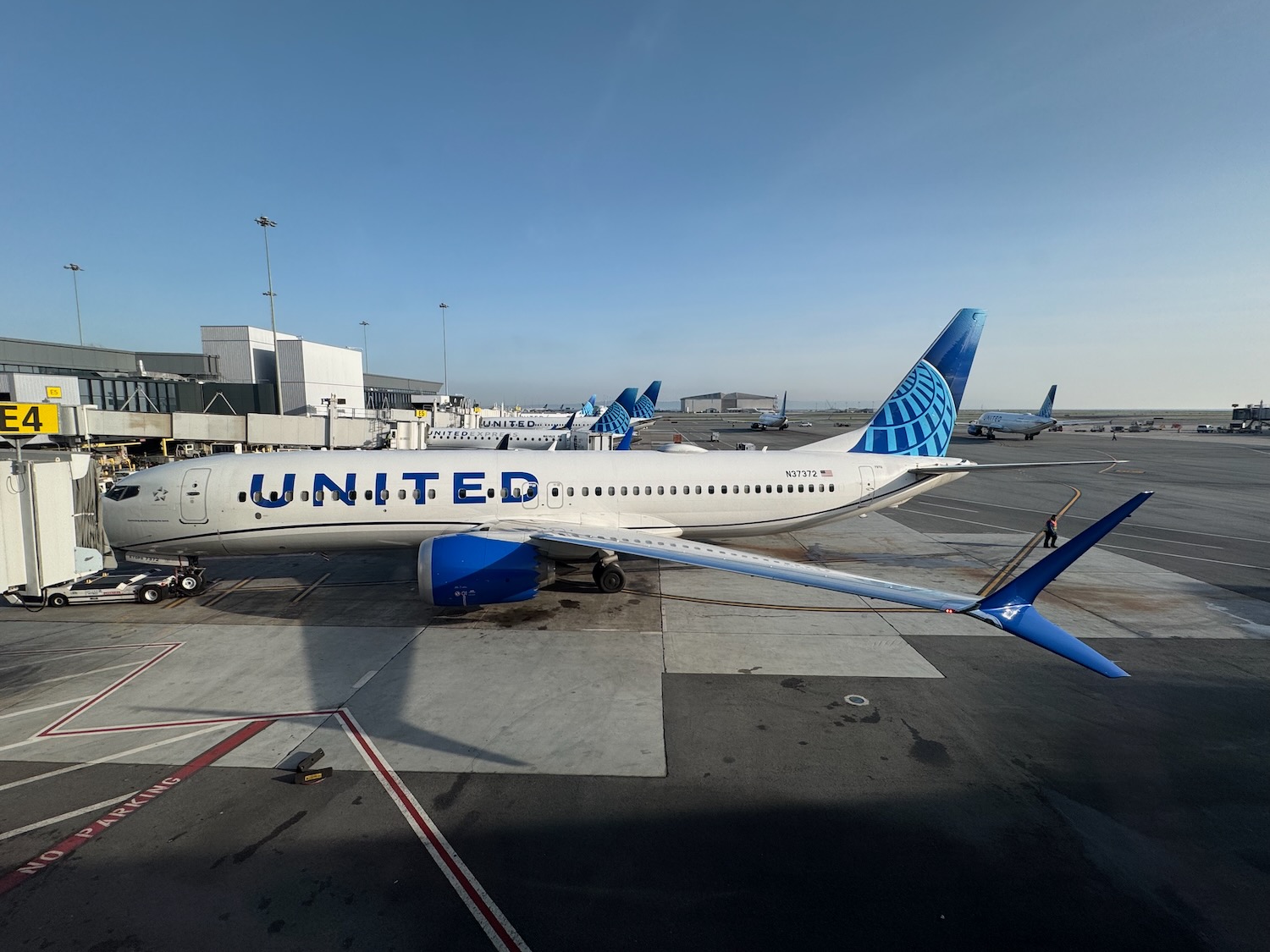
San Francisco International Airport is facing significant disruption right now, and the implications for United Airlines go beyond a few bad weeks of delays.
SFO Runway Problems Could Force United Airlines To Rethink Its Hub
SFO is dealing with two overlapping issues: a runway closure for construction and a new Federal Aviation Administration (FAA) restriction that cuts arrival capacity.
One of the airport’s four runways is closed through early October thanks to a construction project that just commenced. That alone would slow things down. But the bigger issue is a change in how aircraft are allowed to land. The FAA has reduced the number of arrivals per hour because of safety concerns tied to the airport’s closely-spaced parallel runways. Per the FAA:
“The FAA safety measure prohibits flights from making side-by-side approaches to SFO’s parallel east-west runways in clear weather when the pilots acknowledge having the other aircraft in sight. It requires staggered approaches, with one aircraft offset from the aircraft on the parallel runway. The FAA never allowed side-by-side approaches in bad weather.”
It is not clear what prompted this sudden change, but the FAA added that its announcement on the same day runway construction began was purely coincidental.
In the past, SFO could handle about 54 arrivals per hour in good weather. That number has now dropped to around 36, a 33% decrease. Even after construction is finished, projections suggest capacity will only recover to roughly 45 arrivals per hour.
That is a huge reduction at one of the most delay-prone airports in the country and I don’t think any of us can quite appreciate yet what this means for United Airlines. United, which relies on SFO as a major hub for both domestic and international flying, is watching closely.
In a statement to Live And Let’s Fly, United said:
“Planned runway construction at San Francisco International Airport may cause flight delays, and we encourage customers to check their flight status in the United app. Additionally, we are reviewing the FAA’s updated guidance to determine if we will need to make any changes to our flight schedule in the future.”
I specifically asked if United opposed the new FAA rule or would take steps to contest it and was told United had no further comment.
A Long-Term Problem For United At SFO?
The construction will end, but the FAA restriction is likely to remain.
SFO has always had operational constraints due to runway spacing, especially in poor weather. Airlines built schedules around the assumption that in good conditions, the airport could handle higher arrival rates, but it appears that assumption no longer holds.
If arrival rates stay lower, delays will become more common and schedule reductions will be necessary.
United has not announced any cuts yet, but the language in its statement makes that a likely option (United is not going to tolerate 25% of its flights being delayed 30+ minutes going forward). If the current limits remain in place, trimming peak-hour banks will be necessary.
SFO is United’s primary gateway to Asia and an important hub for Europe. This news could hinder growth plans, though at least it comes at a time of rising oil prices when schedule cutbacks may make sense even without new landing restrictions. Might United shift more traffic south to its Los Angeles (LAX) hub? That’s a possibility, especially because Patrick Quayle, the Senior Vice President of Global Network Planning and Alliances at United Airlines, recently put Delta “on notice here at LAX,” promising, “We will be #1 here as well.”
If you are traveling via SFO, expect longer delays in the days ahead, regardless of weather.
CONCLUSION
SFO has always been a difficult airport to run on time, but this surprise landing policy change from the FAA will make operations much harder. If the reduced arrival rates stick, United will have to scale back its operation at SFO…I’d expect fewer frequencies between hubs and a cutback in United Express operations. This is not good news for United.






Yeah, construction will do that. See EWR for the past few years. I’ll miss the parallel runway take-offs at SFO.
this is not just due to construction but permanent and applies to parallel arrivals (landings) on the east- west runways; the arrival rate will go back up slightly after construction is through but will be permanently lower than it was a week ago
United has grown SFO share from 50% in 2019 to 57% today. The FAA portion of the reductions is 20% from the peak which I am sure will improve as alternative RNAV and PRM approaches are evaluated, but airlines and airports also have all kinds of de-peaking options at their disposal. UA is exceptional at managing these issues and there are actually well known competitive benefits to capacity constraints. And no other airline has a fleet that is better equipped to handle such challenges. See up-gauging.
I’m very glad you covered this and did it before other aviation sites; this is a very big deal for SFO and for UA.
SFO’s parallel runways are far closer together than at other airports including LAX. There always was a higher degree of risk with parallel operations as a result, esp. for a hub.
It is certain that UA will have no choice but to reduce the number of flights and spread out its hub banks which reduces connectivity. The question is if the FAA moves to schedule coordination discussions as it did at EWR and ORD after UA, in both cases, tried to overschedule those airports. This is a different case since UA has operated this level of flights for quite some time.
as for moving flights elsewhere, the weakness of UA’s SFO hub has always been that they concentrate a far higher percentage of their TPAC flights into one hub than other carriers.
LAX not only isn’t near as suitable as a connecting hub – UA is gate constrained there but geography is far less favorable – but DL apparently intends to build out LAX even more. JonNYC seems to think that DL is on the verge of more LAX announcements. Given that their application for MNL service appears to be going nowhere, SIN is likely next on the list and, if Jon is right, DL could be announcing it soon for a winter 2026 launch with a conversion to the 35K when those arrive in less than a year.
You do have to wonder what UA has done to draw the FAA’s attention to scheduling at 3 of its most important hubs but this is where we are and SFO has some of the worst weather and a runway configuration that is less ideal for a major hub so perhaps the FAA is getting ahead of things that should have been corrected a long time ago.
You’re reminding me of General Hux from The Rise of Skywalker (2019):
“I don’t care if (Delta) wins. I need (United) to lose.”
what a jaded and completely incorrect take.
DL has won because it has built a successful organization over years while UA thinks it can do it overnight – and steamroll everyone else = except DL – in the process.
Tim, you are wrong. When a construction project impacts an airline’s hub, that airline is actually in the BEST position to accommodate it. It’s the other airlines that have a harder time still providing desirable service. Let me explain.
SFO is a hub for United and Alaska. If the FAA mandates a 33% reduction in flights – it isn’t only coming from UA and AS flights. Yes, they’d have more “raw numbers” of flights, but the cuts are from all airlines. And having more flights means you can spread out the impact. In other words, if UA has 12 flights to ORD, they could cut 4 and drop to 8 – but upgauge the aircraft, adjust the flight times, and still offer close to, or the same, number of seats spread through the day. Customers buying tickets now for flights in June won’t know the difference. AS can do the same for flights to and from SFO to SEA.
Delta, American, and Southwest don’t have that luxury. If Delta has 4 flights to DTW, and one has to go – that’s a significant hit to convenient connectivity to SFO. It certainly leaves a big hole in the schedule. Same with AA from CLT, for example. Their passengers suddenly lose that “middle of the day” return home they were counting on, when their meeting wraps up at noon.
Also – an airline with a hub has more options regarding cancellations that the other airlines do not. Despite any past assertions, both UA’s and AS’s management teams are not stupid. They are not just going to wipe 33% of flights off every city pair. Because SFO has feeder flights for both UA and AS, those two airlines can eliminate one flight from a small city served by Skywest or Horizon (Arcata, Bakersfield, Fresno, etc.) instead. That way, flight reductions affect just the 50-seat or 76-seat jets from a small city, and similar service can be maintained from the most profitable larger cities served by mainline aircraft. American, Delta, and Southwest don’t have the same luxury. For example, Delta will have to cut SEA, LAX, SLC, MSP, DTW, ATL, DTW, JFK, or BOS service. None of those are small impacts.
Further – the main problem attempting to schedule service in SFO is the sharp contrast between “good weather” and “bad weather” days. In good days (two planes land to the West, then 2 planes depart to the north North – repeat about every three minutes), they could manage +/- 54 arrivals per hour. In the worst weather (low ceilings – requiring single ILS approaches on one of the 28’s) it drops nearly in half. Airline management can’t predict the weather 6 months in advance. Schedules are built expecting “good” weather, and “bad” weather causes major last-minute disruptions. Now, with flights planned at caps like the weather is always “bad” the operations will run much smoother. In good weather: 36 arrivals. In modestly bad weather: 36 arrivals. At worst, the 36 hourly combined arrivals will have to drop to about 27 in the worst weather, instead of 54 dropping to 27.
Finally, it’s possible that UA or AS could ADD seats as a result of the reductions, especially UA. They are taking a lot of new airplanes this year, and they could adjust service from cities served by both mainline and express planes. How so? Here’s how: FAA says flights have to be reduced? Drop two E170s from Reno (2×76 = 152 seats), replace with one new 737-Max9 (178 seats). One less flight, 26 more passengers. They’d even get 8 more 1st class and 24 more Economy Plus seats to sell. And with UA’s focus on more premium seating options, that’s actually a win.
UA and AS will be fine during the construction over the next 6 months. It’s actually all the other airlines that will have bigger holes in their service to SFO as a result. I thought you’d be able to figure that out, or at least admit it.
I mean Tim is also just being calamitous – this situation has been in place for 3 days so far, SFO had delay rates of 22%, 23% and 18%, compared to a usual ~15-20% – sure it’ll get worse into the Summer, but this is still in line with airports like Atlanta, Boston, La Guardia and JFK – just to name a few. Tim likes to say that United will fail every time something happens at their airports. With EWR’s air traffic control issues last year, he said Delta would beat United in NYC – they didn’t – DL is still behind in NYC. He said with ORD that UA will lose heaps of money in a contest with AA, no they just hit the red button so the FAA was called in and effectively stopped AA from trying to grow there. Tim thinks that UA is going down the gurgler but they keep managing to outdo his poorly thought out ideas, it is funny to watch him cry about it though. As far as OTP goes though Tim, how’d Delta do in December? Were they ahead of United? No, American? No, Southwest? No – maybe they can learn something from United lol.
sarah,
first, the discussion is about potential cuts to the size of UA’s hub but more than likely a rearrangement of UA’s flight schedules to fit within the maximum allowable number of flights.
Cranky has a good article on the subject today and it highlights 3 times per day which are going to be problematic for UA and the airport.
The FAA has not decided how it will require cuts but, as I noted, they could impose schedule changes on other airlines but they have historically done it proportionately in line with the amount of flights from each airline during the times of day when there are too many flights.
UA will bear at least its proportion of the cuts or schedule changes. Given that SFO is a hub for UA, spreading out the amount of flights over a greater period of time will negatively impact the effectiveness of the hub. No one argued that UA’s local market share would be impacted.
and I have repeatedly said that no one would care if UA added capacity via using larger aircraft but UA continues to double down on using RJs and esp. small RJs – and that is the reason why UA could easily offset the loss of capacity by upgauging – but it means they will lose some connectivity to smaller airports that only support RJs.
Given that this is the 3rd UA hub where the FAA has intervened in schedules, UA is finding it harder and harder to keep adding flights via small RJs. Between high fuel costs and less flights than UA wanted – whether they admit to it or not – the CRJ 450 and 550 make less and less sense.
Andy,
the reason why it is so easy to win debates with you is because you and other UA fan nuts continue to act like petulant children that try to win an argument the minute any piece of data, no matter how cherrypicked it is, shows “your team” a micron ahead of the other guy.
DL does not measure success in months or weeks and neither do most businesses or even customers. If that was the case, UA would have lost during each of its meltdowns at EWR.
Actual trend lines in NYC over time show that DL has narrowed the gap with UA not just in passenger share -which means very little for anything other than the NYC subway but in revenue vs. direct competitors.
And, as I have said repeatedly but you and your ilk ignore, the gap in DL’s NYC presence is direct flights to Asia (other than TLV). DL will add flights to E. Asia and could add several destinations that UA simply cannot add simply because the A350 is a more capable aircraft than the 787 and has better economics.
DL is already the largest domestic airline in NYC, the largest to deep S. America, and offers as much widebody capacity to Europe as UA.
DL’s strategic focus to Asia is on LAX right now but they will get to JFK and BOS.
And simply given that DL has 20% more flights – as a result of slots – DL will always have the potential to be larger than UA – and DL can upgrade just as much as UA does if it chooses to do so.
and, despite your fixation on winning at every turn based on any metric you can grasp, DL has proven it can and does win on a far more holistic basis and over time.
and specific to SFO, this may or may not have a material impact on UA; if they just move around a few RJ flights that have minimal Asian connections, the impact will be minimal.
but UA is facing a challenge that no other airline is facing in the midst of increasing fuel and labor costs in the middle of a major growth strategy that doesn’t work at higher costs and as the .gov increasingly puts limits on UA’s ability to grow.
Cranky’s article was excellent as usual, but his “upside” in the headline was just clickbait – there is no upside for airlines or even consumers when flights may run more on time but cost a lot more due to reduced capacity.
So metrics where DL loses don’t matter but metrics where DL wins somehow do? Make it make sense Tim – if your logic is these small things don’t count, then I don’t want to see you mentioning any “small metrics” that show DL ahead in future comments. Don’t be a hypocrite!
Andy
nowhere have I “clung” to short term blips in stats.
I have accurately noted that DL is where it is because it has slowly and consistently built its business and operation.
UA desperately wants to be seen as the best airline and business and yet what is fair and what they should get credit for is that they have dramatically improved over the past decade.
DL did hold the most improved title but also moved quickly in the last decade to the best run airline and business.
UA has not achieved those titles yet and you and others cling to every movement in data to prove UA has won when it is still #2 to DL by a fairly wide margin.
and you WISH that DL will slip on a banana but they are still running a better business and airline.
I know it is completely counter to the way UA execs think or talk but if UA is really as well run as they think they are, they will become what they think they are – but that is just simply not reality now.
The sooner you and others are willing to wait for the proof of sustained leadership and success before endlessly crowing, the more I can move on to other things in life.
RIP, Parallel landings. We will miss you.
The construction effects are of course understandable, but what is the risk with the parallel landings in clear weather? Was a previous risk assessment found to be inaccurate? Does the FAA suddenly have less confidence in ATC? I don’t understand how two pilots could ever crash into each other in this scenario.
Both sets of parallel runways are far closer together than any other major commercial airports that have parallel operations.
SFO was simply never built to be a large hub – which puts a lot more pressure on the airspace.
As to the comment below, Stapleton has closed and part of the reason is because it did not meet safety requirements to support current large hub airline operations.
The real question – which Matthew poses – is what will be the impact to UA’s operation as well as other airlines. SFO is operating close to capacity now so there will have to be cuts.
From what I heard, there were a lot of conflict warnings with the TCAS when the arrivals got close together. It got to the point where some airlines adopted procedures to turn off the RA at SFO to accommodate the landings. I think the FAA keeps record of each time the alarm goes off and it went off a lot more at SFO than elsewhere. Not that the procedure was dangerous, but the FAA wants to at least give the appearance of prioritizing safety.
when you have to turn off a system that is intended to make aviation safer because one airport consistently fails at the margins that safety system is designed to protect, it is not just an appearance of safety that is taking priority.
It IS safety and it is troubling that some people work so hard to argue otherwise.
SFO actually falls within the FAA’s safety threshold for parallel landings in VFR conditions – 700ft required separation for parallel landings. Now, if that caused the TCAS alarms to go off, that is another issue, but the FAA deemed SFO’s parallel landing procedure safe for decades and they still haven’t changed their own rules. Now whether or not that procedure is good or efficient or not, is a different argument entirely, but according to the FAA’s own rules, TCAS alarms or not, SFO’s VFR arrival procedure was and still is perfectly fine. Now, if only the FAA could look into stopping other procedures, which are even worse and far more dangerous than SFO’s.
I used to watch the planes land side by side simultaneously all the time at Denver’s former Stapleton International airport. That’s when the two airplanes lined up side by side coming in to land.
They were always a thrill to watch. That’s if and when the two planes happen to line up that way.
For once (perhaps supporting the theory that even a broken clock is right twice a day), Timm Dumm makes a salient point: UA is somewhat gate restricted at LAX. (He does, however, fail to acknowledge that his beloved DL is equally gate-constrained). LAX is my home airport and UA is my carrier of choice, so I do hope to see more LAX flying. I am encouraged by seeing UA start to periodically use a couple of gates in adjacent T6 (AC/AS), and perhaps a deal can be struck with their *A partner AC to better utilize those gates. And while not as convenient for UA (especially with the T5 construction disrupting airside transfers), UA could try to use some all-purpose TBIT gates for international flying.
If I understand correctly, simultaneous independent parallel instrument approaches require the runways to have 4300 feet or more of separation, although simultaneous close parallel approaches can be allowed, but require advanced radar with runway separation of 2500-4300 feet. SFO 28L and 28R have 750 feet of separation.
Why now did the FAA decide to make this rule mandatory even in good weather??I assume it was not against FAA rule was the runways were built?? If the rules changed years ago-why were they not brought up to standards then??? VS now–with 1 runway out till October?
Yeah I don’t get it. Pilots don’t accidentally land on wrong runways. What changed?
Safety first!
Terminal 9 at LAX will probably be a thing now.
I asked Andrew Nocella about it and he said it is years away – but, United has re-claimed a portion of T6 (bringing back pre-CO merger memories).
SFO has had plans for separating the two main runways to the standard distance for decades – never implemented due to cost. Maybe it’s finally time to do it?
City Supervisor Peskin led the charge against the new runway configuration with environmental groups right behind him. These groups have even MORE say in how things go in California today, so there’s no chance of expansion unless the political winds change drastically.
The solution is easy. Move flights to OAK and SJC which have plenty of spare capacity. Not every ORD, DEN and IAH flight needs to connect to an international departure. ditto for intra- CA flights
Consumers will adjust and some will even be happy. It’s like flying to EWR instead of LGA. Many don’t like it
I wouldn’t be surprised if slots eventually come to SFO. Capping landings at 36 an hour brings flights to LGA levels.
Also, the FAA’s rule is that parallel landings are permitted on runways whose centerlines are 700ft apart, which is 50ft less than SFO’s runways. I wonder if that rule came about because of SFO, but now that they’ve changed procedures, will it still stand?
And from what I’ve heard, SFO had a lot of TCAS RA alerts due to the nature of the operation. Some airlines turn off the alerts to accommodate the procedure. I think the FAA actually keeps records each time the alerts go off and it just made the airport look bad in terms of safety. It wouldn’t surprise me if the magnitude of alerts was the reason they decided to cut the procedure.
just as you said above, this is a real safety problem that cannot be easily fixed by technology.
Part of the problem is wake turbulence and the fact that it is impossible to match up two airplanes to fly the exact same approach.
as to the comment above, UA simply does not have any fleet advantages to any other US airline – they don’t fly a single aircraft type that is unique to UA, let alone to US carriers. and UA’s combination of aircraft types isn’t “better” or worse than any other airline – other than that UA does not have a small mainline aircraft which would allow upgauging in increments rather than doubling or tripling of capacity.
The only unique characteristic that UA has from a fleet perspective is that it continues to take seats off regional jets which are already fuel inefficient in order to supposedly capture premium demand that UA cannot capture with other aircraft.
DL and UA have had the same RJ scope clause in their pilot contracts which required adding a small mainline aircraft in order to unlock more large RJs. DL added the small mainline aircraft while UA did not so UA has fewer large RJs than AA or DL and thus has to grow its RJ fleet by using small RJs – which is precisely part of the problem the FAA is combatting.
UA could easily grow its capacity by using mainline aircraft without adding more flights – but UA’s growth plan is built around adding flights as much as if not more than upgauging.
The FAA has seen this movie 2X from UA already over the past year and is telling UA to upguage its small aircraft fleet at SFO in order to avoid capacity cuts in the midst of a necessary improvement in safety at SFO.
Let’s see what UA does but I can pretty confidently say that UA will upgauge at SFO and struggle to find places to put its growing fleet of small RJs. Who knows if the FAA will step in at IAH or DEN or wherever UA tries to place the 450s and 550s but the US airspace cannot support growth through significant addition of flights. It can and has successfully supported growth in capacity through upgauging – which is what UA needs to do to offest the coming flight cuts at SFO
Having spoken with pilots who fly this approach, most don’t think it’s unsafe. More of an annoyance as it’s extra work to fly this on a number of levels. TCAS is extra sensitive, which is why it went off more often on this procedure than others at other airports. I don’t know the reason the FAA is canceling this procedure, but from what people have told me, the alerts going off more frequently, even if it wasn’t a safety issue, seems to have influenced the them, especially since you had some actual close calls in SAT and other airports recently.
Having just gone through SFO on April 1, I can attest to the congestion/runway closure issues. We came in almost minutes early from Osaka but reached our gate only about 15 minutes ahead of schedule after being rerouted to circle and then stuck on the ramp. Our outbound flight to Denver ran 30 minutes late arriving at SFO and we roamed around the field for almost 30 minutes queueing for take-off. One great plus is the new contracted TSA-like security; delays were just a few minutes and service was great!
As an update, I spoke with an NCT controller and they weren’t given any heads up of the procedure change. He doesn’t know why HQ did it other than saying they don’t know what they’re doing. He also doesn’t think it makes the operation any safer. If anything, the workload gets worse because of all the extra vectoring and speed changes they have to do now and they’re overworked and understaffed the way it is. It will definitely slow down the operation.
Might it be undone or only gradually implemented?