
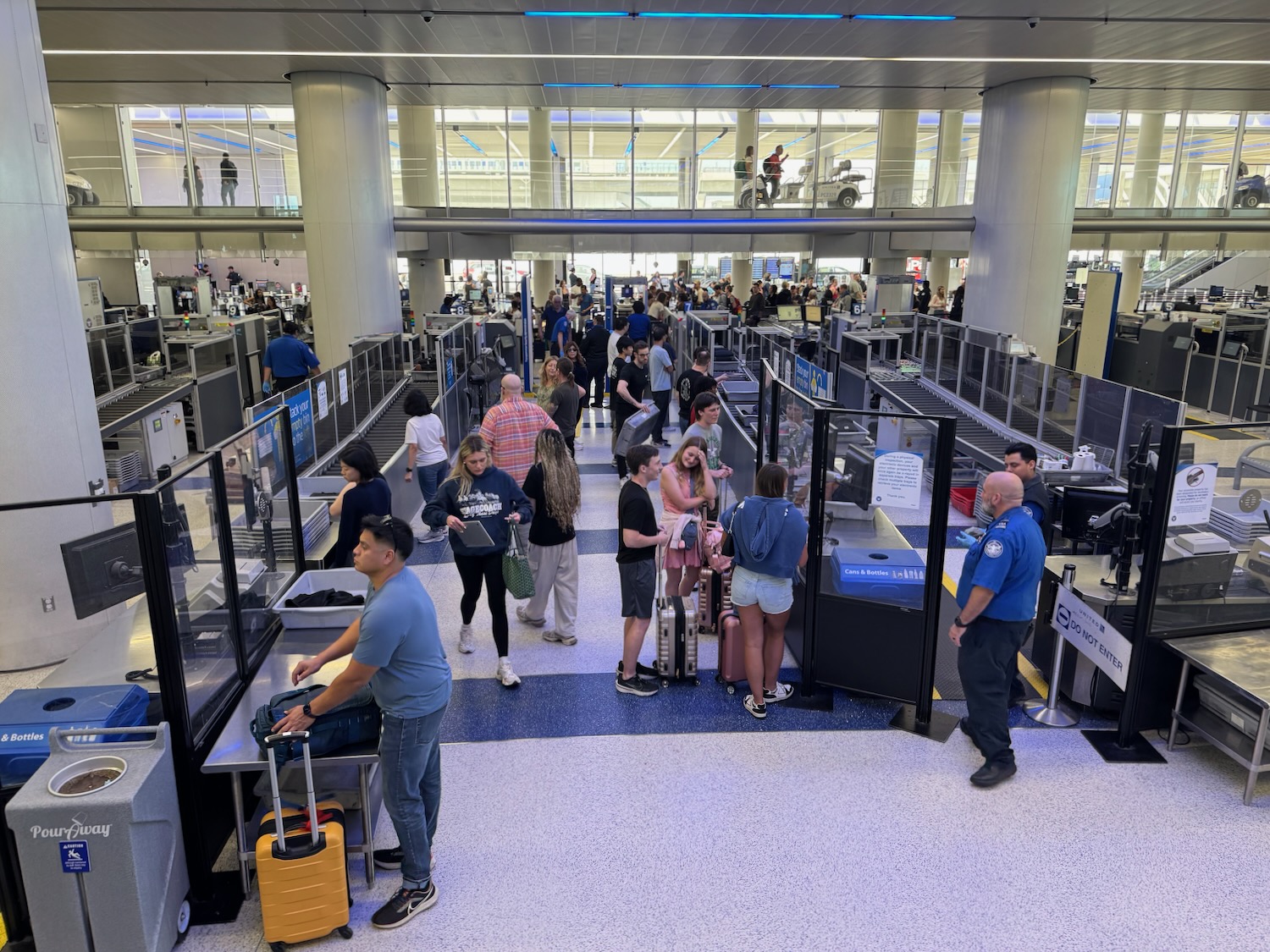
Yesterday I wrote about President Donald Trump’s plan to pay TSA workers using existing funds as airport chaos spirals out of control. Today, we have more clarity on how he intends to do it…and more questions about the legal basis for doing so.
Trump’s “National Emergency” Plan To Pay TSA Workers Raises Legal Questions As Shutdown Drags On
As TSA lines stretch for hours and airports descend into dysfunction, the White House is now moving forward with a plan to keep Transportation Security Administration officers paid despite the ongoing funding impasse in Congress.
The mechanism? A presidential declaration that effectively unlocks funding authority within the Department of Homeland Security, allowing money to be redirected toward TSA payroll.
It’s a creative solution that I pragmatically support, but it’s also legally murky.
How We Got Here
The current stalemate traces back to a breakdown in negotiations over DHS funding, particularly surrounding immigration enforcement and ICE.
The Senate failed to advance a funding bill that would have kept DHS fully operational, with disagreements centering on how much discretion and funding ICE should receive. The House, controlled by Republicans, has been unwilling to accept a narrower funding package that excludes or limits ICE.
The result is a familiar Washington outcome: nothing passes, and essential functions get caught in the middle. TSA, which is funded through DHS, has been operating without appropriations, forcing officers to work without pay while passenger volumes remain high.
Meanwhile, ICE, ironically flush with funding from the so-called “Big Beautiful Bill,” remains at the center of the political fight that is preventing a broader resolution.
The Legal Theory Behind Trump’s Move
The administration is now attempting to sidestep Congress by relying on existing appropriations and emergency authorities to fund TSA operations.
At its core, the argument appears to be that maintaining airport security is an essential function tied to national security, and that failing to fund TSA would “unacceptably heighten the risk of security vulnerabilities within our domestic travel system.”
That is a compelling policy argument, but it is less clear that it is a compelling legal one.
The Constitution vests the power of the purse in Congress. The executive branch does have some flexibility to reprogram funds within agencies, particularly in emergencies, but that authority is not unlimited. Redirecting funds at this scale, for this purpose, without explicit congressional approval pushes into gray territory.
This is not a clean exercise of statutory authority. It is a result-driven maneuver designed to address an immediate crisis. And yet, I don’t expect a successful legal challenge.
Who Could Even Challenge This?
Even if the legal footing is shaky, there is a practical question: who has standing to challenge it?
Congress could, in theory, bring a lawsuit arguing that the executive branch has overstepped its authority. But that would require political will that appears to be in short supply. Individual taxpayers would almost certainly lack standing. TSA workers themselves are unlikely to challenge a move that ensures they get paid.
Which leaves the administration in a familiar position: acting first, with the expectation that no one will be able (or willing) to stop it.
Welcome to 2026….
Airlines Are Watching Closely
Airlines are caught in the middle and forced to act nimbly so as not to upset either side.
Delta Air Lines said in a statement:
“Delta is grateful that the executive order announced today by the President will restore pay to TSA professionals, and we thank them for working to keep our airports secure during the partial government shutdown. We also thank our customers for their patience amid longer-than-usual security lines, and our employees for taking care of our customers during a challenging time for travel.”
United Airlines and American Airlines have not yet addressed Trump’s latest funding maneuver, but United Airlines CEO Scott Kirby heaped praise on the Trump administration at a media event in Los Angeles earlier this week (mostly for its push of air traffic control modernization).
> Read More: 10 Takeaways From Scott Kirby On TSA Chaos, Fuel Shock, And Why United Will “Eat Competitors For Lunch”
The Executive Order
The administration’s directive, in full, reads:
As the Democrat-caused shutdown of the Department of Homeland Security (DHS) continues well into its sixth week, America’s air travel system has reached its breaking point. This is an unprecedented emergency situation. Currently, more than 60,000 Transportation Security Administration (TSA) employees, including approximately 50,000 transportation security officers who perform security functions at domestic airports, are not being paid due to congressional Democrats’ reckless decision to prioritize criminal illegal aliens over American citizens and shut down DHS until their demand to prohibit enforcement of Federal immigration law is met.
Since the shutdown began, nearly 500 transportation security officers have left their positions, and thousands more have begun to call out sick at record rates due to lack of pay. As a result, security wait times at some airports have reached untenable lengths of three or more hours. These increased wait times, combined with declining morale among TSA staff, unacceptably heighten the risk of security vulnerabilities within our domestic travel system and has negatively impacted countless Americans.
If Democrats in the Congress will not act to honor the service of our TSA officers, who are now performing their critical public safety responsibilities without knowing whether they will be able to buy food for their families or pay their rent, then my Administration will take action. As President of the United States, I have determined that these circumstances constitute an emergency situation compromising the Nation’s security.
Accordingly, I hereby direct the Secretary of Homeland Security, in coordination with the Director of the Office of Management and Budget, to use funds that have a reasonable and logical nexus to TSA operations to provide TSA employees with the compensation and benefits that would have accrued to them if not for the Democrat-led DHS shutdown, consistent with applicable law, including 31 U.S.C. 1301(a).
Once regular funding for TSA has been restored, every effort should be made, as authorized by law, to adjust applicable funding accounts within DHS to ensure the continuation of DHS operations and activities consistent with planned expenditures prior to the lapse.
Nothing in this memorandum shall be construed to impair or otherwise affect the authority granted by law to an executive department or agency, or the head thereof; or the functions of the Director of the Office of Management and Budget relating to budgetary, administrative, or legislative proposals. This memorandum shall be implemented consistent with applicable law and subject to the availability of appropriations. This memorandum is not intended to, and does not, create any right or benefit, substantive or procedural, enforceable at law or in equity by any party against the United States, its departments, agencies, or entities, its officers, employees, or agents, or any other person.
Let me note here that I do give the POTUS credit for finding a way to get TSA workers paid, but it’s hard to give credit to him when his team is the reason TSA workers have not been paid for six weeks. Do not forget that Democrats have offered to pay TSA workers over and over throughout this time, but the GOP in the House has repeatedly said that without additional ICE funding, it would not fund the TSA.
Why should we give credit to someone for fixing something they broke?
CONCLUSION
This is a classic case of result-oriented governance. The legal footing is uncertain, the constitutional questions are substantial, and the precedent should make anyone who cares about separation of powers uneasy.
But the alternative has been weeks of chaos at American airports, unpaid workers, and a system that has become incapable of performing its most basic functions.
I am not a fan of bending the law to reach a preferred outcome, but I see an even graver concern of living in a country where airport security collapses because Congress cannot do its job.
But this pragmatism is nothing to celebrate.




Is this just a one time catchup payment for TSA or will it allow them to be paid going forward?
There’s some money to pay…won’t just be catch-up.
First, the president’s directive needs a wink emoji at the end. He has consistently ignored the Constitution and the separation of powers. It means nothing to him. However awkward, we have now discovered the advantage to electing a criminal with background in ” creative accounting “. Let his crimes rest on his conscious. We will clean up the mess when he is gone.
Yeah, this is like waiting for a dementia-riddled family member to finally ‘go’… tragic.
He has not looked well for a while.
Good move, very pragmatic and used for a vital purpose. Long court cases just show ineptitude in the American system. However, this method should onl5 be done sparingly
It was high time!
The situation was becoming really critical… Hopefully, such an event will not happen again.
I appreciate your optimism, Güntürk, but as long is Trump is in power and GOP members of Congress unwilling to stand up to him, it’ll most likely happen again. Hopefully it’ll end sooner next time.
As you mentioned, if a similar situation recurs, let’s hope it will be resolved quickly.
the vast majority of American travelers don’t care what goes on in Washington; they just want to be able to get on a plane w/o the EXTRA drama that has defined the TSA checkpoint for the past 6 months.
Whether what Trump is doing is legal or not misses the point that no one, but no one, is going to be “that guy” that sues to block paying someone to do an essential service.
If Congress really was serious, they would put forth a bill to not allow “essential workers” to have their paychecks subject to the rancor and political infighting of Washington.
But no one realistically expects anyone there – of any stripe – is going to shrink the size of the kingdom over which they get to rule.