
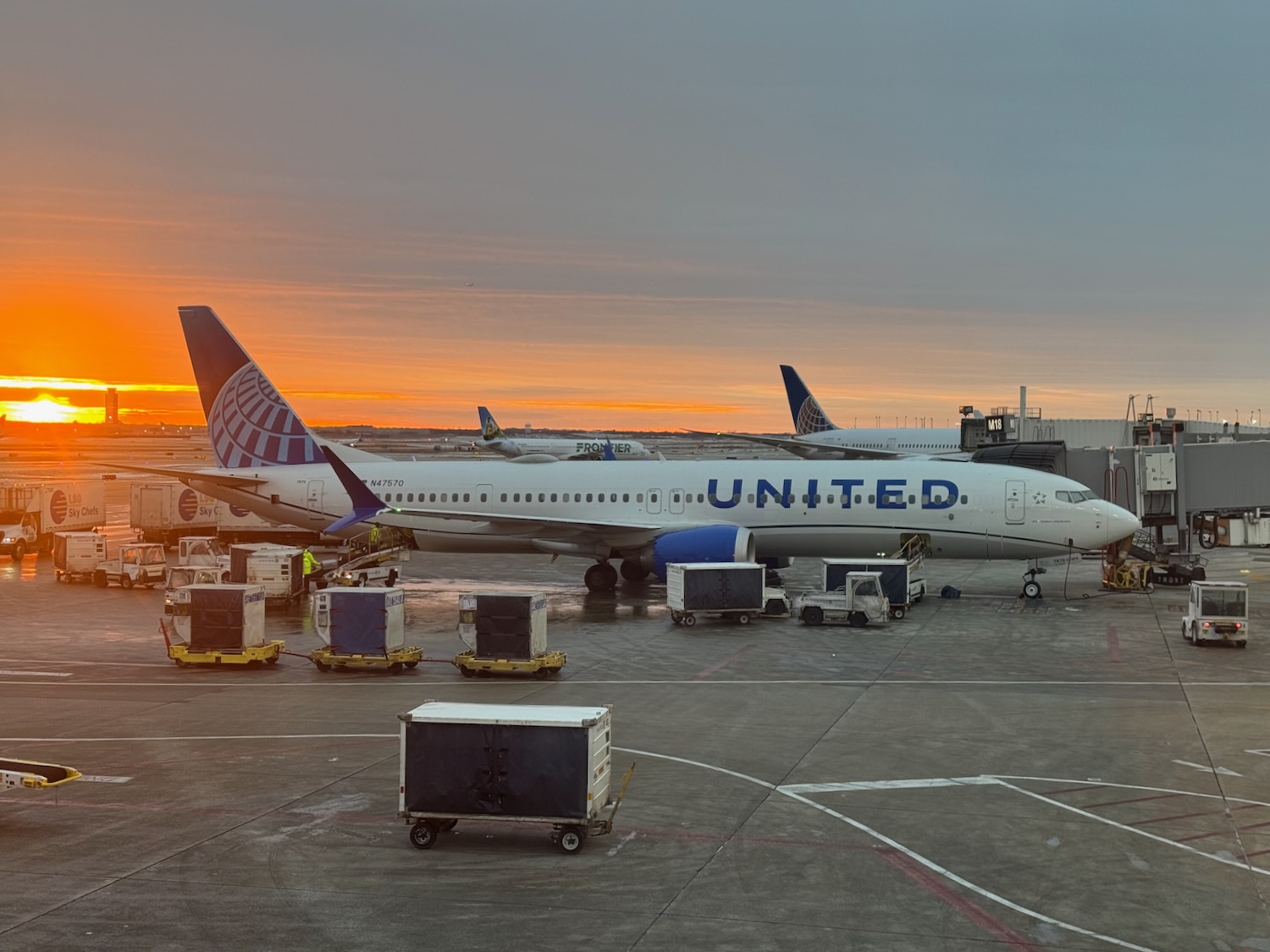
Just days after CEO Scott Kirby vowed to draw a “line in the sand” at Chicago O’Hare, United Airlines has unveiled what that line actually looks like.
United Responds To American With Record 750 Daily Flights At O’Hare
In a newly released summer schedule announcement, United confirmed it will operate up to 750 daily departures from Chicago O’Hare this summer, the largest schedule ever flown by any airline at ORD and roughly 200 more daily flights than American Airlines…at least for now.
As United sees it, this buildup is not a direct answer to AA’s renewed push in Chicago, but a continued evolution of its push to be the dominant carrier in the Windy City.
From Rhetoric To Action
On its recent earnings call, United CEO Scott Kirby warned that the airline would match capacity as needed to ensure it did not lose gate share at ORD. He pledged that United would not allow American to “win a single gate” at its expense.
This latest schedule expansion shows that United is prepared to back up that rhetoric with metal.
United says it will fly nonstop to 222 destinations from Chicago in 2026, including 47 international cities and 175 domestic destinations (and 38 more than American Airlines). Five newly-announced Midwest routes will launch this spring including:
- Bloomington/Normal (BMI) – starting May 7, 2026
- Champaign/Urbana (CMI) – starting April 30, 2026
- Kalamazoo (AZ) – starting April 30, 2026
- La Crosse (LSE) – starting May 7, 2026
- Lansing (LAN) – starting May 7, 2026
Each will operate four times daily using a Canadair regional jet.
These are not flashy long-haul additions. They are connective tissue routes – precisely the kind that strengthen hub economics and reinforce gate usage under Chicago’s allocation framework.
Even more importantly, more than 80 cities will receive additional flights to give passengers additional flight timing options from Chicago. United singled out destinations including:
- Boston (BOS)
- Dallas (DFW)
- Los Angeles (LAX)
- Nashville (BNA)
- San Francisco (SFO)
Not coincidentally, all are AA hubs or focus cities. To spread out these new flights, United will add earlier and later departures, including a new late evening departure bank.
A Gate Strategy Disguised As Growth
This move is not about growth, it is about gates.
Chicago’s gate allocation system rewards utilization. More flying strengthens the argument for retaining and expanding gate access. If American grows, United must grow. If United grows, it makes it harder for American to justify further expansion without triggering a capacity response.
As I see it, United doesn’t really want to grow, but it is doing so to prevent AA from wining back gates. United is effectively saying: if this becomes a volume contest, we are prepared to win it. During a press call outing these changes, Josh Earnest, United’s Executive Vice President of Communication, framed it as a way that United is “continuing to build and make investments that benefit our customers.”
The airline also emphasized operational dominance at ORD, noting it led major carriers in on-time arrivals in 2025 and that AA customers were nearly twice as likely to experience cancellations. Whether one accepts the competitive framing entirely or not, United clearly seeks to be both the bigger and the more reliable carrier in Chicago.

Premium And Infrastructure Muscle
Beyond sheer flight volume, United is highlighting its investments at ORD and beyond:
- Five United Club locations plus a redesigned Polaris Lounge
- More than 370 daily mainline departures this summer, a 20% increase year-over-year
- Free Starlink Wi-Fi rolling out across the fleet
- Connection Saver technology that reportedly saved one million connections in 2025
- Plans to hire approximately 2,500 additional employees at ORD
Here, United is signaling from another vein that it intends to deepen its structural advantage in Chicago, from connectivity to customer experience to workforce scale.
But don’t count AA out here. The carrier is also heavily investing in its premium product, running its new Flagship Suites in business class on its 787-9 from Chicago and recently introducing onboard upgrades like free Wi-Fi, Lavazza coffee in all cabins, and Champagne Bollinger Special Cuvée.
Can Both Airlines Win?
The obvious question is whether this becomes mutually assured margin destruction.
Of course United wants to create a fortress hub in Chicago by forcing AA to back down. But is the market too large for one carrier to dominate? Is the pie big enough for American and United, if both “divide and conquer” instead of trying to drive the other to retreat?
In Newark, United has argued that constrained gates protect yields. In Chicago, the strategy is the opposite: grow aggressively to protect scale and deter encroachment. These are diametrically different approaches.
United believes Chicago is a battle it can win over time. American clearly believes it can claw back relevance in a city it once dominated.
At this point, we will see. I asked Patrick Quayle, United’s SVP of Global Network Planning and Alliances, if the numbers Kirby cited–that AA lost $500 million at ORD last year while United made $500 million and that he expected AA to lose $1 billion at ORD this year–are defensible or just pulled out of thin air. Quayle was adamant that these numbers were not made up; that PRASM guidance demonstrates this and that AA’s rapid build-up this year with a short window between announcement and launch date will lead to even more bleeding on the scale Kirby predicted.
CONCLUSION
United’s announcement of a record 750 daily departures from O’Hare is a strategic counterpunch to American Airlines
Kirby drew a line in the sand. American stepped over it. Now United is pouring concrete…but now we will turn to AA, which will hold its own earnings call today, to see what comes next.
Quayle was quite clear: the schedule is “fluid” and subject to adjustment as needed.
For Chicago travelers, this beautiful battle means more flights, more competition, and potentially better fares in the near term. For United and American, it means an escalating capacity battle where neither side appears ready to blink. The biggest question is whether United’s confident bet that this growth will not erode profits is an erroneous or valid forecast?
Will this strategy strengthen United’s hold on Chicago, or does it risk turning ORD into a prolonged war of attrition? What will American announce today?





I was wondering if United was going to add a late bank. T1 gets pretty quiet after 8:30pm.
I will strive for the late banks now! ORD is bursting at the seams and there’s nothing worse than having a gate change to the other side of the airport…..
Other than on aviation blogs, does anyone even know or care about this so-called turf-war? Feels a bit manufactured.
The people flying to/from ord, hoping it might lead to cheaper prices?
Oh wait maybe it is just us lol
Given that UAL has around 90 assigned gates at Chicago, having 750 flights during summer peak travel dates means that each gate handle 8 flights. That’s fully utilization.
It will work only if there are enough ground crews to serve aircraft efficiently (e.g. refueling, cleaning, catering, etc.)
4X daily from AZO? That will be a doubling of the airport’s capacity.
CMI is the same story…AA flies 3x daily to ord and 2x to DFW so it’s going from 5x -> 9x daily. A lot of these airports have the capacity but have people driving or going on buses to nearby hubs rather than flying directly out
“More than enough is too much.”
How can you say “As I see it United doesn’t want to grow” when that is literally what the United Next strategy is all about? Do better with your research Matt Klint
I’m talking specifically about a fare war with AA in ORD…