
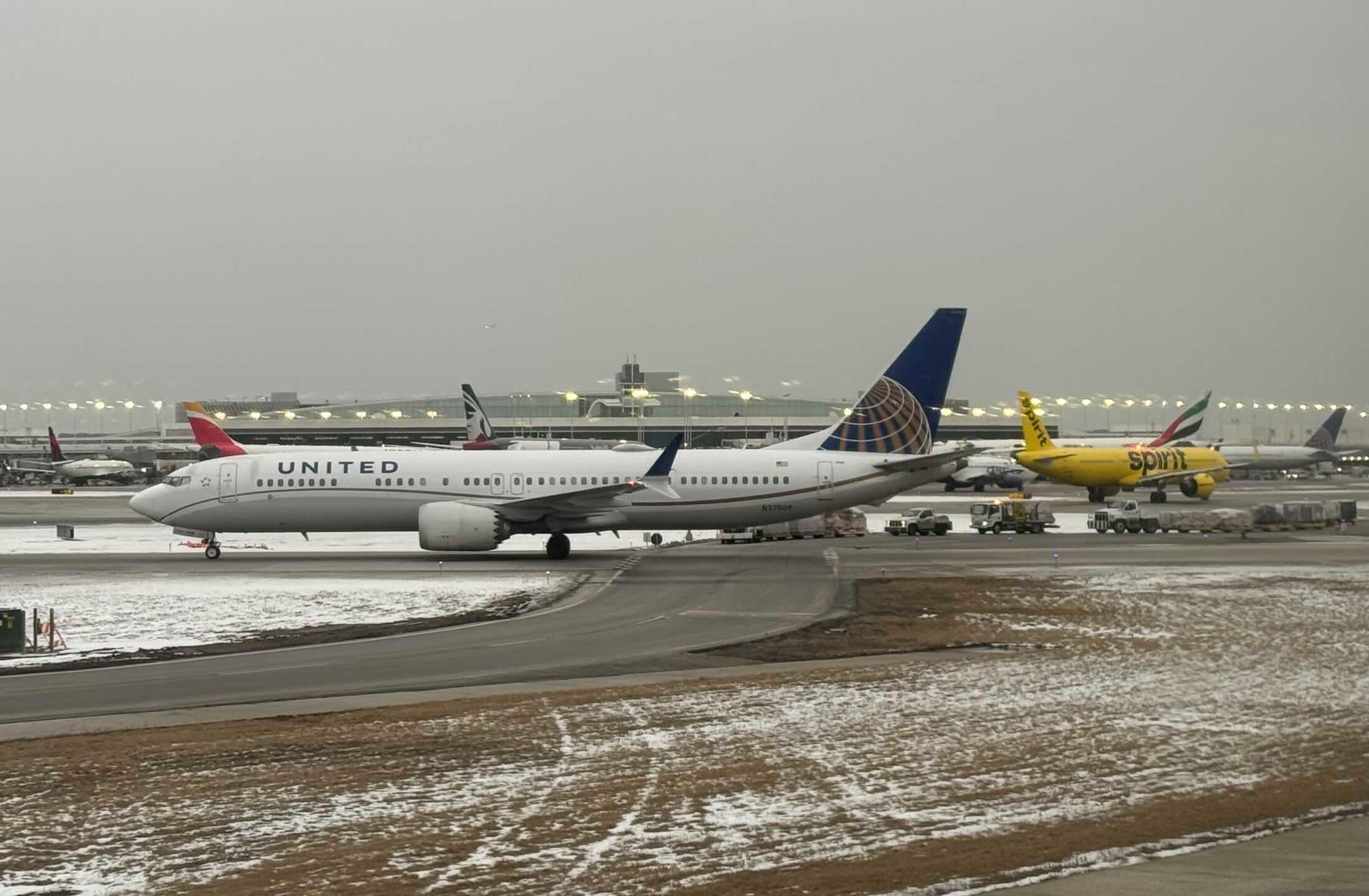
United Airlines has just raised the stakes in its Chicago O’Hare turf war with American Airlines by scooping up Spirit Airlines’ final two preferential use gates at ORD for about $30 million.
United Pays $30 Million For Spirit’s Final Two O’Hare Gates As Chicago Battle Intensifies
As noted by View From The Wing, United agreed to buy Spirit’s last two preferential use gates, G12 and G14, as part of Spirit’s ongoing Chapter 11 bankruptcy restructuring. If the bankruptcy court approves the transfer at a hearing scheduled later this month, those gates will shift directly into United’s portfolio, one permanently and one on a temporary basis.
Spirit had already sold two of its original four ORD gates to American for roughly $30 million in late 2025 and is now operating with a scaled down schedule at O’Hare using common use gates for its remaining departures. It will continue to serve Chicago after this transfer, but with even fewer flights than currently offered.
Chicago O’Hare has become one of the fiercest points of friction between United and American. United has explicitly framed its expansion at ORD as a strategic effort to defend its dominance in the market, publicly drawing a line in the sand and pledging to match American’s growth there.
> Read More: United Backs Up Its Chicago Threat With Record 750 Daily Flights At O’Hare
American, meanwhile, has fought back on multiple fronts, including purchasing gates from Spirit itself and pursuing legal challenges over gate allocations. It has pushed back against the narrative that it is ceding ground to United and has recently announced several new flights for 2026
> Read More: United Draws A Line In The Sand At O’Hare, But American Is Already Stepping Over It
Strategy Over Assets
The price tag for these gates is striking not just for the dollars involved, but because United CEO Scott Kirby had previously indicated that buying Spirit assets was not something the airline was interested in. That shift underscores how fierce, and perhaps how personal, the legacy battle has become at ORD. Access to gate space directly impacts schedule planning, connections, market share, and frequent flyer and co brand credit card revenue, which is a major profit center for both carriers (both carriers lose money flying).
In an internal memo to employees shared with Live And Let’s Fly, United’s Chicago VP Omar Idris explained the rationale:
Additionally, as part of Spirit Airlines’ bankruptcy process, United is in the process of acquiring two gates on the G concourse and support space in Terminal 2 from Spirit (this is subject to approval by the bankruptcy court). We expect to begin operating from these gates late in the second quarter. One of the gates will return to the CDA for reallocation at the end of September, and the other will remain with us longer term.
These gates fit squarely into our long-term strategy by giving us the flexibility we need to keep growing responsibly and to continue building an operation that reflects the leadership position United holds in this city.
Let me reiterate what Scott and others have said about what this means for us. Our focus remains simple: having the right number of gates to run the operation our customers deserve. Nothing more, nothing less.
We are not looking to gain gates at the expense of competitors. We’re continuing to make smart, forward-looking investments that benefit our customers and support the work you do every day.
Maintaining access to the gates we need is part of that and it ensures we can continue offering the reliable, high-quality service Chicago travelers expect from us.
Forgive my cynicism, but allow me to translate: United will aggressively try to squeeze out competition so that they are forced to retreat and it can then raise airfare as the dominant carrier at ORD.
If the transfer goes through:
- United will consolidate even more control over O’Hare’s gate footprint.
- American will face pressure to respond in a game that it is unlikely to win (not that United necessarily will either)
- Spirit’s presence at ORD will be further diminished even as it attempts to maintain flights using common use space.
It’s that final point that strikes me as the saddest. For example, Spirit flies between Los Angeles and Chicago nonstop, keeping pressure on American Airlines and Untied Airlines (so does Frontier and Delta Air Lines will also start service this year). If Spirit abandons the ORD-LAX route, not only does United gain with the two new gates, but it gains in the long-term by driving out a pesky competitor on one of its bread-and-butter hub-to-hub routes.
CONCLUSION
United’s acquisition of Spirit’s final two ORD gates for roughly $30 million is yet another calculated escalation in its turf war with American Airlines in what has become the fiercest hub battle in the USA.
By securing additional infrastructure and asserting capacity, United is further staking its claim in Chicago…let’s see what AA comes up with next.



This is how United closes the gap with Delta on margins. Look at nonstop pricing from Delta hubs and assume that’s the world we’re heading toward without Spirit.
Airfares will look a lot more like they did in 2010 with very high nonstop pricing out of hubs.
As a United hub captive in SFO with family in Chicago, it makes me proud to see United have a strategy and compete and win against American. However, it makes me sad to see United behave like a bully kicking out its competition to raise prices. And by sad, I mean sad for my wallet
You “translate” that what UA is saying is that the move to acquire gates and push AA out is so UA can raise fares.
Well, duh…
The whole point of a publicly traded corporation is to maximize shareholders’ value. This needs no “translation”. If a company can move to limit supply and thus raise prices, good for it. If it can, then it appears the market has not reached the point of inelasticity.
50% of ORD boardings are local and those markets are highly competitive. In fact flights to AA’s hubs are overrepresented in that top 20 and would continue to be just as busy if AA de-hubbed ORD.
The places that are the issue are the Daytons and Saginaws and Syracuses. They are the places that peaked out economically and in population 20, 30, 40 years ago and are now served by regional jets. It’s these routes that are the places where UA would like to see AA de-hub. Instead of 8 DAYORD flights split between UA and AA with RJ’s, UA would like to see 4 UA 737’s. DAY would continue to be served by AA to PHL, DCA, CLT, and DFW.
So, yeah. The people traveling DAY-ORD might see higher local fares. And the people who flew DAY-ORD-CID on AA will now only have UA, but those markets will be pretty limited as the people in DAY will still have DL through both DTW and MSP to connect to other points in the rust belt.
But the fundamental issue is that if AA is indeed losing money, a lot of money, from their ORD hub, then the stockholders are subsidizing the tickets of the people in DAY or CID and that is not the problem or responsibility of the stockholders.
I’m sorry, but this was the same shortsighted, terrible strategy that got AA into this mess. Everybody knows that airlines make money from their credit card spend, especially in high spend markets like NYC, Chicago, and LAX. I seriously doubt AA’s position in Chicago is as bad as you and Kirby say, otherwise they wouldn’t choose to defend it. Looking at the margin from flying alone ignores that card spend is highest in the most competitive markets as noted above. If AA dehubs they may stem some losses from operations, but they give up their last foothold in big market CC spend and their last chance at relevance.
I’m grateful that even a former United homer like Matt can see what should be obvious to everyone – if United successfully drives American out of Chicago or diminishes them any more than they already have, it will be bad for Chicagoans. We will see the same sky high airfare and diminished quality that Atlantans do.
It makes sense that local government is antsy about wanting to stave off Kirby’s threats to move to Denver, but I am hoping that the courts at least take the obvious position that the reallocation process stole American’s gates and United’s departures from them during this period shouldn’t be counted in the next reallocation.
Kirby is a creep – you have to try really really hard to make Isom and AA look less reptilian but he’s done it.
Good job United–keeep it up
Naturally, UA never leaves anything to chance in the face of the growing AA threat in ORD.
AA should counter offer at $45M
And give up half of its 2025 profit? Amazing that two gates would be worth all that hard work to turn $54 billion into $101 million only to give half of it away in a three hub market?
I continue to resist the urge to think this is a bigger deal than it really is. Very inside baseball.
A. Both Mayor Brandon Johnson and Gov. J.B. Pritzker are worried that UA will move HQ to Denver. UA has purchased land adjacent to DEN that is nicely sized for an HQ campus. Running AA out of ORD would blunt the bad PR that will result from the HQ move. If, or some say when, HQ moves, UA will no longer be Chicago’s hometown airline.
B. Remember that Scott Kirby was fired by AA’s board of directors for asking repeatedly when Doug Parker would retire or relinquish the CEO title. So, beating guy, Isom, who has the job you felt should have been yours is the ultimate revenge.
C. So, if AA de-hubs ORD, it becomes a mess for UA. Imagine connecting between Concourse C in Terminal 1 and Concourse H or K, or worse, L in Terminal 3. If a passenger arrives at the north end of Concourse C and connects to Gate G14, that is a very, very long walk.
D. UA is still negotiating a new contract with its F/As. They turned down the contract that AA’s F/As approved. It could be that Kirby is simply mad that UA’s labor costs for its F/As will be higher than AA’s, blurting some of the profit advantage UA has.
I’ll say this. My home airport is ORD. I have Lifetime Gold status with AAdvantage. My wife is about to move up from Platinum to Platinum Pro. If AA de-hubs ORD, we’ll connect at DFW, CLT, PHL, etc. before I set foot on a United aircraft.
Neither of A or C is happening. You spend too much time on airliners.net
Agreed…. Meanwhile, the infamous Global Terminal that AA and UA desperately need with real “new gates” won’t be around for another decade. Even then, someone from Oneworld, AA, or Alaska will still want to use the new International gates that will arrive….
Why pay $30.2 million only to give back 1 of the 2 gates to CDA for reallocation in October 2026?
AA was also bidding on these gates. If UA didnt get them, AA would have. It probably would have been better for customers if AA got them, but I see why UA wanted them
UA probably also needed these gates to support all the new flights they just added.