
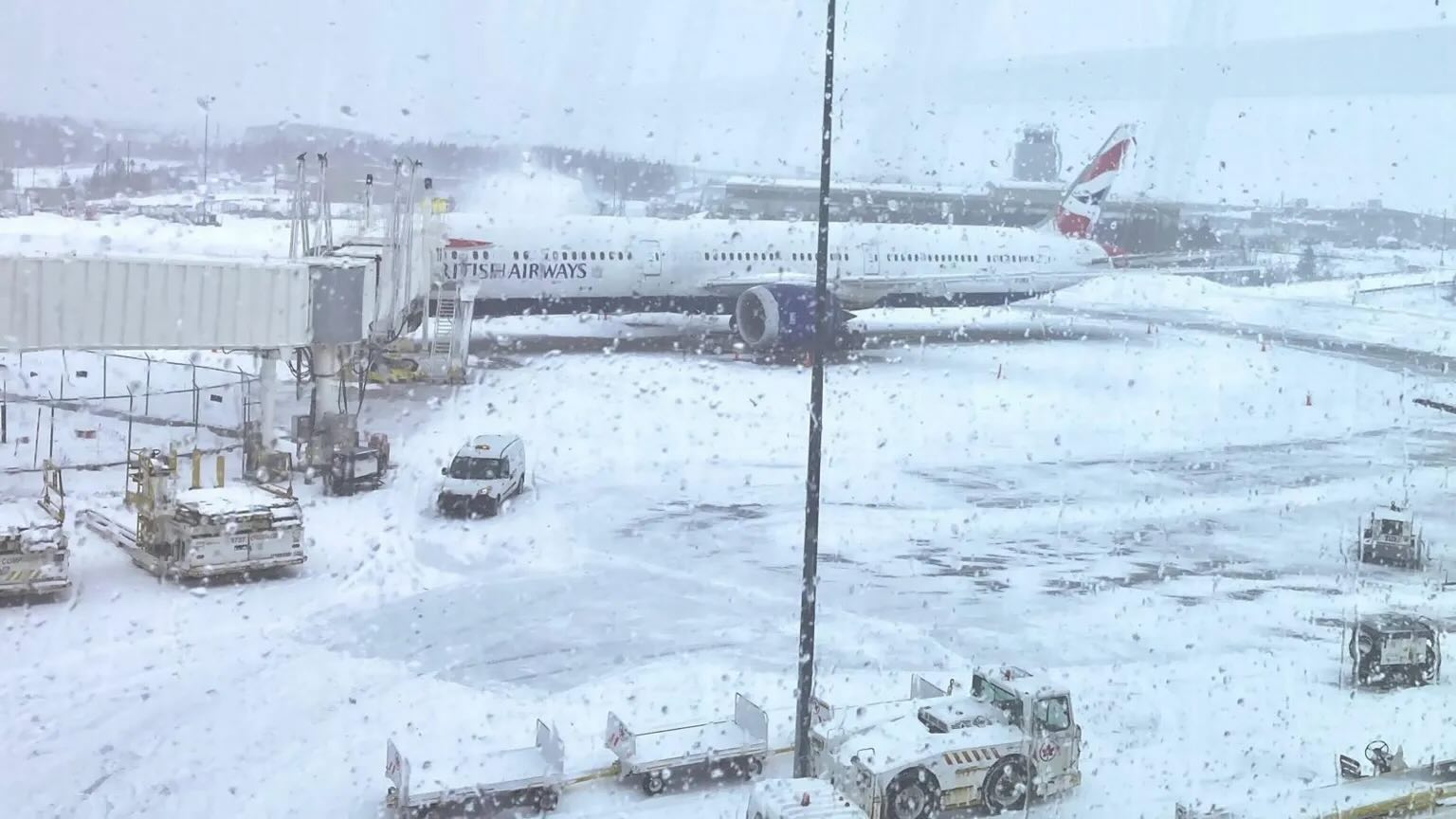
British Airways passengers endured a miserable two-day ordeal after a longhaul flight diverted to Canada, but was it incompetence or simply a string of misfortunate occurrences beyond BA’s control?
British Airways Strands Passengers For Two Days In Canada—Bad Luck Or Bad Management?
British Airways flight 195 from London (LHR) to Houston (IAH) was forced to divert to St. John’s, Newfoundland Newfoundland and Labrador (YYT) after a medical emergency onboard on March 31, 2026. The Boeing 787-10 landed at St. John’s International Airport at 11:32 am local time (Newfoundland Daylight Time, which is GMT-2:30), a journey of just under six hours from London.
After landing, the sick passenger was removed while the remaining passengers sat onboard for roughly three hours before being told there was a technical issue with the aircraft (it also appears that the crew may have exceeded it maximum duty time). Eventually, passengers were deplaned, sent through immigration, and assigned hotels without access to their checked luggage.
Temperatures hovered well below freezing (14ºF/-10ºC) and passengers were left with only the clothes on their back. Communication from British Airways was poor. Passengers reported back to the airport the next day only to learn they were returning to London, not continue to Houston.
But the flight was again cancelled and they were sent back to their hotels…
Two days after the diversion, the flight finally continued to Houston.
British Airways later apologized and offered a £500 electronic voucher to each passenger (it isn’t clear if UK261 would apply since it was a medical issue onboard which prompted the initial delay).
A String Of “Bad Luck”
It is true that the diversion itself was beyond British Airways’ control. Certain medical emergencies create a non-negotiable reason to land. No airline is going to continue across the Atlantic with a seriously ill passenger onboard if, in consultation with doctors and flight operations, it is deemed preferable to divert in order to provide medical care.
Furthermore, St. John’s is not Heathrow or even Houston. It is a relatively small airport on the eastern edge of Canada, with limited resources, especially for widebody diversions.
The root or even nature of the technical issue is not clear, but such problems are not unique to British Airways. When a longhaul jet develops a mechanical problem in an outstation, especially one without a major maintenance base, delays can quickly stretch into days.
Put those together and it becomes clear why it took two day to finally reach Houston. But I’m not absolving BA of blame.
Where British Airways Fell Short
Many passengers have come forward and shared their stories, always in anger, but the disruption alone does not explain the anger. The recurring theme from passengers was not the diversion or even the delay. It was the lack of communication and support from British Airways.
Passengers were reportedly left scrambling for basic information about their flight and luggage.
That is where airlines make or break these situations.
Irregular operations are inevitable. Poor communication is not. Simple, clear, and consistent updates can dramatically change how passengers perceive a disruption. Instead, this appears to be a case of poor communication that understandably created resentment.
I understand that when something goes wrong far from a major hub, the system has very little slack. But you have to communicate…and do so frequently.
CONCLUSION
British Airways did not create the initial problem, but it certainly appeared to make it worse by failing to properly communicate.
In aviation, irregular operations happen. What separates a good response from a bad one is the communication over it. Here, it seems to me as if British Airways turned a difficult situation into an unnecessarily miserable one.
image: Jon Shipman (passenger onboard)





An airline that for years has cut services and resources to the bone as a matter of policy will always encounter major problems when away from base and often enough at the base. Best Avoided is such an airline and is 100% responsible for the situation they created in this instance.
Nor sure it was poor communication. They were told about the medical diversion. When the plane had mechanical issue a repair was attempted and failed. These things could not have been predicted. They did however arrive at their destination . It was a string of terrible luck with a rather cheap attempt to reimburse that has caused the anger.
Ok, so is UK261 gonna help them here? If the airline is at-fault, there should be compensation, in addition to rebooking or partial refund. Even if medical was the initial cause; mechanical thereafter should be the basis, because that is within the airlines’ control. And, since the flight originated in UK, thankfully, their consumer protections should apply, because if it was from the US, passengers would be out of luck, because we hate consumers in the USA.
As I speculated, I think BA has a pretty good argument to wiggle out of UK261.
Delta took 24 hours to get a 777’s worth of folks off Ascension Island in 2013. Can’t help what happened to the original plane, but canceling any flight ex-LHR and sending a rescue aircraft has to be the priority then and that does NOT take 2 days…
(YYT is absolutely lovely tho even in winter I wouldn’t mind a visit, but yea if you’re clothed for only Houston it’ll be rough)
Unfortunately, very few passengers understand their air passenger rights, and the concept of “extraordinary circumstances” is often misunderstood.
Here’s the truth:
Even in the event of extraordinary circumstances, the airline must transport passengers to their destination as quickly as possible (as long as there are reasonable alternatives).
In this case, BA should have rebooked the passenger on an American Airlines flight to Houston via Toronto.
Alternatively: Book the flight yourself and then claim compensation plus the cost of the ticket.
When it rains, it pours. And when it snows… it really snows!
In almost every aspect of daily life, “bad luck” is always ready to strike. But are all airlines prepared to find rational solutions to these blows? That’s where the mystery lies!
Another more than sufficient reason to travel with carry-ons.
Paging Tim Dunn’s BA alter ego.