
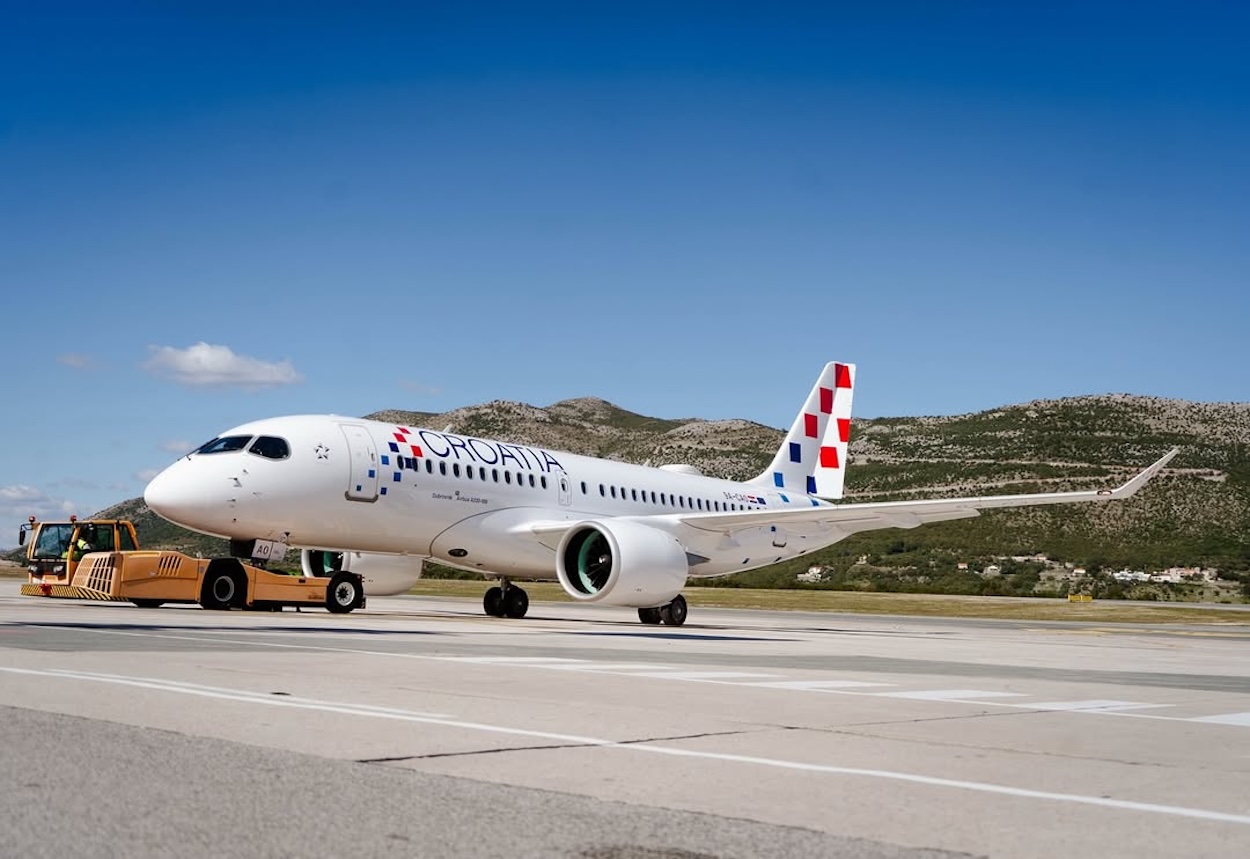
Croatia Airlines is swapping out its aging fleet for shiny new Airbus A220s, but it is trying to do so while the business itself remains stubbornly unprofitable.
Croatia Airlines Bets On The A220, But I Don’t See A Path Forward Without Subsidies
Croatia Airlines is in the middle of a long overdue fleet renewal: replacing a mixed, aging fleet with a standardized Airbus A220 operation. In theory, that is exactly what a small national carrier should do. A single fleet type brings simpler training, better scheduling flexibility, lower maintenance complexity, and a more consistent passenger experience. The A220 is also a good aircraft for Europe: efficient, quiet, and sized for thinner regional routes where an A320 can be too large.
In practice, however, fleet renewal does not magically fix unit economics. And right now, Croatia Airlines is staring at the same dilemma that consumed Malev, CSA, and Adria: a small home market, brutal low cost competition, and a network that is highly seasonal and tourism dependent.
Croatia Airlines Is Modernizing With A220s
The core of the plan is straightforward. Croatia Airlines is introducing Airbus A220 aircraft and intends to phase out older Airbus A319/A320 jets and Q400 turboprops over time. The operational logic is hard to argue with. The A220 should deliver lower fuel burn per seat, modern reliability, and less variability across the fleet.
For passengers, it is also a tangible improvement. A refreshed cabin, comfortable 3-2 seating, and Wi-Fi with USB-A and USB-C power onboard matters in a region where travelers have increasingly gravitated to low cost carriers, which offer no such amenities.
But none of that answers the more pressing question: can Croatia Airlines actually make money flying these planes?
The Real Problem Is Not The Fleet
Despite generous subsidies from the national government, Croatia Airlines has lost more money in 2025 than in 2024 (€21m in the first three quarters of 2025, which is more than twice the figure for the same period in 2024). If your underlying market is structurally tough, a better aircraft is necessary but not sufficient.
Croatia Airlines sits in an over-supplied European short-haul arena where ultra low cost carriers have trained consumers to expect rock-bottom pricing, while legacy carriers and their hubs offer far greater connectivity. Croatia is also a country where demand spikes hard in summer and softens dramatically in winter, creating an awkward mismatch between fleet utilization and revenue stability.
That seasonality is not unique, but it is particularly punishing for a small carrier with limited scale. When the winter lull hits, you either park aircraft, lease them out, or fly marginal routes at weak yields just to keep the planes moving. None of those options is great, and all of them become even more difficult when you are financing new aircraft deliveries.
And unlike a Ryanair or Wizz Air, Croatia Airlines does not have the structural advantage of scale, unit cost discipline, or the ability to redeploy aircraft across dozens of bases with ease.
Can It Avoid The Fate Of Malev, CSA, And Adria?
I keep thinking about the graves of neighboring flag carriers. We have seen this before in Central and Eastern Europe:
- Malev could not survive once the financial support structure collapsed and competitors filled the void.
- CSA slowly withered as the market moved on and the airline never regained relevance.
- Adria tried and failed to reinvent itself, and ultimately collapsed
The common thread was not simply “bad management,” though that often played a role. The larger issue was that each carrier faced the same harsh reality: small markets are unforgiving when low cost competition, hub connectivity, and seasonality all collide.
Croatia Airlines is trying to solve one part of that equation with the A220, and again, I think that is a good move. But modernization does not guarantee competitiveness if the airline is still stuck with thin margins, limited pricing power, and a cost structure that cannot keep up with the LCC playbook.
Is There Sufficient Demand In A Crowded Market?
Croatia’s inbound tourism is real, and it is strong, especially during peak season. The problem is that the most lucrative parts of that demand are already contested, and often won, by carriers that can undercut pricing or offer superior connectivity:
- Low cost carriers push huge volumes of point-to-point leisure traffic to the Adriatic coast
- Network carriers funnel connecting traffic through hubs, capturing higher yield passengers and corporate demand
That leaves Croatia Airlines trying to defend a shrinking middle ground.
You can see why the carrier ends up relying heavily on domestic flying and public service style connectivity, but even there it appears that demand is limited (So limited that the carrier is socnisdering wet-leasing smaller aircraft for these domestic routes after it retires its Q400 fleet, because an A220 is just too big).
Subsidies Will Remain Essential
If Croatia Airlines is expected to serve domestic and regional links that private airlines would not operate at sustainable fares, then the airline is performing a public good. But public goods usually require public funding, as we’ve seen over the last few years. If the goal is national connectivity, year-round service, and maintaining an airline presence for strategic reasons, then government support is understandable, but will become a cornerstone of the business model.
That is why I think the honest question is not “can Croatia Airlines survive without subsidies?” but rather, “does Croatia want an airline enough to subsidize it long-term?” Because if the answer is yes, the path forward exists. If the answer is no, then the A220 becomes pointless…
CONCLUSION
Croatia Airlines’ A220 fleet renewal is sensible and overdue. Standardization and efficiency matter, and the A220 is an excellent tool for the kind of flying Croatia Airlines does.
But tools do not fix economics on their own. In an over-saturated European market, with extreme seasonality and fierce low cost competition, I do not see a viable path forward that does not involve continued government support.
Maybe that is fine. Many countries decide that connectivity is worth paying for. But let’s not kid ourselves that the new A220 fleet will fix the problems Croatia Airlines continues to face.
As a Star Alliance member and flag carrier of one of Europe’s most beautiful nations, I’m rooting for Croatia Airlines…but it’s a tough market indeed.
image: Croatia Airlines






I guess being part of Star Alliance isn’t benefitting them that much these days?
The E195-E2 would have been a superior choice, but I guess maintenance for Franco-Canadian Spaghetti-Os is closer.
E2 or a220 are excellent choices for all regional flights and carriers, especially for the passenger experience as each has at least a set of 2 in its configuration, which is ideal for couples, and for avoiding middle seats. I wish more US carriers had them (only B6 and DL have a220 so far).
The story of CSA is a bit more complicated than that. Smartwings somehow managed to amalgamate it into a hybrid between LCC, charter airline and network carrier (they sell connections, unlike Wizz and co.) and it looks like they’ve managed to find a buyer for it in Pegasus. Having said that, it’s probably going to be harder for OU as Zagreb isn’t the country’s top tourist destination and BEG is receiving a fair bit of investment as a hub.
OTOH, Croatia Airlines, being an EU airline, could theoretically fly between any airport within the union. Croatia Airlines isn’t necessarily beholden only to serve Croatia, although I admit it’d be a tall order for such a small airline to compete in Europe’s brutal aviation market. I guess consolidation is the way forward for the European aviation market, being folded into those major airline holding corporations would be a solution for those small, niche airlines who can’t compete on price or service level.
Could follow the play book of AirBaltic via charter and wet lease work in the winter.
Also, could look to an alliance with one of the Euro Big Three (Luft, IAG, or AF-KLM).
Look for other small Euro airlines to follow this path like AirBaltic.
Post written by Chat GPT?
Like I said, if ChatGPT or some other AI tool can do this for me, do send me an email. I think AI sucks. I’ve tried to use it for headline construction and find it constantly annoying.
How did you miss making the point that Pegasus is buying them?
About CSA? Sorry, I was making a reference about a flag carrier faltering…this wasn’t a story about CSA.
You are correct. I confused CSA with Croatia.
Do you have any numbers to back up your conclusion on Croatia? I’m not suggesting you are wrong, but your conclusion appears to be based on speculation.
I linked to my sources for its losses increasing in 2025 versus 2024…I really want to see the carrier succeed, but I don’t see the business case for it.
Surely at some point we’re going to see the Big 3 start operating more hubs. If AA can make CLT, a city that nobody cares about, become profitable, there’s no reason a ZAG/LJU/ATH/WAW hub couldn’t work in the East. Under the single market, there’s no reason IB or AF can’t open a base in any other EU country.
LH group has pretty good coverage, IAG and AFKL are really missing connectivity East.
They’re not interested in that – there’s hardly anywhere in Europe that’s more than a couple of hours away from MUC/ZRH, and LCCs have killed yields.
You don’t think IAG would be interested in having a base somewhere east or Southeast with a much lower cost of labor that could serve as extra connecting feed for LHR/MAD?
IAG couldn’t even sustain the MAD-BHX route (could anyone imagine KLM not flying into Lyon, or LX into DUS?), are about to get rid of the Aer Lingus hub at MAN, and have outsourced most of their Asia/Africa flying to QR…so I don’t think they would be willing and/or able to develop a hub in the Balkans.
Croatia need to break free of any links to Lufthansa including stopping use of Miles & Less as a programme, it doesn’t allow them to reward loyalty in the way they may wish to to differentiate from low costs. Aegean have done this very well and manage a solid year round operation, obviously very busy in summer but also busy in winter providing full service on all routes in both classes at fair prices. As a consequence O’Liary Airways has little hold in Greece and the same could happen in Croatia – a not dissimilar place made up of very moutaineous territory where flying is often the only sensible way of getting anywhere.
There was also talk of Croatia forming an alliance with Aegean but nothing seems to have happened. In any event, the southern European *A carriers would be better off working together around the huge operation of Turkish than aligning themselves more closely to Lufthansa and having to follow orders or be marginalised – as SAS were and that didn’t end well for *A as we all know. It’s a pity ITA are now part of the LH group because TP, AZ, A3, OU and TK would have made an excellent operation between them covering all of southern Europe.
The problem with Turkish is that there are ownership restrictions. I’m hoping that LOT can become an alternative to the big 3.
Although Aegean do have ambitions of becoming a larger airline, they withdrew from their ventures/proposals to invest in Animawings as well as Croatia, although there might be some scope to expand in the Iberian peninsula through closer alignment with Volotea where they’ve got a 21% stake.