
Delta Air Lines has reported its 2026 first quarter earnings, offering an early look at how U.S. airlines are navigating rising costs, geopolitical uncertainty, and still-strong travel demand. As expected, it was a strong quarter for Delta, but the future is anything but certain.
Delta Air Lines Reports Strong 2026 Q1 Earnings, But Rising Costs And Operational Issues Loom
Delta Air Lines has kicked off airline earnings season with a strong first quarter. For Q1 2026, Delta reported revenue of $14.2 billion and earnings per share of $0.64, both of which slightly beat Wall Street expectations. Demand remains robust, particularly in premium cabins and on international routes, continuing a trend we’ve seen for several quarters.
But there’s more going on than a strong quarter. The concern is not the quarter that just ended, which largely occurred before the Iran War began, but what comes next. Delta’s forward guidance disappointed investors, with second quarter earnings projected below expectations as costs begin to rise and operational pressures mount.
Yet with the Q2 guidance between $1 to $1.50 per share (compared to $1.41 analysts were predicting) Delta has a lot of room to maneuver. If the ceasefire holds and oil prices retreat, Delta may in a position to reach the upper end of its guidance…it’s just too early to tell.
Fuel Prices And Costs Are Back In Focus
The biggest variable is, of course, fuel.
Delta reiterated what we have all seen: that jet fuel prices have surged sharply, driven by geopolitical tensions. That translates into an expected $2 billion in additional cost, even after accounting for Delta’s Pennsylvania refinery operations, which uniquely help Delta offset some of the pain compared to other U.S. carriers.
Airlines have always been at the mercy of fuel prices, but this is a reminder of just how quickly profits can be squeezed. In response, Delta is slashing flights, with CEO Ed Bastian saying Delta will “meaningfully reduce” capacity in the second quarter. Chief Commercial Officer Joe Esposito explained:
“We’re targeting capacity in off peak times: Edge of day, redeye flying. Those markets will be under the most amount of pressure.”
Even in the face of rising airfare, demands remains strong. In fact, Bastian said it remains stronger than ever:
The airline is predicting continued revenue growth, particularly in premium cabins. In fact, Delta said the premium cabin customer is showing no signs of cutting back and while corporate travel fell a bit during the partial government shutdown, it has quickly rebounded now that TSA lines are back to normal.
But Delta also acknowledged something that should not be overlooked: operational challenges. Management pointed to reliability and recovery issues, exacerbated by weather disruptions and changes tied to its pilot contract. Delta COO Dan Janki said:
“We don’t have the resilience that we’re known for. We expect to make progress as we fly through the summer and through the back half of the year.”
So in short, demand is strong, particularly in premium cabins. Delta had a profitable Q1. But costs are rising, operations are under pressure, and the industry remains highly sensitive to external shocks.
Delta is arguably the best-positioned U.S. carrier to handle the current environment, thanks to its strong balance sheet and its own oil refinery, but even Delta may face headwinds due to geopolitical events beyond its control.
CONCLUSION
Delta’s Q1 results confirm that the airline industry remains in a relatively strong position, at least for now.
But higher fuel costs, operational challenges, and broader economic uncertainty are all creeping back into the picture. And while demand remains resilient, that alone may not be enough to offset everything else if Delta reaches a ceiling in which it cannot raise fares beyond.
If this is the “best case” airline right now, it tells you a lot about where the rest of the industry may be headed as we await for others to report Q1 earnings…
image: Delta





@ Matthew — Didn’t you hear the news? The war is over. The Strait of Hormuz is now open for business, and oil will be back at $60-$65 in a few days. Comrade, don’t you watch Fox State News Network?
LOL. We will see, especially as Israel barrages Lebanon…
3.6 roentgen… not great, not terrible…
Oil is already down to $75, genius.
Nah, already back up to $92, and could swing wildly up further, since the ceasefire didn’t last. The uncertainty is toxic for everyone. You cannot sane-wash this unmitigated disaster.
A wise decision from Ed Bastian & Co.
Gene,
multiple sources including Fox say that Iran is ticked about Israel’s attacks on Lebanon so the Strait is not holding.
and, specific to the topic here, DL saved about $300 million because of the refinery in the 1st quarter but the benefit will be in the 2nd quarter and beyond. Matthew is correct that fuel is an issue and no one, including DL execs on the call, said that they expect fuel costs to come down quickly because supplies are so out of balance in most of the world.
DL said demand is strong but there are indications that some demand has booked ahead because of the expectation of higher fares.
DL is cutting capacity from about 3.4% growth to flat.
DL’s losses were actually due to accounting adjustments related to its ownership stakes in multiple airlines. It is not a surprise that global airline stocks have been hit hard since the war.
DL made an operating profit and is seeing strong Amex and MRO revenue due to engine maintenance for other airlines.
DL’s CEO also said that they expect consolidation to happen as a result of high fuel prices. As has been true since covid, most of the industry does not cover its cost of capital; throw in high fuel and losses that will result where profits were expected and DL indicated they are ready to participate in consolidation.
notably, UA pushed back its earnings which are typically a week after DL’s to 2 weeks after – about the same time as AA’s. I doubt that UA has great news if they are now going to report in the middle of the rest of the industry.
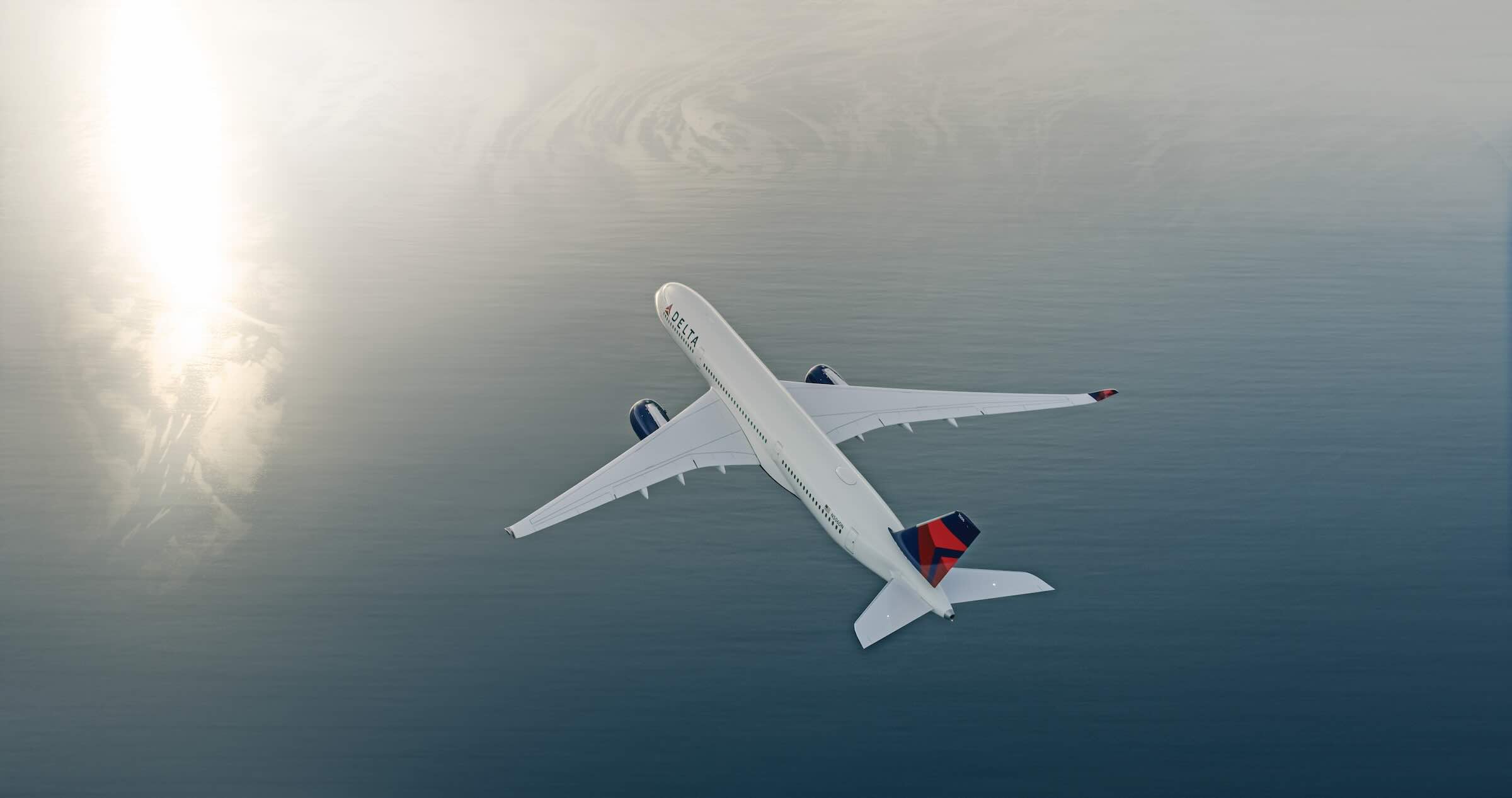
A nice, well-chosen photo of a gliding DL jetliner for the article.
In the meantime, let’s add that U.S. air travel continues to grow steadily. There are currently no signs of demand fatigue; air travel remains one of the most resilient consumer categories.
‘Accounting adjustments’? Airlines are bad investments to the tune of a -$550m. DAL Q1 2026 net loss of $289m, but OCF/Capex/FCF: $2.4b/$1.2b/$1.2b.
I love Tim sometimes,
Every time you bring up earnings timing’s you’re always so wrong and it just reminds me about how little we should listen to you. Remember when you said Delta would announce its 787 order because of its fake 100th anniversary celebration being near its earnings? Lol
Now because United is announcing its Q1 results on April 21 (just for reference the last 3 years have been April 16, 18 and 20) you think they are going to do a bad print? First you say its usually a week to 2 weeks after… April 21 is within 2 weeks of April 8. Second – with so much market volatility it is entirely fair to take longer to produce results – they may be trying to see what they can do to maintain some sort of guidance unlike Delta who just withdrew theirs completely.
Also Glad you called out the terrible investments Delta has made in failing airlines – losses are losses they still destroyed shareholder value
thank you for confirming that you absolutely fear the earnings cycle from here on out.
Those same mark to market adjustments that DL took for lower equity investments have helped boost DL’s earnings in other quarters.
You simply prove once again that you and a bunch of other UA fans are just petulant children that want to find whatever piece of news you can to try to defame the messenger because you can’t stand the message.
DL said it is recapturing about 40-50% of the increased fuel cost through fare and fee increases – and DL’s fuel costs are going up less than other carriers including UAL.
DL’s earnings have been halved for the 1st and for guidance for the 2nd quarter. Add in increased labor costs and UA could be at low single digit margins of profitability – for the year.
and all of that free cash flow that you and others have talked about? UA’s capex for this year could be close to $10 billion. DL said its free cash flow would be reduced – to no surprise on lower earnings; UA could well be adding debt by the end of the year.
Probably the rest of the industry will not be profitable. UA might be just above profitable levels at current fuel prices.
UA will be perhaps in the 3rd place behind DL and WN in being able to lead consolidation if it happens. DL seems ready to jump in; the DOT Sec’y seems ready to let it happen.
UA has no choice but to cut a bunch of capacity because it won’t be profitable; UA just is in the position of having scores of new airplanes coming in that it thought it could use for growth.
The only consolation is that AA was planning even more capacity growth and they will have to pull down as much if not more than UA.
All the mud throwing you do doesn’t change the fact that I said for years that UA’s super aggressive growth could fall apart if everything didn’t line up exactly right. Up to $11 billion more in fuel expense this year is not exactly “lined up right” when UA might capture 1/3 to 40% of it in higher revenue.
Sometimes, the better part of valor is simply to say “you were right” rather than argue and try to defame someone who really was right
Tim, you keep repeating the line about United’s fuel expense going up $11B this year. How can you not get it that Kirby was just doing the math IF oil climbed to $175 per barrel (which it didn’t) and IF it stayed there for the year (which it doesn’t appear likely at all)… and even IF oil climbed that much, ALL of the airlines have to buy fuel based on those prices, even Delta.
If oil goes up that much and stays there, it will affect even mighty Delta – and a small refinery that produces $300M in savings (your numbers) for every $2.742 Billion spent on fuel (from the 1Q26 results) cannot keep Delta’s fuel expenses from going up similarly.
But, again – you seem to incorrectly think United said their costs ARE going up that much – when those numbers were just a math lesson instead to offer perspective.
You really cannot be that dense, but then again – your posts in the past offer evidence to the contrary.
Feel free now to rant about something unrelated, like growth plans (oh- wait! Delta is scaling back theirs too…can’t pick that one) – maybe baggage mishandling, or 777 ETOPS, or whatever fuels your UDS lately.
Michael
why is it so hard for you to grasp that, even if UA’s fuel cost goes up $5 billion and they are only able to recover 40-50% of it through fare increases that UA and similarly sized AA face a much larger increase in costs than DL does with the refinery?
and jet fuel is near $5/gallon; the actual cost of crude is not the problem. The jet fuel crack spread is.
No other airline except for DL has any protection at all for the crack spread.
Jet fuel is well over $200/bbl right now.
Let’s wait until UA reports but you and others keep clinging to the HOPE – and it is only hope – that this isn’t devastating to every other US airline.
DL was already the most profitable; UA layers on higher labor costs and will, with AS, have much higher fuel costs than the rest of the industry because of UA and AS’ strong west coast presence where fuel is higher.
and the $300 million is not chump change – and the refinery benefit increases in the 2nd quarter.
and DL’s refinery provides 75% of DL’s jet fuel directly or via product swaps. That is not a small refinery for any big 3 airline.
You really can’t accept reality – but that is par for the course for UA fans.
and, yes, AA and UA had much higher growth plans than DL. That growth will have to come out but the costs have already been sunk.
DL was the high water mark for the industry. It will only get worse as earnings season continues.
UA MIGHT pull out a low small single digit margin for 2026 and could well have to take on additional debt as its massive capex exceeds its cash generation on lower earnings.
UA had a great run in the arrogance dept. but it is over.
That $1 million contribution clearly didn’t do much for UA. In fact, it appears to have backfired
And note that shares of U.S. airlines began to rise thanks to falling oil prices and DL’s encouraging predict…
love seeing Bastain and Kirby thinking the airline business cycle is no longer applicable and profits forever as far as the eyes can see. They are both obtuse. Premium this Premium that. Their costs have EXPLODED. Watch out ahead.