
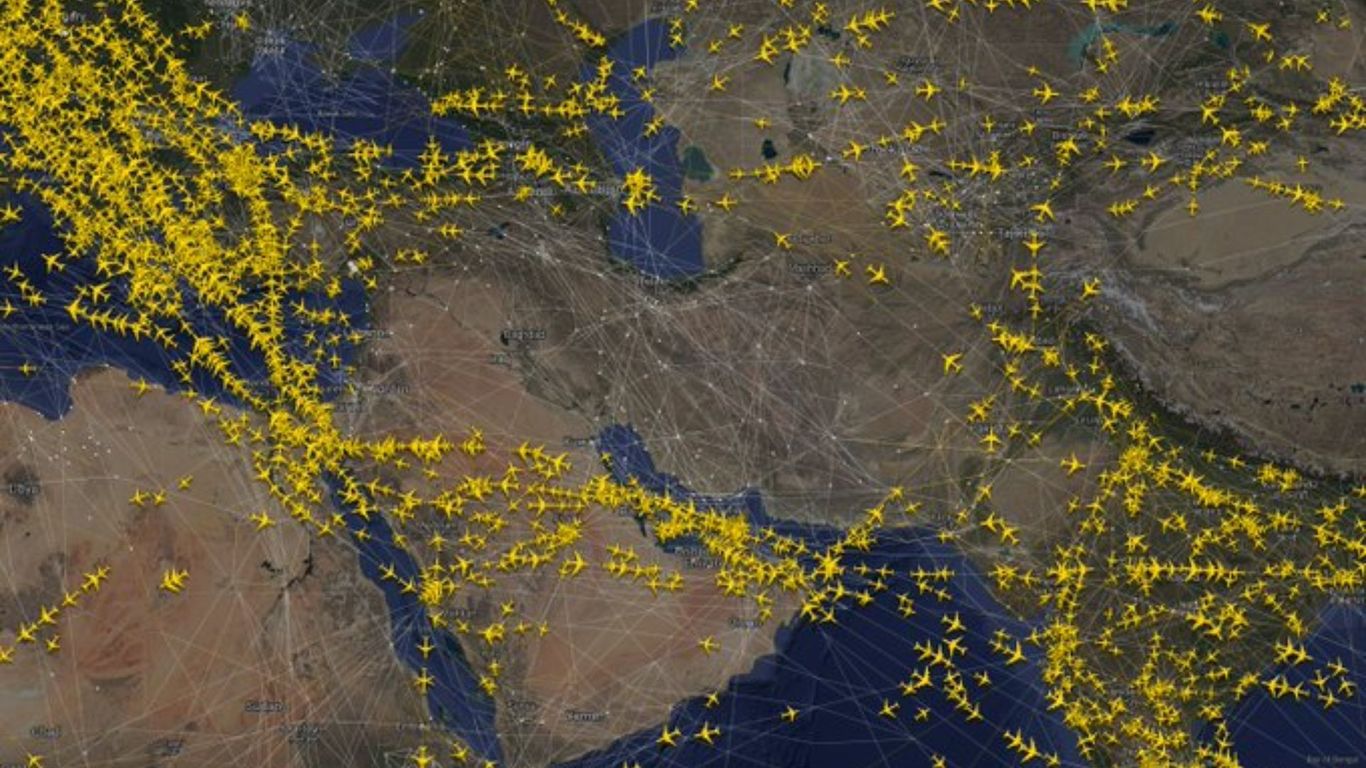
The situation across the Middle East remains highly fluid and may change dramatically as the U.S. and Israel signal that attacks on Iran will intensify in the days ahead. That has placed airlines in a precarious position of uncertainly. Here’s a look at current airspace closures country-by-country.
Middle East Airspace Remains In Flux As War Escalates
Over 6,000 flights have been cancelled since the conflict began. Some airspace across the Middle East remains fully shut. Some has partially reopened under narrow corridors. Some is technically open, but only in the sense that flights are operating in a highly restricted and unpredictable environment.
9-second video of the clearing of Iranian and Iraqi airspace. pic.twitter.com/VZLWbmk9sC
— Flightradar24 (@flightradar24) June 13, 2025
That is what makes this latest conflict so difficult for travelers and airlines alike. A country that is “open” this morning may face new restrictions by the afternoon. A carrier that resumes service may once again suspend flights hours later, as we’ve seen this week in Dubai. And with missile attacks, drone threats, and changing military activity across the region, even official guidance can quickly become outdated.
Nevertheless, I’ve compiled a country-by-country snapshot below of where things appear to stand right now.
| Country | Current Status | Notes |
|---|---|---|
| Bahrain | Closed | Bahraini airspace remains closed amid missile and drone threats linked to the broader conflict. |
| Egypt | Open | Egyptian airspace remains open and Cairo has become an important fallback point for reroutings and diversions. |
| Iran | Closed | Iranian airspace remains effectively closed to normal civilian traffic amid ongoing military operations and retaliatory strikes. |
| Iraq | Closed | Iraqi airspace remains closed, cutting off one of the most important overflight corridors in the region. |
| Israel | Closed / Limited Exceptions | Normal passenger traffic remains heavily restricted, though limited inbound repatriation flights are operating under strict caps on arrivals. |
| Jordan | Open | Jordanian airspace appears open and Royal Jordanian flights are operating, though the situation remains highly sensitive due to the country’s position between multiple conflict zones. |
| Kuwait | Closed | Kuwaiti airspace remains closed as the regional security picture remains unstable. |
| Lebanon | Open / High Risk | Lebanese airspace remains open, but the security environment remains highly volatile, especially after a barrage of Israeli attacks on Beirut overnight. |
| Oman | Open / High Risk | Omani airspace remains open and has become an important bypass route around more dangerous corridors. |
| Qatar | Closed | Qatari airspace remains closed and Qatar Airways has continued to suspend scheduled operations. |
| Saudi Arabia | Open / High Risk | Saudi airspace remains open, but the broader threat environment remains elevated. |
| Syria | Closed | Syrian airspace remains closed and is effectively part of the wider conflict corridor. |
| United Arab Emirates | Partial / Restricted | Airspace has partially reopened, but flights remain limited and tightly managed, especially into Dubai and Abu Dhabi. |
Note: This table is a snapshot and may change quickly as military operations continue, governments adjust restrictions, and airlines revise schedules.
The Situation Remains Extremely Fluid
Even this table should be read with caution. “Open” does not necessarily mean normal. “Partial” does not necessarily mean reliable. And “closed” does not always mean there are no flights at all, since repatriation, military, relief, or specially authorized operations may still be taking place.
The broader issue is that the operational environment remains unstable and subject to rapid change, especially as the U.S. and Israel continue to ratchet up pressure on Iran and Iran continues to retaliate across the region.
For airlines, the challenge is not merely whether a country’s airspace is technically open. It is whether that airspace is usable, insurable, and safe enough to justify operating commercial passenger service through it.
CONCLUSION
The Middle East airspace picture remains chaotic, uneven, and highly dynamic. Some countries remain fully shut. Others have reopened only partially. Others are technically open, but in a way that still leaves airlines and passengers dealing with an extraordinary amount of uncertainty.
As this conflict continues to escalate, it would be foolish to assume that today’s airspace picture will still hold tomorrow. For now, anyone traveling to, from, or through the region should expect disruption, reroutings, and the possibility of sudden cancellations with little notice.
As the conflict deepens, how long will flights be disrupted?
image: @flightradar24/X





Why are Oman and Saudi Arabia considered “High Risk” while Jordan is not?
I suppose all are high risk, but I was thinking geographic location.
The U.S. State Department ‘map’ on Travel Advisories is often laughable. Zambia? Same as Switzerland. Poland, you know, bordering Ukraine, better than France! Libya… better than Colombia?! Psh.
Just heard on CNN that a barrage of flights on EK were turned back and passengers waiting at the airport sent home. Fluid would be an understatement.
You know who I’d like to hear from? Folks that actually got stranded, in ME or elsewhere, due to ME3 disruptions. Like, how did the airlines handle it; did they cover alternate transportation on other carriers; if stuck, did they cover hotels; what was/is it like on the ground?
Could be a while for QR (they’re kinda trapped); EK seems to be using southern routes.
How is financial viability (lots of refunds, parking fees, loss of expected revenue, supplies, since much of that is shipped in, and the ships aren’t getting through)?
Not sure I’d book future travel through the region for a little while. Unless it’s a big hit, I’d brush up on cancel/change fees. Like, if you booked refundable fares, may wanna seek alternatives in-advance.
I am potentially going to be “stuck” in South Africa unable to get home to the UK due to a pair of Qatar flights not operating.
Comms have been fine – Qatar have emailed me a couple of times, and my flight isn’t for 5/6 days still, with clear instructions of what their current policy.
The problem is their policy sucks – they are only offering date change or refund. Not rebooking on OW partners. Won’t work for all, and I am sure there aren’t enough seats for all to be rebook but it is really poor imo that Qatar are taking zero steps to assist you overflying Doha to get home.
You’re handling it well. They really should allow rebooking via OW, though, I’m sure BA, etc. is booked solid from JNB/CPT, etc. I hope you can still enjoy your time in SA! (If only Airlink flew to London… though, they do fly to NBO, so maybe from there BA would be more willing…)
Also, Matt, is this a precursor to what’ll happen if/when China attacks Taiwan (and/or Little Rocket Man going for the South)? Like, I can imagine that’ll go well for disruption in E. Asia. And, what if you’re in Taiwan or Hong Kong or Seoul… yeesh.
2026 is feeling more and more like 2020… me no-like-y the ‘fire horse’ so far…
We all know that the CEOs of the Big 3 US carriers are probably deep down inside laughing their ass off at the sudden terrible misfortunes of the ME3 carriers (Emirates, Etihad and Qatar Airways) given the long-standing bitter acrimonious hostility and resentment the US carriers have towards the M3 over perceived unfair competitive advantages the ME3 have. The financial losses of these disruptions in Doha, Dubai and Abu Dhabi is costing the ME3 several billions in losses, especially as people will be extremely reluctant to book any future flights with the ME3 if the war continues for a lengthy period which it likely will. Oh my, how the worm has suddenly turned against the ME3 in just the blink of a eye. Big 3 US carriers are likely having a nice fat chuckle over this awful predicament the ME3 find themselves trapped in… to absolutely no fault of their own.
Never wise to laugh at others misfortune, lest we tempt the fates… rising oil prices (and a general lack of stability globally) will be ‘karma’ for US3 as well.
Time to install Defensive Aid Suite (DAS) like El Al has on its aircraft for all ME3