
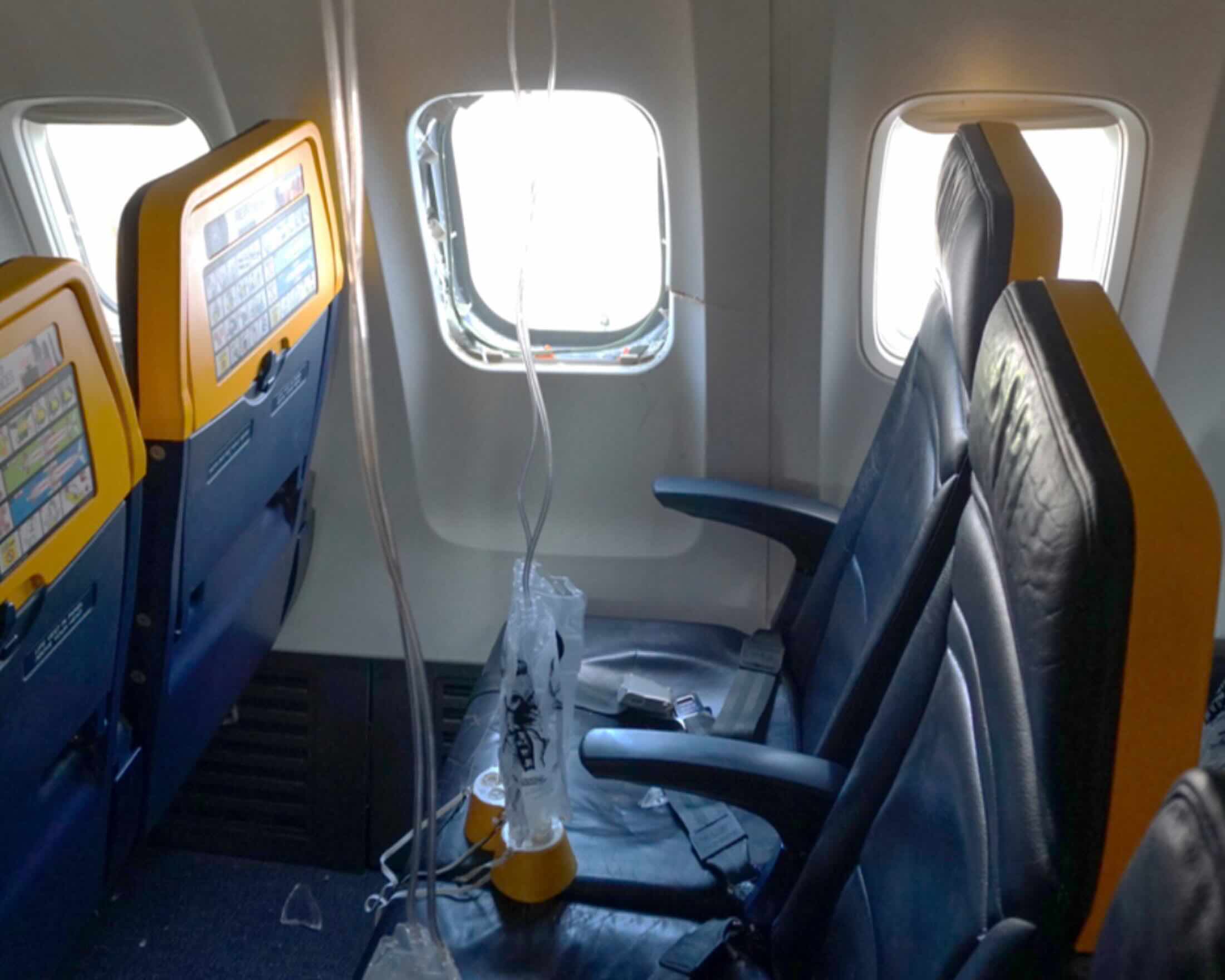
We now know what caused a Ryanair passenger to be partially sucked out of a Boeing 737 window over Greece last month, and the details are frighteningly similar to the fatal Southwest Airlines accident in 2018.
Engine Debris Shattered Ryanair 737 Window, Partially Sucking Passenger Outside
Last month, I wrote about the terrifying incident aboard Ryanair flight FR1879, in which a passenger was partially sucked out of a broken window shortly after takeoff from Thessaloniki, Greece (SKG).
At the time, initial reports suggested that debris from the right engine had struck the window, but we did not know exactly what happened.
Now we do.
A preliminary report from the U.S. National Transportation Safety Board confirms that the Boeing 737-800, operated by Malta Air on behalf of Ryanair, suffered a fan-blade-out failure in its right CFM56-7B engine while climbing out of Thessaloniki on July 10, 2026.
The flight was headed to Memmingen, Germany (FMM) with 149 passengers and four flight attendants onboard.
Fan Blade Failure Sent Debris Into Ryanair 737 Fuselage
According to investigators, the pilots first received a high engine vibration indication during the climb. They reduced power on the right engine and the vibration decreased, but it subsequently increased again.
Then came a loud bang.
A fan blade had fractured and the resulting failure sent debris outside the engine nacelle (the housing that covers an aircraft engine). Pieces struck the fuselage in several places, including a cabin window beside seat 11F, which shattered.
The cabin rapidly depressurized and the oxygen masks dropped.
61-year-old Ljubisa Karović was sitting in 11F. His head and right arm were pulled outside the aircraft through the broken window. Other passengers managed to grab him and pull him back inside while a flight attendant and a doctor onboard subsequently rendered assistance.
Karović survived, but suffered serious injuries. The pilots donned their oxygen masks, declared an emergency, descended, and returned safely to Thessaloniki.
This easily could have ended very differently.
An Uncomfortable Similarity To Southwest Flight 1380
When I first wrote about this accident, I noted the obvious parallel to Southwest Airlines flight 1380.
In April 2018, a fan blade fractured in the CFM56-7B engine of a Southwest Boeing 737-700. Parts of the engine nacelle separated and struck the fuselage, breaking a passenger window. Jennifer Riordan was partially pulled through that window and later died from her injuries.
Eight years later, we have another CFM56-7B fan-blade-out event on a Boeing 737 in which debris from the engine struck the fuselage, broke a cabin window, caused a rapid depressurization, and left the passenger sitting beside that window partially outside the aircraft.
Thankfully, this time the passenger survived. But there’s another part of the preliminary investigation that warrants our attention.
Four Previous Bird Strikes, But Inspections Found No Damage
The NTSB found that flight crews had reported four suspected bird strikes involving this same right engine during the previous 12 months. Bird remains were reportedly discovered after two of those incidents.
Maintenance inspections after those events did not identify damage. The fan blades had also undergone ultrasonic inspections, including one as recently as May 2026, with no findings reported.
After this accident, however, investigators found bird remains in the damaged engine. Those remains have been sent for further analysis.
That does not mean investigators have determined that a bird strike caused the fan blade to fail. The investigation is ongoing, and the presence of bird remains raises an obvious question rather than answering it.
Was there a new bird strike during departure from Thessaloniki? Did one of the earlier strikes somehow contribute to damage that was not detected during subsequent inspections? Or was the fan blade failure unrelated to the bird strikes?
We don’t know yet.
But considering that the same engine experienced four reported bird strikes in a year, investigators are certainly going to look closely at the inspection history.
The FAA Had Already Ordered 737 Engine Nacelle Modifications
After previous CFM56-7B fan-blade-out events, including Southwest flight 1380, the Federal Aviation Administration developed new requirements intended to strengthen portions of the engine nacelle on Boeing 737NG aircraft.
An FAA Airworthiness Directive issued in 2025 specifically warns that during a fan-blade-out event, portions of an insufficiently strengthened engine cowling could separate and strike the fuselage or cabin windows, creating a hazard to passengers seated behind the wing.
Sound familiar?
The mandated modifications have a compliance deadline of July 31, 2028, and had not yet been incorporated on this Ryanair 737.
To be clear, Ryanair was not delinquent, at least by regulatory standards. The aircraft was still well within the FAA’s compliance period. But after an accident that looks disturbingly similar to the very scenario these modifications are intended to mitigate, I would not be surprised if regulators now examine whether that 2028 deadline should be accelerated.
There will also be understandable questions over whether the modifications would have prevented this particular window strike. The preliminary report does not establish that, and it seems we don’t have the evidence (yet) to make the determination.
CONCLUSION
The preliminary findings confirm what was initially suspected after Ryanair flight FR1879: an engine fan blade failed and debris struck the fuselage, shattering a cabin window and leaving a passenger partially outside the aircraft.
He was incredibly fortunate to survive.
The similarity to Southwest flight 1380 is striking, particularly when regulators had already ordered modifications specifically intended to reduce the danger of engine nacelle debris striking the fuselage and windows after a fan-blade-out event. Now the critical question is why the fan blade failed.
The four previous reported bird strikes and apparently clean subsequent inspections will be an important part of that investigation. And considering what happened to the passenger in 11F, I suspect regulators will also be taking another look at how much longer airlines should have to complete those nacelle modifications.



I also immediately thought of WN1380 (RIP). The four prior bird strikes to that engine is telling. What we should be worried about is all the existing engines with bird strikes that have been ‘cleared’ but are still operating (and could have similar issue, even if years later.) Probably will see more incidents like this, even if there’s a delay. Not great.