
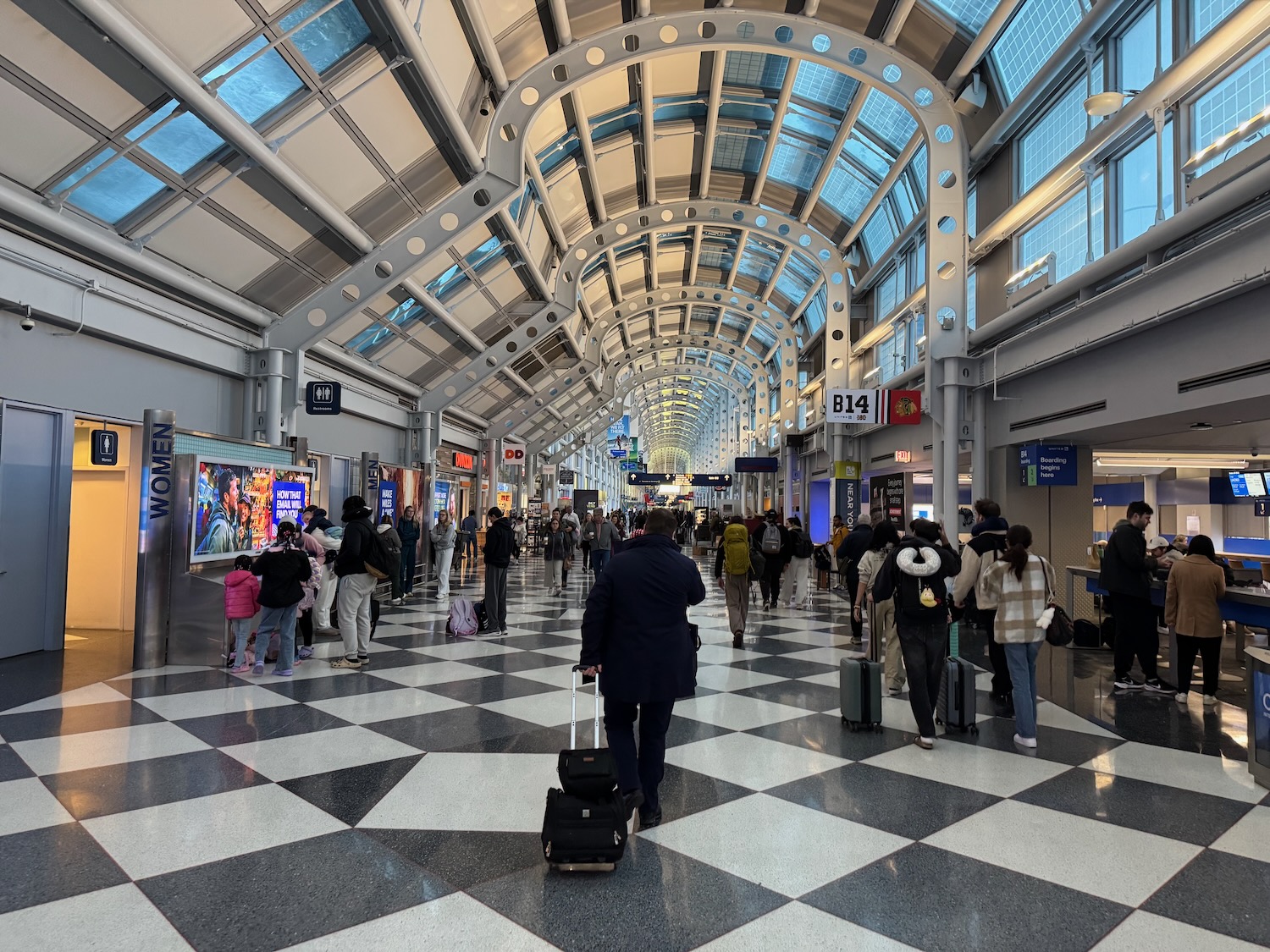
United Airlines is drawing a very public line in the sand at Chicago O’Hare, and American Airlines is already testing it.
United Draws A “Line In The Sand” At Chicago O’Hare As American Fires Back
There are airline battles, and then there are airport battles. What’s brewing at Chicago O’Hare (ORD) between United Airlines and American Airlines is less about fares and more about something far more consequential: gates.
On United’s Q4 2025 earnings call, CEO Scott Kirby made it crystal clear that United is done watching American rebuild at ORD without responding. In 2025, Kirby said American’s growth ultimately cost United gates, and he’s not willing to let that repeat in 2026.
Kirby put it bluntly:
“But in 2026, we’re drawing a line in the sand. We are not going to allow them to win a single gate at our expense in 2026. We’re not trying to win gates, but we’re going to add as many flights as are required to make sure that we keep our gate count the same in Chicago.”
If American adds flights to protect or win gate space under the city’s gate allocation formula, United will add flights too. Kirby effectively pledged to match capacity as needed, not because United is trying to “win” gates, but because it refuses to lose them.
A Gate War, Not A Fare War
This is not primarily about fares, at least in this phase of the war. It’s about access. At constrained airports like O’Hare, gates are critical. More gates and peak-time slots mean more schedule breadth, better connectivity, and greater corporate relevance. If you want to win high-yield business travelers, you do not start by focusing on undercutting rival fares. You start by making the schedule impossible to ignore.
Kirby also came armed with numbers, claiming that United made roughly $500 million in profit in Chicago in 2025 while American lost approximately $500 million, with American’s losses potentially widening in 2026. Those are eye-popping figures and I deeply question them (how would Kirby possibly have access to this highly-protected internal data?). Whether one accepts the exact math or not, the message United wants to send is unmistakable: this is a fight United believes it can win, even if it has to spend money to do it. It’s a strategy of intimidation more than anything else…United hopes that American Airlines will back down, or least slow its own ambitious growth plans.
Kirby not only believes that American Airlines will lose money, but that this strategy will help United to make more money in Chicago:
“Certainly, we’ll make at least the same $500 million, I believe. And likely, we’ll still be able to grow our earnings in Chicago for the same reasons it worked last year. American, and we’re pretty good at estimating this is likely to push to about $1 billion in losses in Chicago.”
I find that that logic highly skeptical. In the same earnings call, United effectively boasted that it would make a lot of money in Newark (EWR) because gate restraints would prohibit capacity growth and keep competitors out. Under this formula, United’s own schedule cannot grow either. While of course we would expect an airline to say it will make money with whatever it does, we are talking about diametrically opposite strategies in EWR and ORD.
Plus, I think this tough rhetoric will only embolden American Airlines even more rather than encourage them to retreat.
American Tests The Line
AA has not backed down. On the contrary (and perhaps in direct response to the United earnings call), it just announced additional service from O’Hare, including new domestic routes and a seasonal Hawaii addition.
| Departure airport | Arrival airport | Aircraft type | Service start date | Service end date | Frequency |
|---|---|---|---|---|---|
| Chicago (ORD) | Allentown, Pennsylvania (ABE) | Embraer 170 | May 21 | Year-round | 2x daily |
| ORD | Columbia, South Carolina (CAE) | Embraer 170 | May 21 | Year-round | 2x daily |
| ORD | Kahului, Hawaii (OGG) | Boeing 787-8 | December 17, 2026 | March 27, 2027 | 1x daily |
All three of these routes overlap with existing United service, the latest battle tin this ongoing war. AA is not looking to maximize short-term margins, it is picking routes that it hopes will force United to decide whether to retreat bur may cause United not just to defend, but escalate.
Chicago’s gate allocation system only intensifies this dynamic. Gate usage is tied to flight activity. If American grows enough flying, it strengthens its case for retaining or even gaining gate access. If United matches or exceeds that growth, it protects its footprint.
Consumers Win This Battle
This is a battle over controls O’Hare over the next decade.
United clearly believes it holds a structural advantage in Chicago: stronger corporate contracts, deeper connectivity, and a larger local base. Kirby’s comments suggest he views American’s expansion as economically unsustainable over time. In his framing, “economic gravity” eventually wins.
“Ego usually beats economic gravity in the short term, but economic gravity always wins in the end.”
But capacity battles have a way of lasting longer than expected. And even if United ultimately prevails, there may be real short-term pain for both carriers, much to the benefit of consumers (which is why I am happy to sit back and watch this unfold.)
May the best carrier win…
CONCLUSION
United has made it clear that it will not cede ground at O’Hare. American has made it clear that it will not retreat quietly. What happens next depends on how long each airline is willing to endure margin pressure in hopes of maximizing long-term positioning.
This is not just a Chicago story. It is a reminder that in the airline industry, control of key hubs often determines who thrives and who merely survives (look at Delta’s fortress hubs as the biggest reason as to why it dominates the industry in terms of profit). American and United both want to emerge as the dominant carrier, but the real winner in terms of increased flight options, better pricing, and upgraded facilities will be Chicago flyers.
Who will win the battle for Chicago ORD?




let’s see how Scottie’s shallow ,but much ballyhoo’d, ‘moat’ works in field testing.
I guess I don’t see why there has to be a winner and a loser. This isn’t Minneapolis, or Detroit, or Salt Lake City. Chicago is a real city with global demand. It seems more than reasonable that two airlines would have a major hub there.
The problem is when two airlines share a hub, general the competing airlines lose pricing power due to the competition. Now, the airlines sharing a hub may ultimately get to a “happy medium” where both succeed. However, in the case of ORD, it sounds like AA and UA are ready for a fight.
So, while you’re correct DTW, MSP and SLC are no ORD, they are fortress hubs where DL has a lot of pricing power.
overcapacity will push fares down. THAT is economic reality.
and AA and UA will both pay the price financially.
the real winner is DL that can watch all of this from the sidelines and move into markets where AA and UA can’t defend themselves because they have used up all of their “battle capital”
To a lesser extent, WN benefits but it has a sizeable operation in Chicago which is also being negatively impacted by the shootout at ORD
Lol it’s always about delta with you.
when the discussion turns to “who will win,” then it is clear that it is neither AA or UA. It will be consumers and it will be AA and UA’s competitors, of which DL is the most significant legacy carrier.
If DL was significant at ORD, they wouldn’t have been in Terminal 2, then Terminal 5.
DL got out of the way so ORD can do its massive expansion which includes the global terminal which will add billions to the cost of every airline that operates at ORD.
All local Chicago passengers will pay their share but airlines that connect passengers through ORD will be at a significant financial disadvantage; ORD is already the most expansive interior US connecting hub on a cost per passenger basis and it will only get worse.
As AA and UA battle it out, DL and WN and other carriers that do not hub at ORD will be the short and long term beneficiaries.
It is probably too much to expect you to be able to logically think through this whole battle logically but that is where we are headed.
Knee jerk reaction. He can’t help himself.
It’ll be interesting to see how DL’s ORD-LAX flights work out
United can use T-100 public data to back into AA’s financial results given that the cost element is probably similar. That’s common industry practice but not a perfect science so it’s possible they came up with a range ($300-550M loss) and Kirby picked a round number toward the high end. If AA doesn’t refute the number then I think we can say it’s at least in the ballpark. It’s an easy win for them to say Kirby is wrong if he is in fact wrong.
Gate allocation by flight scheduling is not unique to ORD, so it’s possible that AA may lose gates elsewhere as it pulls down flying to fund the incremental additions to ORD.
San Francisco and Denver are two airports which UAL want to increase flying in 2026. Now AAL is forcing UAL to redirect finite resources (planes, pilots and flight attendants) to ORD.
Dallas is about 800 miles from Chicago, while Denver is less than 900 miles from Chicago. Expanding ORD flights means both UAL and AAL would taking passengers from their own other mid-continental hubs. It is not good business wise.
UA will be taking delivery of 120 mainline planes this year. The resources aren’t that finite, certainly less than those at AA. Not sure how AA is funding their growth.
Same with DL. They’re shrinking NYC as UA grows there so that they can fund growth in AUS as they fight WN and SEA as they fight AS.
UA reported just 2/3 of the profits that DL reported for 2025, Mark.
They simply can’t keep growing without delivering comparable financial performance to DL or investors start sinking UAL stock,
UA’s strategic plan for most of the time post-covid has been market share at the expense of financial performance.
UA has picked fights with everyone it can fight – except for DL – because UA knows it will not win a pi789ng match with DL.
UA’s battles are costly and are a big reason why UA underperformed DL so badly in 2025 despite the huge labor cost advantage UA has.
There will be a whole lot more LAX-HKG route announcements if UA decides that picking a fight with everyone else is what matters to UA
cling to the notion that UA’s massive fleet orderbook will save it strategically if it makes you feel better.
5 /3 yr stock price appreciation
UAL: +167%/139%
DAL: +69%/79%
Wall Street is pretty happy, at least with UAL.
Maybe it’s the 5 yr OCF/FCF(Capex) in $B
UAL: 32.6/7.2(25.4)
DAL: 32.5/8.8(23.7)
Those rating agencies are happy too.
and yet the past won’t save UA as long as it continues to pick fights with everyone it can in hopes that it will get rid of the 60% of capacity that DL and UA don’t fly.
United will do just fine. Another amazing UA recovery from the weather event, and DL did better than in December. DFW is a skating rink which is pretty rough for AA.
Self important People on pedestals should and often do fall because of their arrogance. Be careful Fluffer Scotty.
‘Oh no they di’en!’
Fortunate ORD, fortunate Chicago flyers!
Great article. Expect it has numerous typos.
I’m having a huge problem with Grammarly:
Reading between the lines it sounds a lot like Kirby is afraid of the competition.
American Airlines will ultimately de-hub ORD when the 30-something gate expansion in DFW is done. History has shown time and again that being #2 is a bad idea.
Delta showed this perfectly when it de-hubbed DFW and used the resources to flesh out ATL and make an impenetrable fortress hub.
AA will have PHX, DFW, and MIA, the most formidable presence across the southern tier of the US .
Yea, im sure AA is going to spend billions for their share of the Ohare expansion, then dehub it shortly after. Great thinking
AA is going to make any decisions based on hard numbers.
They aren’t going to be “emboldened” to make billion dollar decisions based on media trash talk .
I am more concerned about all of the typos I found. The author should contact me so I could help him do some editing work before he posts again. Seeing this many typos makes the article look sloppy.
One thing a American has over United at O’Hare is Customer Service desks with live people. United has nine!
Correction United has NONE