
Aeroplan has quietly nudged up the price of at least some United Airlines economy class awards, another reminder that when loyalty programs introduce variable award pricing, the “variable” part has an unfortunate tendency to move only in one direction.
Aeroplan Quietly Raises Prices On Some United Airlines Awards
Aeroplan has not announced another devaluation (not that it would in this case) and, so far, I cannot find evidence that this is a sweeping change across United Airlines awards. But I am seeing slightly higher prices on at least some domestic United economy awards that previously priced at familiar round numbers.
Despite Aeroplan’s partner booking fee and the lack of flexibility compared to booking directly through United, I still find Aeroplan quite valuable for domestic United awards in the USA since Aeroplan miles are easier to come by (via American Express).
United often releases plenty of economy class partner award space even when cash fares are very high. Take Los Angeles – Chicago.
Hardly a sexy award redemption, but I’d much rather redeem 15,000 Aeroplan points than pay $400 for a one-way ticket, which can easily be the price a day or two before departure.
Even after accounting for Aeroplan’s partner fee, that’s comfortably more than tw0 cents per point in value.
And with fewer low-cost alternatives in some U.S. markets following the demise of Spirit Airlines, having another reasonably priced way to book United flights is useful.
But United Awards On Aeroplan Are Already Variable-Priced
Recall that Aeroplan stopped pricing United awards according to a traditional fixed partner award chart in March 2025.
United was moved into a category Aeroplan calls “select partners,” alongside carriers including Emirates, Etihad, flydubai, and several Canadian regional airlines. Instead of a fixed price, Aeroplan’s current award chart shows a “starting at” price and, where available, a median redemption price.
Within North America, the current chart looks like this for economy class on Air Canada and select partners such as United:
- 0-500 miles: starting at 6,000 points; median 12,400 points
- 501-1,500 miles: starting at 10,000 points; median 14,000 points
- 1,501-2,750 miles: starting at 12,500 points; median 15,900 points
- 2,751+ miles: starting at 17,500 points; median 22,500 points
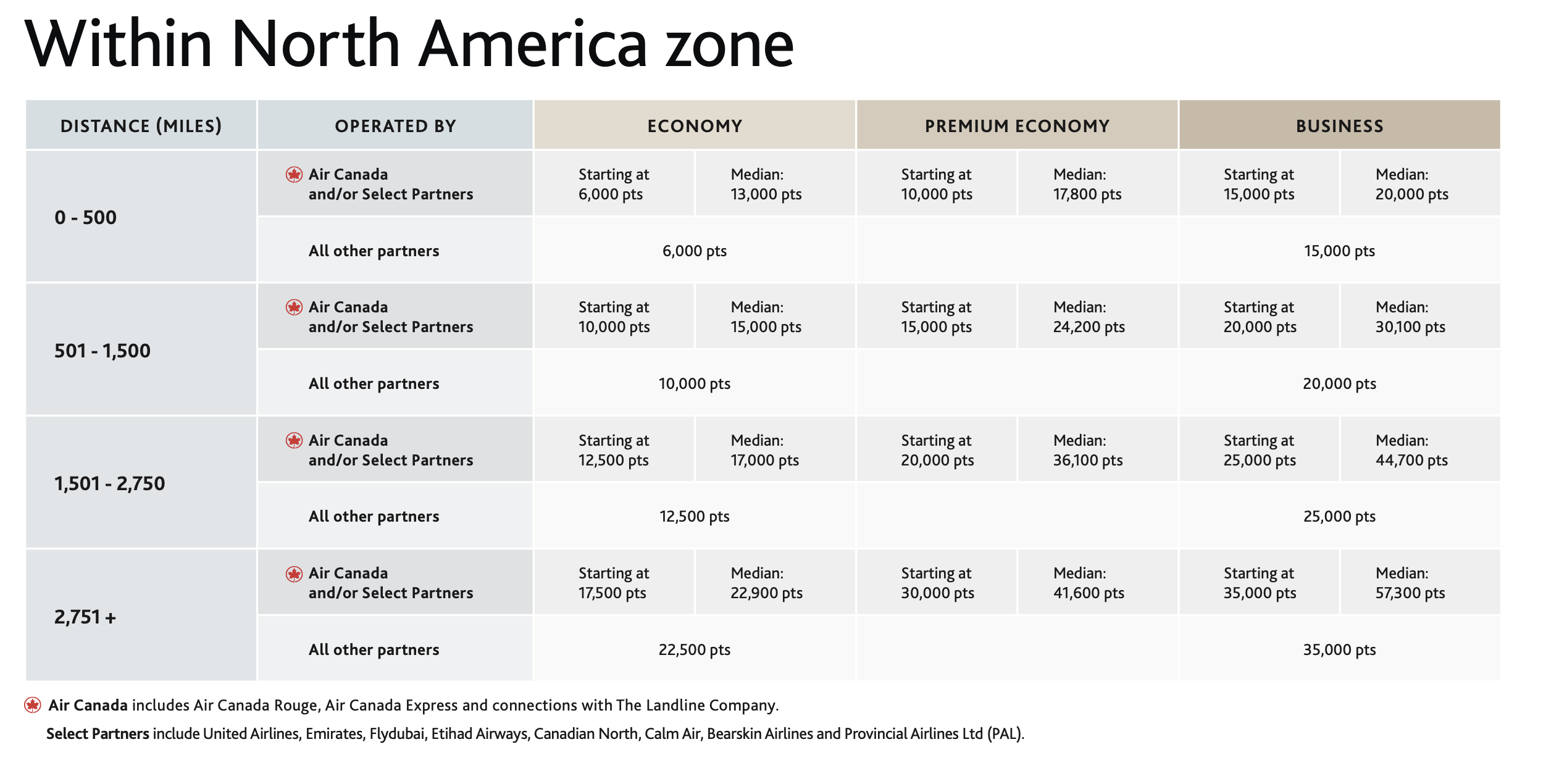
To return to my example, Los Angeles-Chicago falls into that 1,501-2,750-mile band. 15,000 points has been the consistent price I’ve seen for these sorts of United redemptions, but now the price has edged up to 17,500.
From what I can see, the 0-500 band has not changed. The price is still 10,000 miles one-way:
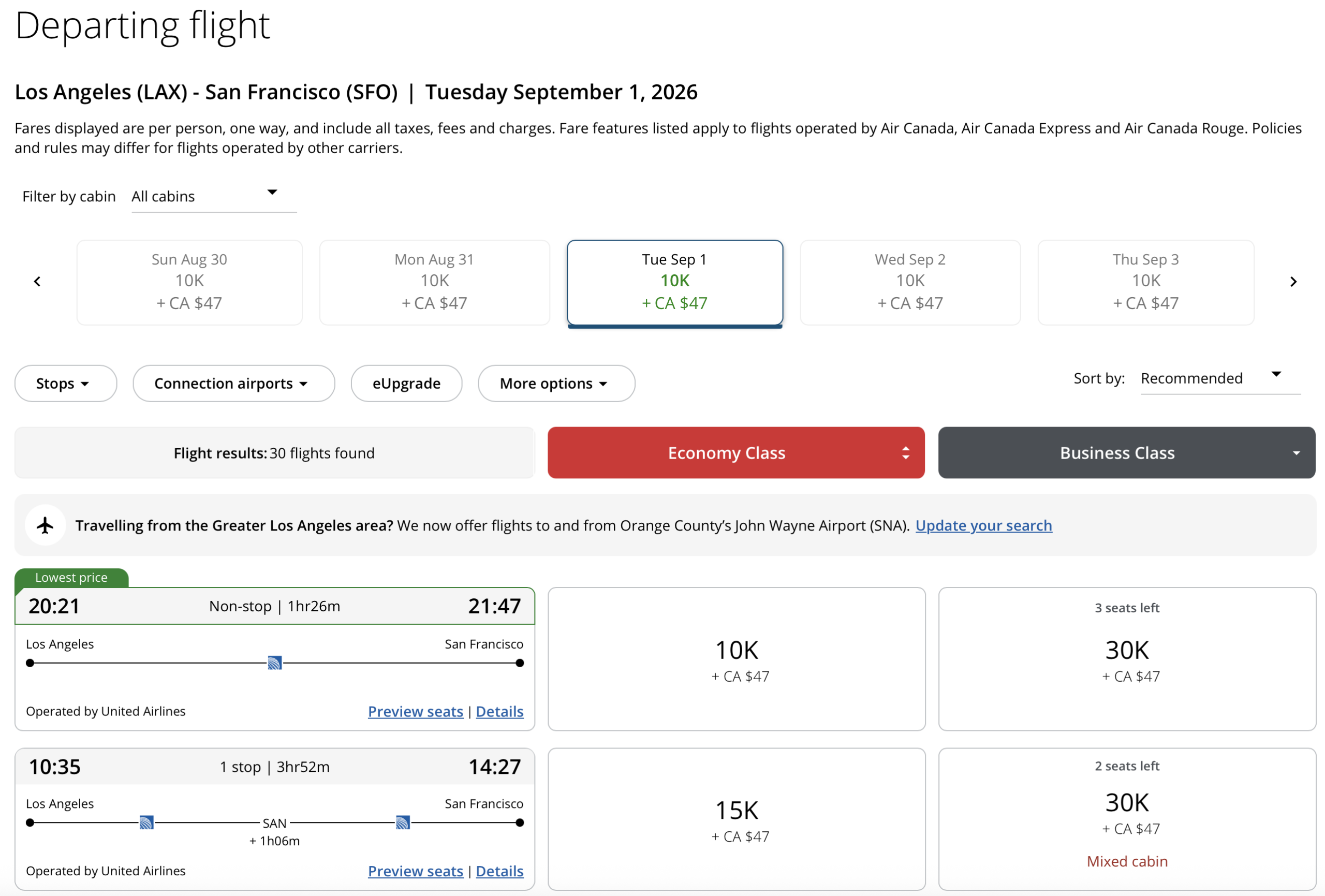
The 501-1,500 ban is 15,000 miles oneway:
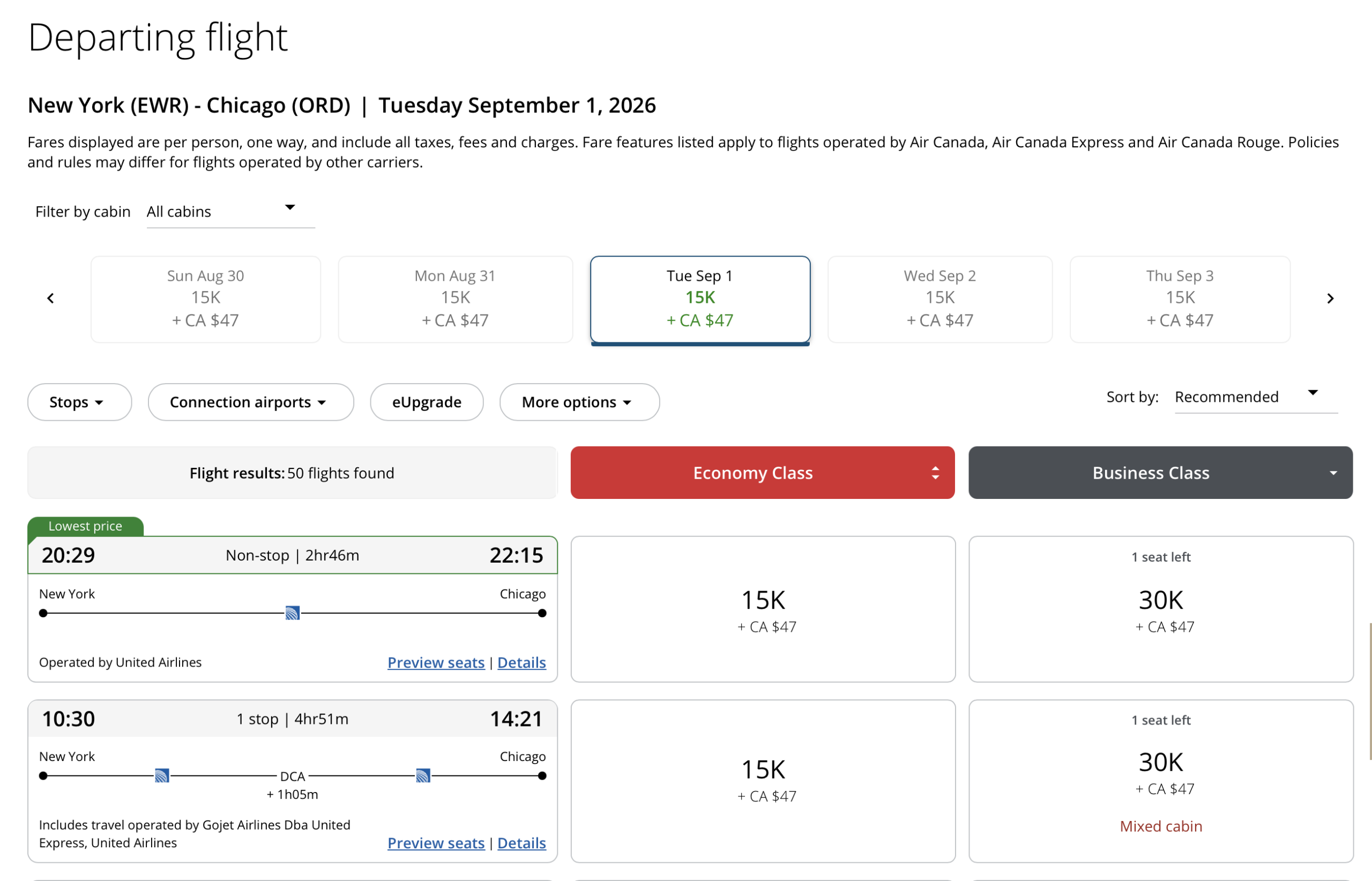
But now the 1,501-2,750 band has risen from 15,000 to 17,500 points.
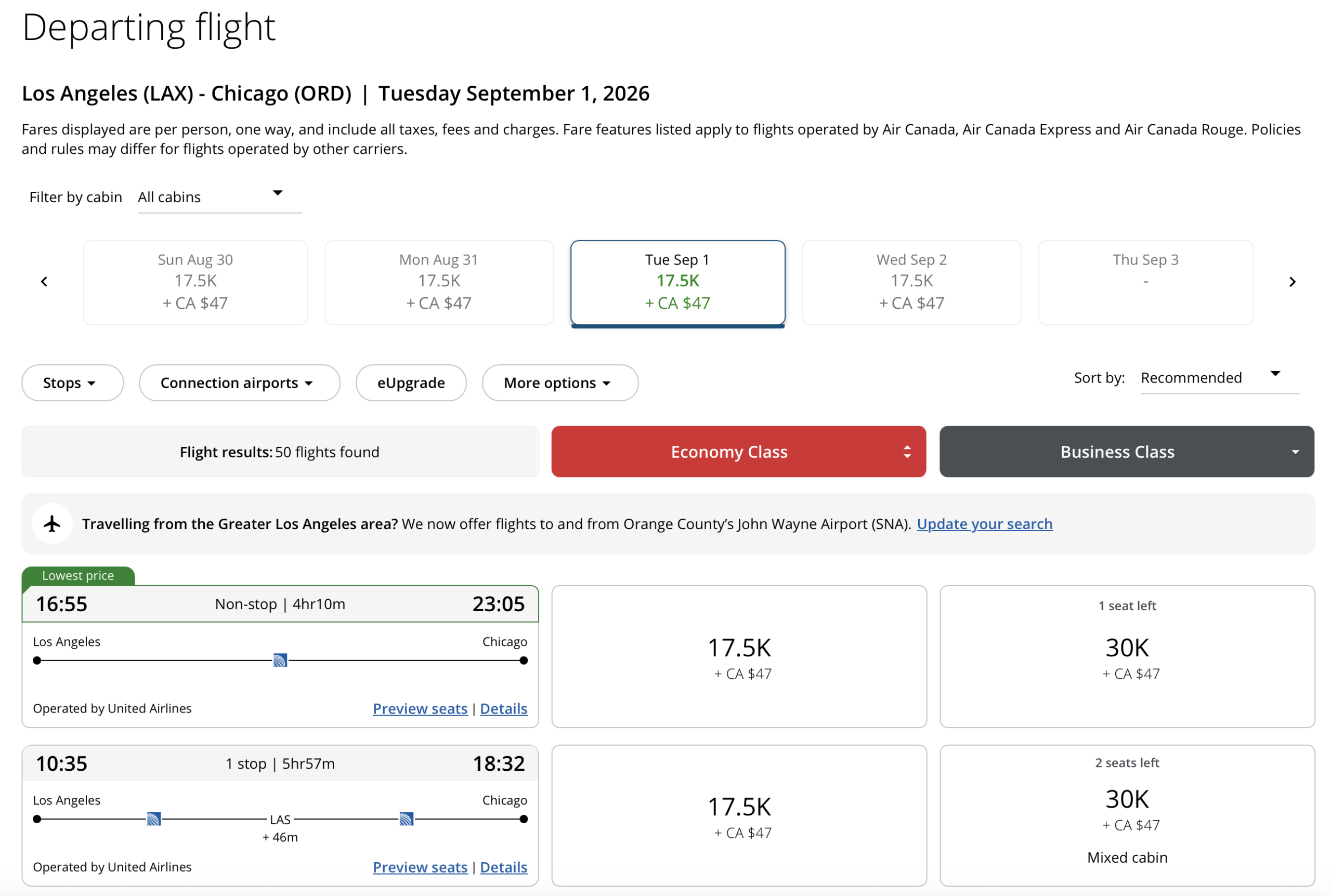
Business class awards remain a 30,000 points one-way, all the way up to flight(s) of 2,750 miles within North America.
This Isn’t The First Time Aeroplan Has Quietly Moved United Pricing Higher
When Aeroplan first introduced variable pricing for United awards, the consequences became apparent fairly quickly.
United awards which had previously cost 10,000 points began pricing consistently at 15,000 points after the change. Shorter awards that had cost 6,000 points also began appearing at 10,000 points.
In other words, Aeroplan called the new system variable pricing, but at least initially the variation looked suspiciously like a straightforward increase.
As an aside, Aeroplan made a separate series of award-chart changes in June 2026, but those changes primarily concerned fixed-price partners. United was already dynamically priced and was not supposed to be directly affected by that particular adjustment.
Variable Pricing Has A Funny Way Of Moving Up
My broader frustration with dynamic award pricing is that airlines love to present it as a system in which award prices can respond more accurately to demand.
In theory, that means prices should move both ways. But in practice, we tend to notice plenty of increases and very few instances in which the same saver-level partner award suddenly becomes cheaper (thought I’ve seen that, to some extent, with American Airlines).
Aeroplan does technically publish “starting at” prices below the amounts I typically encounter, so cheaper awards certainly can exist.
But the direction of travel over the last couple of years is difficult to miss.
A 10,000-point award becomes 15,000. Then perhaps 15,000 becomes something slightly higher.
Each individual adjustment is small enough that most people shrug. Over time, though, the value proposition changes considerably…
CONCLUSION
I don’t see evidence of a broad new Aeroplan devaluation of United Airlines awards, and Aeroplan has made no announcement that I can find.
But some United economy awards appear to be creeping higher, consistent with a pricing model that has already become considerably more expensive since United moved from fixed partner pricing to Aeroplan’s variable “select partner” system.
For now, the value can still be excellent. A roughly 15,000-point redemption, or even a 17,500-point redemption, instead of a $400 last-minute ticket remains an easy decision for me.
But when award programs tell us prices are becoming more “dynamic,” that’s a polite way of saying they go up in price.






Leave a Reply