
United Airlines is betting heavily on the Airbus A321XLR for its next phase of international growth, using the narrowbody not merely to replace aging Boeing 757s, but to open longhaul routes that would not be viable with a larger widebody aircraft.
Why United Airlines Thinks You’ll Love Flying Across The Atlantic On An A321XLR
United just announced the largest international expansion in its history, including five new destinations that will be served by its new Airbus A321XLR:
- Newark – Luxembourg (LUX)
- Washington Dulles – Toulouse (TLS)
- Newark – Ibiza (IBZ)
- Newark – Valencia (VLC)
- Newark – Marseille (MRS)
Those routes tell us a lot about what United intends to do with this airplane.
Yes, the A321XLR will gradually replace United’s Boeing 757-200 fleet, but this is not simply a newer 757.
Instead, United is using the aircraft to create new markets.
The A321XLR Makes Thin Longhaul Routes Possible
Look at those five cities:
- Luxembourg
- Toulouse
- Ibiza
- Valencia
- Marseille
Every one of them would be absolutely unviable on widebody jet.
And that’s precisely the point…
The A321XLR combines transatlantic range with substantially fewer seats than a widebody, allowing United to offer nonstop service in markets where there may be plenty of demand at the right price and aircraft size, but not enough to fill a 250-seat jet every day.
Patrick Quayle, United’s Senior Vice President of Global Network Planning and Alliances, pointed to Luxembourg as a good example. There are substantial technology, banking, and corporate ties between Luxembourg and the United States, but passengers have historically needed to connect elsewhere in Europe.
Starting next April, United can offer them a daily nonstop from Newark instead.
Toulouse is another interesting example, connecting Airbus North America with Airbus Europe. Ibiza and Valencia are leisure markets that become far less risky when United does not need to fill a large widebody. Marseille gives United another gateway to southern France without forcing passengers through Paris.
This is exactly what the XLR was built to do.
But Do Passengers Actually Want Seven Or Eight Hours On A Narrowbody?
Over and over I hear from readers that they hate the idea of flying across the ocean in a single-aisle jet.
I don’t really understand that. I recently crossed the Atlantic on a TAP Air Portugal A321LR and slept very well. Give me a lie-flat bed, a cool cabin, individual air vents, decent food, and I really don’t care whether there is one aisle or two. In economy class, the difference is even more negligible.
Quayle was asked directly why United is so bullish on longhaul single-aisle flying, and his answer was revealing.
“When you add that in with the fact that it’s a nonstop flight and it avoids a connection in Europe, on a brand that people trust, which is the United brand, this is all the ingredients for success.”
I think he’s right about the most important part of that equation: nonstop.
Would I rather fly Newark to Europe nonstop on an A321XLR or fly a widebody to Madrid, Frankfurt, London, or Lisbon and connect?
If I am traveling with my family, the nonstop wins every time.
A widebody is nicer if everything else is equal, but everything else is not equal when one option requires a connection.
United Is Putting A Serious Premium Product On The XLR
United also appears determined to remove many of the compromises travelers associate with narrowbody longhaul flying.
The A321XLR will have:
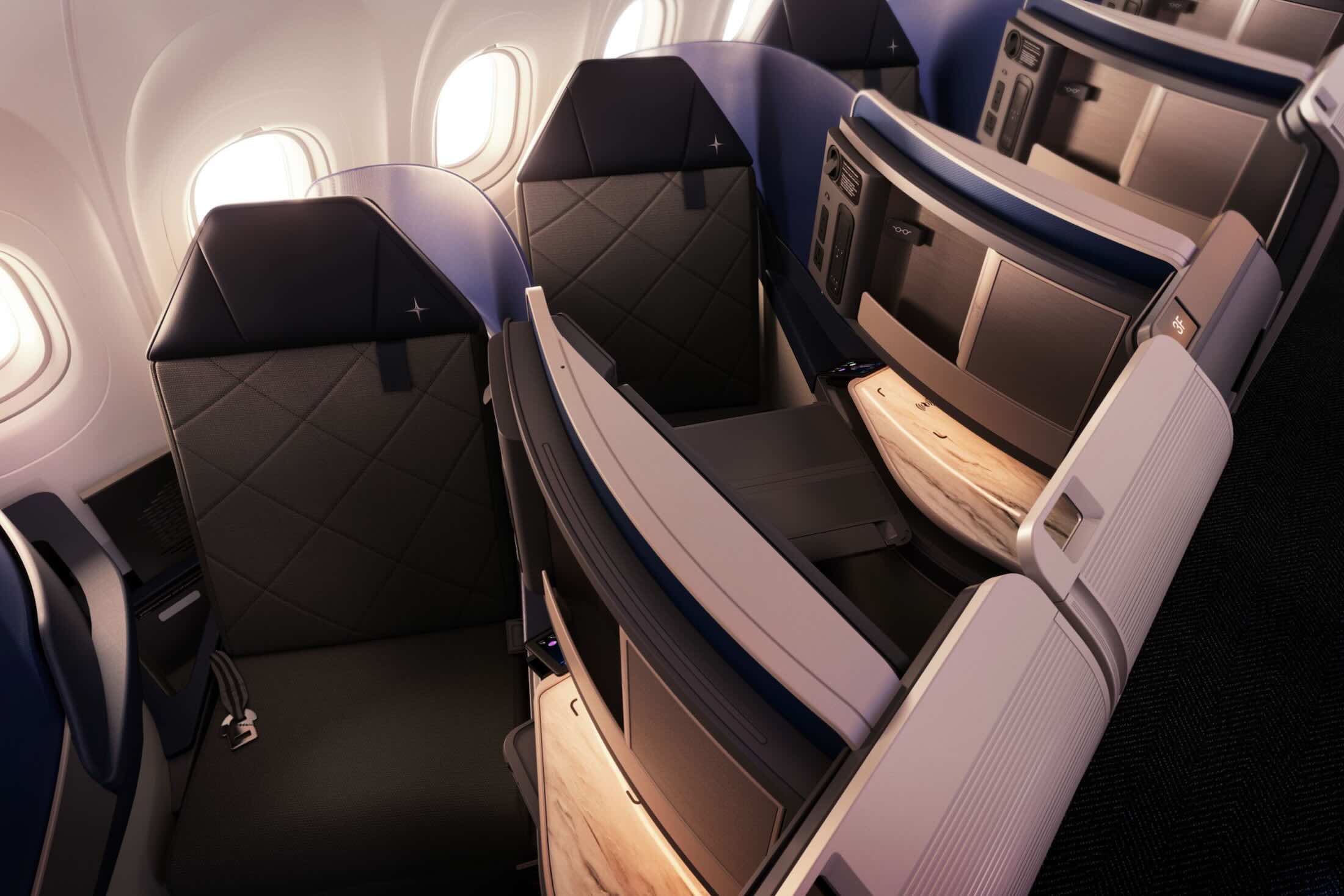
- 20 United Polaris suites with privacy doors
- 12 United Premium Plus seats
- Free Starlink Wi-Fi for MileagePlus members
- 4K OLED inflight entertainment screens with Bluetooth connectivity
- A snack bar in economy
- A new Economy Plus seating option with additional elbow room and a shared table across an open middle seat
That’s 32 premium seats, 16 more than United offers on its Boeing 757-200.
Quayle emphasized that United’s XLR product will also be different from what competitors currently offer:
“We have a brand new aircraft with lie-flat seats that are different than what’s on the market today. So any airline flying that XLR today does not have our seat and does not have our product.”
That’s an important point considering how much people complain about the new business class suites on the AA A321XLR, though I’ll reserve judgement until I fly in the seat myself.
> Read More: American A321XLR Business Class: I’ve Never Seen Passengers So Happy?
> Read More: American Airlines A321XLR Business Class Review
The question should not simply be whether you want to fly across the Atlantic on an A321.
Would you rather fly nonstop in a Polaris suite with a door and Starlink on an A321XLR or connect somewhere in Europe because the destination cannot support a widebody?
I don’t know about you, but intra-European flying, especially with those Recaro slimline seats, is not something I look generally forward to.
The A321XLR Will Start International Flying Before Summer 2027
United’s first A321XLR has already arrived and will initially operate select domestic flights beginning in September.
International service begins December 1, 2026 with:
- Washington Dulles – Amsterdam
- Washington Dulles – Dublin
Those are established markets and give United several months to work out any operational wrinkles before the more adventurous destinations begin next spring.
Then Luxembourg starts April 2, followed by Toulouse on April 26, Ibiza on May 31, Valencia on June 2, and Marseille on June 4.
United currently has only one A321XLR in its fleet, but many more are coming if Airbus can deliver them. As those aircraft arrive, the Boeing 757-200 will gradually disappear.
But based on what United announced this week, I suspect the most interesting XLR routes will be the dots that did not exist before, not the 757 routes it replaces.
What’s Next For United A321XLR?
United’s international network has become increasingly exotic, while remaining profitable, because the airline has demonstrated a willingness to try destinations other U.S. carriers will not touch.
Nuuk. Ulaanbaatar. Madeira. Bilbao. Bari. Split. Santiago de Compostela.
Now add Luxembourg, Toulouse, Ibiza, Valencia, and Marseille.
Once United has dozens of these airplanes rather than one, I expect the experimentation to become even more interesting. Prague? Budapest? Zagreb? Stockholm? Oslo? More secondary cities in France, Spain, Italy, and Portugal?
Some of those routes will fail, but United can now test markets that were previously difficult to justify at all and thereby open whole new markets and create new demand.
CONCLUSION
Like most of us, I prefer a widebody aircraft across the Atlantic, all else being equal. But I don’t think all else is equal here.
The A321XLR gives United (or any other operator) the ability to connect cities that might otherwise require passengers to make an additional stop in Europe, while still offering a lie-flat Polaris suite, Premium Plus, Starlink, and a competitive economy product.
That’s a tradeoff I will happily make.
United will eventually use the A321XLR to replace its aging 757s, but the five new routes announced for 2027 show that United is looking beyond current 757 transatlantic routes.
image: United






Passengers mostly want cheap flights. So all depends on pricing – if it’s $250 cheaper to take the connection many still will. And clearly with UA connection point in Germany mostly going for Western Europe destinations where connecting in Germany makes no sense.
But everyone else seems to have the XLRs on domestic transcontinental-esque duty and then will rotate XLRs off for summer seasonal. UA seems to be taking the opposite approach. Would be interesting to understand that thinking a bit more. I realize the XLR was marketed for long and thin but isn’t the attractiveness of the product the design of the RCT to allow for more cargo? Isn’t that why folks are deploying XLR on their bread and butter routes throughout the year?
It depends on the customer. Sure, bargain hunters will choose the cheapest option, regardless of aircraft type.
However, those seeking a premium cabin (and when cost is less of a consideration, but value still matters), they will have to consider, would they prefer a brand-new suite with a door, or the older Polaris with a stop at a hub somewhere, then a 3-3 economy flight on a partner airline to where they actually want to go.
Personally, I’d much prefer a nonstop in a lie-flat suite with a door, than a stop and a less comfortable overall experience, before even considering cost differences, if it’s not too different.
Also… the AA XLR seat is more than fine. Perfectly comfortable. Sure UA probably designed a slightly better one but that’s not going to be much of a differentiator.
That is my own thought as well, but OMAAT and others seems to strongly dislike the AA seat.
Didn’t have any issues with meal service flow with the TV. Wireless charger actually works. Very high walls and very private. Can nitpick but overall it is more than fine.
Economy though – absolutely no MCE seating. Just two rows of MCE which is exit row so can’t book with family. Huge disadvantage. I realize they just announced they’ll put more MCE in on planes but… these are the new factory fresh ones. That’s the differentiator.
Seriously. XLR is not just ‘fine.’ It’s great (B6, etc.) Trying AA’s later this year. Not sure why Ben and some others were upset about it. Some crews will be upset with any changes, anyway. By now, they’ve hopefully gotten used to it.
Well I did say it was more than fine! It’s a very private seat – a little narrow but no big deal for a 6-8 hour flight.
I presume your point was lie-flat on 321s is good (no XLRs for B6, just LRs).
But can’t give AA top marks for XLR given only 12 all exit row MCE seats. Bah!
Good catch! Whoopsie, was thinking about B6 for suites with doors, and how AA’s XLRs will have them.
Yes, more MCE would have been better. 24 minimum. They couldn’t manage at least 4 rows?! Nope-a the LOPA!
Another repeating problem on the 757s was the lavatories. The 757s are old. We were on a DUB-EWR flight where none of the lavatories worked by mid-flight.
What is the lavatory plan for the XLRs?
Well, I missed the chance to tour one this morning in Newark, but I will soon – I don’t like that there is no door 2 and no mid-cabin lavatory – it’s a problem indeed, but at least there are three in the back (plus the one up front).
I think the issue here is during meal service you basically can’t go to the restroom in economy. You can’t use biz lav in international flights, with single aisle and no mid cabin lav there’s no where to go.
That becomes tough ratio on long hauls, especially post meal, or pre landing rush. 3 in back for 300 pax is 1:100 which is rough, Biz is still 1:20 or 1:32 if Pre+ is meant to go up front.
first, you miss the main point which is that the majority of people do not fly business class and the economy class experience on a narrowbody is vastly inferior to a widebody. AA and UA clearly need economy passengers because more than half of the seats on their XLRs are economy cabin – even more considering extra legroom economy.
second, of course, anyone would prefer a nonstop over a connection but a large percentage of these passengers on TATL narrowbodies are connecting passengers so the logic is really about cities which have no service to Europe and a connection w/in Europe vs. a connection at Europe. Given NYC airports are consistently some of the most delay prone in the world. many people would choose a connection anywhere else over NYC.
and third, most of these destinations don’t work financially for half of the year which means you appeal heavily to summer leisure passengers – the opposite of business passengers in terms of seasonality. Some destinations will always skew to leisure passengers while others do have year round demand. The fact that UA is using some of the XLRs to replace widebodies in the winter on routes where UA is clearly weak says that UA hopes to use the XLR to reduce capacity on routes that UA should be operating on a seasonal basis.
I addressed the economy class experience above – I think the difference between a widebody and narrowbody is even less than in business class. I just don’t see what makes it an inferior experience. To your second point, you are quite correct that when connecting it may not matter as much to connect in Europe versus in Newark, when faced with those two options. These flights will probably appeal more to Easter Coasters than anyone like me starting in LA.
Matthew,
the 737 and 320 family are both 3X3 in coach which is most certainly inferior to any widebody. A far lower percentage of passengers are in aisle seats, there is one aisle and lavs are generally inaccessible whenever FAs are serving – or else the entire service process is stopped.
and remember that UA is serving TATL flights beyond Iceland (which many airlines serve on
and EWR is not the sum total of even the east coast. At best, UA is appealing to NYers but at the expense of building a larger domestic system. EWR is at capacity per the FAA so every flight to Europe they add comes at the expense of another domestic flight. The logic from UA fans is always that there is something more sexy about a secondary or tertiary city in Europe than to add domestic destinations which other carrier(s) serve from NYC but UA does not. and the chances are high that other carrier(s) get higher margins on their domestic network than UA does from its narrowbody flights from NYC
Im sure you know already know the numbers but delta probably does get great margins in NY because they are clogging up all the LGA slots with regional jets.
In the entire NY market, DL and UA are almost even in terms of domestic passenger traffic with UA growing and DL shrinking, so they probably afford to give a few new international routes a shot
Tim what you’ve described is exactly what economy passengers choose their airline on. Not price, destination or frequency. It’s whether we can go to the bathroom during service. I’ll happily pay $300 extra with a 4hr layover in CDG (the best airport in the world) so I can pee during service.
BB,
DL operates the lowest percentage of its network on regional jets of the big 3 and has no 50 seat or smaller RJs.
DCA and LGA’s perimeter restrictions force high numbers of RJs but also open up a whole lot of destinations in the eastern US that UA does not serve from EWR.
and all UA did when the FAA cut the number of flights at EWR was to shift RJs it had already contracted with to other hubs – and they still are adding CRJ450s.
I don’t think you really want to try to play the RJ argument.
Andy,
funny that you try now to argue that leisure passengers care more about schedules than price when leisure traffic – even premium leisure traffic – is far more price sensitive than business traffic. And yet no airline passenger is completely price or schedule sensitive to the exclusion of the other.
and regarding comments below, the people that are driving premium leisure are higher income and wealth Americans that are generally well-traveled and do have enough experience flying to know not only the difference between a widebody and narrowbody (you figure it out just looking at the seat map which most US airlines allow you to do even before booking) and that widebodies are more spacious and offer a higher percentage of seats on the aisle, even in a tight 3-4-3 configuration which only exists on the 777 now that the 747 is just about out of service.
you can profitably fill any flight across the Atlantic during the summer; UA’s use of domestic 737s proves that the level of onboard service is not as much of a factor as some imagine. the XLR does allow lower demand flights to switch from widebodies to XLRs in the winter and to be used to Latin America which is counterseasonal to TATL.
I think the biggest question will be price. Assuming you lived in the East Coast and could take one of these flights from EWR. Forget about miles which is basically impossible to use during peak of summer which is when most of these flights will be available. You are paying 4 tickets to take your family of 4 from EWR to one of these destinations. How much more would you be willing to pay per ticket to fly non-stop on a narrow body coach vs flying on a bigger plane with 1 connection in Europe? That’s what United hasn’t shared yet. Flying non-stop when there is no competition will come with a hefty price.
It’s a very good point indeed.
I would travel in Y on an A321XLR any day over a 3-4-3 777. I don’t know what you have in mind when you say the narrow-body experience is vastly inferior in Y.
Also I have never really seen many instances where only one of the aisles is blocked by service carts leaving the other open for pax to access lavs, etc. Service generally happens on both aisles at the same time.
OK, let’s assume a 3-4-3 Y on a 777 is inferior to a 3-3 321 TATL (though, I’m not sure it is). I would rather fly 8 or so hours on a 330 in 2-4-2 Y, a 350/787 in 3-3-3, or a 767 in 2-3-2. As much as I don’t like the 767 in J, the PE (2-2-2) and Y are fantastic. Admittedly, I’m only in Y on a downgrade. The last time was the aisle seat of the “2” side. Way better that an aisle seat on a 3-3 narrowbody. Give me the aisle on a 3-3-3 in the middle section, with the middle seat empty or travellings with the other aisle pax? Fantastic for Y.
So, IMHO, existing widebodies in coach are better than 3-3 Y on narrowbodies, except maybe the 777. And, how in the world is a window, middle, or aisle seat on the “3” sides any worse that the exact same thing on a narrowbody? As always: you get your preferences, I get mine. The can often differ.
Agree that an A330 and 767 are great in economy class, but I too would rather be on an A321 than a 777 (at least on UA/AA).
The average flyer (outside of us avgeeks and frequent flyers) does not know the difference between a wide body or narrow body aircraft when booking a ticket. The numbers A321 or A330 or B777 mean nothing to them. Even if they figure it out from the seat map, I’m sure it doesn’t register as being superior or inferior. Similarly the average flyer does not know that NYC or Chicago are delay prone. They merely want to fly to city XYZ and will book what they see that’s cheapest, or if able, most convenient and familiar, and find out the ugly side of air travel in real time, often with shock.
American Airlines received Airbus A321XLR a year earlier than United Airlines, but AAL seems not take this advantage through a large scale deployment to transatlantic routes.
I think it’s clear the business and probably the premium economy cabins will be an acceptable experience. The real question is whether 120+ others will want to be stuck in a sardine can for 8+ hours at profitable fares. Widebodies are simply more spacious, and that affects the sensory experience unless you’re the type that can simply fall asleep for the entire flight.
Count me out, even in business–give me an AF meal, a shower (maybe a spa treatment) and a charcuterie breakfast at CDG and send me on my 90 min flight to the final destination. In economy…forget about it. 5-6 hours is all I can handle on a narrowbody, and that’s not pleasant either.
But no sauna! 😉
The lack of a 757/737-9 mid-cabin lavatory has a huge negative impact on the business class experience on a 7 hour flight.
Part of what I don’t like about the UA 321xlr arrangement: one lav in front, two in the back. So, do the 20 J pax get the front one, and 130 others (12PE and 118 Y) get the aft three at 43 per lav? Or, do the PE use the front, netting 32 for the front lav and 118, or 39 per lav for the aft? I suspect PE will use the front (though, I don’tthink they shpuld be allowed). Thus, J pax get one lav that 32 share. While having 39 pax per lav for Y sounds worse, I think it is better. One slow poke, and there’s always a slow poke, really affects things negatively in such cases. Think about it. Would you rather go to a bank branch with one teller that serves 16 customers an hour or a branch with three tellers that handles 20 customers per hour per teller?
I would not mind a narrow-body in lie-flat business class. Sure, I prefer the smoother flight on a wide-body, but it’s not a major consideration. I do think it will be important to see how this prices out, in cash and miles. I wonder if a more obscure destination could lead to some days when there is more J available, and whether it might also pull people off of the connecting wide-body flights thereby opening up more J, which might then re-price accordingly. Time will tell.
Given how rail connections work in the EU, I’d be happy to look at these secondary cities if it saves significant miles or dollars in J and just take a train to my final destination. I have often flown to whichever of AMS, BRU or CDG has a saver award and then caught the Thalys/TGV to my destination. And Marseilles is only 3 hours and 20 minutes from Paris by TGV. I think many people already fly to CDG and take the train to Marseilles, so the reverse is no big deal.
Not sure I’d like this. But, I’d love to try this in J. But, the two routes I find interesting (MRS, TLS) start too late for my normal travel window.
The narrow-body business-seat flight experience over Atlantic is not the same as on wide-body planes. AA, Iberia and JetBlue all recently switched to 321XRs and the seats are uncomfortable and narrow, sliding doors are blocked from usage (because of staffing shortcuts), and the food/services are below the business-class standards.
The normal Polaris seats are much better compared to the above. I’m sure United will have squished design for 321XRs like other carriers – as there is simply not enough room otherwise. And flight attendants seemingly dislike these type of seat/configuration: very narrow isle, very limited bathrooms, hard to operate equipment.
If the prices are low enough, people will fly those new routes, but without the expected comforts of wide-body business class. For shorter flights – it would be a tradeoff. But personally, I’d rather fly 6-8 hours at Premium Economy seats rather than in 321 tin-can-like J seat (and pay double for it).
Happy travels!!
I dont think the average flyer cares about the plane they are on. They will look at price and schedule. These flights will work out since they are they are nonstops on cities that typically needed an European connection. I think its as simple as that
Will the Econ Plus just be an economy aisle with the middle seat blocked out? Or will there be additional pitch/legroom as well?
No, Economy Plus will be the same extra legroom (3-3) economy as it is now with up to five extra inches of legroom. There will only be a single row with a blocked middle, a la European business class.
Wow… so it will be like almost like a 5-class airplane: Business, Premium Plus, Econ Plus with blocked middle seat, Econ Plus regular, and Econ.
Eastbound in business, and westbound in Econ Plus might be a way to squeeze some good value on TATL flights, we’ll see.
Just flew SNN -> ORD in a 757 in economy plus. It was perfectly fine. The aircraft was old, but the interior had been redone fairly recently. It was comfortable and frankly I enjoyed flying in a 757 which is one of the best passenger aircraft ever built. Anyhow, it doesn’t make that much different as long as the interior offers similar amenities as a widebody. That said, there’s a time limit which I’d say is 8 hours.
As someone living close to LGA and JFK, I would make the move to EWR for a direct J or PE seat. In economy, I won’t do that. But they don’t need many people from Manhattan, SI, and NJ to fill the back of that plane out of pure convenience.
If I’m choosing widebody vs. narrow, I’ll take the widebody. If I’m choosing direct narrow or connecting on a wide, that’s a tougher decision. It isn’t just comfort — it is time. You have to buffer connections by at least 90 minutes, and they frequently aren’t on a straight line. Direct flight saves you 3 hours, at least (many times much more). That’s worth a slightly more claustrophobic plane experience.
In my case, the benefit of direct gets eaten up by the 2 hour commute to EWR (vs. 15-40 minutes for LGA/JFK).
This is an example of just how badly Boeing screwed up years ago by not developing a clean sheet aircraft to replace the 757 and then some.
We have just did some long haul flying in South America on A321’s and 737 Max aircraft. The Airbus is just a far more comfortable aircraft than the Boeing. I believe that the economics of USA East Coast to these many places in Europe are so much better than the Max’.
It’s a shame. I grew up Boeing and have complety shifted to strongly preferring Airbus.
When you say United bets people want to fly to the European destinations nonstop, this presumes they’re New Yorkers (or Newark-ers), right?
Otherwise, most Americans, especially from the West Coast or even Midwest, could fly into a European hub like FRA, MUC, AMS, etc and then connect to the secondary destination like Ibiza. This allows:
– avoid connecting in EWR
– having the long flight on a wide body aircraft
What am I missing?
Yes, I’m thinking these routes will have particular appeal to the NYC market. That said, from the Midwest or East Coast I’d rather connect in EWR than in Europe (West Coast is a different story).
To be honest, the A321XLR is the aircraft Boeing should have built a decade ago.
The ever-enthusiastic U.S. airline giant is betting that passengers will prioritize fuselage width over the width of a direct flight. History seems to confirm this bet. When given the choice between a direct flight on a B757 and a connecting itinerary on a widebody, passengers overwhelmingly opted for the B757. The A321XLR appears to be an improved version of the same offering.
Actually the same argument can be made against it, unless your base airport is EWR. Why would you take a flight to connect in EWR to then take a narrow plane to your destination. Let’s say your base airport is either IAH, DEN or ORD, you’re better off taking a long haul flight from your base airport and then have a short connection in Europe, or have a short connection (let’s say IAH to DFW) and then have the long flight (DFW – MAD) in a single shot, you get more hours of sleep.
Single aisle okay but that layout in business class is horrible. Who in heaven’s name wants to sit with their back to the window?? Some of us do want to look out of the window if only for a little while, not all the movement in the aisle and people across the aisle or the closed doors. One thing about United, they always “push the envelope” to squeeze in every possible 1/2 inch they can get. Claustrophobic !!!