

Airlines are always looking for new ways to boost revenue, but the latest move by Spanish budget carrier Volotea is quite unorthodox…and likely illegal.
Spanish Airline Volotea Adds Fuel Surcharge After Booking…Fair Or Illegal?
Spanish low-cost carrier Volotea is notifying passengers that they may have to pay an additional fuel surcharge after booking their tickets. The airline has introduced a policy that allows it to add a surcharge of up to €9 per segment if fuel prices rise after a ticket is purchased. If fuel prices fall, passengers “may receive a partial refund.”
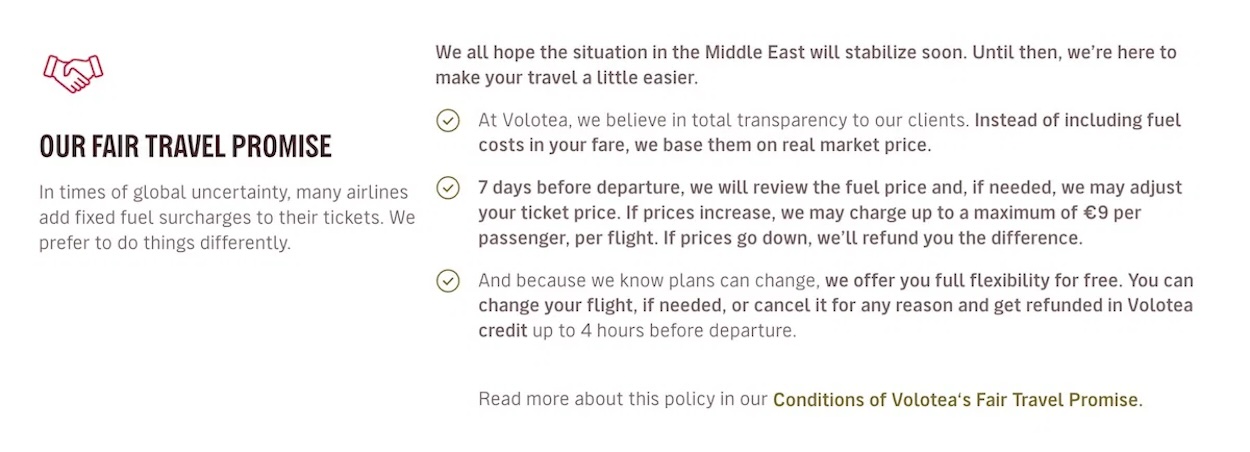
We all hope the situation in the Middle East will stabilize soon. Until then, we’re here to make your travel a little easier.
- At Volotea, we believe in total transparency to our clients. Instead of including fuel costs in your fare, we base them on real market price.
- 7 days before departure, we will review the fuel price and, if needed, we may adjust your ticket price. If prices increase, we may charge up to a maximum of €9 per passenger, per flight. If prices go down, we’ll refund you the difference.
- And because we know plans can change, we offer you full flexibility for free. You can change your flight, if needed, or cancel it for any reason and get refunded in Volotea credit up to 4 hours before departure. Read more about this policy in our Conditions of Volotea‘s Fair Travel Promise.
At first glance, this might sound reasonable…a sort of dynamic pricing tied to real-world costs. The fine print (contract of carriage) even explicitly states that Volotea can do this.
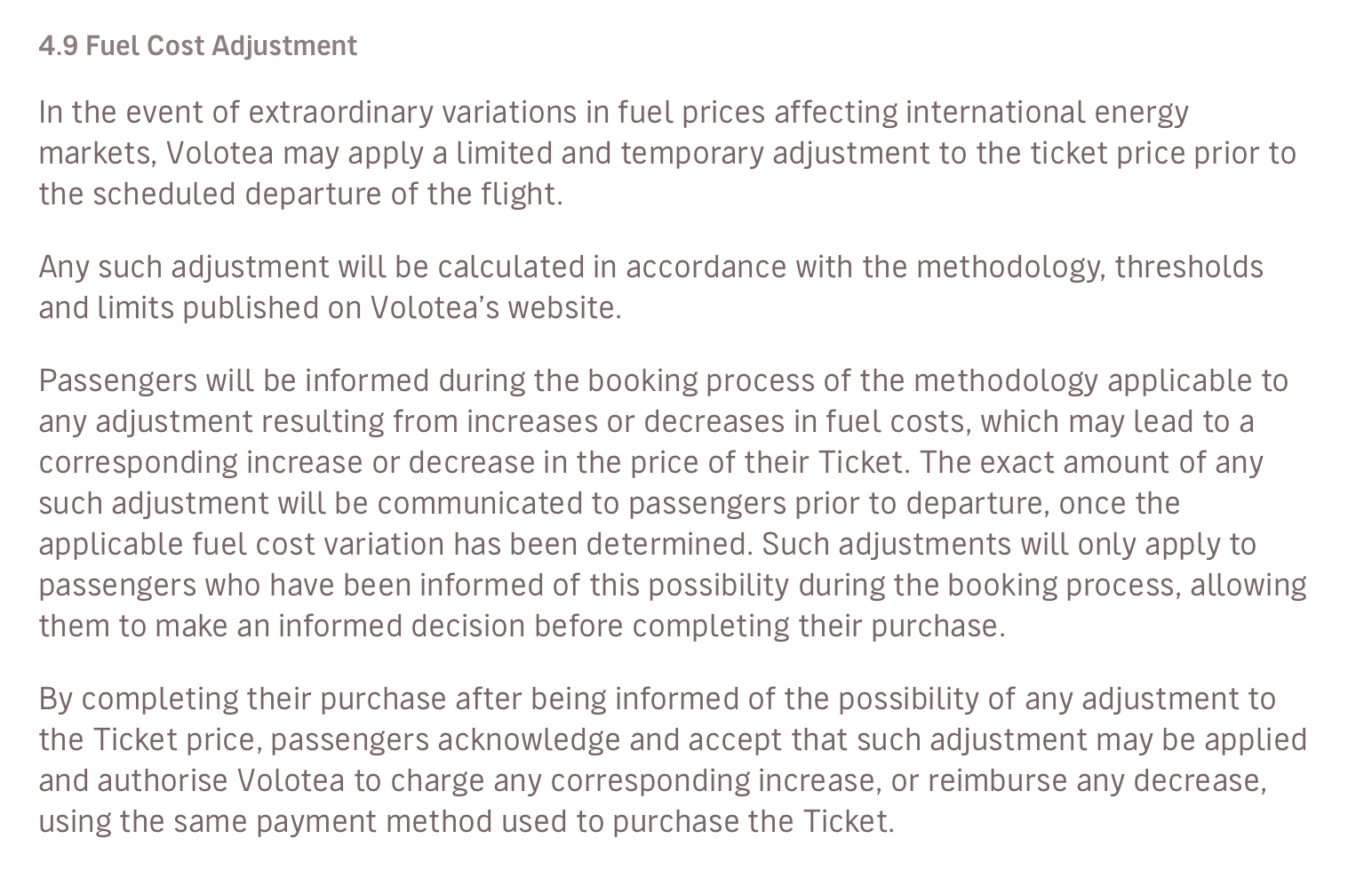
But that’s not how airline pricing works. And more importantly, that’s not how EU law works either.
This Is Not How Airline Pricing Generally Works
Airlines deal with volatile fuel prices all the time, even if the recent Iran War has been a rather severe shock.
Some hedge fuel. All build risk into fares. They adjust pricing constantly based on demand and costs. But once you purchase a ticket, the price is supposed to be fixed.
Sometimes you win, sometimes you lose…that’s the business.
But Volotea is effectively trying to shift that risk directly onto passengers and I’m not buying it.
EU Law Requires Final Pricing Upfront
I’m by no means an expert in EU law, but as I read EU Regulation 1008/2008, it appears that airlines must display the final price at the time of booking, including all unavoidable and foreseeable charges.
Customers should be able to compare effectively the prices for air services of different airlines. Therefore the final price to be paid by the customer for air services originating in the Community should at all times be indicated, inclusive of all taxes, charges and fees.
Fuel costs are not some unforeseeable surprise: they are a core part of airline operations. If an airline wants to account for fuel volatility, it must do so in the ticket price at the time of purchase…not after the fact.
There is (arguably) a limited exception for government-imposed taxes or airport fees that change after booking. But fuel is not a tax: it is an operating cost.
Even if Volotea argues that passengers were informed of this policy at the time of booking, that does not automatically make it acceptable, legally or practically. There are certain consumer protections that should not be barterable (safety being the most obvious example). I’d say this is one too: post-purchase price increases create dangerous precedent and the EU has clearly spoken that ticket prices are locked in at the time of ticketing.
So when One Mile At A Time says, “So if an airline wants to tell passengers that their ticket cost will be based on the cost of providing the service, there’s nothing wrong with that, in theory,” I agree, to the extent that cost is calculated before the contract us formed, i.e. the ticket is purchased. But after booking? Nope…
CONCLUSION
Volotea’s new fuel surcharge policy may sound innovative or even fair, but it runs counter to how airline pricing has traditionally worked, is not an ancillary item, and likely conflicts with EU consumer protection rules.
Airlines are free to price tickets however they want…but once you buy, the price should be the price. We’ve seen so many ancillary benefits chipped away and that strikes me as a reasonable business model, but this is a hostage situation: you pay use more or you can’t fly. Sorry, but no, gracias.
image: joy_merc / TikTok // hat tip: PYOK






Matt, correct me if I am wrong, clearly deceptive and likely violations of the following:
If in the US, such an after the fact mandatory charge would likely violate DOT rules like 14 CFR § 399.88, which bans post-purchase price increases, and 14 CFR § 399.89, which governs fuel surcharge notifications.
If in Europe, EU price transparency rules, specifically Regulation (EC) No 1008/2008, requires that the final price shown at the time of booking must include all unavoidable and foreseeable taxes, fees, and surcharges.
But, like most laws, these are human constructs, and have to actually be enforced. Time to sue some airlines.
Yes, it is my understanding both US and EU law prohibit this sort of thing even if it is “disclosed” during time of purchase.
So, it’s basically like speeding at this point; if it’s 1-5 mph over (or in this case, an extra €9/passenger), maybe no one cares enough to enforce it. But, if airlines (or drivers) start to get greedy/excessive (say, €99 or €999), it’s like going 30 mph over the limit in a school zone… fines, arrest, etc.
I checked their website. You get a clear warning of the policy. You can continue or not. So, I consider it fair, but I can’t comment on the legality (and, of course, you can argue illegal is never fair, but deep philosophical arguments don’t happen here).
Why must you cheapen our discourse, sir? There are ample ‘deep’ conversation here, and the various other blogs. There’s also ample banter, tomfoolery, inside jokes, etc. Live a little. Say whatever you wanna say. Matt (and maybe Kyle) is the only gatekeeper here.
Compared to what? I’d say they happen on this travel blog far more than just about any other in this space.
Exactly. You’re more high-brow that the usual turd-slinging we get over at View from the (Right) Wing (sorry, Gary!) And certainly more long-form than the comments sections at OMAAT. No where else is really having discussions, but for Cranky Flier, and they get a bit technical, while trying to stay a-political. I like what you got going on at LALF.
To be clear, I was not offering criticism of your (or Kyle’s) posts. They’re always quite thoughtful (as the topic allows). The quality of the debate by most who post here on contentious topics would kill my HS debate coach if he were alive. (He’d have sharp words for me, too.)
With a fleet of 40 aircraft (average fleet age of 19 years) as of April 13, 2026, only time will tell if V7 can overcome this challenging period following its recent controversial decision…
as you said you are not an expert in EU law – in any case we will find out if you are right or not if the EU acts – they can also simply cancel the flight period – yes of course you get a refund of the original price paid which may not even enough to buy a new ticket on any airline
airlines cancel flights routinely for many reasons – they do not need to provide explanations and many cancellatiosn carry no compensation
and indeed I found an article in Spanish stating they are actually cancelling not some but All flights until end of April – yes you can rebook or be refunded –
I hope the EU will crack down on this anti-consumer behavior.
Sorry, but an airline that can’t properly forecast for fuel strikes me as a carrier that may not be fit to manage safety properly…or other critical functions.