
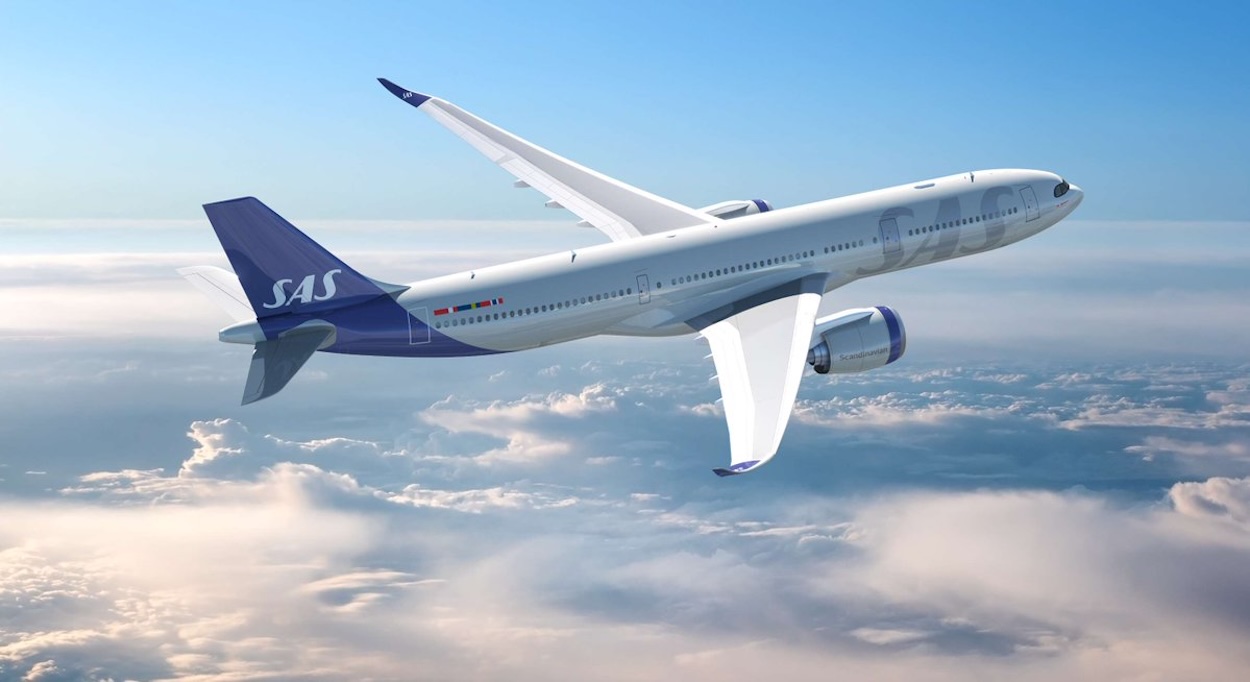
SAS has announced the largest aircraft investment in its history: Copenhagen is going to become a much more serious global hub.
SAS Orders Airbus A330neos As Copenhagen Global Hub Ambitions Grow
SAS has announced the largest investment in company history, with plans for up to 40 Airbus widebody aircraft as it rebuilds itself around Copenhagen and looks toward a much larger longhaul network.
The order includes new Airbus A330-900neo aircraft, along with additional Airbus A330-300 aircraft to support nearer-term growth before the new jets arrive. The plan includes 18 firm A330-900neos, options for 10 more, and 12 used A330-300s.
To put that in perspective, SAS currently operates only 14 longhaul aircraft, eight Airbus A330s and six Airbus A350s, so even the firm A330neo order alone would more than double its longhaul fleet. Including the used A330-300s, SAS could roughly triple its intercontinental fleet, before even counting options.
SAS calls this the largest investment in its history, with a list price of more than $10 billion. The airline says the aircraft will strengthen connectivity between Scandinavia and the world, with Copenhagen at the center of that strategy. SAS also says its planned growth at Copenhagen could support an additional 25,000 jobs and contribute DKK 25 billion to GDP by 2030.
After years of dissapointing performance and a lack of investment from Norway and Sweden, SAS is no longer pretending it can spread longhaul flying across Copenhagen, Stockholm, and Oslo.
Copenhagen is the hub…
Copenhagen Is The Logical SAS Longhaul Hub
SAS has long suffered from trying to serve three Scandinavian capitals while competing against larger European airline groups with more focused hub structures. Stockholm and Oslo are important markets, but Copenhagen has the best geography for a true connecting hub. It sits at the southern edge of Scandinavia, has a strong local market, and can funnel traffic from Denmark, Sweden, Norway, and parts of Northern Europe into longhaul flying. The Danish government has also been a more willing partner.
The move to SkyTeam also changes the picture. SAS is now aligned with Air France-KLM, and Copenhagen can become a useful northern complement to Amsterdam and Paris rather than a stranded Star Alliance outpost competing against Lufthansa Group, United, and Turkish Airlines.
Copenhagen does not necessarily need to become another Amsterdam or Paris to be successful, though I could see a growth rate that exceeds that of CDG or AMS. The A330-900neo, and even the used A330-300s, are also a sensible aircraft for that mission. It has the range for Asia, North America, and Africa, but also not too large that yields will be errored in order to fill seats.
Where Could SAS Fly Next?
The obvious question is where these aircraft will go.
In North America, SAS already has excellent coverage and I’m not sure that more service to New York, Washington, Los Angeles, or Boston is needed. Maybe Vancouver, even though it already serves Seattle? Perhaps some Delta hubs like Detroit and Minneapolis if it joins the transatlantic joint venture? Maybe to South America for the first time?
SAS already has a long history in Asia, and Copenhagen is geographically well positioned for routes to Tokyo, Seoul, Bangkok, Singapore, and Shanghai. Seoul would be particularly interesting in a SkyTeam context with Korean Air. Tokyo and Bangkok will certainly continue and maybe we will see expansion to Mainland China? Singapore or Vietnam would be ambitious, but doable.
I would also watch India. SAS recently launched service to Mumbai and we could see growth to additional cities in India. Africa is probably more selective and well-handled by Air France, but Cape Town, Johannesburg, or Nairobi could be intriguing if SAS wants seasonal winter flying and SkyTeam connectivity. I would not expect a huge African push, but I’d love to see Cape Town service.
CONCLUSION
SAS has announced a major widebody investment, including new Airbus A330neos and additional A330-300 jets, in what it calls the largest investment in company history.
The aircraft order is big news, but the bigger story is Copenhagen. SAS is increasingly building around CPH as its primary global hub, and that is the only strategy that really makes sense.
SAS is coming out of a very difficult period. It has changed alliances, restructured, taken on new investors, and now wants to build a much larger longhaul operation. To succeed, it will need the right schedule banks, competitive premium cabins, reliable operations, and enough connecting feed from Scandinavia and Northern Europe to fill these aircraft year-round.
I would expect more North America first, then a careful rebuilding of Asia, with select opportunities in India, Africa, and seasonal leisure markets. Not every route will work, but SAS finally appears to have a more focused longhaul plan.
Copenhagen is not going to become Amsterdam overnight. But with the right aircraft, the right SkyTeam feed, and a little discipline, it can become a much more important global hub than it is today.
image: Airbus




Leave a Reply