
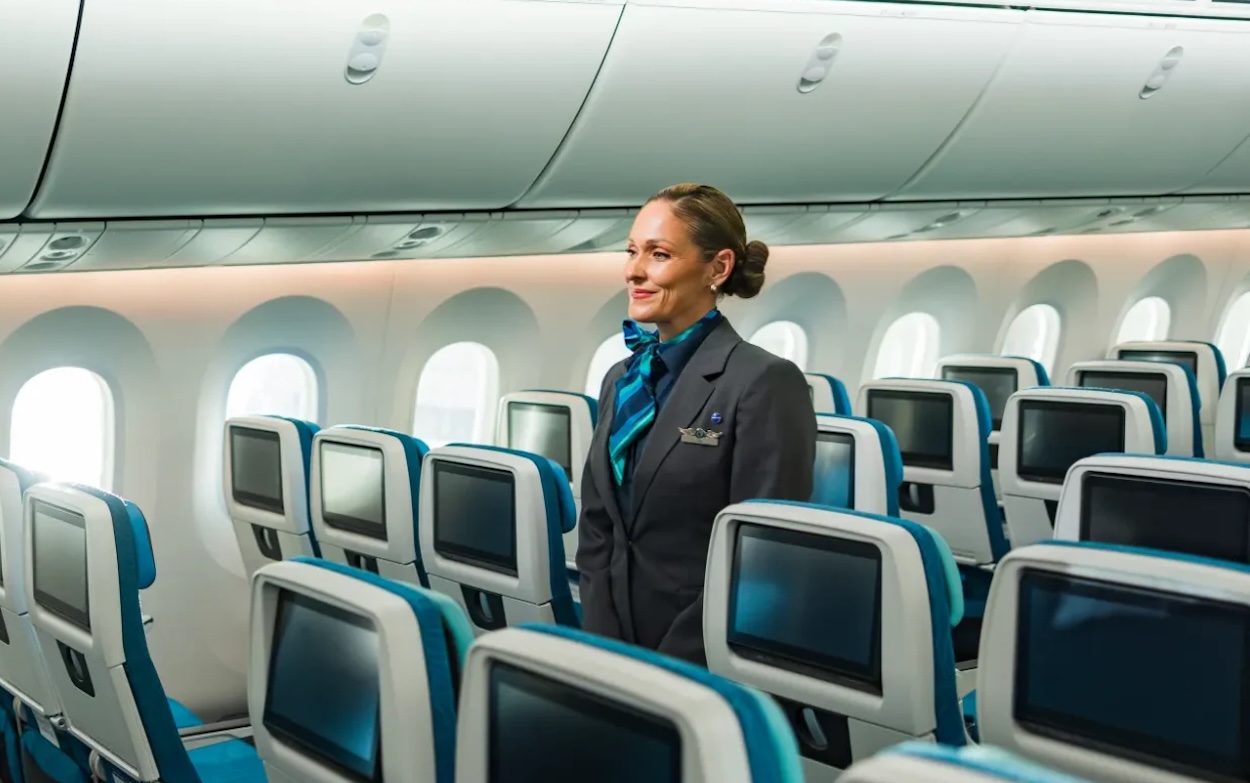
Flight attendants operating Alaska Airlines’ new longhaul Boeing 787-9 flights say the carrier is asking too much of them, filing a formal grievance that attempts to gives management an ultimatum: add more flight attendants or cut back onboard service. I’m all for more staffing, if truly needed, but cutting service strikes me as exactly the wrong answer.
Alaska Airlines Flight Attendants Demand More 787 Staffing Or Reduced Inflight Service
Alaska Airlines is only a few months into its new longhaul era, with Boeing 787-9 service from Seattle (SEA) to destinations including Rome (FCO), London (LHR), Seoul (ICN), and Tokyo Narita (NRT).
These aircraft came from Hawaiian Airlines and, for now, the Alaska-branded 787 flights are operated by pre-merger Hawaiian flight attendants. Apparently, the transition has not been entirely smooth…
The Association of Flight Attendants has now filed a formal grievance over the inflight service model on these aircraft, arguing that Alaska has created an “unsustainable” workload, particularly in economy class.
In a memo to flight attendants, the union explains:
“For decades, Hawaiian Airlines Flight Attendants have defined the Spirit of Aloha. We take pride in delivering world-class service, but management’s current Boeing 787-9 service model is threatening that legacy. It isn’t just inefficient, it’s an unsustainable pace that undermines the quality our passengers expect and the professional standards our crews deserve.”
The dispute dates back to the launch of Alaska-branded international 787 service in April. Management offered a 30-day observation period during which flight attendants could provide feedback on the new service flow. That period ended on May 28, but the union says Alaska has yet to make the changes flight attendants have requested.
The union claims Alaska’s response has essentially been:
“Make it work.”
Now AFA has filed a formal grievance, arguing that Alaska has violated Section 29.I.4 of the Hawaiian flight attendant collective bargaining agreement, which requires mutual agreement concerning inflight service requirements.
What’s So Difficult About Alaska’s 787 Service?
The issue is primarily in economy class, according to the union.
Alaska’s 787-9 has 300 seats, including 34 in business class and 266 in economy. Flights are typically staffed with 10 flight attendants, with four assigned to business class and six to economy.
The economy service uses a “train” model in which flight attendants work through the cabin from front to back rather than each working only a small section.
The union says it originally signed off on that service flow, but Alaska subsequently added additional elements without putting the revised service through another round of testing. Those additions reportedly include enhanced service for Premium Class passengers, elite recognition, expanded beverage choices, alcohol for purchase, ice cream, and warm cookies.
The union argues those extras changed the workload substantially:
“Current main cabin staffing levels currently make it impossible to deliver on management’s promises. We will not stand by while our professional standards are compromised due to their unwillingness to invest the necessary resources needed to make their service model work.
“At its core, this grievance is about one simple principle: If management expects a certain level of service, it must provide the staffing necessary to deliver it. They face a clear choice: increase staffing to meet their service goals, or work with our Inflight Service Committee to establish realistic service standards that actually reflect the staffing provided. Until they choose one, we will not accept being set up for failure.”
I understand the contractual argument. If the collective bargaining agreement requires Alaska and AFA to mutually agree upon service standards and Alaska materially changed the service after the union signed off on it, that’s a legitimate issue for the grievance process.
I’m less convinced by the argument that the service itself is simply too much to accomplish with the staffing Alaska provides.
I’d Rather Alaska Add Crew Than Cut Service, But Is The Current Service Really Impossible?
I have not flown Alaska’s new longhaul product yet. I look forward to doing so, and therefore I cannot offer a firsthand judgment on whether the service flow actually works in practice. But on paper, I’m not overly sympathetic to the suggestion that the service Alaska is offering is somehow unreasonable.
Ten flight attendants on a 300-seat 787 does not strike me as extraordinarily lean staffing by U.S. airline standards. Nor do the service elements being singled out strike me as particularly exotic.
Expanded beverage choices? Alcohol sales? Ice cream? Warm cookies? Other U.S. airlines manage similar service elements on longhaul flights, including Delta from Seattle. It’s not as though Alaska is asking flight attendants to prepare individually plated seven-course tasting menus in economy class.
Of course, I would happily see Alaska add another flight attendant or two. One reason service on carriers in East Asia can be so much better than what we receive on U.S. airlines is that those carriers often devote more human resources to the cabin (thanks to cheaper labor costs). More flight attendants means more time for proactive service, more frequent beverage refills, faster meal delivery, and cleaner lavatories.
If Alaska decides that investing in additional staffing is worthwhile to create a better product, wonderful. I would applaud that. In any case, what I don’t want to see is Alaska solve this dispute by eliminating service. If the choice becomes another flight attendant versus no ice cream, fewer drinks, or a stripped-down economy service, I’m rooting for the extra flight attendant.
But I also wonder whether some of this simply reflects a learning curve?
Alaska Is Learning How To Be A Global Airline.
For the first time in its history, Alaska is building a true longhaul international network from Seattle. That means new aircraft, new routes, new catering, new service procedures, and a different rhythm onboard than flying domestically.
The flight attendants operating these aircraft came from Hawaiian, but Alaska’s service concept is new to them too.
I expect both sides will learn.
Management will figure out which parts of the service look good on paper but do not work particularly well at 35,000 feet. Flight attendants will become faster and more efficient as they perform the same service repeatedly. Procedures will be refined. Galleys will be better organized. Little inefficiencies will disappear.
That’s why I’m especially reluctant to conclude a few months into this experiment that Alaska needs to start cutting things. Give it some time…
My friend Rocky Horan just flew Alaska’s new 787-9 from Seattle to Rome and reviewed the flight on Travel Codex. His biggest complaint was not that the flight attendants couldn’t complete the service, it was the food.
Rocky liked the seat, bedding, amenity kit, and overall onboard product, but called the catering “abhorrent” and described his main course as “inedible.” He encountered an incorrect menu, cold soup, stale bread, rock-hard butter, and entrees so salty that he and his partner sent them back.
That’s particularly surprising because Alaska traditionally does a very good job with its domestic catering. But it also illustrates the larger point. Alaska is learning how to operate a longhaul airline, and there are going to be growing pains.
Fix the catering, refine the service flow, and add staffing if the numbers justify it…but please don’t respond by making the passenger experience worse, especially in a competitive environment out of a competitive hub like SEA.
CONCLUSION
Alaska’s 787 flight attendants have filed a formal grievance arguing that the carrier’s current economy service is unsustainable at existing staffing levels. Their demand is straightforward: add crew or reduce the service.
I respect the contractual issue and would certainly welcome more flight attendants onboard. More staffing is one of the easiest ways to improve service. But I’m not persuaded that offering expanded beverages, alcohol, warm cookies, and ice cream makes Alaska’s economy service uniquely burdensome compared to its U.S. competitors.
This is Alaska’s first attempt at longhaul international flying. There will be a learning curve for management and flight attendants alike. They’ll figure it out….that learning curve should not come at the expense of onboard service.
image: Alaska Airlines // hat tip: Paddle Your Own Kanoo






Alaska’s experiencing a lot of changes (and growth), between the new international routes and aircraft and the continued merge with Hawaiian, so while they did ratify a new contract in 2025, more changes should be expected. Keep in mind, most of their bases are in higher-cost-of-living areas, majority on the West Coast. Hope they get the relief they’re looking for, soon.
Standard crew is 9 flight attendants with 5 in main cabin on these flights.
AS mgmt will solve the staffing issue by flying a Max 10, when they get certified.
another example as to why unions should be illegal
Two examples provided today here on LALF!
Lazy and too busy looking forward to small Asian d#ck when they land.
Kyle I don’t know you, and I’m far from prudish, but do you think your comment was mature and befitting of an adult? Or is that type of comment more common amongst adolescents/preteens? I’d actually argue that most adolescents wouldn’t even post a comment like that on an aviation blog. You should be ashamed of yourself.