
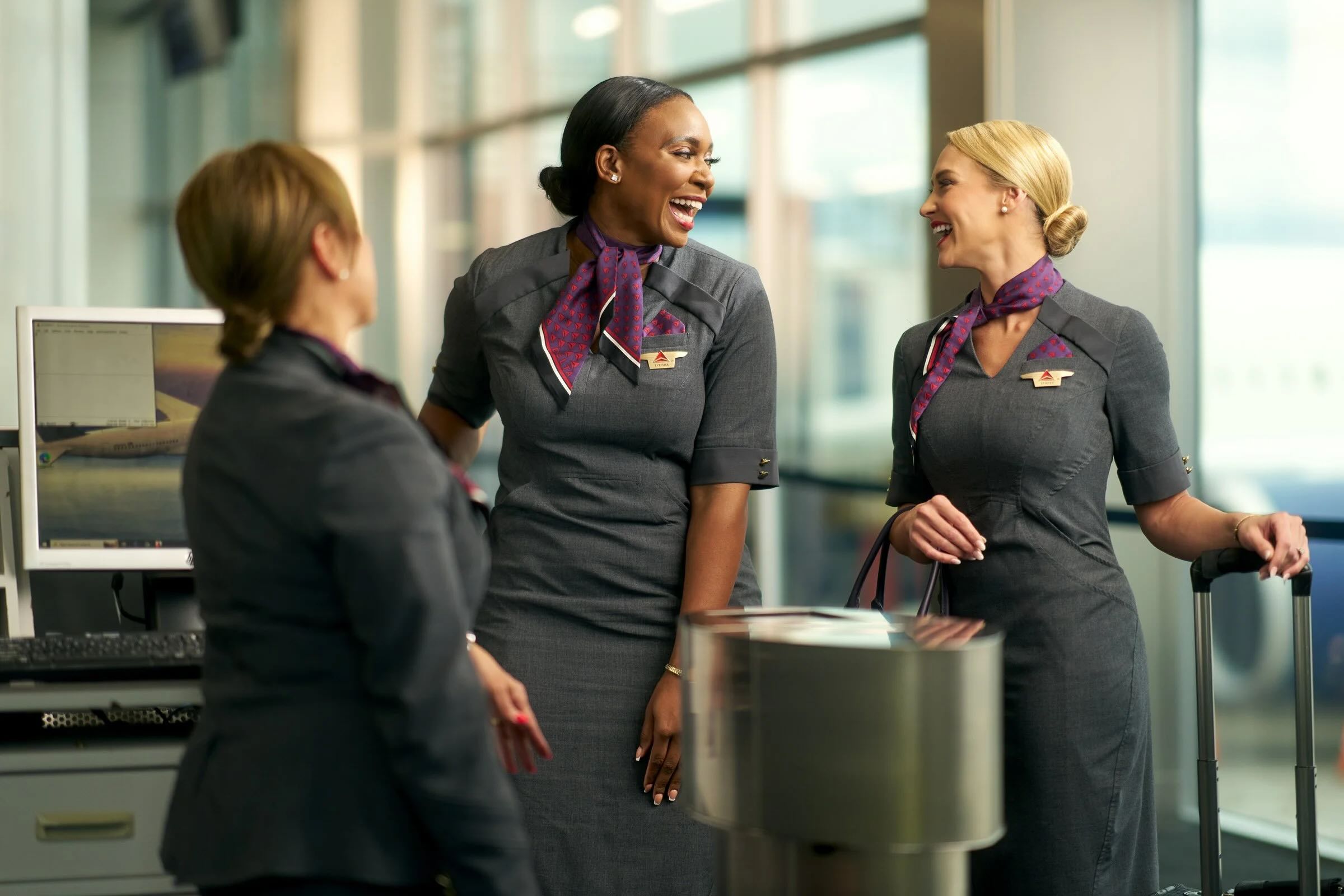
Delta Air Lines flight attendants woke up to tangible money this week. United Airlines flight attendants woke up to another update about negotiations.
Delta Flight Attendants Collect Massive Bonuses And Pay Raises While United Talks “Offsets”
The contrast could not be clearer.
Delta announced that its flight attendants (and other employees) received their portion of $1.3 billion in profit sharing today, alongside recently implemented industry-leading pay increases that went into effect as part of Delta’s non-union compensation structure. It is real money, paid now, layered on top of wage rates that Delta had already raised preemptively in response to post-pandemic labor pressure across the industry. Delta has also promised pay raises in 2026 to flight attendants and other work groups.
At United Airlines, by contrast, flight attendants remain in protracted negotiations with management, with no agreement yet in place. A new update from United’s labor relations leadership underscores just how wide the gap remains.
In a February 2026 memo to inflight services employees reviewed by Live And Let’s Fly, United Vice President of Labor Relations Nathan Lopp framed the most recent bargaining session as centered on economics, while emphasizing that the company believes it has already put a best-in-industry offer on the table.
Lopp wrote that United has proposed a contract that would deliver the highest flight attendant pay among U.S. carriers, effective from day one through the amendable date of the agreement. According to management, the proposal would place pay for every flight attendant at every level at the top of the industry.
“United offered a proposal that would deliver the highest flight attendant pay among U.S. carriers. Over the term of the agreement, starting on day one to the amendable date of the contract, pay for EVERY flight attendant at EVERY level would be top of industry.”
But the memo also makes clear why no deal has been reached.
United says there remains a “significant gap” over how to offset the cost of the Association of Flight Attendants’ latest proposals, including expanded sit pay and signing bonuses. United claims it has offered solutions and pathways to improve compensation while keeping the contract balanced, competitive, and financially sustainable, but says AFA leadership has rejected those proposals and has not presented alternative cost offsets.
“The union has thus far failed to present cost offsets or alternative proposals that would help balance the contract.”
The tone of the message is telling. While reaffirming a commitment to reaching an agreement, the emphasis is not on urgency or closure, but on process, balance, and sustainability. The next negotiating session is scheduled for early March.
A Huge Contrast Between Delta And United
That messaging lands very differently when set against what Delta flight attendants (and other workers) just received.
Delta’s model is not without its critics, particularly among union advocates, but the outcome is hard to ignore: higher pay, immediate cash, and a workforce that sees results without waiting years for a tentative agreement to be ratified. The idea that this is all a “ruse” to keep Delta employees from unionizing or only possible thanks to unionized flight attendants at American Airlines and United Airlines strikes me as unpersuasive.
The key at Delta, among its unionized and non-unionized workgroups, is good management. I’d day the same thing is true at United under CEO Scott Kirby, though the difference is that the archaic system that unions have built in the airline industry leads itself to these sorts of stalemates, and so much of the delay strikes me as merely for posturing (at least at this late point the game).
For United flight attendants, the frustration is less about whether management’s offer is theoretically competitive and more about fringe benefits and other rules that flight attendants fear will be reduced to their disadvantage to offset higher wages. There are real issues on the table and like any negotiation, compromise will leave both sides somewhat unhappy.
The divergence between Delta and United also highlights a broader structural reality. Delta can adjust compensation unilaterally and distribute profit sharing at will. United must negotiate every dollar, every rule, and every premium across the table with a union that is not also not willing to budge, but in a weaker bargaining position.
CONCLUSION
Whether United can close that gap with Delta in the coming months on a deal with flight attendants will depend less on rhetoric about “top-of-industry pay” and more on whether management and labor can strike a pragmatic deal that leaves flight attendants somewhat satisfied without burdening United with labor costs that will inhibit its growth plans or force it to cut back on improvements to the onboard product to meet Wall Street profit expectations.
Like American Airlines’ nebulous strategy for growth, so to is the solution to this five-year labor battle with United. And even an industry-leading deal will not solve the “delta” (if you’ll pardon the pun) in profits between the two carriers that means that Delta will continue to lead in profit sharing.
But what is clear that United appears in no rush to cave in and that spells a problem for flight attendants because even though United will eventually have to “pay the piper” in terms of backpay, it figures that it does not need to give in and can continue to push for an overall package that it feels will not put it at a competitive disadvantage. I don’t see that posture changing anytime soon.
image: Delta Air Lines






The union-bashers are gonna rush on here, forgetting that Delta has a pilots union since 1934…
Fellas, unions aren’t the problem; it’s management. Mis-management.
So Kirby is blaming everyone but himself. That’s just about right for him. Remember the last time he said “This is my fault”? Me neither.
Delta gets it … a take on “Happy Wife. Happy life”. And because Delta Management gets it, Employees are happier and willingly give a better performance. It’s been proven many times over. United and American seem to want discourse and dissension. Therefore, they’ll never be rated #1 until their Employees are happy.
DL is giving the crew an incentive to accept single aisle planes with 44 F seats.
Some win, some wait.
Just a reminder that DL led the industry in raising pay post covid for its pilots with a contract that was twice what UA offered its pilots in a contract that was shot down; DL then followed that with a raises for its non-union employees and they have seen multiple raises since.
The difference isn’t between union vs. non-union structure. DL has both and both received massive increases before everyone else.
UA has multiple open labor contracts covering tens of thousands of employees. They could pay out profit sharing or anything above the current contract if they wanted to – but UA simply wants to grow off the backs of its underpaid employees.
and the core topic here, profit sharing, will be much lower for UA employees if they all get the same profit sharing formula; UA’s labor costs are going to increase by at least hundreds of millions of dollars per year.
DL pays its employees well including with US corporate leading profit sharing because it wants its employees to deliver industry-leading service; UA mgmt talks about offering high pay but you don’t trail your competitors in every contract negotiation cycle and pay them less if you really want the highest paid employees. In return, UA is quite ok w/ industry average or worse customer service metrics.
and let’s keep in mind that most of the rest of the industry has no meaningful profit sharing so this discussion is really just between DL and UA, the former of which is the only airline that actually delivers industry leading pay and profit sharing
Delta pays their employees well to keep them from unionizing, plain and simple.
As bad as some corporate management is, unions are run by the dumbest folks you can find. Or, they aren’t so dumb, they just act to benefit themselves and f¤ck the membership.
Do attendants get back pay? Mechanics don’t at UA
Don’t get me wrong, if the other airlines were not unionized you wouldn’t see DL thriving in this way, and don’t forget they are the most profitable. I guarantee you AA wouldn’t be handing out raises and bonuses lmao.
It’s wild that UA just drags out negotiations for years. Backpay is what punishes that, without it the company doesn’t care and will literally go 5-10 years before negotiating. I think UA will get to the top or close to the top of the pay scale though, regardless of the doom and gloom. It’s just gonna be years out.
I don’t believe in backpay, but it’s a thing and will be part of any deal.
I am curious,. By all measures, what do recommend in lieu of back pay? It’s obvious that discussions for years of lost wages will not be paid into a new contact. That becomes a much larger fixed cost the Airline would never agree to pay out over the terms of a new contact. In fact, no business would ever look back and pay anyone for lost wages in much larger financial agreement.
Bryant REPLY
February 15, 2026 at 4:51 pm
I am curious,. By all measures, what do you recommend in lieu of back pay? It’s obvious that discussions for years of lost wages will not be paid into a new contract. That becomes a much larger fixed cost the Airline would never agree to pay out over the terms of a new contract. In fact, no business would ever look back and pay anyone for lost wages in a much larger financial agreement. Here is a better spell checked response. Thank you
Delta, of course, being non-union doesn’t talk about “off sets” or anything else. Delta just pays what it wants and sets work rules as it wants, so don’t get smarmy about United.
Everybody talks about the FAs contract negotiations (for good reason), but the mechanics are also going on over a year without a contract now. Their profit sharing payout this year was 2.8%