
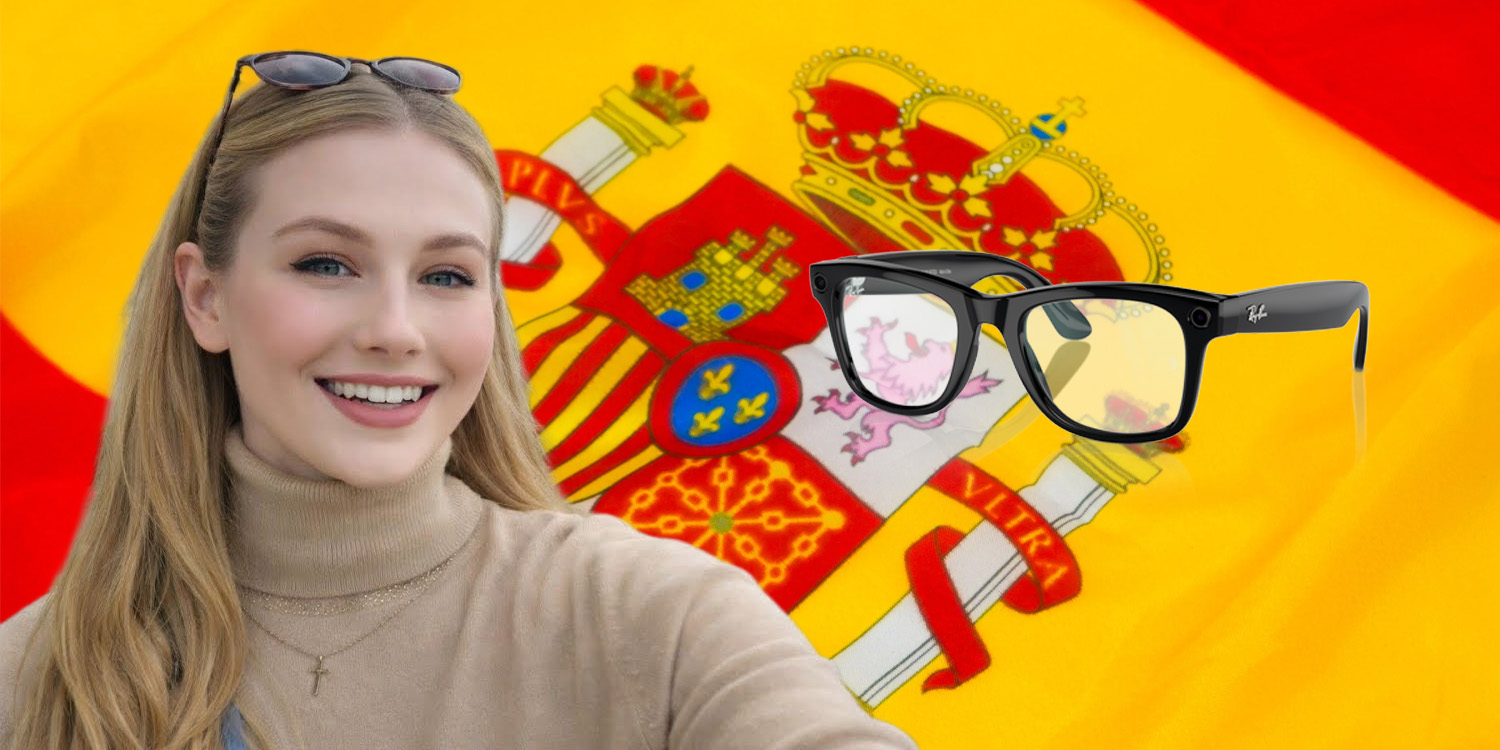
A travel vlogger claims Volotea staff abandoned their desk after she refused to stop recording them with Meta AI glasses, but the bigger lesson here is a reminder that privacy laws in Europe are very different than in the United States.
Travel Vlogger Records Volotea Staff With Meta AI Glasses, Then Wonders Why They Refused To Help Her
A travel vlogger says Volotea staff at an airport in Spain refused to help her with a boarding pass issue after she declined to stop recording them with Meta AI glasses.
The incident occurred on June 4, 2026, when travel vlogger “Escape with Emily” was attempting to fly on Volotea from Oviedo, Spain (OVD) to Paris-Orly (ORY). She says she checked in online, but never received her boarding pass, despite a message from Volotea indicating it would be sent by email.
When she arrived at the airport, Volotea staff reportedly told her that the system did not show her as checked in and that she would have to pay the airport check-in fee to receive a boarding pass. Like many European low-cost carriers, Volotea charges passengers who show up at the airport without having completed the online check-in process or obtained a boarding pass in advance.
That is frustrating, especially if she truly did check in and the failure was on Volotea’s side. Volotea also has a rather punitive online check-in cutoff of 2.5 hours prior to the flight.
But the situation took a turn when staff realized she was recording them with Meta AI glasses. The agent told her that the conversation would only continue if she stopped recording. She refused. The agent disengaged. A station manager later repeated the request, warned her not to post video of airline workers on social media, and threatened to call law enforcement if she continued.
Eventually, the staff reportedly left the customer service booth rather than continue being recorded.
Emily later complained to Volotea, but the airline’s response focused not on the boarding pass dispute, but on the recording:
“It has been reported that you recorded our airport staff without their consent, violating Civil Aviation regulations, as well as the accepted conditions of carriage.”
Volotea added:
“At Volotea, we maintain a zero-tolerance policy towards any behavior that may compromise safety and compliance with current regulations.”
Here are a couple of the social media posts from Emily:
(you have to go to about 21 minutes in for the airport interaction)
Part 1 @volotea I complained about how I was treated by Volotea staff at the airport after being charged for a boarding pass issue and receiving no assistance from multiple employees.
Their response?
Not an apology. Not an investigation into the customer service complaint. pic.twitter.com/cATg82rgKe
— Escape with Emily (@Escapewithemily) June 13, 2026
Spain a third world country?! Please stay away from Europe Emily, because you give every American a bad name…
Europe Is Not The USA When It Comes To Recording People
There is a very American instinct that says, “I have a right to record this.” It’s true that in many public-facing interactions in the United States, that instinct is broadly correct, or at least widely tolerated. But this happened in Spain.
European privacy norms are different. Spanish privacy protections are different. Volotea’s conditions of carriage reference Ley Orgánica 1/1982, Spain’s law protecting honor, personal image, and personal and family privacy. That framework is far more protective of personal privacy than what many Americans are used to.
An airport may feel like a public space, but in Spain you subject to national law, which protects privacy. Airline employees working at a counter are not props in a TikTok video, and they are not obligated to keep participating in a conversation while being recorded for social media.
I understand why a passenger may want to document a dispute, but it just doesn’t fly in Spain and in most of Europe.
Volotea’s response framed the recording as a matter of safety and compliance. Maybe that’s a bit much. This was not a direct security threat in the way that intoxicated behavior would be. Recording a customer service interaction at a check-in counter is not inherently dangerous.
But a privacy issue can become a security or compliance issue when a passenger is repeatedly instructed to stop and refuses. At that point, the problem is no longer merely “recording.” The problem is refusing to comply with instructions…lawful instructions.
Airline and airport staff should not be able to hide behind “security” every time a customer wants accountability, but passengers also do not get to import American social media habits into every country and then act shocked when local laws and norms are different.
If an employee in Spain tells you not to record her, stop recording her…that’s sage advice for wherever you are in Europe.
I Have Some Sympathy On The Boarding Pass Issue
If Emily really checked in online and Volotea’s system told her that her boarding pass would arrive by email and it never did, then I have sympathy for her. Low-cost carriers love to build fee traps into the customer journey, and an airport boarding pass fee can feel especially obnoxious when the problem is caused by the airline’s own technology.
Volotea says passengers can check in online and obtain boarding passes before reaching the airport, but passengers who show up needing assistance at the counter can face a fee of €30.
So if Volotea’s website or app failed, the passenger should not be punished for that. But I am also a little suspicious.
Volotea allows online check-in well in advance of departure, including up to four days before travel for passengers who have not purchased seats. That means there was time to chase this down before arriving at the airport. If a boarding pass never came by email, I would have tried the app, the website, screenshots, customer service chat, and anything else available before getting to the check-in counter.
That does not excuse poor customer service or even necessarily the initial refusal just to print a boarding pass. But it does make me wonder whether this was a last-minute problem that could have been addressed earlier.
Tip: Record Staff With Caution, Even Where Legal
Recording people can sometimes be necessary. It can protect passengers from bad behavior, discriminatory treatment, false accusations, or abusive staff. I am by no means categorically against recording in travel disputes.
But recording should be a last resort, not the first move.
Once you start filming, the interaction changes and everyone becomes defensive or even angrier. And with smart glasses, the optics are worse. A phone camera is obvious. Meta glasses feel sneaky, even if they are technically visible with that bight light they are supposed to emit when recording..
When this happen, the traveler may think she is documenting injustice, but if staff thinks they are being harassed and recorded without consent, problems will not be solved.
CONCLUSION
A USA-based travel vlogger claims Volotea staff abandoned their desk after she refused to stop recording them with Meta AI glasses during a boarding pass dispute in Spain.
I have some sympathy if Volotea’s technology failed and she really did check in online. But recording airline staff in Spain after being told to stop is a very bad idea. European privacy laws are different than U.S. norms, and airline workers are entitled by law to privacy. This was not primarily a security issue, but it was a privacy and respect issue that could quickly become a security issue once the passenger refused instructions.
Document your dispute with screenshots, but do not assume you can walk into a European airport, record workers, and be surprised when they refuse to play along. I could describe this person in much harsher terms, but I think you get my point and so I’ll save my breath.
Hat Tip: PYOK






“Newest African Country…” Ok, so, this person is ignorant, because some of the most luxurious properties with the best service in the world are safari lodges in Africa, but, okay, probably just intentional bigotry (Africa-bad), rather than lack of awareness. *sigh*
She’s a low-information Trump voter (not calling all Trump voters that), which his shocking considering how well-traveled she is.
I’m reminded Mark Twain’s wisdom:
“Travel is fatal to prejudice, bigotry, and narrow-mindedness, and many of our people need it sorely on these accounts. Broad, wholesome, charitable views of men and things cannot be acquired by vegetating in one little corner of the earth all one’s lifetime.”—”Innocents Abroad,” 1869
“I have found out there ain’t no surer way to find out whether you like people or hate them than to travel with them.”—”Tom Sawyer Abroad,” 1894
Matt, I take it back; I went and actually watched some of her content. Emily has been all over. Honestly, probably more than you or Ben at this point. She’s pushing toward 184 countries (Matt, what’s your official count right now? 135-ish? I’m closing in on 100, mostly because I’m still relatively risk-averse, and just a commenter).
Quantity over quality, that’s for sure. She’s posted on her visits to Somalia, Afghanistan, Syria, Burkina Faso, Eritrea, and Guinea-Bissau. She clearly doesn’t fit into the mainstream, even among top travel vloggers like Mark Wiens, Kara and Nate, or Abroad in Japan (each who enjoy millions of subscribers). Instead, she feels much closer to the Josh Cahill school of travel vlogging, seemingly manufacturing or leaning into controversy, exaggerating localized service flaws, and escalating standoffs with airline crews just to generate sensational, clickbait content.
Surveilling of private workplace and social interactions leading to public denunciation was a key part of the Franco regime’s apparatus of political repression. It is therefore unsurprising that Spain takes a much stronger legal and cultural stance on this even compared to the rest of the EU (which already has stronger privacy laws than North America does).
Unfortunately, the US these days is becoming more like mainland China in its use of surveillance and attempts to quash dissent with the ruling part. Instead, we certainly should have learned our lessons and be more like Spain and the EU in actually protecting individuals’ privacy. Maybe we’ll ‘learn this the hard way’ and correct course after.
Sure Aidan, keep drinking the “Spain is oppressive because Franco” kool-aid, never mind he’s been dead over 50 years. Just try pulling the same stunt in France or Denmark, see if you get away with it. When you don’t, what will you blame that on? De Gaulle’s chauvinism? Viking bad temper?
I went to a high-end restaurant recently (one that is often a destination for influencers/etc – but that’s not why I went) and my partner noticed (I didnt pick it up at first – but was obvious once pointed out) that many of the Wait-staff wore Meta/Ray-Bans. Even though the lights were never on and while I dont care why they did it – I will never go back there again.
A person must first know themselves well in order to fully understand their surroundings!
If there was predictive market action on this, I’d place most of my money on “she’s lying about checking in,” with a side bet “she goofed up checking in.” No money goes on “she did everything right, but their system goofed up.”
Garsh! That’s a lot of Goof’n! Huh’yuck!
For those interested, Ray-Ban Meta AI glasses are high-tech smart glasses that combine iconic sunglass and optical frames with hands-free capture, spatial audio, and Meta AI. They feature a 12MP camera for 3K video, open-ear speakers for phone calls and music, and voice-activated AI capable of real-time translation and visual search. They are available in popular designs like the classic Wayfarer, the sleek Skyler, and sporty Oakley Meta variants. They prices typically start around $224 to $499, depending on the model, lens type, and retailer.
She is entitled, crass, and embarrassing. a bit of kindness along with her email might have garnered her BP, but she chose to be on the defense in another country–and now she has been “hustled” by the “African taxi driver” last time and the Spanish airport workers this time. Okay, Emily. Keep it up and you will be stuck in the Midwest–where we won’t put up with your attitude either.
Why do these “vloggers” actually think they are relevant and to who ??? All they do is give Americans MORE of a bad name.
There are people who can generate views to receive compensation. It like lousy television. It’s the modern equivalent of lousy television surviving on good ratings. It would shock me if a few trashy bloggers are sweet, smart people playing a character to monetize their posts.
Good girls go to heaven, but Emily goes everywhere.
Zing!
BTW, for those unfamiliar with such carriers, screenshot every “important” event. You just checked in? Screenshot. Get BP? Screenshot. Volotea has a policy to not charge or refund the airport check in charge if you can provide evidence, and screenshots are what they want. Oh, yhen, of course, approach staff respectfully and don’t be recording them (or at least stop when they ask you to.
That’s good advice.
Agreed. SOP has been the screenshot of any/every BP, and now, adding to Google Wallet. Not going to be fumbling for a BP with poor signal strength…by any/every means necessary.
Ban her from both Volotea, Schengen area. Having said that, if you have an issue like hers at the airport, do as told, then immediately file a credit card dispute.
The problem with your approach (comply, then credit card dispute), is that carriers insulate themselves within their Terms and Conditions. You need documented evidence (like screenshots, proving the app was down, etc.); otherwise, the credit card issuer will likely side with the airline. (Also, if you start regularly filing credit card disputes with carriers, the airlines may blacklist you.) Proactive documentation is best; reactive financial disputes may not work.
“Ban her from… Schegen area”… over a customer service dispute? That’d be a wildly disproportionate reaction. Legitimate grounds for an entry ban or deportation include serious criminal activity, terrorism, human trafficking, visa overstays, or presenting a direct threat to the state. An annoying interaction at a check-in desk, even refusal to stop recording, is not a national security threat to the entire EU. Spanish courts could probably remove her and fine her, but can’t ban her from all 29 European countries over a verbal argument at a check-in desk. So, yeah, Volotea can ban her; the EU can’t and won’t, at least not for this interaction alone. Besides, you would not want to be treated that way if you ever experienced a disagreement with a business (automatic banned from the continent!)
Clearly not all Trump voters are low information.
There are voters like Matt who know what’s right or wrong but just harbour hate within themselves