
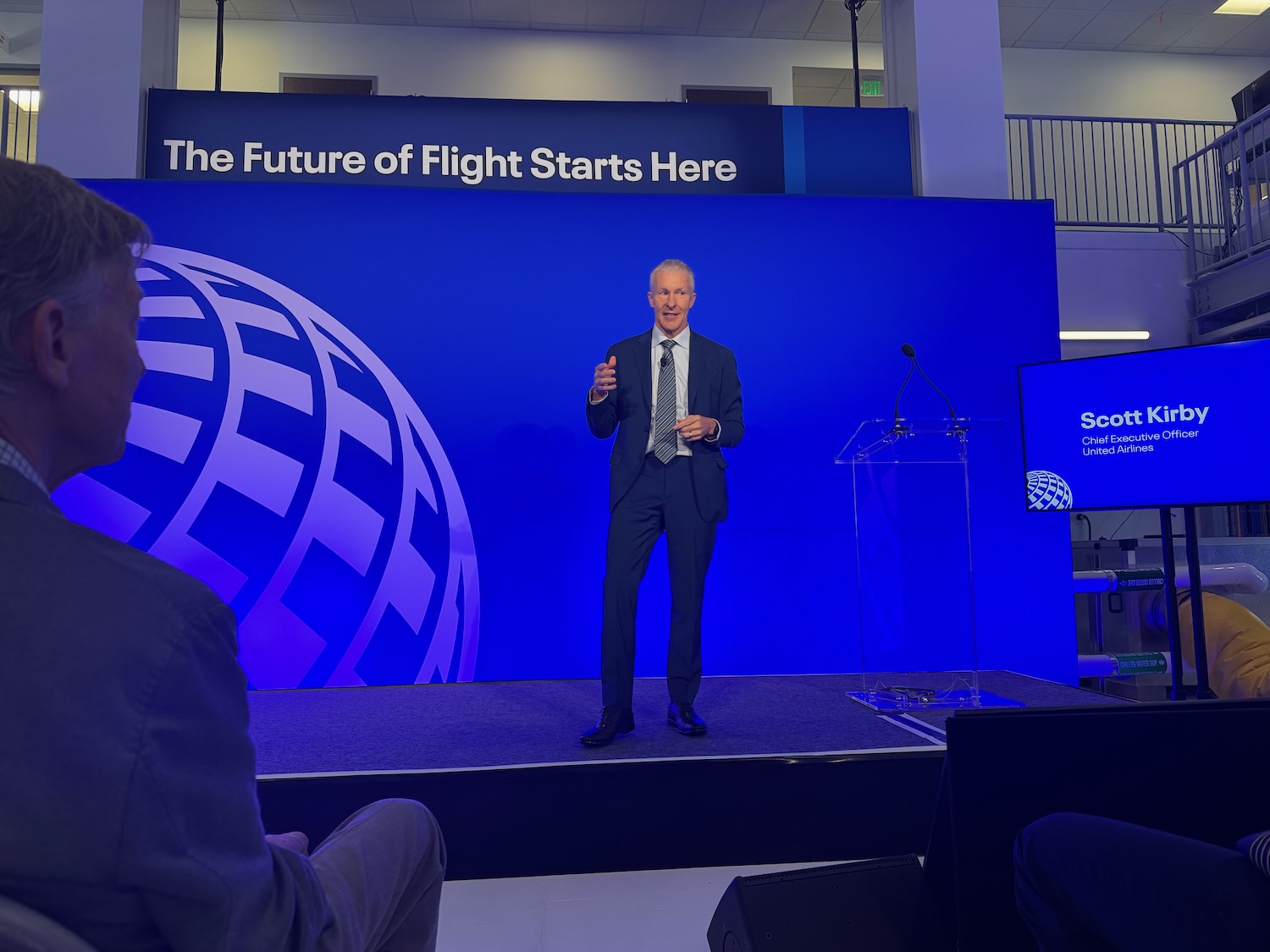
I asked United Airlines CEO Scott Kirby about his reported merger overtures to both American Airlines and Delta Air Lines. He would not confirm the conversation with Delta, but his answer revealed something more interesting: Kirby wants to build a U.S. airline with enough scale to compete not just with Delta and American, but with the best airlines in Asia and the Middle East on product as well as network.
Scott Kirby Wants A U.S. Airline That Can Compete With The Best Airlines In The World
United Airlines CEO Scott Kirby has already made clear that he believes the United States should have a much larger global airline.
Earlier this year, he openly acknowledged approaching American Airlines about a potential combination. More recently, The Wall Street Journal reported that Kirby had approached Delta CEO Ed Bastian in 2025 about a potential United-Delta merger as well. Delta reportedly considered the proposal internally, but nothing came of it.
United has never confirmed that Delta overture. So when I had a chance to speak to Kirby in Denver yesterday, I asked him about it and also added why United would need a partner when it was growing so well organically.
He would not confirm my premise, but his answer went well beyond the question of whether he had called Delta.
“I’m not going to validate your question, but you’re right, United has incredible organic growth opportunities and we’re doing it really well. We’re adding 120 airplanes a year. That’s more than any airline in history has ever done. We think there is incredible…but I think there is an opportunity to create something that is a true national, flag carrier of the United States that could go head-to-head with subsidized airlines around the world and in the Middle East and in the Gulf.
“I said in my remarks that United in totality is the best airline in the world, but we’re not the best in everything. And the truth is, those carriers in Asia and the Middle East have a better product than any airline in the Western world, including United.
“And I think it’s the kind of scale that enables us to compete with those kinds of airlines on every facet around the world without any government support or subsidies.”
That is a rather revealing answer, isn’t it?
Kirby Is No Longer Just Talking About Network Scale
Kirby has talked before about creating what he calls a true U.S. flag carrier.
When he explained his proposed combination with American earlier this year, he argued that a larger airline could offer more destinations, serve more communities, create a stronger loyalty program, grow internationally, and compete more effectively around the world.
United’s own statement at the time described the goal as creating “a great, new U.S. airline with the scale to compete and lead around the globe.”
But I thought his answer yesterday went a step further. He specifically acknowledged something U.S. airline executives rarely say quite so plainly: the best airlines in Asia and the Middle East offer a better product than United (or any other U.S. carrier).
Not a better route network or better balance sheet, but a better product. And Kirby linked the ability to close that gap directly to scale.
Scale Can Buy A Better Product
Airlines like Emirates, Qatar Airways, Singapore Airlines, and several other Asian and Middle Eastern carriers routinely offer a level of onboard service that U.S. airlines do not match.
There are obvious structural differences. Labor costs can be dramatically lower in some of these markets. Gulf carriers can staff aircraft with far more flight attendants than a comparable U.S. carrier could economically justify. Depending on the airline and country, there may also be direct or indirect government advantages that United simply does not have.
Kirby’s argument is that scale can offset some of that disadvantage.
A larger network generates more revenue opportunities. A larger loyalty program becomes more valuable. A larger premium customer base can support greater investment in lounges, seats, food, technology, staffing, and service. And perhaps most importantly, a carrier with greater market power may simply have more ability to charge for that product.
If United became an even larger global juggernaut with fewer meaningful domestic competitors, it could potentially command higher fares from premium travelers. Those higher revenues could then support a product closer to what passengers receive from the best Gulf and Asian airlines.
There is an obvious tension there: scale may make a better product possible, but consolidation can also reduce competitive pressure to provide one.
A United-Delta Combination Makes More Sense With That Objective
A United-American combination would have created enormous domestic scale, particularly across hubs and smaller communities. Delta is different.
Delta already has many of the things Kirby appears to value most: a strong premium brand, a powerful loyalty ecosystem, high corporate penetration, a strong operation, and a reputation for extracting more revenue from customers willing to pay for a better experience.
Combine that with United’s international network, Pacific strength, Newark presence, San Francisco hub, Washington Dulles operation, and rapidly growing Denver hub, and you begin to see what Kirby may have envisioned.
It could have been an airline with the revenue base and customer mix to try to compete with Emirates, Qatar Airways, Singapore Airlines, and other global premium carriers on their own terms.
Of course, a United-Delta merger would also have been breathtakingly difficult to get past regulators. The two carriers are already among the largest and most profitable airlines in the United States.
But strategically? At least I understand why Kirby might have made the call.
The Real Competition Is Not Delta
Kirby is not really measuring United against Delta anymore, or at least not exclusively.
He is looking at airlines like Emirates, Qatar Airways, Singapore Airlines, and the strongest Asian carriers and asking why an American airline cannot compete with them on every dimension.
United already believes it has the network and Kirby plainly believes it has the operation.
What he conceded yesterday is that it does not yet have the world’s best product. That is an unusually candid admission from an airline CEO who also said in the same answer that he considers United, “in totality,” the best airline in the world.
His ambition is apparently to remove it, but that’s a very arduous task with the high cost of labor in the USA…it seems that without consolidation with American or Delta, Kirby doesn’t think it is possible.
CONCLUSION
Scott Kirby would not confirm that he approached Delta Air Lines about combining with United. But I found his answer more interesting than a confirmation would have been.
Kirby sees an opportunity to build what he calls a true U.S. flag carrier capable of competing head-to-head with the largest airlines in Asia and the Middle East.
And this time, he was not talking only about network breadth or international scale. He acknowledged that those airlines offer a better product than United and suggested that greater scale is what would allow a U.S. airline to close that gap without government support.
That helps put his interest in both American and, reportedly, Delta into a different context.
The objective is to build an American global airline large and profitable enough to compete with the very best airlines in the world on everything. But America and Delta are not interested so for now, United will have to try to do that on its own…





“Ok, hear me out. We take our low quality–and scale it! It’s a win/win.”
Reminds me of “We take a loss on every sale, but we make it up in volume” old business joke. The last thing the world needs is the painful US airline industry to have its stench infect other countries.
He’s just blowing bullshit. Typical corporate lies and nonsense.
United’s product will never be as good as a half-dozen or more Asian/Middle East airlines, because it’s driven by greed, um…shareholder value. That’s never going to change, no matter how you “scale” things.
For better or for worse, United already *IS* the national “flag carrier” airline of the USA. It’s pretty good at a lot of things, and good enough at enough things to get by, especially when it faces relatively little competition (and much of that competition is incompetent).
Great coverage, Matthew! (You’ve been a rockstar at this event!) Ok, so it is refreshing to hear an executive admit foreign carriers are beating us on hard product, but Kirby’s fixation on “scale” sidesteps the human and consumer cost. If United wants to be a true global flag carrier, the capital needs to come from sustainable operational ‘excellence’ and real competition, not building a domestic fortress that leaves everyday flyers and employees footing the bill. Sure, the new Coastliner and Polaris suites look great…if we can afford them. But dragging fleets out of the 2010s while navigating economic strife will lead to a capital squeeze. I have to wonder if these multi-year upgrades can actually cross the finish line before the next economic downturn pulls the rug out from under them.
I think enilria made a great point:
This is frighteningly honest for him. It’s like someone dosed crazy uncle Scott with his Thorazine.
What he’s missing though is that the entire premise of airline deregulation was to specifically NOT have a flag carrier. Otherwise it would already be here as Pan Am.
United Airlines already have economic of scale advantage over most of her international competitors. However, there is one area which UAL may improve further, low number large dominant hubs compared to Delta. UAL only has two large dominate hubs, EWR and IAH, both were Continental Airlines hubs. UAL needs to increase flihhts ( or market share) at both SFO, DEN and IAD. Only when UAL has more profitable hubs then better (i.e. costlier) in-flight products/services can be introduced.
Kirby’s desire to acquire or merge with either AA or DL is a recognition that
1. UA cannot build the domestic route systems that AA or DL have; the market will not support the addition of that much capacity w/o diluting UA’s own revenue in its hubs and the cost of adding all of that new capacity is simply too high.
2. All of the big 3 are starting to bump into each other on international routes; AA and UA’s 321XLRs will increase competition in markets that each have as advantage markets. DL’s expansion over the Pacific will take away alot of the size advantage that UA has while adding a 2nd US carrier to a lot of markets.
as for product, US carriers can invest more in the hard product (where they do fairly well) as well as in food and lounges but Americans simply cannot deliver the type of deferential service that some Asians can do and the ME carriers incorporate into their product image even if they do it with employees from around the world.
there simply is no planet where the US big 3 are allowed to consolidate which means that each of AA, DL and UA have to build robust domestic and international route systems and offer decent products if they wish to compete with the world’s best carriers.
Great reporting. Looking forward to the future United Gold+ (or whatever it is that Mr. Kirby has ambition for). Short of renaming the airline for DJT, not sure he’ll get the support he’s looking for from the federal government.