
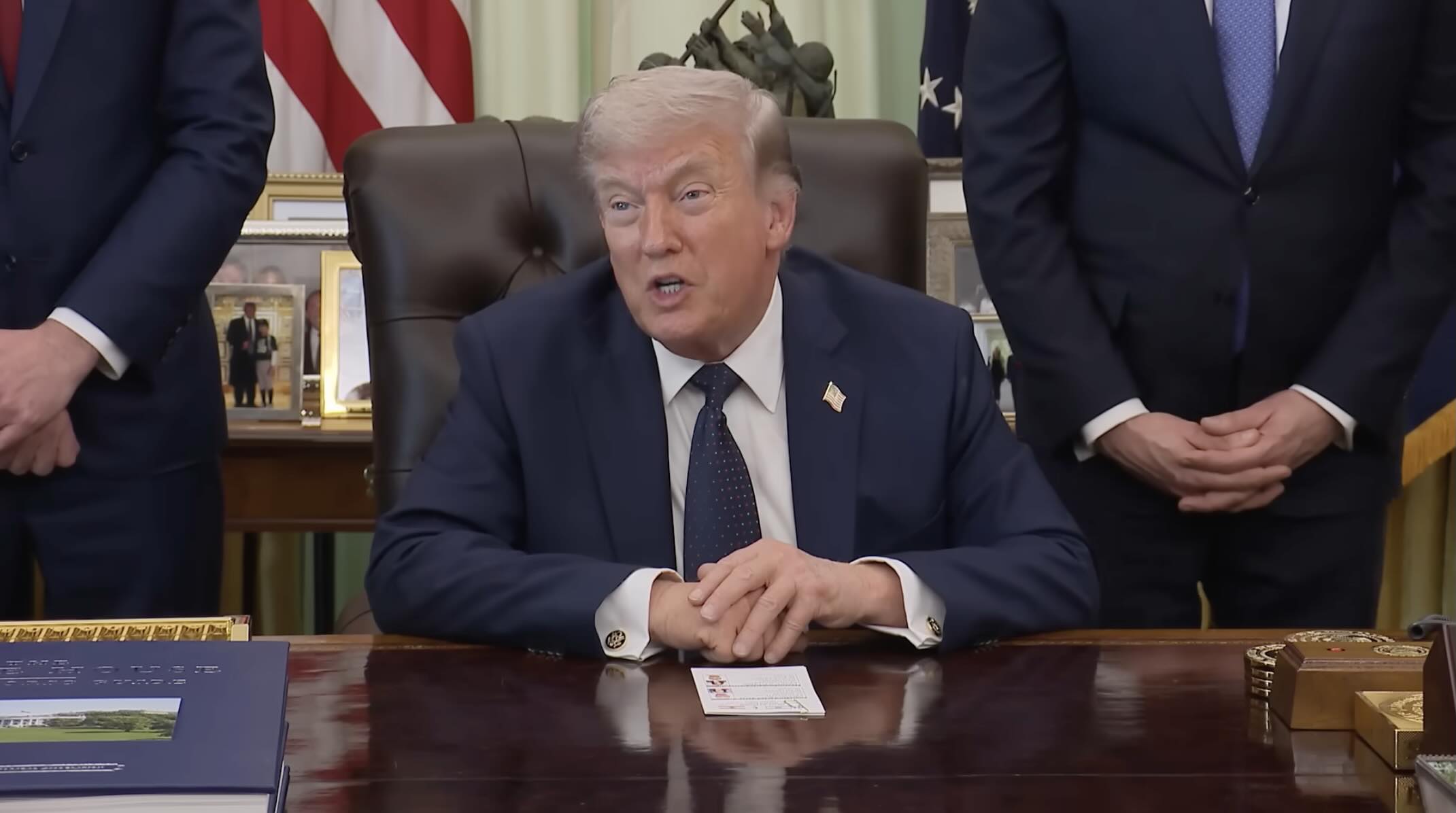
President Trump says the government should just buy Spirit Airlines, sell it later for a profit, and call that good stewardship. That is not how any of this works.
Trump Digs In, Says Government Should Buy Spirit Airlines. What Exactly Are Taxpayers Buying?
President Donald Trump has again openly floated the idea that the U.S. government should buy Spirit Airlines.
Speaking in the Oval Office on Thursday, Trump framed the idea as a common-sense business deal:
“I think we just buy it. We’d be getting it virtually debt-free. They have some good aircraft, good assets — and when the price of oil goes down, we’ll sell it for a profit. I’d love to be able to save those jobs… I like having a lot of airlines so it’s competitive.”
Where to begin?
What “Good Assets” Are We Talking About?
Spirit has some aircraft (of the older and less efficient kind). Spirit has gates, slots, leases, employees, brand recognition, and an operating certificate. But sorry, it is not some hidden gem.
If Spirit’s assets were so attractive, private capital would already be lining up to buy the airline. Instead, we are talking about the federal government stepping in because creditors are circling like sharks preparing for liquidation and because the business cannot find a viable path forward on its own.
The aircraft are not magic. Many are leased. Some may be valuable to competitors, but likely more valuable in pieces than as part of a government-owned Spirit Airlines.
And that is the point.
If the best argument for buying Spirit is that it has “good aircraft,” then let the market bid for the aircraft.
We Have Seen This Before…
When it comes to war, the U.S. never learns from history. So it’s no surprise we cannot even remember recent history when it comes to bailouts.
During the pandemic, the federal government spent extraordinary sums to support the airline industry.
Recall that the Payroll Support Program authorized up to $63 billion in direct assistance for passenger airlines, cargo carriers, and certain contractors, with the money intended to maintain wages, salaries, and benefits. Treasury’s Inspector General reported that PSP1 payments totaled about $28.6 billion, PSP2 about $15.6 billion, and PSP3 about $14.6 billion. The GAO also noted that the program came with furlough restrictions and other conditions.
Add that up and you’ll tabulate taxpayers spent well over $300,000 per airline job saved.
That number should haunt this discussion…
Because even if those pandemic bailouts were defensible in March 2020 (I still question why it was given in the form of grants, unlike in other developed nations), this is very different. Back then, the government shut down the economy and air travel collapsed almost overnight. This time, Spirit is not failing because of a national shutdown or even because of the latest adventure in the sandbox. It is failing because its business model no longer works well enough in the current market.
The Per-Person Cost Is Small, But That Is The Trap.
A $500 million Spirit bailout sounds small in Washington.
Spread across roughly 342 million Americans, that is only about $1.46 per person.
That is how these things get justified.
Just a dollar here. A few dollars there. A billion here. A bailout there. And suddenly the national debt is approaching $39 trillion, with the federal government projected to run a $1.9 trillion deficit this fiscal year.
That works out to roughly $114,000 in gross federal debt for every person in the country.
And yet we are now talking about using taxpayer money to buy an airline that has already failed twice in a short period.
This is how a republic starts to look unserious.
One of the most tiresome features of American politics is how deficits become a crisis only when the other party controls the White House.
Republicans talk about debt and deficits when Democrats are in power. Democrats talk about compassion and investment when Republicans are in power.
Then everyone switches roles when convenient. Meanwhile, the debt keeps growing.
If the Trump administration really moves forward with buying or financing Spirit Airlines, what principle is left? This is not national defense, nor is not critical infrastructure in the narrow sense. The overall airline industry is healthy.
This is a struggling airline that does not deserve to be propped up and longer and for which no statutory authority exists to prop it up any longer.
Are we really happy just descending into a system where the government takes over failing corporations?
The “Sell It Later For A Profit” Fantasy
Trump’s argument rests on the idea that the government can buy Spirit cheaply, wait for oil prices to fall, and then sell it for a profit.
Again, if that were at all likely, how come not a single investor has stepped forward?
Trump’s plan assumes:
- Fuel prices fall soon
- Spirit’s operating model becomes viable again
- Labor, leases, debt, and customer perception can all be fixed
- A private buyer will later want what private buyers apparently do not want now
That is a lot of assumptions and I’m not convinced any of them will happen.
It also ignores another obvious problem I have brought up in the past: once the government owns or finances one airline, how does it fairly regulate the rest?
Does the Department of Transportation treat Spirit like every other carrier while the government has money on the line? Does the FAA? Does the DOJ? Does the administration start making route, labor, or pricing decisions based on political considerations?
This is why governments should not be in the business of owning airlines (even with a very clear national interest and a very clear legal framework, which does not exist here).
Last Days Of Rome…
I do not say this lightly, but this sort of thing feels like the last days of Rome.
Not because Spirit Airlines matters that much (taken alone, it doesn’t). But because the instinct now is always to intervene, always to spend, always to paper over failure, always to claim that taxpayers will somehow come out ahead later.
The British Empire did not collapse because of one bad decision. Rome did not fall because of one bailout. These things happen slowly, then suddenly, as institutions become unserious and public money becomes a tool for political theater. Can we ever learn from history?
Buying Spirit Airlines would not break America. But it would be another sign that we are very comfortable stacking one more card onto a house that is already wobbling. Unless we really start thinking differently about this, one day it will fall and China will be ready to step in.
CONCLUSION
Trump says the government should buy Spirit Airlines because it has “good aircraft” and “good assets.” No, sorry. That’s not true.
If the assets are good, let someone buy them in bankruptcy. If the business is viable, let private capital step in. But if the model is broken…and most analysts seem to think it is…let it fail.
Saving jobs is a noble goal. But there is no limiting principle if every failing company with employees can run to Washington and ask taxpayers for a lifeline. What kind of a country do we live in? Spirit Airlines may deserve sympathy, but it does not deserve to become a government-owned airline.
image: White House




Spirit should liquidate. But it’s not as if airlines are the best examples of free market players – they operate under heavily regulated conditions. If it was the regulations that were killing off Spirit and not market conditions, one could make an argument (perhaps still a weak argument) that some financial offset could make sense. But that’s not really the case here- it’s just a business that has been failing for a long, long time. The idea of the government stepping in at this point is simply misguided as much as we would like to see thousands of people retain their jobs. And a $500 million investment can quickly turn into $5 billion – no idea why $500 million is “the number” that will “save” Spirit. If the government goes in for a penny, it will quickly turn into a pound…
The idea of unemployment being a bigger issue in an AI age is actually something we should all be thinking more about, of course. Andrew Yang was laughed off the national stage with universal basic income a decade ago, now Musk tweets about universal high income. But why should Spirit’s ~8,000 employees get a government bailout while Meta’s firing 8,000 employees next month without government intervention – should we give $500 million to Meta to keep those jobs around for another year? (Of course that works out to 62.5k per employee, which is probably substantially less than those employees make to begin with).
As for China… I don’t know. I think they may have a better global narrative at the moment, but they also have plenty of problems of their own. What happens in China when the world doesn’t need as many factory workers?
Well said, Peter. It’s all nuanced; I certainly care for the workers and consumers who will inevitably be hurt by this failure. That said, I agree, Yang was onto this (with AI, UBI, and negative income tax, as creative solutions.) CCP is still a totalitarian dictatorship (some may think it’s benevolent, others, such as the Uyghurs, obviously, would disagree.)
@Peter, not that I would give money to Meta, but governments routinely give out money to favored companies to “create jobs”.
Like $77 million in tax breaks for one permanent data center job:
https://brooklyn.news12.com/jpmorgan-data-center-tax-breaks-spark-debate-in-rockland-county
You forgot to mention that the Imbecile-in-Chief does NOT have a good track record with buying airlines. The Eastern Air Shuttle lasted only 3 short years after the Liar-in-Chief bought it. Among other things he wanted to put that ridiculous gold (plating) all over the aircraft interiors, not understanding even the most basic principles of aircraft “weight and balance”. Contrary to (some very stupid people’s) popular belief, the Douchebag-in Chief is NOT a good businessman. The Toxic-Narcissist-Psychopath-in-Chief has the opposite of the Midas Touch, everything he touches turns to feces. His only possibly successful business, his family business, would likely be 10 times larger had anyone else inherited what he did.
Absolutely agree. Everything he has done has failed… I am from Las Vegas born and raised and it takes special talent to bankrupt not 1 but 2 casinos ! And the EA Shuttle…. he just couldnt leave it alone.
The merger of B6 and NK should not have been rejected… Yes, there’s no point in discussing it now, but it might be useful to remember that for similar situations in the future.
It’s true and I railed against that dimwit judge William Young when that ruling came down. But even so, it does not justify bailing out NK now.
William G. Young, not to be picky, just in case someone wants to look further.
It is worth recalling that while the federal government has intervened to help the airline industry broadly after the 9/11 attacks and during the COVID-19 pandemic, supporting a single airline is an unusual action.
The business model for low cost, low fare airlines in the United Stated is becoming very problematic. There’s no amount of public money that could meaningfully change that. and even regulatory updates can only make circumstantial improvements. They should be concerned with an orderly wind-down of Spirit’s operation, to mininize impacts to employees, customers.
There is something so symbolic about the Trump administration buying America’s trailer-trash airline. It pretty much sums up where this country is headed under the Trump administration.
Oh this is where the republic starts to look “unserious”. Not the crypto scams, the trump coins, or the “renovation” of the White House.