
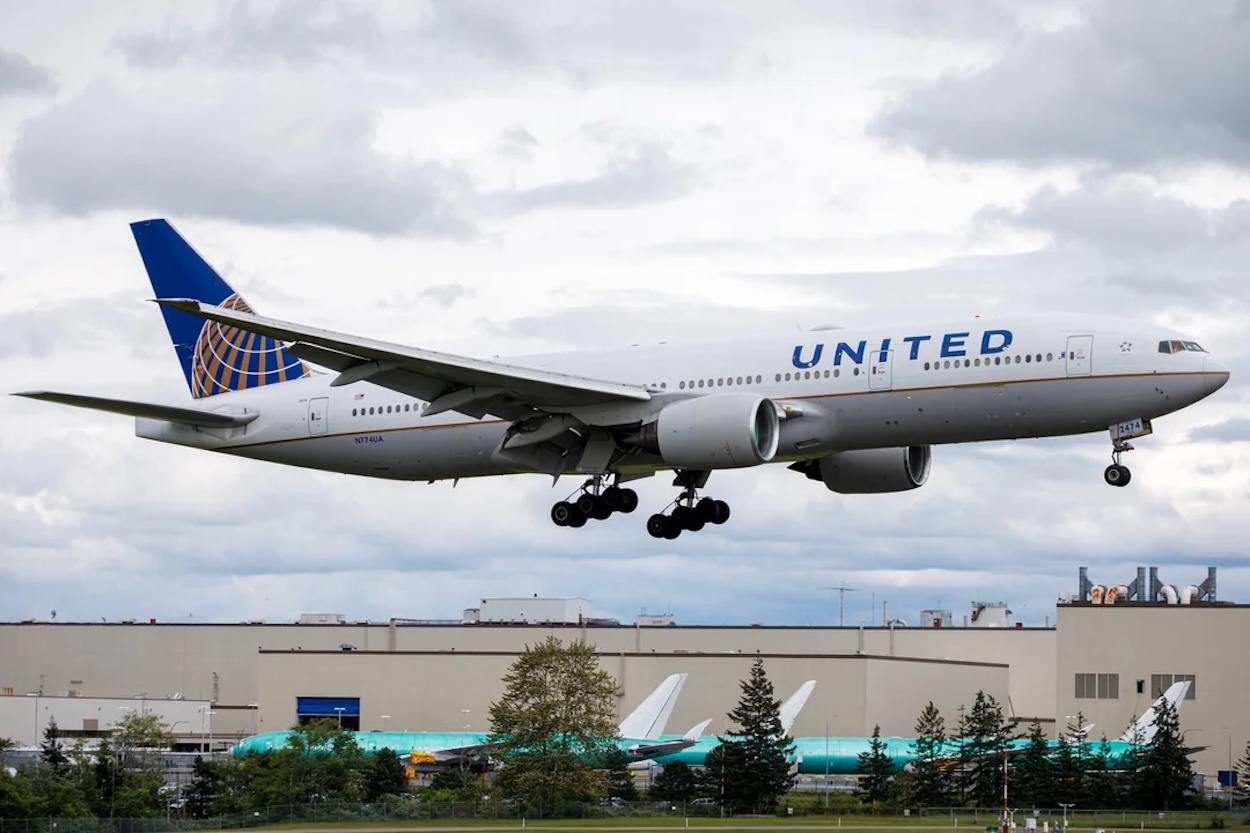
United flew N774UA, the oldest active Boeing 777 in the world, back to Paine Field this week for what has internally been called a “press event.” That alone is a fun avgeek story. But whenever United, Boeing, and the 777 are in the same sentence, I cannot help but to speculate: could United finally be looking at the 777X?
Could United Airlines Finally Be Considering The Boeing 777X?
United Airlines sent N774UA, a Boeing 777-200 and one of the oldest active 777s in the world, from San Francisco (SFO) to Paine Field (PAE) this on Thursday, May 14, 2026. The aircraft reportedly flew up as UA3821 for a press or corporate event.
United was the launch customer for the Boeing 777, and the type has been central to United’s longhaul network for three decades. N774UA is line number two from the 777 production line, a living museum piece that still carries passengers.
I find the timing interesting. Boeing is trying to get the 777X across the finish line. The aircraft is years late, but certification and entry into service are now finally approaching. Lufthansa, Emirates, Qatar Airways, Cathay Pacific, and others are waiting. No U.S. airline has ordered it.
United has repeatedly signaled that it does not need the 777X. Patrick Quayle, United’s Senior Vice President of Global Network Planning and Global Alliances, has said the aircraft is very big and that a smaller widebody better fits United’s multi-hub network. His logic is sound: United does not operate like Emirates, funneling everything over one giant global hub. United can split demand across its seven domestic hubs in the continental USA.
That is exactly why the 787 has been such a good fit.
United has ordered a huge number of Dreamliners, including 787-9s and 787-10s, and recently shifted some orders toward the larger 787-10. The Dreamliner gives United flexibility. It can open thinner routes, right-size capacity, and serve longhaul markets from multiple hubs without dumping too many seats into a single market.
So, does United need the 777X?
Probably not. But “probably not” is not the same thing as “absolutely not.”
What Would A 777X Do For United?
The Boeing 777-9 is a very large aircraft. Boeing lists it at up to 426 passengers in a two-class configuration, with a range of about 7,285 nautical miles. It is not a 787 replacement. It is a 777-300ER replacement and, in some ways, a 747-400/A380 replacement for airlines that still need that much capacity.
United’s current widebody strategy is built around the 787 and existing 777s. The 787-10 can do a lot of what United needs on high-demand longhaul routes, but it cannot do everything. The 787-10 is capacity-efficient but more range-limited than the 787-9 and 777-200ER. The 787-9 has excellent range but fewer seats and less belly cargo than a large 777.
That is where a 777X could theoretically fit.
A 777-9 would give United more seats, more cargo capacity, and a true flagship platform for routes where demand is deep and premium-heavy. Think Newark – Tel Aviv, Newark – London, or San Francisco – Hong Kong, among others.
Would the 777X enable many routes that a 787 could not operate at all?
Not really.
That is the key point. This is not like the old days when the 747 or 777 opened routes that smaller aircraft could not touch. The 787-9 already gives United tremendous range and is often the more sensible tool. The 777X would not be about opening exotic new dots on the map. It would be about carrying more people and more cargo on routes that are already strong.
That can be valuable. But it is not transformational.
The 777X Problem For United
The problem with the 777X is also its strength: size.
A big airplane is great when you can fill it at good yields. It is a headache when demand softens and fuel rises. United has spent years building a fleet that lets it match aircraft size to demand. A 777X order would move in the opposite direction, at least at the top end of the fleet.
Could United fill a 777-9 on certain routes? Absolutely. But would United be better off with two smaller widebodies, more frequency, and more scheduling flexibility? Often, yes.
That is why Quayle’s argument still makes sense. United’s network is fragmented by design. It does not need one super-jumbo twinjet to funnel the world through a single hub. It needs a lot of efficient widebodies that can serve a lot of markets from a lot of places. The 787 does that beautifully.
The other issue is timing. United already has a massive order book. It has A321neos, A321XLRs, 737 MAX aircraft, and many 787s coming. It also still has a long-delayed Airbus A350 order hanging out there, which may or may not ever become real (my bet is no). Adding the 777X would not exactly simplify the fleet plan.
But Never Say Never…
Still, I would not completely dismiss the possibility.
United’s oldest 777-200s cannot fly forever. The 777-200ER fleet will eventually need a more complete replacement plan, even if virtually all flights can be covered by 787-9s and 787-10s. The 777-300ER fleet will also age, and if United wants to maintain a very large widebody option for its biggest routes, the 777X is the obvious Boeing successor.
There is also the Boeing relationship. United is one of Boeing’s most important customers and was the launch customer for the 777. If Boeing wanted a U.S. airline endorsement for the 777X, United would be the prize.
Would Boeing offer United a very attractive deal? I would assume so. Would United take 777Xs if the economics were compelling enough and deliveries could be timed for the 2030s as 777-300ER replacement aircraft? Possibly…I don’t see why not.
I do not think United needs 100 777Xs…or even 50. But a smaller subfleet of 777-9s for slot-constrained, premium-heavy, cargo-rich routes is not crazy.
Imagine a future United 777-9 with a true next-generation Polaris cabin, Premium Plus, a large economy cabin, Starlink Wi-Fi, and even more cargo capacity on longhaul routes. That would be a very useful airplane on the right routes.
The question is whether “useful on the right routes” is enough to justify introducing a new plane type and the complication that would result to United’s fleet.
N774UA At Paine Field: Symbolism Or Signal?
So what do we make of N774UA returning to Paine Field?
Probably symbolism.
A 777 anniversary event featuring one of the earliest United 777s is exactly the sort of thing Boeing and United would do even if no order is coming. It celebrates a hugely successful aircraft program and United’s role in launching it. If Boeing wanted to remind the world that United and the 777 go way back, flying the oldest active 777 back to its birthplace is a pretty good way to do it.
My guess? Today’s event will be a more a 777 heritage moment than a 777X order teaser. But if United eventually orders the 777X, I would not be shocked. The aircraft does not fit United’s network as naturally as the 787 does, but it could still play a limited role as a high-capacity flagship and eventual 777-300ER replacement.
CONCLUSION
N774UA returning to Paine Field is a wonderful avgeek moment. United was the Boeing 777 launch customer, and seeing one of the earliest 777s still flying three decades later is remarkable.
Does it mean United is about to order the 777X? I doubt it.
United’s current widebody strategy is clearly centered on the 787, and for good reason. The Dreamliner is flexible, efficient, and better suited to United’s multi-hub network. The 777X is big, expensive, delayed, and best suited for airlines that need huge capacity over centralized hubs.
But I would not rule it out forever. A small 777X order for the 2030s could make sense as a 777-300ER replacement and flagship aircraft for United’s biggest longhaul routes. For now, though, I see N774UA’s Paine Field visit less as a smoking gun and more as a sentimental reminder: United helped launch the 777. Whether it helps launch the 777X in the United States seems less likely…but not impossible.
image: TabsAZ / reddit (N774UA arriving at PAE)






I looked over the 777X customers. There is none I expect to ever use (maybe BA if they configure it right). So, a part of me hopes a carrier I’m likely to fly gets some so I can fly on one. Did you know there are people who get off a plane and can’t tell you the model. Crazy? Yes.
Waaay overdue.
Also, UA’s 772 with the rear-facing 2-4-2 ‘Polaris’ makes even Delta’s ancient 763 look… luxurious.
I go out of my way to fly those 2-4-2 777s versus standard recliners.
Yes, lie-flat over recliners, every day, but 1-2-1 newer Polaris (787, 777, 767), over 772 (and 757, 2-2), any day.
Maybe United will order B777-9s to replace its older B777s and will officially cancel its A350 order…
I think one way or another, the A350 order will be canceled.
A UA order for the 777X was all but guaranteed when UA took the A350 off of its confirmed order list. Who would have thought that Rolls Royce would honor 10 year old pricing and even more remarkable that UA thought it could keep pushing the order later and later and still keep the original terms.
Kirby could never have stomached having DL maintain UA’s Rolls Royce Trent XWBs given that DL has the exclusive overhaul rights for the Americas for that engine.
UA’s TPAC network is far more heavily concentrated on SFO than DL’s is on any one US gateway; not only is SFO capable of supporting a large aircraft like the 777X but it probably will be able to fly most of the Pacific Rim.
DL’s advantage will be that the A350-1000 is better suited in size for service from all of DL’s hubs to Asia and the 35K will still have more range and better efficiency than either version of the 777X.
The 789 with 100 seats less than the 35K can fly similar routes but that is unlikely to be a viable solution for ultra long haul flying; unit costs go up much faster as distance increases than unit revenue.
UA has supposedly asked for a longer range version of the 777-9 rather than wait for the 777-8 which might have range comparable to the 35K but at worse economics.
I am betting that UA will order the 777-9 which Boeing has been unable to sell to US carriers; it is also very possible that the Middle East carriers want to cancel or push back some of their orders now that Boeing is on the verge of finally delivering it.
United still has a A220 sized hole in their fleet, at least in terms of seating capacity.
Or they could buy E195-E2s, pay less, have sufficient capacity and range, and be able to stay away from Franco-Canadian Spaghetti-Os and their abominable 2-3 seating.
Does anyone think that Boeing will ever launch the 777-8. That is a better fit for 777-300ER or A350 (wink) replacement. The 777-9 would be too large in my opinion but the -8 (if certified and put into production) would be a much better fit. I think with the updated MTOW on the 787-10, that would be a replacement for the 777-200ER and that is why United is shifting towards that model (-10)
the problem is that per seat economics on the 787-9, the longest range aircraft in UA’s fleet, are terrible at 225 seats which is what it takes to compete with either version of the A350 – both of which are larger – which is heavily used across the Pacific includng by DL.
DL’s “small” A350s seat 50 more seats than UA’s premium 789s while the 35K is going to seat about 90 more seats – and both versions carry much more cargo than the 787-9.
UA flies alot of very long to ultra long haul flights and they must have a plane w/ good longhaul economics. The 777X will be alot of seats to fill but it will have good economics – perhaps not as good as the A350 but UA has apparently ruled that plane out as an option.
When you back yourself into a corner, you have to make whatever options work that you have left.
If UA can get Boeing to add another 30-45 minutes of range to the 777-9, they will call it a day and move forward w/ a larger but less capable plane than the 35K but one that UA can add relatively easily to its fleet given the commonality that will exist with UA’s other 777s
The B777-9 having more range now is a matter of increasing the maximum take-off weight.
The B777-9 DOW is spec-ed to be 15t heavier, at the current MTOW it can maintain the B77W range using less fuel, if and when Boeing increases the MTOW to 365t as initially shown to airlines that will add 2hrs more flying time
For aviation enhusiasts → The veteran jetliner pictured in the article is the aforementioned UA B777-200, which is 32.8 years old. UA currently has a total of 74 B772s in its fleet with an average age of 27 years.
Yes. UA was the launch customer for the B777-200. They placed the historic first order on October 14, 1990, and took delivery of the very first production aircraft (registration N777UA) on May 15, 1995. The jetliner officially entered commercial service on June 7, 1995, flying from LHR to IAD.
@Big Prime, here’s the thing. Boeing is going to build the 777 freighter and that will be the same airframe (modified) as the 777-8. It won’t take Boeing that much more to modify it and yes, it’s going to at least initially sell slow but so did the A350-1000. As others have pointed out the 777-8 is a better (only slightly larger) replacement for the 777-300ER than the the 777-9.
For aviation enhusiasts → The B777X series is marketed as an advanced, next-generation continuation of the original B777 line. Depending on the specific variant or intended use, other names and designations include:
* Boeing 777-9: The first aircraft model in the series to enter service, and the longest twinjet in the world.
* Boeing 777-8: A smaller, ultra-long-range passenger variant designed to replace the 777-200LR Worldliner.
* Boeing 777-8F / 777X Freighter: The cargo version of the aircraft family.
* BBJ 777X: The designation for the Boeing Business Jet (VIP/corporate) variant.
Indeed, even if not now, in the future, the B777X could be a logical choice to replace the 22 B777-300ERs (average age: 8.4 years) in UA’s fleet.
How would the 777-8 fit into United’s strategy? Smaller aircraft, longer range.
Remember that UA does not have any orders for the passenger version of the Boeing 777-8. While the airline operates a massive fleet of older 777 variants (including the -200, -200ER, and -300ER), UA relies heavily on the B787 Dreamliner family (including the -8, -9, and -10 variants) and Airbus aircraft for its next-generation long-haul and ultra-long-haul fleet expansion. The B777-8 passenger variant is primarily targeted at Gulf carriers or operators needing niche ultra-long-haul capacity.