

Delta Air Lines CEO Ed Bastian is defending the carrier’s decision to choose Amazon Leo over Starlink, arguing that Amazon brings more to the table than just satellite internet and that the price point was more attractive. That does not fully resolve the Starlink question, but it does make Delta’s logic easier to understand.
Delta CEO Defends Amazon Leo Over Starlink, Citing Price And Partnership Upside
Delta Air Lines raised eyebrows when it chose Amazon Leo, Amazon’s low-Earth-orbit satellite network, over Starlink for its next-generation onboard Wi-Fi.
The decision was especially notable because Starlink is already proven in commercial aviation. United, Alaska, Hawaiian, Qatar Airways, Air France, British Airways, Emirates, and others have all moved toward Starlink or announced plans to use it. United, in particular, is moving quickly and expects to outfit its fleet with Starlink before Delta even begins installing Amazon Leo on its aircraft in 2028.
That makes Delta’s choice look risky. But CEO Ed Bastian is now offering a more complete defense of the Amazon decision, and his explanation (not that you would expect anything less) suggests a deeper in-flight-entertainment relationship with Amazon is coming.
Speaking to Bloomberg, Bastian argued that Amazon is offering more than just satellite connectivity:
“Amazon brings a lot more than just satellite technology. They bring great retailing capability and Amazon Prime and video gaming technologies, which Starlink does not have.”
He also pointed to price:
“I think the opportunities, in terms of the improved bandwidth with a much lower price point than what we’ve ever seen from Starlink, will make a big difference.”
And Bastian brushed off the idea that Delta should worry about Starlink warning customers that Delta chose an inferior product:
“Of course, we expect Starlink will be warning people that we’re going to go with an inferior product. But I’m not too worried about partnering with Amazon.”
Indeed, Elon Musk has already made that charge repeatedly.
This Was Never Just About Wi-Fi Speed
A few days ago, Musk suggested the issue was Delta’s insistence on routing passengers through its Delta Sync portal. Musk framed that as Delta wanting to make the process more annoying and expensive for customers.
> Read More: Delta Air Lines Passed On Starlink For A Reason More Valuable Than Wi-Fi
I still think Musk’s jab should be taken with the appropriate truckload of salt. Delta has been one of the leaders in free onboard Wi-Fi and I do not buy the idea that Delta’s goal is to make internet access painful for passengers.
But Musk is not totally wrong.
The portal matters because the customer relationship matters. Delta wants to control the digital environment onboard not just provide internet. It wants passengers logging into Delta Sync, engaging with SkyMiles, seeing targeted offers, consuming content, and creating data Delta can use and monetize.
That is central to modern airline economics. So when Bastian talks about Amazon Prime, video gaming technologies, retailing capability, and a broader partnership, I hear a very different explanation from “we picked cheaper Wi-Fi.”
Amazon May Be The Better Partner, Even If Starlink Is The Better Product Today
Starlink is clearly the more proven inflight internet product today. It has more satellites in orbit, more airline customers, and real-world performance that passengers can already judge. Amazon Leo is still ramping up and is not yet a fully mature consumer product in the same way.
That is the risk for Delta.
If United passengers are enjoying fast, simple, free Starlink across the fleet before Delta even begins installing Amazon Leo, Delta will have a real competitive problem. Passengers do not care about backend partnership strategy if the Wi-Fi is slow, spotty, or late.
But that does not automatically mean Delta made a bad decision.
If Amazon is offering Delta a much better price, deeper integration with Prime, gaming, retail, entertainment, advertising, loyalty, and data, then Delta may have decided that Starlink’s technical lead was not worth surrendering control or paying a premium.
That may be right.
Or it may turn out to be a very expensive bet if Amazon Leo is delayed, underwhelming, or noticeably inferior to Starlink. But Bastian is correct that Amazon tends to do things well.
The Timeline Is Still The Weak Point
Delta will not start installing Amazon Leo until 2028. Meanwhile, United is aggressively rolling out Starlink and may have next-generation connectivity across its entire fleet before Delta begins its Amazon Leo rollout in earnest.
While Delta offers decent complimentary Wi-Fi already, the difference between Starlink and Viasat is night and day and many Delta transpacific flights do not even have functional Wi-Fi right now.
Delta has spent years cultivating a premium image and was ahead of United and American in offering free Wi-Fi. But if United leapfrogs Delta on onboard connectivity, Delta may find itself on the defensive.
And once passengers experience fast, seamless, low-latency Wi-Fi, anything else becomes just annoying.
CONCLUSION
Ed Bastian’s defense of Amazon Leo makes sense in one important way: Delta is choosing a broader digital partner, not just a Wi-Fi provider.
Amazon brings retailing, Prime, gaming, entertainment, advertising potential, and likely a lower price point. For an airline as focused on monetizing loyalty and customer data as Delta, that matters.
But the risk remains obvious. Starlink works today. Amazon Leo still has to prove itself in commercial aviation. United is moving quickly, while Delta is waiting until 2028 to begin installations.
So I understand Delta’s logic more after Bastian’s comments: this may not be a mistake in terms of long-term strategy.
But if United has fast, free, seamless Starlink across its fleet while Delta is still waiting for Amazon Leo, passengers may become more impatient than Delta anticipates.
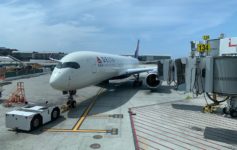
image: Delta





I am so fed up with no wifi over the pacific on Delta. It’s hard to believe this is the case in 2026. Viasat’s failures were such a multitude you’d think DL would cry uncle to remain competitive with wifi, but no, they always have to do something different….even if it means waiting until 2028. Amazon LEO technology sounds promising…but Starlink has a proven track record.
I’m pretty sure Never Trumpers and Forever Trumpers want fast wifi, and I can’t help but think politics played a role in DL’s pettiness towards Starlink here.
This was a nice, fair, and balanced article. Delta choosing LEO over Starlink isn’t as “Brilliant! Delta Rules!” or “Idiot! Another Stupid Delta move!” as some would have. Issues are always nuanced, and you did a nice job in highlighting that here.
Several things stand out to me:
1) Bastain’s comments were very predictable. CEOs are as much “PR Spokesperson / Salesperson” as they are “Company Manager”. Outside of the limits inherent within the SEC rules (about lying to / deceiving investors), they will always put the positive spin on the decisions and conditions during their tenure. Whether it is United’s Kirby, Ryanair’s O’Leary, Emirates’ Clark, or American Airlines’ Isom, you get the same thing. “What we’re doing is great, it’s working or will soon work, and we are doing it better than anyone else.” Even the Spirit leadership team had nothing to share except a positive spin, right up until the last flight landed.
2) Choosing Amazon over Starlink is a “risk/reward” proposition. There may be more to leverage in the future with Amazon’s strengths integrated into the Delta experience. But there is certainly significant risk in being the last to improve an important part of the flight – the ability to stay connected, trouble-free, to the entertainment and productivity platform that is the internet. Currently, Starlink is the clear leader, despite claims from some that Viasat is a great alternative. Viasat can be glitchy and have bandwidth limitations, and has more global areas that lack coverage. And with LEO’s plans to mature into a viable alternative – rollout plans often change, but only to be delayed, not accelerated. Even if the “Sometime in 2028” timeline holds for the start of LEO installs on Delta planes, competitors (not just United) will be offering a superior Wifi product for quite some time until Delta can start to catch up. Time will tell if the move to pick LEO was smart and eventually pays off.
3) Just because Delta didn’t like the price doesn’t mean that Hawaiian/Alaska, United, Qatar, Emirates, etc. are all paying the same price. Airlines don’t pay the same price for planes to Boeing/AirBus. Same is true with their negotiated services. I’d bet the airlines that committed earlier to Starlink got a better price than Delta was offered.
This will be fun to watch it play out. In the end, the consumer is winning. Inflight WiFi has gotten faster while the cost has gotten cheaper. Hopefully both Starlink and LEO succeed in the end.
The guy looks like an idiot wearing those shoes.
He most certainly does.
This time, it’s not the DL difference, but the UA difference!
“Time is money.” – Benjamin Franklin –
“More money, more problems” –Abraham Lincoln–
“In the journey of human existence, there is never enough time.” – Güntürk Üstün – (And he said this even though he is not and will never be as celebrated as Benjamin Franklin and Abraham Lincoln.)
Starlink is much better!
Amazon doesn’t do everything well…
Look into the safety record of their AmazonBasics products, or their terrible Fire tablets that rely on the very limited Amazon app store
Amazon Leo has things to learn from Starlink…
I’m sure AA will look to kill two birds with one stone by not only following Delta and choosing Amazon, but then letting Amazon manufacture and install Fire tablets as their IFE screens. Flying American is your Prime AAdvantage!
Who cares about wifi speed? I don’t. When I choose an airline, I choose them based on PRASM and other financial metrics.