
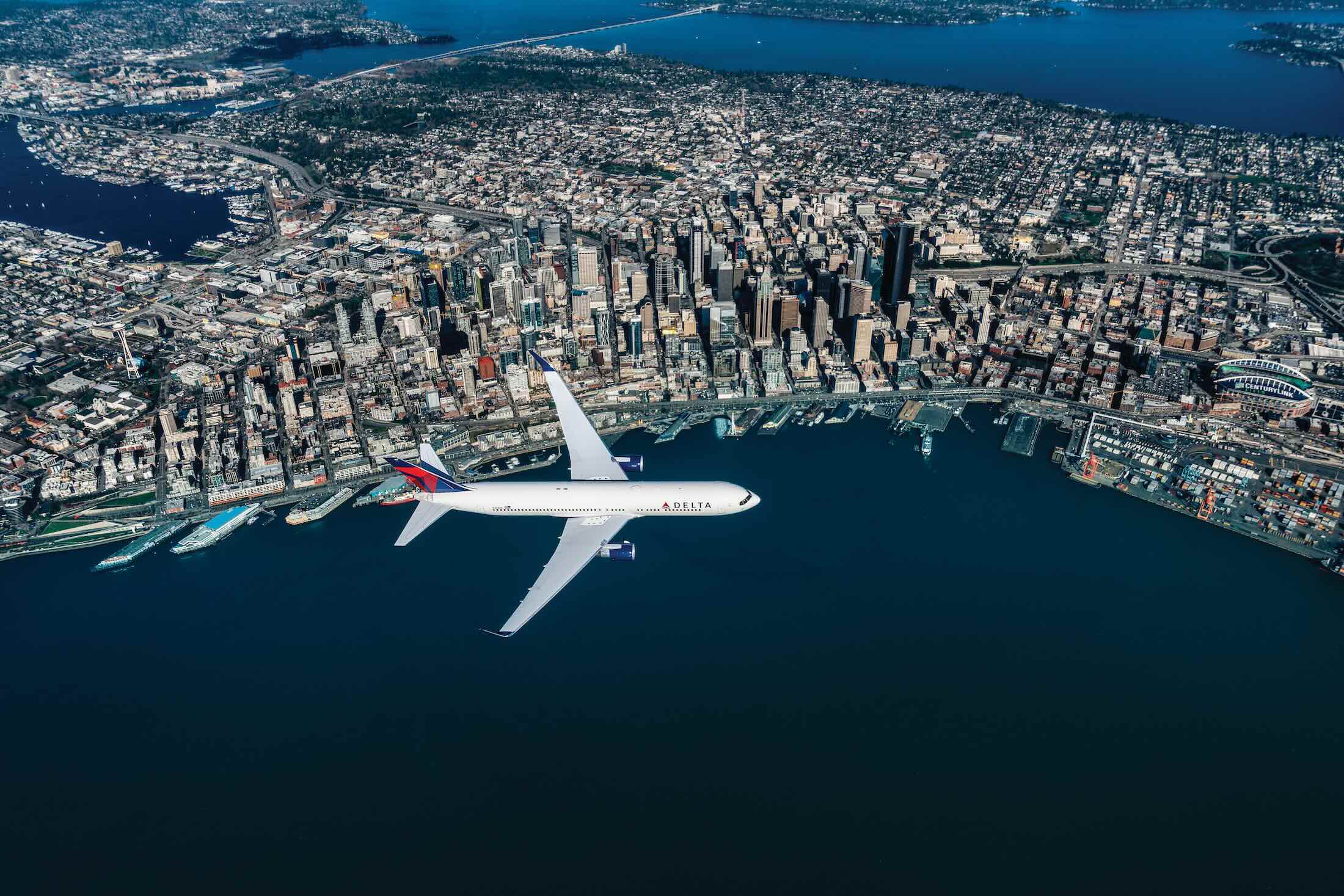
Delta Air Lines is returning to Tokyo Narita Airport after a seven-year absence, launching daily nonstop service from Seattle in March 2027. I welcome the added capacity, particularly on a market where competition should help consumers. But the route still raises a fair question: why Seattle?
Delta Returns To Tokyo Narita With New Seattle Flight, But Why Seattle?
Beginning March 28, 2027, Delta will resume daily nonstop service between Seattle and Tokyo Narita:
- DL167 Seattle (SEA) – Tokyo Narita (NRT): 1:35 pm – 4:20 pm+1
- DL166 Tokyo Narita (NRT) – Seattle (SEA): 6:30 pm – 12:00 pm
Delta will use an Airbus A330-900neo on the route, which I reviewed in Delta One here (and I know I used a 767-300 in my image above).
This will complement Delta’s existing Seattle-Haneda service and mark its return to Narita after abandoning the airport in 2020 as it consolidated Tokyo flying at Haneda.
At a basic level, I welcome this route. More capacity between the USA and Japan is good for consumers, particularly as demand to Japan remains very strong (the weak JPY makes it even better for Americans traveling to Japan right now).
I’m not prepared to reduce this route resumption entirely to another battle in the Delta vs. Alaska war in Seattle: Delta cannot simply add another Haneda flight, as those slots are tightly controlled. Delta already serves Haneda from Atlanta, Detroit, Honolulu, Los Angeles, Minneapolis, and Seattle. If Delta wants to add more Tokyo capacity without waiting for another slot allocation, Narita is the only option right now.
So yes, Alaska Airlines will operate Seattle-Narita with Japan Airlines also in the market, and Delta clearly has no objection to making Alaska’s longhaul expansion more difficult. But Delta is also testing whether there is room to grow its own Tokyo operation again…sorry, but I won’t reduce that to desperation.
Why Seattle Instead Of New York Or Salt Lake City?
That still leaves me scratching my head over the choice of Seattle.
Seattle-Tokyo is certainly a large market, and Delta knows it well. But Delta already flies Seattle-Haneda, and Alaska/JAL will provide formidable competition at Narita.
Why not try JFK-Narita?
That question becomes more interesting when viewed against Delta’s recent retrenchment in New York.
Delta has dropped JFK-London Gatwick and abandoned planned or returning service to Geneva, while it has also pulled back from Brussels and Munich. Domestically, Delta recently confirmed that routes between JFK and Houston, Memphis, and St. Louis will not return after initially being suspended.
Meanwhile, Delta has no nonstop service whatsoever between New York and Tokyo while United serves both Haneda and Narita and American Airlines serves Haneda (a slot that Delta could well have maintained had it been willing to operate a JFK-HND flight of its own). Japan Airlines and ANA also offer substantial New York-Tokyo capacity.
It is curious that Delta has once again chosen not to challenge that market.
Salt Lake City-Narita would also be a logical add. SLC is one of Delta’s fortress hubs, and unlike Seattle it would offer an enormous bank of connecting traffic without a local rival sitting on top of it. Delta itself, not Northwest, previously operated SLC-Narita, so there is historical precedent for the route. Even some of the discussion surrounding this announcement raised the question of why Delta continues putting incremental transpacific capacity into Seattle rather than SLC.
I am not suggesting either JFK or SLC would necessarily perform better, but SEA-NRT still comes as a surprise to me.
The Bigger Problem: Who Is Going To Fill These Seats?
Narita works particularly well as a connecting airport when you have a partner on the other side.
American has JAL, United has ANA and an increasingly substantial Narita network of its own, but Delta has neither.
Delta walked away from its old Narita hub after the Northwest merger era and now routes much of its connecting Asian traffic through Seoul Incheon, where Korean Air provides a powerful joint venture hub. Narita therefore becomes much more dependent upon local traffic, save for the domestic interline connections tend to price out very high when booked with Delta.
There certainly is local demand.
Tokyo is one of the largest metropolitan areas on earth and Narita is not universally inconvenient. Depending upon where you are going in greater Tokyo, Narita can actually be preferable to Haneda. But the traffic imbalance is still perplexing.
The weak Japanese yen has made Japan an extraordinarily attractive destination for Americans while making travel to the United States considerably more expensive for Japanese travelers. That means much of the demand is likely to originate on the U.S. side rather than Japan.
Leisure-heavy, U.S.-originating traffic can fill airplanes. It does not necessarily fill them at great yields.
Thus, Delta can probably fill this A330-900neo. But can it fill it at fares that justify flying another widebody across the Pacific every day?
Or will we see the sort of deeply discounted seats Delta is already offering as it tries to stimulate demand on Atlanta-Riyadh?
Load factor alone does not make a route successful.
Is This Really About Alaska Airlines?
Let me return to Alaska Airlines for a moment.
Delta and Alaska are increasingly going head-to-head in Seattle, particularly now that Alaska has inherited Hawaiian’s widebody fleet and is building a longhaul network from SEA.
Delta already competes directly with Alaska on several new international routes, and adding Narita certainly puts another Delta widebody into a market Alaska is trying to develop.
Some have suggested the entire point is to flood the route with capacity and make Alaska bleed.
Maybe.
But I think that interpretation is too simplistic and would hope Delta has better uses for its fleet than vanity routes.
Delta has publicly committed to growing across the Pacific, and SEA-NRT gives it another Tokyo frequency without requiring a scarce Haneda slot. Delta almost certainly would have preferred a second SEA-HND flight had it been able to secure the slot, but this is an experiment.
Alaska has a vastly superior feed into SEA and as such, will have an easier time filling seats. But the pie may be big enough to go around right now.
CONCLUSION
I welcome Delta’s return to Tokyo Narita. More competition and more seats between the USA and Japan are good for travelers, and I am not prepared to dismiss SEA-NRT as some irrational attempt to spite Alaska Airlines, without ruling out that it could be what is driving this route addition.
Delta wants to grow across the Pacific. Haneda offers virtually no room for incremental growth. Narita does. I see the logic. But I’m still scratching my head as to why Delta chose Seattle over Salt Lake City or New York.
Delta already serves Haneda from SEA, lacks a Japanese partner at Narita, faces strong competition from Alaska and Japan Airlines, and will be heavily reliant upon U.S.-originating traffic at a time when the weak yen makes outbound Japanese demand comparatively soft. At the same time, Delta continues to leave New York-Tokyo untouched and has recently cut a surprising number of routes from JFK.
Could SEA-NRT work? Absolutely.
Could Delta fill the airplane while still struggling to generate respectable yields? Also absolutely.
I hope it does work, but considering the competition, lack of feed in Japan, and current direction of transpacific yields, it is hardly unreasonable to wonder whether it might not…
image: Delta






SkyTeam has essentially nothing to offer beyond Tokyo, so it’s a purely O&D destination for Delta, while UA/AA have lots of options beyond. SEA-NRT is competitively strategic, and that’s what this is about, as JFK is obviously the more lucrative (and underserved) route but DL would be at a disadvantage to its competitors.
Unrelated (but relevant to Delta and SoCal fliers), Delta just cut their once daily direct D1 flight from SNA-JfK for most of the winter schedule. They’ve pulled out of the market before to optimize for the slot. United seems to be the only one who can make the route work well.
your article is quite a bit more rational than some of the others which seem to be just about generating clicks.
DL and no other carrier can grow anywhere in Tokyo unless they do it at NRT; the US-Japan treaty, despite being Open Skies everywhere else, does not allow any more flights at HND.
The Japanese Yen is at multi-decade lows which increases US tourism to Japan which favors US carriers.
AS and JL are not a single entity in a JV; they may get there but neither flies SEA-HND which is the preferred route for business traffic to Tokyo and HND gets the best revenue.
DL will be the only airline or alliance that flies to both Tokyo airports from SEA, something AA/JL and UA/NH do from some of their hubs.
the 339 can easily make it from SEA to Japan but cannot from JFK which will eventually be an A350 gateway including w/ service to Seoul and other cities in Asia (south and east). The 339 is more leisure configured and lower cost. DL might add NYC or BOS to Tokyo service but it will almost certainly be to HND and when the US and Japan allow more HND flights or for DL to swap its HNL-HND route for something on the east coast.
That isn’t allowed right now so it isn’t a surprise that DL is adding SEA-NRT to grow.
and mak,
of course DL doesn’t have beyond Japan flights from HND. They do feed alot of domestic Japan traffic onto JL and NH and AA and UA don’t push beyond traffic through ICN.
Tokyo is a big enough market that DL can serve just the local market
If Delta has fifth freedom rights like Northwest did, they should base some old 717’s there. Start some Narita flights to Kaohsiung Taiwan, Busan Korea, maybe even Macau. Or have a change of gauge, international only passengers to Hiroshima or Fukuoka.
Why not PDX-NRT?