
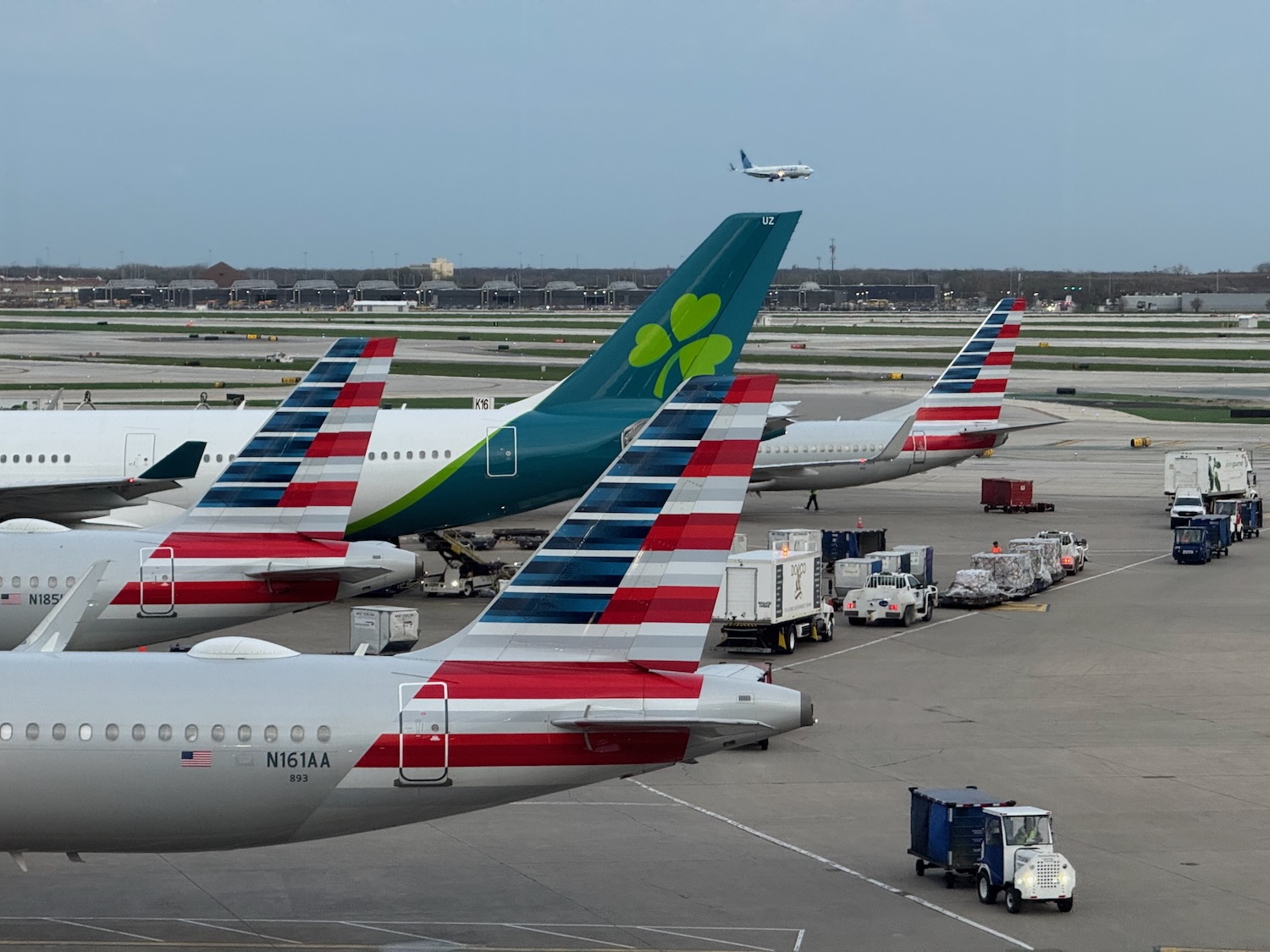
The FAA is stepping in at Chicago O’Hare and cutting flights this summer, a move that ironically provides relief to both American Airlines and United Airlines and likely benefits consumers too.
FAA Flight Cuts At Chicago O’Hare Are A Win For Both United And American
The Federal Aviation Administration will cap flight operations at Chicago O’Hare International Airport this summer in an effort to reduce congestion and chronic delays.
The new policy will reduce flights at O’Hare by 12% this summer, limiting daily peak day operations to 2,708 between May 17 and October 24, 2026. As a point of reference, ORD had 2,680 peak day operations during this period in 2025 and carriers has planned 3,080 this year. The limits will be per on a half-hour basis, with 30-84 operations per half-hour.
On paper, this looks like a victory for American Airlines. After all, American has been losing ground to United at ORD and has struggled to match United’s aggressive growth. But that framing misses the bigger picture.
This “Capacity War” Was Artificial To Begin With
The additional flights at O’Hare were not purely about demand. They were about gates.
United and American have both been operating more flights than they otherwise would have in order to maintain their gate allocations under O’Hare’s unusual gate usage rules.
As United CEO Scott Kirby bluntly put it last month at an event in Los Angeles:
“We didn’t want to fly 780 flights this year from Chicago, but we didn’t want to lose the gates. The whole thing is pointless and stupid.”
That tells you everything you need to know.
When airlines are flying routes they don’t even want to operate just to protect gate access, something is broken…the FAA’s edict helps both carriers avoiding dumping capacity.
Why This Is A Win For Both Airlines
The FAA stepping in effectively resets a “game” that seemed even more foolish in light of surging oil prices. By capping flights, airlines no longer have to operate marginal or duplicative service simply to hold onto gates. That benefits both United and American.
United can trim back capacity it never really wanted in the first place. American, meanwhile, is no longer forced to match United flight-for-flight in order to remain competitive under the current allocation system.
This is not a case of American “winning” and United “losing,” it is a case of both airlines being relieved from a system that encouraged inefficient flying.
It’s Foolish To Write Off American At O’Hare…
There is also a tendency to dismiss American’s strategy in Chicago as irrational or unsustainable, but of course that misses a key point.
Chicago is one of the most important loyalty markets in the United States, particularly for co-branded credit cards. That is where the real money is. Even if American’s O’Hare operation does not match United in scale or profitability on a pure flying basis, maintaining a strong presence in Chicago supports its broader loyalty ecosystem, the true profit center for the airline.
In that sense, American’s investment in O’Hare is not just about flights. It is about credit card customers and long-term brand relevance in a massive market.
The competitive balance between United and American at O’Hare remains intact.
Mixed Bag For Passengers?
For consumers, the impact is more nuanced.
Fewer flights should mean:
- less congestion
- fewer delays
- a more reliable operation overall
But there is a tradeoff.
Less capacity can also mean higher fares, particularly in a fortress hub like Chicago where both United and American dominate and where Spirit Airlines (if it even survives) continues to shrink.
So while the operational experience may improve, passengers may end up paying more for it.
CONCLUSION
The FAA’s decision to cap flights at Chicago O’Hare is not a win for one airline over another. It is a correction to a system that incentivized airlines to operate flights they did not even want to fly. Both United and American benefit from the reset, even if AA benefits slightly more.
For passengers, the result will likely be a more reliable experience, but potentially at a higher cost. Having faced aggravatingly-long taxi times in Chicago O’Hare, I’d call this a win for consumers too.





I flew ORD-MEX this week on AA. It was $129, and my upgrade cleared at T-100. I definitely don’t want to see any reductions at ORD. For cheap fares and easy upgrades, I’m fine with the occasional ground delay.
Actually, this is not a very surprising FAA decision.
“Actually, this is not a very surprising FAA decision.”
Not at all.
“is not a win for one airline over another” 100%
*incoming* Tim to tell us how this is good for Delta and bad for United… *facepalm*
quit sniffing.
This is BAD for UA but has little to no effect on DL or the other airlines that do not hub at ORD.
prosch,
hogwash that UA didn’t really want to fly all that capacity; they scheduled the flights and put them on sale. Of course they wanted someone to stop the madness but they most certainly did not want to have to cut far more of the 2025-2026 added flights than AA. UA’s strategy failed plain and simple.
and, no, UA cannot redeploy that capacity someplace else. Not only are the cuts coming to close to redeploy that capacity but high fuel prices make it impossible to find places to redeploy that capacity this year.
You called it.
Then why did both AA and UA not do a better job in negotiating with the City of Chicago to come up with better terms surrounding ORD’s new gate utilization use or loose it rule that basically forces airlines to fly unprofitable routes just to hold on to gates.
To hear Kirby say United didn’t want to fly 780 flights out of ORD but would have to not loose gates tell me this needs to be addressed when their leases come up for renewal.
United can now put those resources that would have been waisted flying 780 flights out of ORD into other markets where United can reap the benefits instead of in a pointless war with American which would have cost both airlines money.
Attention air travelers!
It’s worh adding that the FAA said it will also take other steps to better operations at ORD, such as adding more air traffic controllers to increase bandwidth plus optimizing routes and the airspace around Chicago.