

JetZero has secured up to $3 billion in potential federal financing for a radical blended-wing aircraft that promises dramatically lower fuel consumption, four aisles, and a passenger cabin unlike anything flying today. The concept is compelling, and United, Delta, Alaska Airlines, and the U.S. Air Force are paying attention. Even so, building a striking prototype is one thing..certifying and mass-producing a credible Boeing competitor is quite another.
Can JetZero’s Radical Blended-Wing Aircraft Really Challenge Boeing?
For more than seven decades, nearly every commercial passenger aircraft has followed the same basic formula: a cylindrical fuselage with wings attached to it.
JetZero wants to discard that formula.
The Long Beach-based startup is developing the Z4, a 250-seat blended-wing-body aircraft that resembles a manta ray more than a conventional jetliner. Rather than relying on a traditional tube to carry passengers while the wings generate most of the lift, nearly the entire aircraft contributes to lift.
That produces a shape that is lighter and creates less aerodynamic drag. JetZero says the Z4 could consume up to 50% less fuel than existing commercial aircraft, while The Wall Street Journal reports an anticipated improvement of roughly 30% compared to a Boeing 787.
Either figure would represent a tremendous leap.
Aircraft manufacturers typically fight for incremental efficiency gains. A new engine, lighter materials, improved aerodynamics, and revised wings might collectively produce a double-digit improvement over the aircraft being replaced. JetZero is promising something much more dramatic without waiting for hydrogen propulsion or batteries.
The Z4 would use conventional jet engines and could operate using existing airport infrastructure.
At least, that is the plan.
JetZero Z4 Cabin Would Have Four Aisles, But Few Real Windows
The unusual exterior produces an equally unconventional passenger cabin.
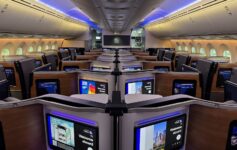
Instead of one long, narrow tube, the Z4 would have a broad interior divided by four aisles. JetZero envisions fewer rows, wider passageways, accessible lavatories, designated waiting areas outside the toilets, and dedicated overhead storage for each passenger (I’m picturing this like a ferry boat…).

Here are some cabin renderings of a premium cabin and economy class:


The expansive cabin could give airlines considerable flexibility to create lounges, larger premium cabins, family areas, or other spaces that are difficult to accommodate inside a conventional fuselage.
But there is one obvious drawback: most passengers would not have access to an actual window. Instead, JetZero proposes digital displays showing exterior views, along with overhead skylights that would bring natural light into the cabin.
I am intrigued by the concept, but skeptical about a mostly windowless passenger aircraft. A digital screen may provide a beautiful view, perhaps even a better one than a small scratched window above the wing. But it’s not the same, sort of like the digital windows in Emirates First Class on its “Game Changing” 777:

Perhaps this is not a big deal to most, but it is to me.
There are also questions about how passengers seated farther from the aircraft’s centerline would experience banking turns. The wider the cabin, the more noticeable vertical movement might become near its outer edges, although JetZero says the aircraft can be designed to minimize discomfort.
Then there is evacuation. A four-aisle cabin sounds excellent when everyone is calmly boarding, but JetZero will have to demonstrate that hundreds of passengers can evacuate rapidly from an airframe that looks and functions very differently from today’s aircraft.
Still, I don’t see anything insurmountable in theory.
United, Delta, And Alaska Airlines Are Taking JetZero Seriously
JetZero is no longer merely a collection of futuristic renderings.
United Airlines has invested in the company under an agreement that creates a path to purchase up to 100 Z4 aircraft, with options for another 100, provided the airplane meets United’s operational, safety, and performance requirements (a huge escape clause, as I previously noted).
That remains a highly conditional commitment, not a firm order for 200 airplanes. But United’s involvement gives JetZero both credibility and access to the operational expertise of one of the world’s largest airlines.
Delta Air Lines is also working with JetZero through its Sustainable Skies Lab. Delta is advising the startup on airport operations, maintenance, cabin design, accessibility, boarding, and the broader passenger experience.
Alaska Airlines has invested as well, while Japan Airlines recently announced its support for the program. Gulf Air has signed a letter of intent for an undisclosed number of Z4 aircraft.
That is an impressive collection of airline interest for a manufacturer that has not yet flown a full-scale aircraft.
The U.S. Air Force may be even more important. It awarded JetZero $235 million to build and fly a full-scale blended-wing demonstrator, with the first flight targeted for late 2027. The military sees potential applications for aerial refueling and cargo missions, where greater range and lower fuel consumption would be extremely valuable.
A Potential $3 Billion Lifeline
JetZero also received a significant financial boost when the Export-Import Bank of the United States signed a letter of interest to explore up to $3 billion in financing for the company’s manufacturing campus in Greensboro, North Carolina.
A letter of interest is not the same thing as an approved $3 billion loan. It signals the terms EXIM may be prepared to consider after a preliminary review, with substantial work still required before any financing is finalized.
Nevertheless, this is serious potential government support, without which this project is probably doomed.
JetZero broke ground in June on an eight-million-square-foot manufacturing and final-assembly campus covering more than 600 acres. The company says the $4.7 billion development could eventually employ 14,500 people and produce the Z4 at scale.
The aircraft is intended to carry approximately 250 passengers up to 5,000 nautical miles, placing it in the neglected “middle of the market” once served by aircraft like the Boeing 757 and 767.
JetZero hopes to begin commercial deliveries in the early 2030s.
Could JetZero Actually Challenge Boeing?
Designing, certifying, producing, and supporting a clean-sheet commercial aircraft is one of the most difficult industrial undertakings in the world. The cost is enormous, certification takes years, suppliers must deliver thousands of parts with extraordinary consistency, and airlines expect global maintenance and spare-parts support from the day the aircraft enters service.
Bombardier developed a superb aircraft in the CSeries and still nearly bankrupted itself, eventually surrendering control of the program to Airbus, which renamed it the A220.
Mitsubishi spent billions developing the SpaceJet before abandoning the program. Other startups have made bold promises, collected provisional orders, and disappeared before carrying a single paying passenger.
JetZero faces all those ordinary startup risks while also attempting to certify an extraordinary airframe.
Even so, Boeing has not helped itself to squash this potential competitor. Boeing has not launched an all-new commercial airplane since the 787, and its next clean-sheet jet remains years away. The 757 has no direct replacement, the 767 passenger program is effectively over, and airlines need a highly efficient aircraft that can serve long, relatively thin routes without the capacity of a large widebody.
JetZero does not need to replace Boeing or Airbus to succeed. Even capturing a small share of that enormous market could support a meaningful aircraft program.
And frankly, the United States…and the entire world…could use another commercial aircraft manufacturer.
Competition is healthy. Boeing needs more competition than Airbus. If JetZero can deliver a safe, comfortable, and genuinely more efficient aircraft, airlines will have every reason to consider it.
Finally, I can’t help but note that this theoretical concept is hardly new…check out this 1948 ad from Northrup…
Sooner or later, what’s old is new and what’s new is old…
CONCLUSION
The JetZero Z4 may be the most radical serious commercial aircraft proposal since Concorde, replacing the familiar tube-and-wing configuration with a broad blended-wing body.
Its promised benefits are extraordinary: substantially lower fuel consumption, a spacious four-aisle cabin, quieter operations, and 250-passenger capacity with enough range to cross the Atlantic. The support from United, Delta, Alaska, Japan Airlines, Gulf Air, the U.S. Air Force, and potentially the Export-Import Bank suggests this project should not be casually dismissed.
But obviously, a demonstrator must fly and pass certification. Passengers must accept a cabin largely without real windows. Airlines must be convinced the aircraft can turn quickly, operate reliably, and integrate into their networks. Now JetZero must somehow transform itself from a startup into a global manufacturer capable of supporting aircraft for decades.
I hope it succeeds!






Early 2030’s sounds like a pipe dream considering they are basically starting from scratch.
But like you, I hope it becomes a reality.
Smallest problem is producing the design. Next problem is getting the funds to actually produce it. Biggest problem is getting airlines to buy into the plane, without the support structure that Airbus or Boeing has.
Other planes made by already-established manufacturers can often get past the first two hurdles, but not the last. That’s primarily why Airbus took over the C-series, and why other aircraft are “dead in the water” when it comes to sales outside their home country (Russian and Chinese planes come to mind, any geopolitics and/or sanctions not withstanding).
For airlines, the ability to support a fleet matters as much, if not more, than the ability to design and build it. If this plane DOES go anywhere in the “design/build/airline interest” timeline, my money is on Boeing buying the company, or buying a controlling interest, to prop up the “support leg” of the stool.