
Lindsey Graham was remembered this week for his military service, his long Senate career, and his unusually influential role in American foreign policy. But another part of his life also deserves recognition: he traveled relentlessly, believing that elected leaders should see the world and its conflicts with their own eyes.
Lindsey Graham Traveled The World To See It For Himself
President Donald Trump and other national and international leaders gathered at Washington National Cathedral yesterday to remember Senator Lindsey Graham, who died suddenly on July 11, 2026, at age 71.
(service leaflet here if you care to follow along)
A second service is being held today in South Carolina before his private burial.
Much has been said about Graham’s 23 years in the Senate, his military career, his friendship with the late John McCain, and his role as an unofficial diplomatic envoy around the world. But one portion of the eulogies particularly resonated with me: Lindsey Graham traveled.
He traveled constantly because he believed that foreign policy should be informed by seeing people and places firsthand. I concur!
A Senator Who Rarely Stayed Home
I have seen Graham described as the most-traveled member of the Senate, though I have not found a comprehensive public database that proves that claim. But few senators traveled abroad as frequently, broadly, or consistently as Graham.
Richard Fontaine, who served as a foreign policy adviser to John McCain, recalled traveling with Graham to approximately 40 countries. That represents only the journeys on which Fontaine accompanied him, not Graham’s entire congressional travel record.
For years, Graham traveled with McCain and Senator Joe Lieberman as part of the foreign policy trio nicknamed the “Three Amigos.” Their destinations were rarely relaxing:
- Afghanistan
- Iraq
- Ukraine
- Israel
- Syria
- Turkey
- Saudi Arabia
(and all across Africa, Asia, and Europe)
His views were frequently controversial. Graham was an unapologetic advocate of American military power, and his critics accused him of being too eager to involve the United States in foreign conflicts.
But whether you agreed with him or not, he generally did not form those opinions exclusively from a Senate hearing room or what he was told by others.
He went.
He met soldiers, diplomats, presidents, dissidents, and ordinary citizens. He visited war zones and returned to countries repeatedly as circumstances changed.
That deserves respect, regardless of the complicated legacy he leaves behind.
His Final Journey Was To Ukraine
Travel remained central to Graham’s public service until the final hours of his life.
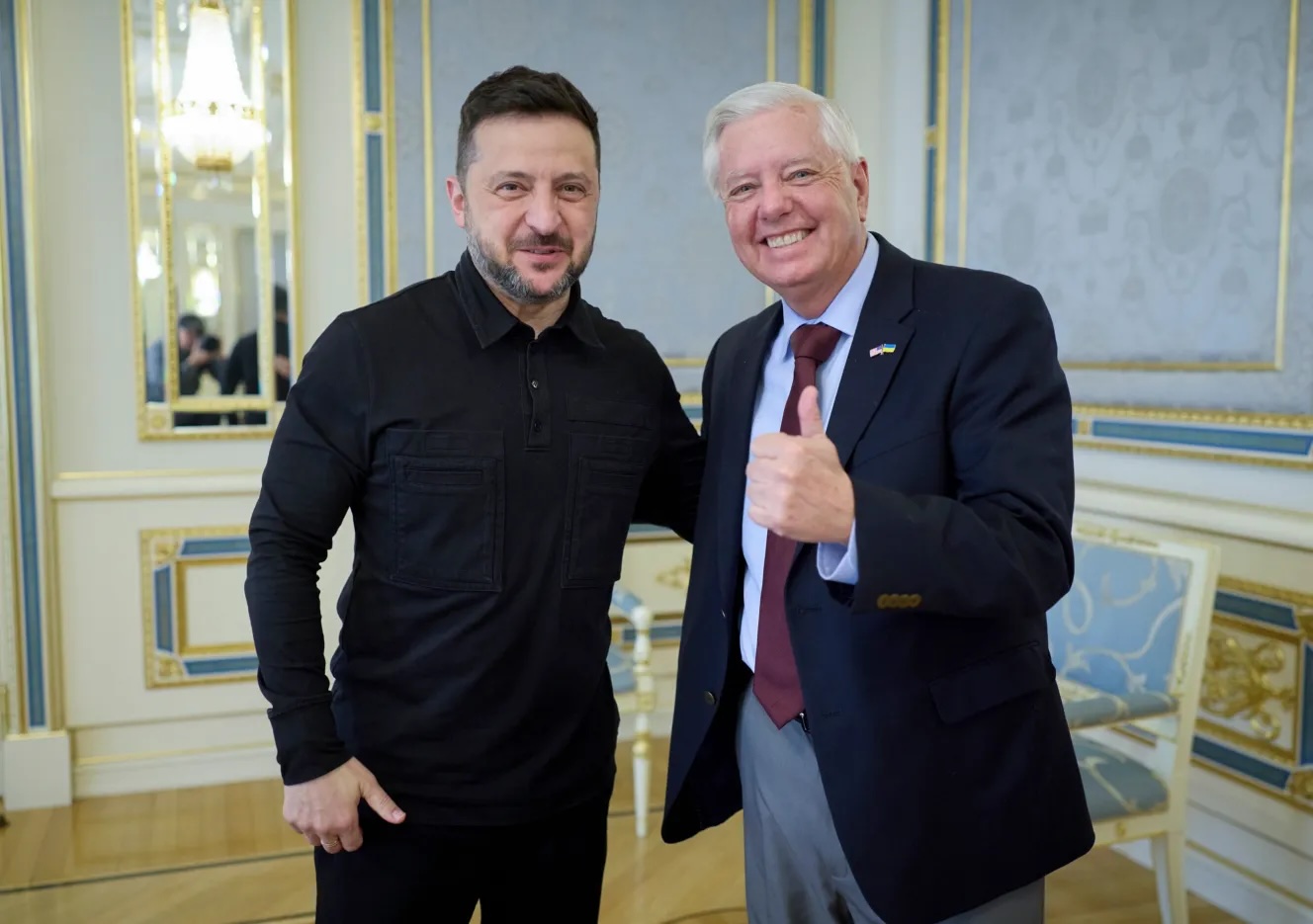
He spent his 71st birthday abroad and visited Kyiv on July 10, meeting Ukrainian President Volodymyr Zelenskyy and continuing his push for stronger sanctions against Russia (the picture above was taken on that day). It was Graham’s 10th visit to Ukraine since Russia launched its full-scale invasion in 2022, reportedly more than any other U.S. senator during that period.
He returned to Washington and died the following evening.
There is something poignant about that final journey. Graham did not spend his last days resting at home or merely speaking about Ukraine from afar. At 71, he crossed the Atlantic and traveled into a country at war because he believed the outcome mattered to the United States and the free world, a point in which I fully concur.
One day later, he was gone.
The sanctions legislation he had championed advanced in the Senate during the week of his funeral, with Zelenskyy watching from the gallery.
Travel Is More Than Recreation
I travel for different reasons than Lindsey Graham did, of course.
Most of my journeys involve airlines, hotels, lounges, churches, cities, and the pleasure of discovering how people live in parts of the world different from my own.
But the underlying motivation is similar.
I want to see it with my own eyes.
There is value in books, briefings, news reports, and expert analysis, but none can fully replace standing in a place, speaking with the people who live there, and observing details that never make it into an official report.
Travel rarely makes the world simpler. It often makes it more complicated.
That is precisely its value.
You may return home with your original beliefs reinforced, or you may return humbled by how much you misunderstood. Either outcome is better than confidently reaching conclusions about people and places you have never encountered.
Graham’s extensive travel reflected the best characteristic of a true traveler: curiosity combined with the willingness to go.
A Life Of Public Service
Graham served more than three decades in Congress and spent over 30 years in the United States Air Force, Air National Guard, and Air Force Reserve, retiring as a colonel.
His political legacy will be debated, as it should be. He was a consequential and polarizing figure whose positions inspired both deep loyalty and fierce opposition. But today, I commend his service in uniform and in the Senate.
I also commend the way he traveled the world, often to difficult and dangerous places, in an effort to understand events firsthand and advocate for what he believed was right.
I got to meet Graham when I was an intern on the Hill…20 years ago (oh, how time flies) while attending the confirmation hearing for Chief Justice John Roberts. A nice man.
CONCLUSION
Lindsey Graham was one of the most prolific travelers in the United States Senate, visiting scores of countries over a congressional career that lasted more than three decades.
His final international journey took him to Kyiv, where he spent his 71st birthday and met President Zelenskyy one day before returning to Washington and suddenly dying.
Whatever you thought of his politics, Graham understood you cannot fully understand the world from behind a desk.
Sometimes you have to go and see it for yourself…something we should all do more of.
image: The Presidential Office of Ukraine






I cant imagine how much more fulfilling his life would have been had he felt free to be his true self instead of pretending to be someone he wasn’t
A lovely tribute Matthew. Beyond politics Graham had some admirable qualities
Yeah, Matthew’s sentiments, “Sometimes you have to go and see it for yourself…something we should all do more of” are true. And, I certainly admire the late Senator’s advocacy for Ukraine’s defending itself against Putin’s criminal war (in violation of the Budapest Memorandum, since the annexation of Crimea in 2014, and the escalation from 2022.)
However, oof, I think his best quotes are: “If we nominate Trump, we will get destroyed…….and we will deserve it.” And, “I believe Donald Trump would be an absolute, utter disaster for the Republican Party, destroy conservatism as we know it.” And, “we would get wiped out and it would take generations to overcome a Trump candidacy.” And, when he correctly described Trump as a “race-baiting, xenophobic, religious bigot” and a “nut job.” Well said, Lindsey. RIP.
Only way to see all the innocent poor people you slaughter, is to fly to where you bomb them!
Is there another senator who has done more to harm our foreign standing, bankrupt our country (morally and fiscally) – by starting and supporting endless wars?
I don’t think so.
That is why Matthew has an advantage over politicians. Many politicians are dumb and poorly trained, except they are good at fundraising for their campaign. Look at Tim Walz. Totally unqualified to be VP and, possibly, an accidental President. He doesn’t even invest for his retirement. He has no clue about IRA or non-retirement accounts. He just uses bank checking accounts and a teacher’s pension. He has no idea how to run a small business and make payroll. He has no medical experience, though that is hard to get and few have it, except the President of Taiwan and the former Minister of Defense in Singapore.
At least Senator Graham had on the job training by traveling. Of course, his kind of travel is official travel, which doesn’t expose you to the real country. Matthew has had real life experience in Benin, Singapore, Switzerland, and many other countries.
Ok, bud. Let’s take those meds, now. Good. Good. Time for a nice nap-nap. Thank you…
Ok bud. You’ve had your fun. Now turn yourself into the prison and go back to your cell, you pedo tax evading drug smuggler rapist.
Ah, sorry, you have me confused with Mr. Trump.
Trump died in 2009. All this is just AI, just like they say about McConnell. Please withdraw your accusations against me and I will withdraw letting people know that you F* your mother and grandma.
That can’t be! Mitch and I just had a “20 minutes phone call.”
Very plausible. You were on the phone for 20 minutes and did all the talking. The AI on the other side just said “uh huh” once or twice. At least there was no claim that he and Senator Diane Feinstein had a 20 minute call because that would confirm that they both are on the other side. You may recall where Senator Feinstein froze up and Senator Murray (D-WA) told her “just say yes”, and Senator Feinstein said “yes”.
Senator Feinstein used to be one of the best Senators. Not wacky like Kamala or AOC or Bernie.
Naw, Mitch and I just finished 18 holes on the golf course! Make. That. Make. Sense.
No personal knowledge but I believe Lindsey was a big fan of my work.
And of course he traveled a lot to be anonymous in places where he could satisfy his needs for c#ck. Hopefully one of his aides writes a tell all book on day.
And I wonder if he ever hooked up with Mayor Pete on the side?
Kyle, on this, we agree. Who knows, maybe Ladybug was one of your biggest fans!
Enough Kyle. Graham isn’t buried. Can we keep it off speculation and on topic? 1990 don’t encourage him.
Are you going to bitch about BillyBob too? How about Bingo? Don?
Or just me because I don’t agree with your old hippie beliefs? The topic IS he was a closeted homosexual. And a war monger who is hell with Ruthie waiting for Bernie Sanders to F them both.
You want to debate it?
Watch your language and grow up.
I think he was too…but he denied it his entire life and for the last 10-15 years there was absolutely no need to if that is who he was…this wasn’t Liberace in the 80s and there never were credible people who came forward with proof that he sought them out for liaisons. I’ll choose to believe him over fugly demagogues like Laura Loomer or washed-out sex workers looking for their 15 minutes of fame.
Totally disagree respectfully Matthew. He was a Republican from the South where gays still are discriminated against. Regardless of public posturing, the GOP still isn’t welcoming gays with open arms. At a minimum he would have faced tough primaries and maybe a general election if he came out.
We know the challenges Mayor Pete faces with blacks in his own party. They alone are the biggest reason he has no shot. It’s his kryptonite, just like being a Jew is for a good Governor in Josh Shapiro.
Imagine what a major figure like Lindsey would have faced if it was publicly admitted. This isn’t some token cabinet appointment like Bessent or rich donor like Thiel.
@Maryland is right as usual, but it seems few people are willing to take the high road any longer. The era of political decency is over.
I’d argue it was over when half the country left the Union, but I’d be aging myself.
Sorry, Maryland. It’s too fun sometimes. There is indeed a line. RIP.
Ms. Ladybugs was a warmongering POS. Death is too kind for him. May his eternal soul never find peace.
I’m surprised to see you write so flatteringly about him. Lindsey Graham was a warmonger who traveled the world and decided he wanted to blow it up. Trump even said it, “Lindsey loves war.” That giddy look on his face after the Venezuela attack told you everything you need to know about him.
Graham was a spineless Senator that, despite being “pro-life,” saw little value in the life of US servicemen or civilians around the world. The way he capitulated in every opportunity to Trump was pathetic. Graham was the living embodiment of why we need term limits in Congress. The world is a safer place without him.
Unlike DJT, I think LG actually believed in what he stood for, even if there was some serious cognitive dissonance going on (like his switch to support Trump). Like Cheney, I don’t support many of the interventions, but I can support the genuine belief behind them that they were necessary.
Did it ever occur to you that like many closeted gay men, his supposed love of travel was fueled by the adility to enjoy overseas hookups without being outed?
Again, I don’t care one way or the other, but it’s not like he traveled alone. You think the secret would not have come out with all the aides he traveled with?
He traveled so much because 1) he had no family 2) was escaping his own identity and 3) couldn’t stand the sight of trump.