
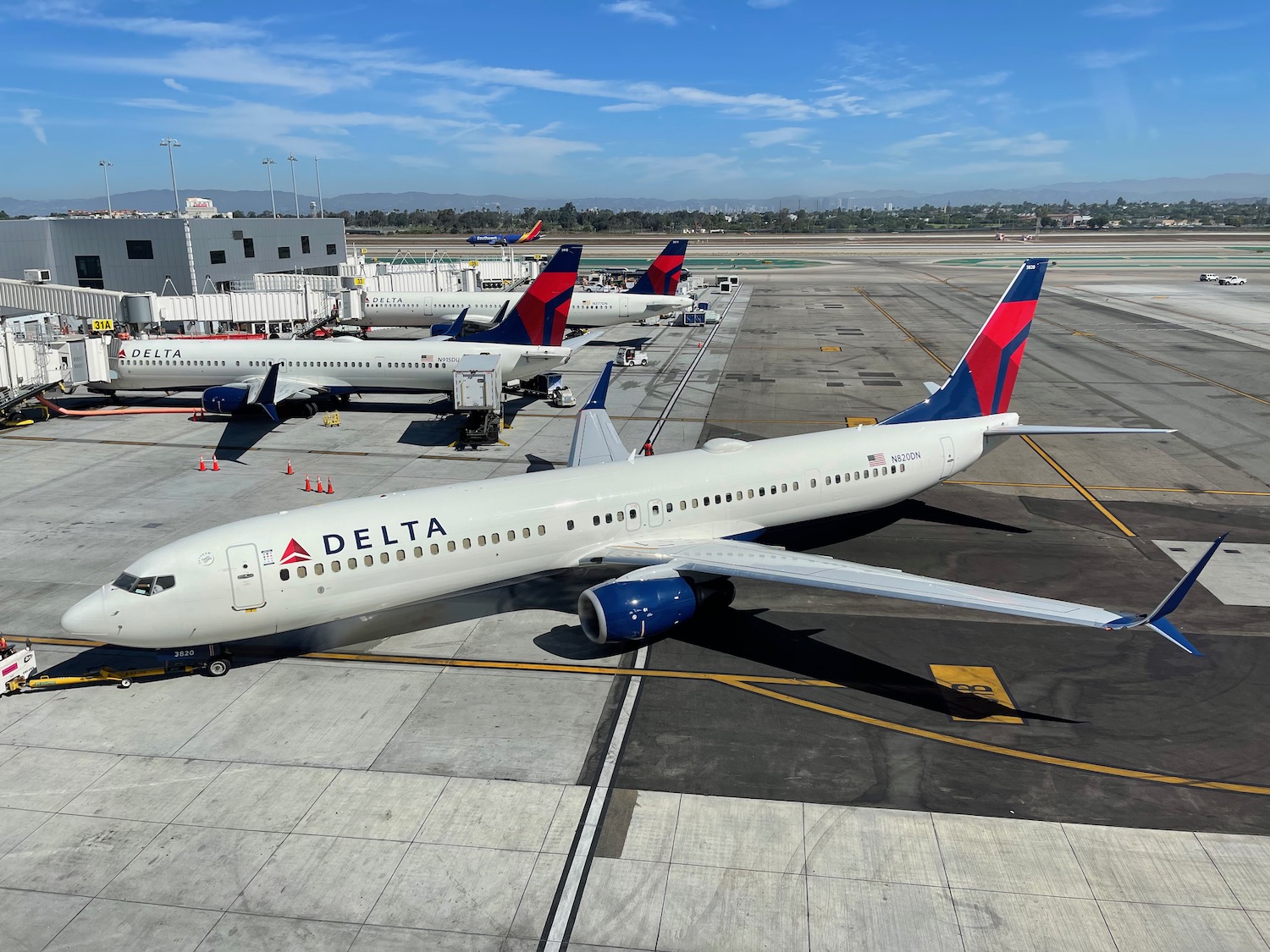
Live and Let’s Fly has learned that Delta’s new Los Angeles–Newark service may be only one piece of a broader LAX expansion strategy, with future nonstop service also planned for Philadelphia and Washington Dulles.
Delta’s Los Angeles Expansion May Not Stop With Newark
As I covered earlier, Delta Air Lines just announced new nonstop service between Los Angeles and Newark, but industry insider JonNYC shares that the carrier is not done filling gaps in its LAX network.
So, ORD transcon having already been announced, DL LAX-EWR was originally planned for 2030! This is quite a move-up in that department.
That means LAX-IAD and LAX-PHL wont be too far behind at this point (next 2 years in any case.)— JonNYC (@xJonNYC) June 27, 2026
Delta is expected to add Los Angeles–Newark service in 2027, but Philadelphia and Washington Dulles are also understood to be on the carrier’s radar for future nonstop service, potentially as early as 2028.
That makes the Newark addition look less like a deliberate jab at United and more like part of a broader effort to make Los Angeles more useful for corporate travelers and premium customers.
Delta Wants A More Complete LAX Map
Delta will never have a fortress hub at LAX in the traditional sense, because no airline does. But Delta does not need to dominate Los Angeles to make LAX work. It needs to be credible in the markets that matter (I discussed that here).
That is why Newark, Philadelphia, and Washington Dulles are valuable adds. These are large business markets, and each is tied to an entrenched competitor: United at Newark and Dulles, American at Philadelphia.
For Delta, serving those markets from Los Angeles seems to be focused on telling corporate accounts that it can cover the places they actually need to go (versus just offering added connectivity from its smallest hub). These LA-based corporate customers are more likely to take Delta seriously if the carrier can offer nonstop coverage to nearly every major domestic business market. Even if some of those routes are thin, they can still make the broader network more valuable.
> Read More: Delta’s LAX Advantage Is Not Just Ambition, It’s Gates
Philadelphia And Dulles Would Fit The Pattern
Philadelphia would put Delta back into another American Airlines hub market from Los Angeles (United abandoned this route for years and no other carrier serves it nonstop). Washington Dulles would give Delta a nonstop presence from LAX to United’s Washington-area hub (Delta already serves Washington National nonstop and AA just suspended plans to add nonstop service from LA to Dulles).
Neither route would be easy. American will not simply surrender Philadelphia traffic, and United will defend Dulles, as it always has over the years (exhibit one: Independence Air, but more recently Alaska Airlines). Newark will be challenging enough, particularly with United offering lie-flat seats on every LAX–EWR flight while Delta plans to use A321neo aircraft with recliner first class.
Oh side note on that, JonNYC also shares that Delta originally planned 3x daily lie-flat service to Newark…the A321neo reflects the reality of Delta’s ongoing seat certification issue rather than a deliberate decision to deploy a non-premium seat to the “premium” LAX-EWR route.
DL had planned on using the flat bed 3NF on the LAX-EWR route, but we all know how that’s going. Guess they just decided to just start it early with whatever they have now then upgrade it later on once those planes come in is my guess.
— JonNYC (@xJonNYC) June 27, 2026
(the route was also originally planned for 2030, but moved up three years).
The logic is becoming clearer: Delta appears to be filling specific holes in its domestic network from LAX, especially in markets that matter to corporate travelers. That is indeed a more coherent strategy, even if it is quite conservative (why not start all these routes next year?).
The risk, of course, is that “strategic” routes can become a polite way of describing routes that do not make money. LAX is expensive, competitive, and fragmented. But Delta has invested heavily there, and a more complete domestic network makes the whole operation easier to sell and increases lucrative credit card loyalty engagement, even if the specific routes only break even or even lose money.
> Read More: Delta Weighs Pragmatic Alternative To Swanky New A321neo Business Class Seat
CONCLUSION
Delta’s new Los Angeles–Newark route may be just the start of the carrier’s next phase of LAX growth. Philadelphia and Washington Dulles are also planned future additions, which would further strengthen Delta’s domestic coverage from Los Angeles.
Challenging American and United in important hub markets are not going to be easy wins for Delta, but Delta’s LAX strategy looks increasingly methodical: build enough nonstop coverage to make the airline harder to ignore for premium and corporate travelers in Southern California.






Won’t this hurt Delta hubs since those who really need to be in their destination for work will take the nonstop? Price sensitive leisure travelers may take one or two connections to save money but not business travelers. It also seems like a risky bet on Los Angeles at a time when California is declining in population and economic might.
Dallas seems like the one competitor hub where Delta should expand. Hugely expanding local market. More and more corporate offices. A large existing Delta presence from when Delta used to have a hub here in the 1980s. And a decent domestic presence already. Dallas seems more logical than Philadelphia or even Newark.
As is known, DL is currently the largest carrier at LAX. To secure large Southern California corporate accounts, DL must offer nonstops to all major Northeast business nodes.
For aviation enthusiasts → The DL jet seen in the foreground in the article photo is a B737-900ER. It is 12.2 years old and is currently en route from MSP to PDX.
More focused on growing than winning… And that’s better for DL for the time being!
Really wish Delta would add LAX-MKE 🙁
We need to see more premium cabins for these transcons. Like, actual lie-flat for 4-5 hour redeyes. Sorry, but if the goal is to compete on premium, a recliner just isn’t good enough. SQ does lie-flat on 737max. Nothing holding back Delta from installing better seats…
While I understand the general thrust of the move, DL will not succeed if they do not have the frequencies for it. Just as UA failed at making 2x JFK-LAX/SFO sustainable during the JFK slot waiver period during the pandemic, I suspect the same will happen to DL on these attempts unless they have at least 4x frequency. 2x LAX-EWR is not competitive from a scheduling perspective, much less from a hard product perspective.
as I have said repeatedly, DL intends to fly to other airline hubs which no other carrier has done well.
UA doesn’t fly to ATL
or DTW
or MSP
or SLC
IOW, UA doesn’t really compete much to DL hubs.
AA does better but doesn’t fly LAX to DTW, MSP or SLC
No carrier has managed to serve all of the major LAX markets – of which all US carriers hubs are from LAX – and yet DL appears set to serve every UA hub – fewer of them than DL hubs – and apparenly all AA hubs except CLT – and that is certain to be coming.
this is a good day for consumers and DL fans.
The UA fans esp. are having a really hard day and night.
Well, at least you didn’t include the bit about the pillow on this one…
You’re wrong yet again. Let’s see if you can figure out which city and why.
I wonder why UA doesn’t fly to as many DL hubs? Too funny.
#/Metro/GDP ($ trillions)
1/NYC/$2.4
2/LA/$1.4
3/ORD/$0.9
4/SFO/$0.8 + SJC/0.4
5/DFW/$0.8
6/IAH/$0.8
7/DC/$0.8
8/BOS/$0.6
9/ATL/$0.6
10/SEA/$0.6
11/PHL/$0.6
12/MIA/$0.6
13/SJC/$0.4
14/PHX/$0.4
15/MSP/$0.4
16/DTW/$0.3
17/SAN/$0.3
18/DEN/$0.3
19/CLT/$0.3
20/BWI/$0.3
.
.
.
.
.
37/SLC/$0.1
UA does fly LAX-SLC twice daily, but I’m not sure flying to ATL, DTW, or MSP would make any sense (same with CLT and PHL). As connecting fortress hubs or Delta, sure, funnel traffic through, but as an o/d destination, I don’t think so.
I will say it is too bad UA cannot even make DFW work from LAX…maybe with the demise of NK that route can return (especially since DL seems to make it work).
I agree that DFW should work, but UA serves SFO-SFW 4x/day with mainline so maybe its the cannibalizing.
GDP is simply not a reflection of airline market size or share of any airline.
DL gets far higher average fares from LAX to its hubs than AA or UA do and thus has more opportunity to grow
LTD says, “GDP is simply not a reflection of airline market size”
Wrong again TD. See, passengers pay for airline tickets with $.
no, GDP per metro does not equate to air travel spend per carrier on a route
now tell us the difference in average fare between ATL/DTW/MSP-LAX and ORD-LAX and the amount of revenue that each airline gets.
DL gets much higher average fares from its hubs.
and, yes, UA flies 2 RJs per day on SLC-LAX against more than a half dozen mainline flights. DL’s capacity on EWR-LAX is a far higher percentage of what UA flies than what UA flies on SLC-LAX
Look at LTD providing data. Good for you, but unfortunately it proves the obvious, which is that many factors determine ticket prices.
You said, “GDP is simply not a reflection of airline market size”
GDP is a reflection of market size, but not average ticket prices which are subject to supply and demand, the level of competition and a myriad of factors, obviously.
You were the one who said, “serving the largest industry markets is what matters in order to gain pricing power” in an effort to show how brilliant a move LAX-EWR/IAD/PHL would be. I am just showing the flaws in your DL biased circular logic.
It’s possible that UA wants to serve more destinations from LAX, they just don’t have the space and/or aircraft. They have to choose their markets. Yes, TD UA does serve LAX-SLC, and has for some time now. UA can’t make LAX into a fortress hub,
“ American will not simply surrender Philadelphia traffic”
I wouldn’t be so certain!
rebel would do well to google Bureau of Transportation Statistics Average Domestic Airline Itinerary Fares
and see how much of a premium DL gets at its hubs than AA and UA gets from its hubs.
this table is by airport but it isn’t hard to figure out who is the largest airline at each of those airports.
ATL which sits above Florida where there are tons of cheap tickets gets $55 more per average ticket than ORD.
MSP and DTW get $100 more per ticket than ORD.
ATL gets average fares as high as EWR even though the distance from EWR to most major domestic markets is much greater.
SLC gets over $100 more per ticket than DEN.
DL’s core hubs get much more revenue per ticket than UA hubs. which are larger and more competitive.
AA gets higher average fares than UA in its hubs which are in smaller markets than UA’s.
it is hard to understand how much some deny reality when every piece of data shows how much of a revenue premium DL gets.
The size of the metro area doesn’t matter; the size of the ticket that each carrier gets in each market is what matters and DL does far better than UA and has a larger size in the largest markets than AA.
1. LAX Los Angeles CA 459.79 459.79
2 ORD Chicago-O’Hare IL 421.70 421.70
3 DEN Denver CO 392.90 392.90
4 ATL Atlanta GA 476.37 476.37
5 BOS Boston MA 419.73 419.73
6 EWR Newark NJ 474.65 474.65
7 DFW Dallas-DFW TX 474.21 474.21
8 SEA Seattle WA 414.06 414.06
9 MCO Orlando FL 304.41 304.41
10 SFO San Francisco CA 476.89 476.89
11 PHX Phoenix AZ 398.66 398.66
12 LGA New York-La Guardia NY 378.81 378.81
13 JFK New York-JFK NY 486.16 486.16
14 LAS Las Vegas NV 325.48 325.48
15 MSP Minneapolis MN 519.33 519.33
16 IAH Houston-Intercontinental TX 465.76 465.76
17 PHL Philadelphia PA 469.69 469.69
18 SAN San Diego CA 382.82 382.82
19 FLL Fort Lauderdale FL 309.73 309.73
20 DTW Detroit MI 516.90 516.90
I never said a word about air fares, but thanks for all the irrelevant data, but I was responding to you saying, “GDP is simply not a reflection of airline market size”
You do understand that market size and air fares are two completely different things, right? Poor LTD.
Poor rebel cannot accept that the size of GDP doesn’t correlate directly to the size of the air travel market and certainly doesn’t correlate to the amount of revenue that any airline gets in a market.
rebel loves to talk about the size of the metro areas where UA has hubs but he simply won’t know – he certainly knows – that UA does not have as high of market share in its hub metros as DL esp but also AA – and DL gets much higher average fares.
Scott Kirby understands that dominating markets is what it takes to get high average fares which is why he wants to knock off AA at ORD and then buy AA to gain access to all of the domestic market share that AA has but UA does not.
sadly, rebel will argue until the cows come home before he will admit the reality that everyone else can see which is that UA chased the wrong things – massive international route system – to the exclusion of domestic market dominance.
DL is growing LAX to achieve greater dominance than any US airline has had at that airport.
LTD says, “GDP doesn’t correlate directly to the size of the air travel market”
Actually, it does. Air fares are a completely different matter along with all the other variables in the airline business.
just admit you are wrong, rebel.
IAH wouldn’t be in the mid teens in the size of domestic air travel market if there was a correlation between GDP and the size of the domestic market.
poor little fella will stay up all night long banging the keyboard because he can’t admit he is wrong.
and DL IS growing LAX because it has a real estate advantage that it intends to use to grow its position as the largest domestic carrier at LAX by adding service to more other airline hubs – in addition to EWR, IAD and PHL are both on DL’s agenda – which leaves CLT as one of the few markets that Jon hasn’t been able to find DL as saying it is going after.
let’s face it, though. CLT has the US’ 26th largest domestic air travel market, smaller than AUS.
IAH, much like UA is just getting rolling.
LTD projecting, “poor little fella will stay up all night long banging the keyboard because he can’t admit he is wrong.
Too funny.