
FLL to Dallas jumped from $39 to $124 within 48 hours of Spirit’s May 2 wind-down. Two weeks in, the routes Frontier didn’t backfill are still up 20%.
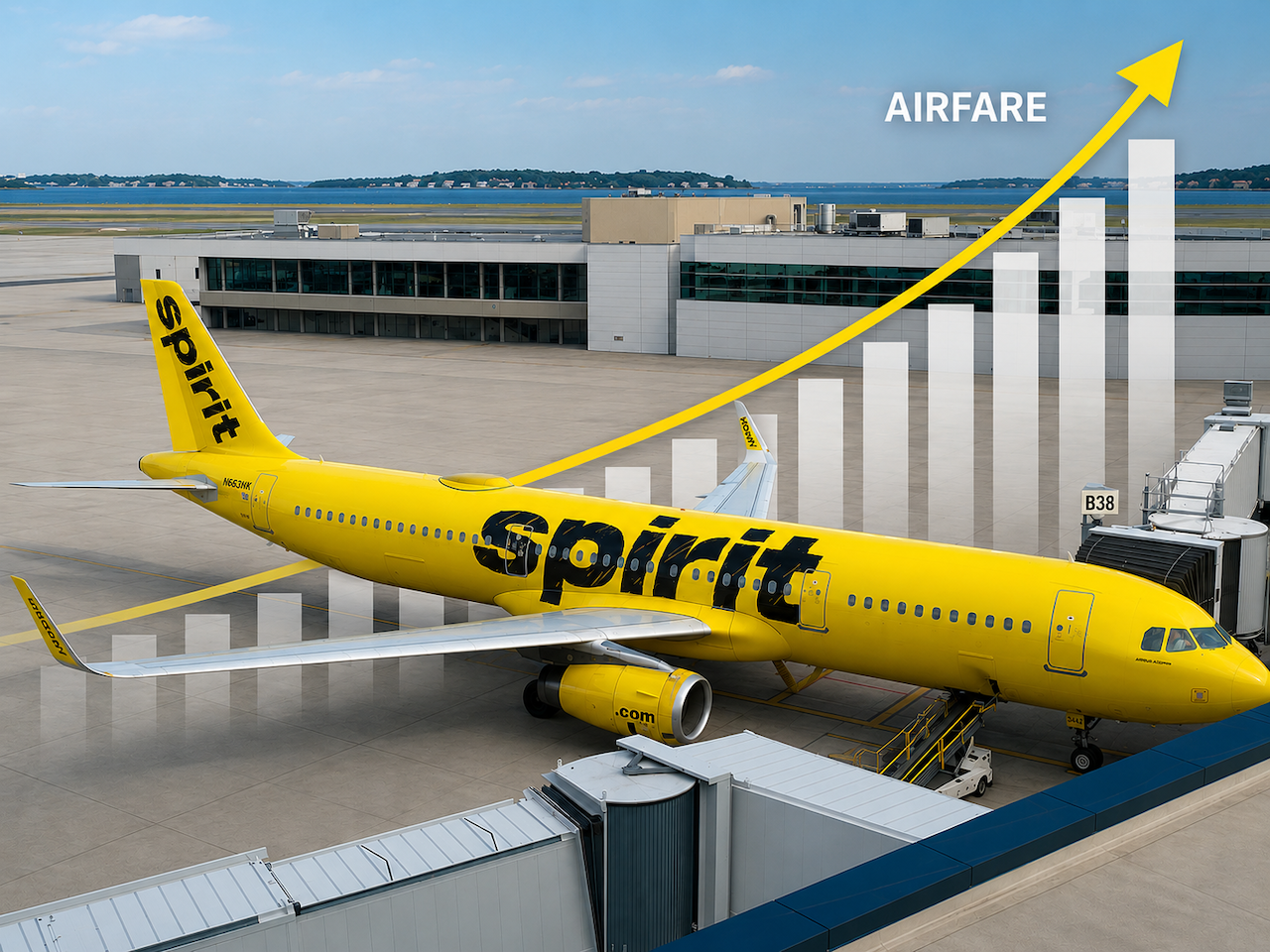
The 218% Spike Was Real, And Briefly Worse Than It Sounds
Spirit Airlines stopped flying at 3 AM Eastern on May 2, 2026 taking 1.8 million seats off the May calendar with two days’ notice. The fare data that came in over that weekend was the steepest single-week domestic move tracked in a decade.
24/7 Wall St ran the numbers and pegged the peak at 218% on Spirit’s busiest trunk routes within 48 hours of the wind-down. Their cleanest example was Fort Lauderdale to Dallas: a $39 Spirit fare on Friday, May 1, hit $124 by Sunday night, May 3, on the legacy carriers stepping into the gap. The math is a 218% increase on the base. The replacement ticket is 3.2x what Spirit charged.
Marketplace’s reporting the same week put the sustained estimate at 15% to 20%, citing a spokesperson from Going.com. The wider Cirium and Kayak real-time data ran 15% to 25% across every route where Spirit had double-digit market share. The 218% number is the peak. The 15% to 20% number is what is sticking.
On a more anecdotal level, I held tickets on Spirit for an upcoming event. I purchased four tickets for less than $400 roundtrip total. Before Spirit went under, I shopped alternatives, JetBlue was at $857 for the four tickets prior to Spirit going under, American at $2100. Once Spirit exited the market, JetBlue climbed 20%, American remained flat. It’s even higher now. Southwest was over $1,300 for the four roundtrips, better than American but 30% higher than where JetBlue ended after increases.
Boarding Area’s own, Zach Griff, was taken aback by not just the fare, but the nearly double the cost for an Even More Legroom seat.
Holy cow.@JetBlue is charging $179 for extra-legroom EvenMore seats between PBI and LGA.
That’s just for the seat assignment — the fare is “only” $239.
Ugh, I miss Spirit. pic.twitter.com/5Nwgakr72p
— Zach Griff (@_ZachGriff) May 13, 2026
Where Frontier Stepped In, Fares Moderated
Two weeks later, the picture splits into two stories. On Fort Lauderdale to Atlanta, which has Frontier, JetBlue, Delta, and a now-empty Spirit slot, current cheapest fares are back to $20 to $28 nonstop each way for May travel per various OTAs, and Frontier direct. Four airlines fighting over a route Spirit used to dominate looks healthy.
Fort Lauderdale to Dallas is a messier case. As of time of writing, Kayak prices show $43 one-way as the new floor, with Frontier and American Airlines both at $47. That is a 10% increase on Spirit’s $39 floor at face value, but the routes Frontier did not backfill quickly are running closer to the Marketplace 15% to 20% estimate. The 218% panic priced into the weekend has cooled. The structural change has not.
Frontier moved fastest. Rescue fares went live within 48 hours, a $199 GoWild Summer Pass landed days later, and Frontier now serves more than 100 former Spirit routes. JetBlue added 11 destinations from Fort Lauderdale with $99 rescue fares. Breeze grabbed Atlantic City. Where these carriers showed up fast, Spirit’s old pricing pressure was effectively replaced.
How Much Is Spirit, How Much Is Hormuz?
Honest answer: both are a factor, and we cannot fully separate them. Jet fuel is up 84% since January because the Iran war has near-halted shipping through the Strait of Hormuz, which moves about a fifth of world oil supply. Every airline is paying more per gallon. That alone has raised fares justifiably.
Analysts have stated it’s difficult to cleanly isolate fuel-driven price moves from Spirit-driven ones because both are happening at once. But the geography of the increases tells you which is which. Fuel-driven inflation hits everywhere. Spirit-driven inflation concentrates on Spirit’s old strongholds. Cirium’s hub-level capacity data lights up red on FLL, MCO, and LAS specifically. That is the Spirit signal sitting on top of the fuel signal.
The cleanest way to read the data is to assume 5%-10% of any fare increase you see right now is jet fuel, and the rest on Spirit routes is the missing competition.
A commenter on a previous post took a statement I made about flights to south Florida from Pittsburgh missing the point.
“The round trip distance PIT-FLL is approximately 2,000 miles. If Jet Blue wants $250 for that trip and it’s seen as much too costly by some, maybe- just maybe- they shouldn’t be considering any trip beyond their own front door.”
Spirit routinely priced Pittsburgh-Fort Lauderdale at $100 (or less) roundtrip . To Miami on American, the price was about $500, JetBlue came in at about $250. Yes, Spirit might have been losing money at $100, but without them there, JetBlue has no reason to play the value position in the middle of those two fares. They just go slightly under American and show a better value to Fort Lauderdale but instead of half price, it’s nearly double what it was. JetBlue’s $250 option expired with Spirit. Spirit Airlines fares, though under market, kept the entire market in check. For flyers that never flew Spirit, never wanted to, and never would, are now paying double on JetBlue.
What Price-Sensitive Travelers Should Do This Summer
Those in smaller leisure markets should consider secondary city options until ULCC backfill can be put in place more broadly.
Book further out than you usually would on Spirit-heavy hubs. Kayak’s data suggests 23-32 days out for most domestic flights, but on FLL, MCO, and LAS I would push to 60 days or more for summer travel, because Frontier and JetBlue are still ramping into the new slots.
Third, use credit card points more aggressively right now. The cash-to-points value gap widens any time cash fares spike disproportionately. The Points Guy’s May 2026 valuations show the same point now buying meaningfully more flight than it did in April. I personally backed my trip with an American Aadvantage award before it was a certainty that Spirit would terminate operations.
Conclusion
The Spirit Effect was a strong, measurable check on legacy carrier basic economy fares for the last decade. Now it is gone, and the math is showing up exactly where you would expect: on routes nobody filled, in months no ULCC could ramp into in time, on the leisure trunk that Spirit built. Frontier wins the immediate scramble, but the travelers who lose are the families booking FLL, MCO, and LAS for summer assuming the budget option would still be there. The Spirit obituaries are everywhere. But for the flyers who never flew Spirit, they pay more and sometimes a lot more in the wake of its death.
What do you think?



It was only a matter of time before Spirit would have closed up shop anyway. If Jet Blue had been allowed to buy Spirit the pricing would have changed regardless of what some think. We all can miss certain things from the past but it does not mean they are coming back. It is time to move on from Spirit. In a couple years Jet Blue may not be around either and then we will have to deal with that scenario.
Oh no! Maybe Spirit flyers will now have to pay fares that actually represent what it costs for their flights. The horror….an airline that is trying to make a profit and not require Federal bailout money. Capitalism at its worst….letting the market dictate the price. When will the madness end?
Corporate shill says what?
Can the “shower cap in public” crowd afford it? Or as they call them “bonnets”.
How’s the weather in Moscow, bigot?
My flights are expensed, so I don’t care about fares. Therefore, I don’t fly garbage airlines like F9, MX, and especially B6.
Happy to know your flights are on OPM. But remember they still inevitably control spending. And what you see as garbage today, might be your future.
Not in my business. I pay for the flight, my employer reimburses me and bills the client for my expenses. So no garbage airlines for me.
” Reimburses ” being the key. Good luck while that may last.
$28 for a ATL-FLL is not a “healthy” market, as that is an unsustainably unprofitable price. Same with the PIT-FLL example. You may like these unsustainably low fares, but the two airlines offering them – NK and B6 – clearly can’t afford to price that low.
I can’t even take a taxi or an Uber 30 minutes to the airport for under $60. Why should I expect to fly two hours for less than that?
Don’t forget you are looking at only the base fare. Once you include a seating fee, carry on fee or checked luggage fee, facilities fee (gate rent) security fee (TSA), franchise fee ( airport authority) and other fees and taxes it is not close to $28.
A 218% jump sounds like a big deal. A fare of $124 on that route sounds like a bargain. If a bar charges me $1 per beer during happy hour and $3 otherwise, I could suggest my price goes up by a whopping 200% when happy hour ends. But, a truer picture is my bar serves inexpensive beer regularly and nearly gives it away during happy hour.
If only the Biden administration had allowed the Jet Blue merger, so all these fare increases…. could have happened years earlier!
Not a surprise, but an expected outcome!
Gone, but not forgotten! Let’s recall that the “Spirit Effect” is the economic concept that ultra-low-cost carriers force larger airlines to lower their fares to stay competitive. With Spirit Airlines officially shutting down operations, this market disciplining effect has vanished, leaving consumers facing higher baseline ticket prices overall. Without NK’s rock-bottom base prices keeping the industry honest, legacy airlines have significantly less incentive to keep general ticket prices down. Undoubtedly, NK was an innovator that kept the entire commercial aviation market in check, even for passengers who rarely or never flew the unfortunate airline themselves.
$39-$47 from FLL to DFW is still not profitable for any airline.
$124 is not unreasonable by any means.
The complaints about price increases show exactly why Spirit went out of business. Yes it sucks for customers but it just wasn’t substantial regardless of the add on fees.
And yet… Spirit did it for decades… and other airlines around the world offer similar distances and experiences for similar prices…
Your lack of understanding of the costs of running an airline continue to astound.
Ryanair, Wizz, and Allegiant are prime examples.
You don’t have to ‘like’ it, but that’s reality.
Thank you for continuing to prove me correct.
For aviation enthusiasts → The NK jetliner featured in the article is an A321-200 (10.2 years old). On May 1, 2026, the aircraft was withdrawn from use and storied at LAS.
If it keeps most of their clientele out of the general flying marketplace, we all benefit. Good riddance
No more brawls at the airport ticket counter!
Will miss them.