
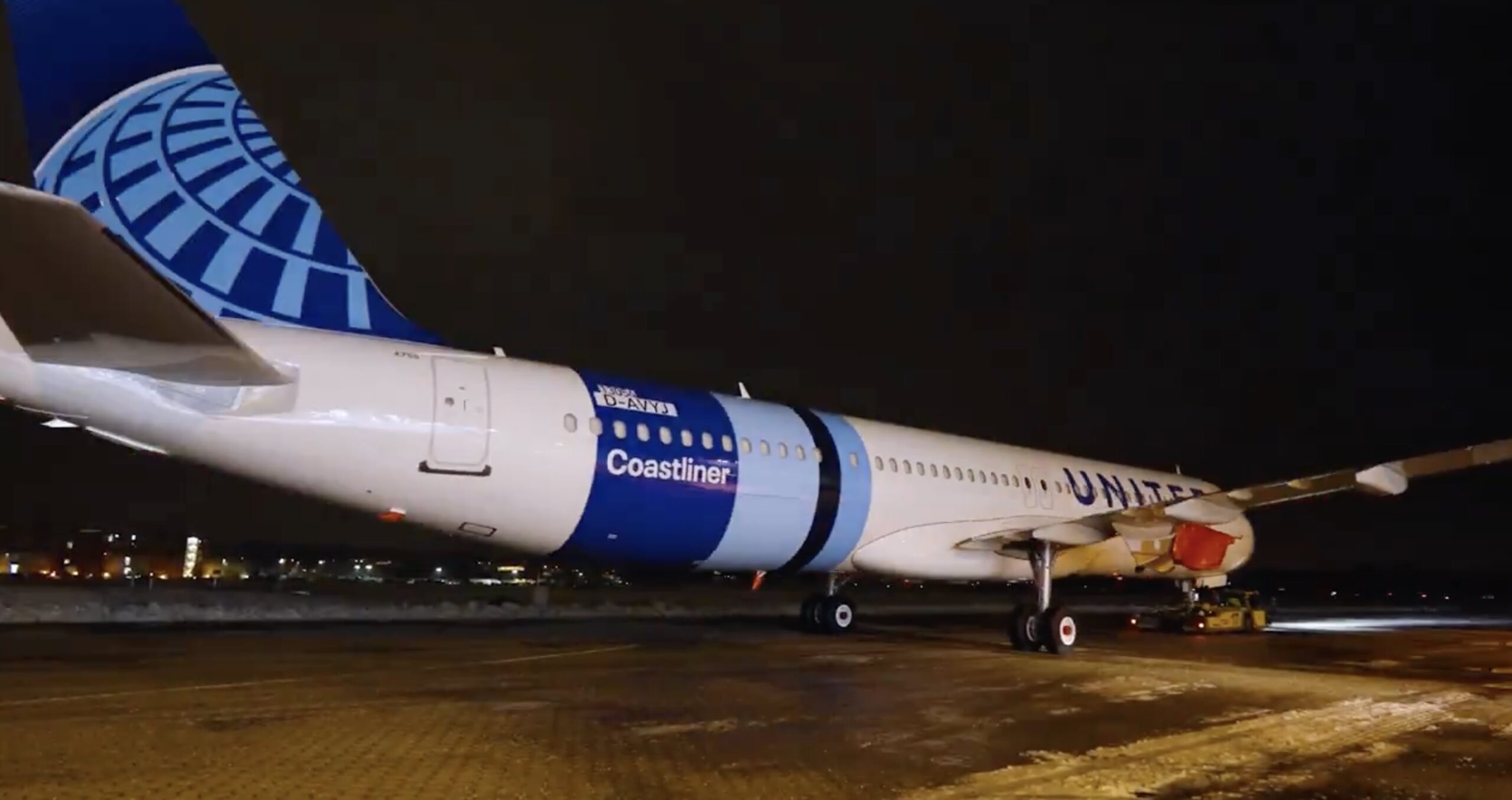
After years of promise and speculation about narrowbody lie-flat seats at United Airlines, it looks like the airline may finally be ready to receive a “Coastliner” A321 aircraft that will represent a genuinely premium upgrade on its transcontinental routes.
United Airlines’ Premium Coastliner A321neo Could Transform Transcontinental Flying
United Airlines has started showing off a new variant of its Airbus A321neo that appears destined to transform the premium transcontinental flying experience, though not as we originally anticipated. Rather than waiting for the Boeing 737 MAX 10 to be certified with a competitive premium cabin, United seems to have turned to the Airbus A321neo to bridge the gap.
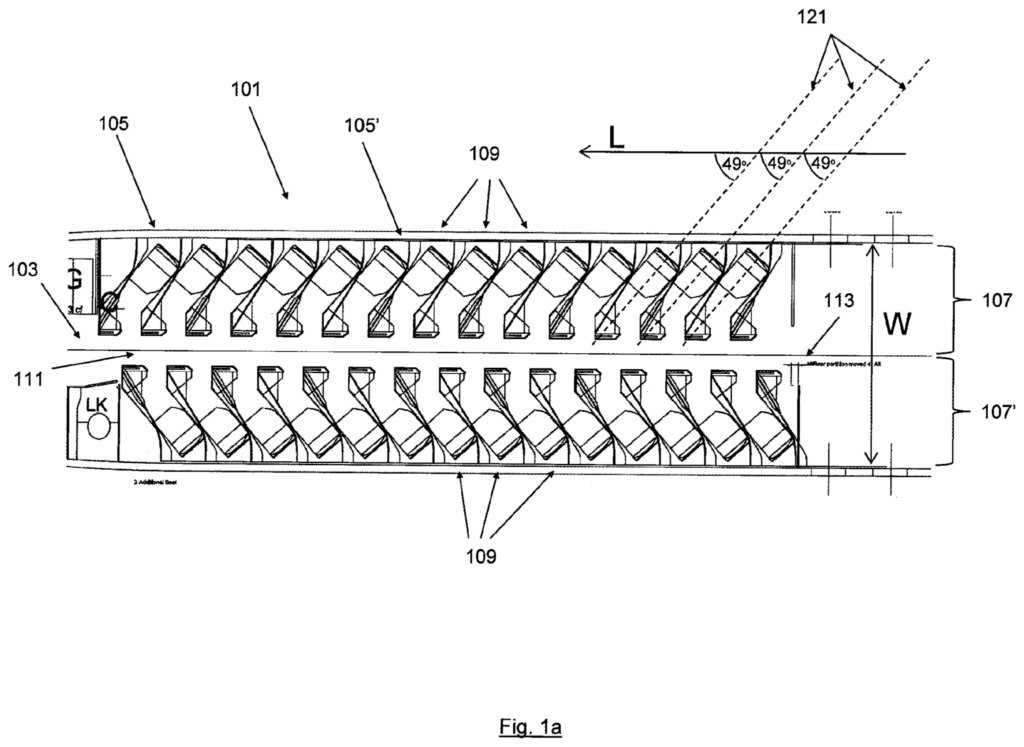
Recent sightings and leaked info to JonNYC suggest the subfleet, dubbed the “Coastliner” and likely coded A321LF, will be geared toward premium coast-to-coast flying between markets like New York, Los Angeles and San Francisco. Early reports point to a configuration with 161 seats including:
- 20 lie-flat business class seats in a 1-1 configuration
- 12 premium economy seats
- 118 economy class seats
This layout effectively creates a dedicated narrowbody premium aircraft offering the kind of lie-flat product you’d normally see only on widebody jets.
United has teased this aircraft on social channels, though the airline has not released a full official announcement with complete specifications or rollout dates. What is clear is that one of these new Airbus A321neos has emerged from the Airbus factory branded with the “Coastliner” name.
This is a significant development for a few reasons.
First, the move signals that United recognizes the importance of premium domestic travel. Routes like Newark-Los Angeles and Newark-San Francisco are premium-heavy, and the current mix of 757-200s and domestic 777-200s just does not cut it. Delta is working on its own premium narrow-body jets, albeit with certification delays, and American has pushed hard with its A321XLR Flagship Suite product…it’s a trend.
Second, United nearly chose another aircraft type for this mission. The airline previously had plans to use the Boeing 737 MAX 10 for a lie-flat narrow-body product. But certification challenges and delays with that aircraft appear to have forced United’s hand, making the Airbus A321neo subfleet the more pragmatic near-term solution.
Third, the Coastliner concept hints at broader network implications. With a dedicated premium domestic aircraft, United could expand premium transcontinental flying beyond the traditional Newark-to-California hubs. It wouldn’t be surprising to see this service extended to Boston, Washington, DC, and (maybe just to spite American Airlines) Philadelphia.
This is an exciting and logical development for United.
CONCLUSION
The premium narrow-body landscape in the U.S. is evolving quickly. United’s Coastliner concept is a bet on where premium domestic leisure and business travel is headed: more lie-flat comfort, more differentiated cabins, and more meaningful product segmentation. Whether United can execute the soft product is an open question, but the Coastliner A321neo is shaping up to be a very interesting piece of United’s fleet.
Will United Airlines expand its premium transcontinental service with new routes made possible by these “Coastliner” A321neos?






UA could use these wider O seats on their widebodies as well. Should be a 2-3-2 config on their 777s and 2-2-2- on the 787s
J seems a bit cramped. Hopefully, it is better designed than AAs
and which FAs serve O? If J, expect degraded service to J. If Y, expect O pax to complain
It looks REALLY dense in the diagram… but im in chicago so I probably wont run into this plane very much
Regular UA A321neo’s have 200 seats while these have 150 so far less dense and the same number of lavs.
UA will able to use these 40 aircraft and the incoming 50 A321xlr’s interchangeably based on seasonality on transcons and to some extent on close-in trans-Atlantic destinations given the extra fuel tank and range. Advantage United.
Why would PP passengers complain if they are being served by Y flight attendants? That’s how it’s done on any flights where PP is selling.
On these planes, the meals are restricted to O and J, wo it wouldn’t make sense for Y attends to serve O
That way all meals could be concentrated in the front galley
We need more lie-flat on narrowbodies so that 4+ hour flights, especially redeyes, have a truly comfortable premium product. I’m sorry, but recliner for 6+ hours is lame, if you’re gonna call it First or Business class. Glad to see more airlines are finally catching on. jetBlue kinda lead the way in the US with Mint. DL and UA used to have more 752s with 2-2 lie-flat for trancon. AA has a321T. These new XLRs are wonderful steps in the right direction.
The most disappointing thing (to me) and perhaps a marketing failure (time will tell) is the “Coastliner” moniker.
Lay-flat premium experiences are only for the Hollywood elites and Guvmint bigwigs. The rest of you peons will still have to suffer long redeyes in recliners because you don’t deserve the special treatment of these planes for the mose elite of the coastal elites.
Hey, I live on a coast too (thank god, neither NY, DC, SF or LA), I end up pretty miserable in recliners on United’s narrow-body redeyes all too often. But I guess I don’t matter to them because I’m not part of America’s 2% elite in those four metro areas. And I wouldn’t be caught dead in either NY, DC, SF or LA….ewwwww. And I do suffer on very long redeyes (longer than NY to LA) to South America and Europe on United’s uncomfortable narrow body jets, which could really use these kind of seats.
Not sure how well this is going to be received by the public at large. “Look, we have cool new lay-flat beds on domestic flights!….but of course, not for you, just for your overlords.”
Mike, I used to live in Florida, and while United sometimes flew its 757 with lie-flat on transcon and up to EWR, it was mostly jetBlue’s Mint operating lie-flat. Just saying, it doesn’t have to be only NY-CA traffic. I’m in-favor of more lie-flat all-over.
Actually ‘Mike’, I would guess United knows who buys their plane tickets, and also how much they are willing to pay for them. In the real world, those data points are called ‘facts’. And it appears from reading this article that United applied those ‘facts’ and made a business decision. I’m sorry to be the one to point out to you that no one cares about your own personal grievances and they are just focused on the facts related to what their passengers are willing to spend on a plane ticket.
I donno, Michael. I wouldn’t be so quick to claim whatever your opinion or cherry-picked data are is ‘facts.’ Things are fluid, and often do change. I think Mike shared some valid concerns, and it doesn’t make him right or wrong; it just is. Hoping United’s new aircraft improve the experience for everyone, but there are limits to that extent.
Thanks for sharing that you “wouldn’t be caught dead” in any of the four cities mentioned in the story. Thousands of strangers online appreciate knowing that a complete stranger needs to sound off on that even though it literally has nothing to do with anything. Your anti-urban signaling is noted, and we’re laughing at you.
You might miss your old ride when your transcon is stuck in turbulence in the low 30K’s while 757’s ten-thousand feet above you have found smooth air.
I like the idea of the distinctive branding and the name Coastliner is evocative of prior luxury, but this is giving off some weird Condor beach chair vibes.
Agree about the name (makes me think of AA’s old LuxuryLiners and WhisperJets) and also about the unfortunate livery!
Back in the day, American’s wide-bodies & Boeing 757s were “LuxuryLiners,” while its narrow-bodies were “Astrojets.”
“Whisperjets” & “Whisperliners” were OG Eastern’s narrow-bodies & wide-bodies, respectively.
You’re right!
“Coastliner” brings to mind United’s longtime history of using the word “Mainliner” for its premier passenger aircraft, which dates back to the 1930s & was also used when it began flying DC-8s in 1959 by adding the word “Jet,” as in “Jet Mainliner.”
These A321’s are part of a separate batch of A321’s with CFM engines that United Airlines is leasing. UA has long planned for a portion of their MAX 10 order to be used on transcon routes with lie-flats. UA doesn’t need the longer range the A321 has over the MAX 10 on transcon. The A321’s secret sauce is its cost per seat. It’s overall costs are higher than the MAX.
So if an airline doesn’t need the extra range of the A321 over the MAX 10 and doesn’t need the slightly larger capacity of it, there’s no reason to buy the A331 over the MAX 10. That’s why UA leased this bunch separately from its order with P&W engines. I’m sure some airline will be really happy to get the planes when UA is done with them upon receipt of their MAX 10’s.
These A321’s are part of a separate batch of A321’s with CFM engines that United Airlines is leasing. UA has long planned for a portion of their MAX 10 order to be used on transcon routes with lie-flats. UA doesn’t need the longer range the A321 has over the MAX 10 on transcon. The A321’s secret sauce is its cost per seat. It’s overall costs are higher than the MAX.
So if an airline doesn’t need the extra range of the A321 over the MAX 10 and doesn’t need the slightly larger capacity of it, there’s no reason to buy the A331 over the MAX 10. That’s why UA leased this bunch separately from its order with P&W engines. I’m sure some airline will be really happy to get the planes when UA is done with them upon receipt of their MAX 10’s.
BTW, with 40-odd MAX 10’s planned so far for lie-flat seats. UA has more in mind than just SFO/LAX=EWR. By the time these arrive, the new terminal at JFK will be done, JetBlue will be gone, and UA will be able to really big into that transcon market. With the smaller MAX 10 and lower trip costs, there are a lot more potential transcons-SAN/SEA-BOS, SFO/LAX-MCO, etc.
Why is SEA always left out of the transcon discussion?
With 60 A321neos (average age of 1 years) now in service, UA is betting big on this modern jetliner and their route strategy proves it.
United will be dumping most of these leased A321neos as soon as the Max 10’s arrive. The max 10 has a way better cost per seat mile. And United as no use for the extra range of the 321 neo on these trans on routes.
Note that a massive sub fleet of 40 A321neos could support something like 60 daily transcon frequencies…
These look good but until United includes premium lounge access with these flights they will lag Delta and American.
It seems they will have a similar configuration as AA and the same complaints you mentioned if the earlier article. No pre flight beverage and nuts. No lavatory near premium economy. I work for a gentleman who is Gold Guest List for Life with BA and similar with AA and UA and in his opinion this plane should have never been targeted for this type of premium travel whether it be for AA or UA or anyone else.
and UA really needs to call these routes Polaris. They are badly lagging DL, AA, even Hawaiian, which do consider premium transcon and long haul Hawaii as their flagship product, along with longhaul int’l
I agree – but I also don’t think the Polaris Lounges have the capacity to handle this influx of passengers.
wouldn’t the proper thing for UA to do be to expand the Polaris Lounge to handle all Polaris passengers?
Else, they are going to be uncompetitive on these routes
Will the Coastliners have 150 or 161 seats? The article says 161 but then gives a cabin breakdown and seat map for the XLR and its 150 seats.
Will coach on the Coastliner have 11 extra coach seats? At the expense of what?
I thought United was using the 737 MAX 10 for transcon. They have been saying this for ages, so why change all of a sudden? It’s a shame as an American airline they are using non-American aircraft on their flagship routes instead of those designed & manufactured in America.
Now that I think about it, someone on airliners.net or Jon Ostrower (xjonnyc on twitter) was talking about it but I always thought both of these places are just full of rumors and not fact. Are these places actually believable?
The question is, can a fully laden MAX10 do EWR/SFO-LAX against fierce winter headwinds without a freight and/or pax load penalty? That’s the reason Qantas chose the A321XLR, so they could operate BNE/SYD-PER in the southern winter without leaving pax, luggage, or freight behind. Freight is more lucrative per pound/kg than pax will ever be, so it makes sense to operate aircraft that can make it nonstop in both directions, year-round.
The branding seems wrong for routes which won’t include much flying over a coastline!
Would love to see this on the UA SNA – EWR route
I really would love to see UA introduce “ps” service to SNA and BUR. I think there’s a market for it. AA proves that from SNA-JFK.