
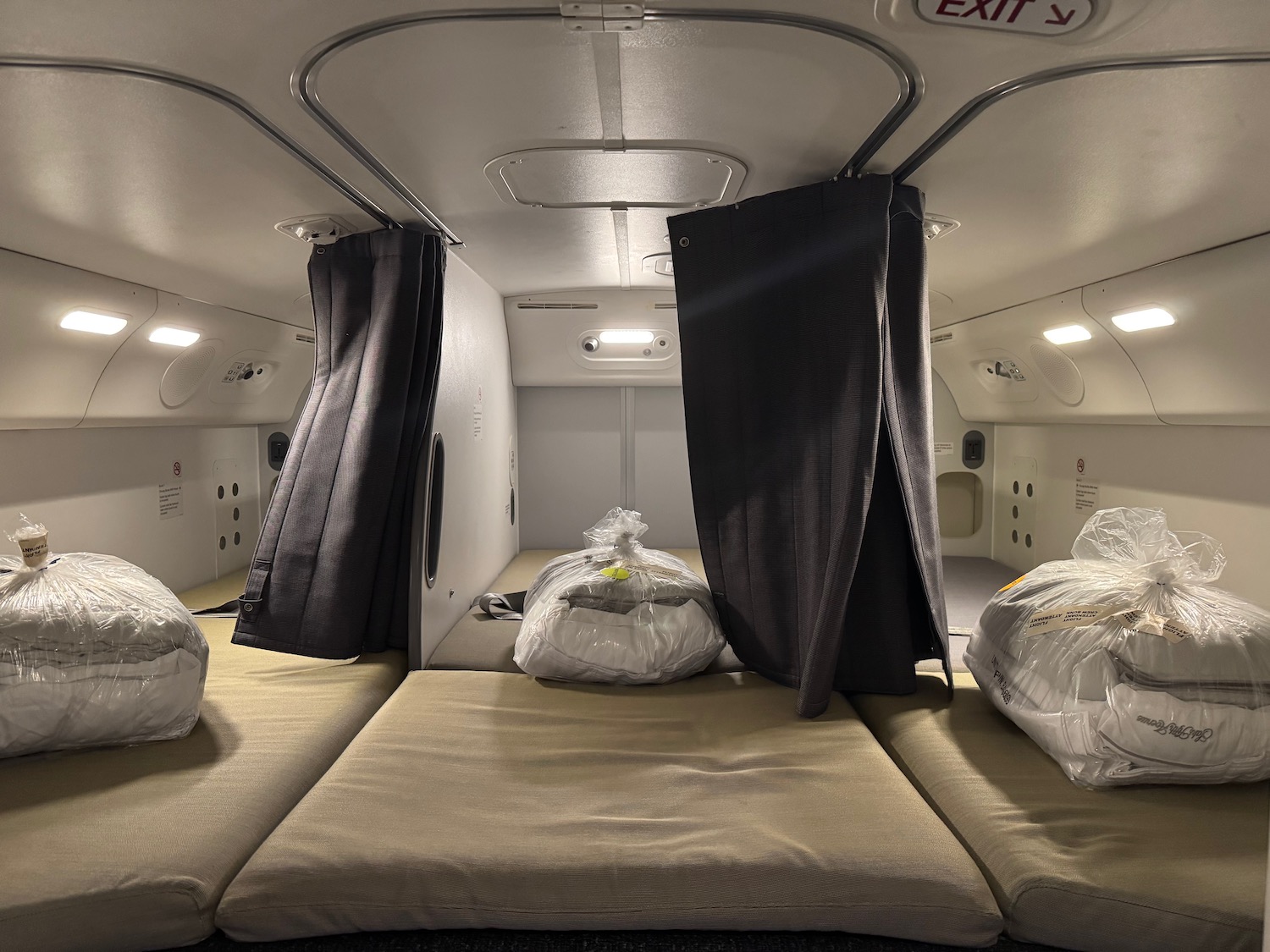
United Airlines flight attendants traveling on a space-available basis may soon trade one of the least comfortable seats onboard for one of the best-kept secrets on a widebody jet: the hidden crew bunks above the passenger cabin.
United Flight Attendants Can Now Use Secret Crew Bunks When Traveling In A Jumpseat
United Airlines is extending a welcome new benefit to its flight attendants traveling on a jumpseat.
Effective August 1, 2026, off-duty United flight attendants who are traveling on their employee pass benefits and have been assigned a jumpseat may use an available crew bunk or designated crew rest seat during portions of a long-haul flight.
That is a significant improvement over spending eight, 10, or 14 hours strapped into a narrow fold-down jumpseat.
These are not Polaris seats. On many United Boeing 777 and 787 aircraft, flight attendants sleep in hidden overhead rest compartments that passengers may never realize exist. The compact facilities include individual bunks, reading lights, ventilation, and seat belts. The photo above I took onboard a United 787-9.
Now, when space permits, jumpseating United flight attendants will be able to use them too.
How United’s New Crew Bunk Policy Will Work
According to guidance from the United chapter of the Association of Flight Attendants, the working crew always receives priority. A flight attendant traveling in a jumpseat must coordinate with the purser to determine whether a bunk or crew rest seat is available. There is no guarantee that one will be available for all or even part of the flight.
Other rules include:
- The traveler must actually be assigned to and occupying a jumpseat. A non-revenue passenger who receives a regular cabin seat cannot choose the bunk instead.
- Only United flight attendants are eligible. Employees of other airlines and flight-qualified managers are excluded.
- Available bunks will be allocated by seniority when more than one eligible jumpseat rider is onboard.
- Only one person may occupy each bunk.
- Jumpseat riders must not interfere with the scheduled rest periods of the working crew.
- They must leave the bunk at least 45 minutes before landing.
- Sleeping pills and other sleep aids are prohibited while using either the jumpseat or crew rest area.
The altitude rules vary by aircraft. On a Boeing 787, the bunk may be occupied above 15,000 feet. On a Boeing 777, the aircraft must be above 25,000 feet.
During taxi, takeoff, the initial climb, descent, and landing, the traveling flight attendant must remain in the assigned jumpseat.
United will not provide extra bedding for jumpseat riders, and they cannot request additional Polaris pillows or blankets.
I think this is a great idea (and far better than letting flight attendants sleep in open business class seats, like on British Airways). Allowing an off-duty flight attendant to sleep in an otherwise unused bunk costs United virtually nothing. It does not displace a revenue passenger, and it remains entirely subordinate to the needs of the crew working the flight.
Delta has reportedly offered a similar opportunity to eligible jumpseating flight attendants for years, so United is hardly breaking new ground. But it is correcting a policy that made little sense: leaving an empty bed unused while an employee endured an overnight flight on a metal jumpseat…I can see this being particularly valuable on domestic transcons where on-duty FAs do not receive a break to sleep in thew crew rest area.
> Read More: British Airways Will Let Flight Attendants Sleep In Empty First Class Seats
CONCLUSION
Beginning August 1, eligible United flight attendants assigned to jumpseats may use available crew bunks or crew rest seats on long-haul flights.
The working crew will always have priority, availability is not guaranteed, and strict rules govern when and how the facilities may be used. Still, this strikes me as a reasonable policy accommodation. If the bunk is empty and the flight attendant would otherwise spend the night sitting upright on a jumpseat, let the poor soul sleep!
Hat Tip: PYOK



Pilots already had this ability, right?
Incidentally, have you seen the videos from My Layover Life on YouTube? He’s a United pilot on the 757/767 based out of EWR but commutes from MSP. You might like them!
Ask any United pilot their feelings about that self-promoting blowhard. He’s not popular amongst his peers.
The fact that this wasn’t an official policy is odd to me. Provided the pass-rider is an FA trained in crew rest evacuation, fire-fighting, and decompression procedures and doesn’t interfere with the breaks of working crew, why would UA care?
Part of me feels like this already happens already (under the company’s nose) at the purser’s permission.
Seems nice. Of course, “when space permits” and “the working crew will always have priority, availability is not guaranteed, and strict rules govern when and how the facilities may be used” makes sense.
I’m surprised that it has taken this long for UA to catch on. HA crewmembers traveling for leisure have been allowed to use the crew rest compartment during cruise regardless of seat assignment for quite some time now.
Hawaiian? I think you may be mixing this up with the recent Alaska/Hawaiian merger.
Alaska does have similar pass policies (HA does not), but AS historically flies smaller Boeing 737s that don’t even have those secret overhead bedrooms (and since you said “for quite some time now,” you can’t be referring to their brand-new 787s).
Hawaiian’s widebody planes do have them, but they are locked down for the working crew on duty. No airline lets vacationing employees sleep in those secret bunks “regardless of seat assignment” (the FAA would hand out massive safety fines for that!)
Wow I would have thought this would have already been official policy at United. They are represented by the AFA and considering Delta has allowed for over 7 years now FA’s and Pilots on the jumpseat to utilize crew rest facilities on both long haul and domestic flights where facilities are available.
would rather they allowed Chairman Circle members this opportunity to get a real bed
Kudos to UA!