
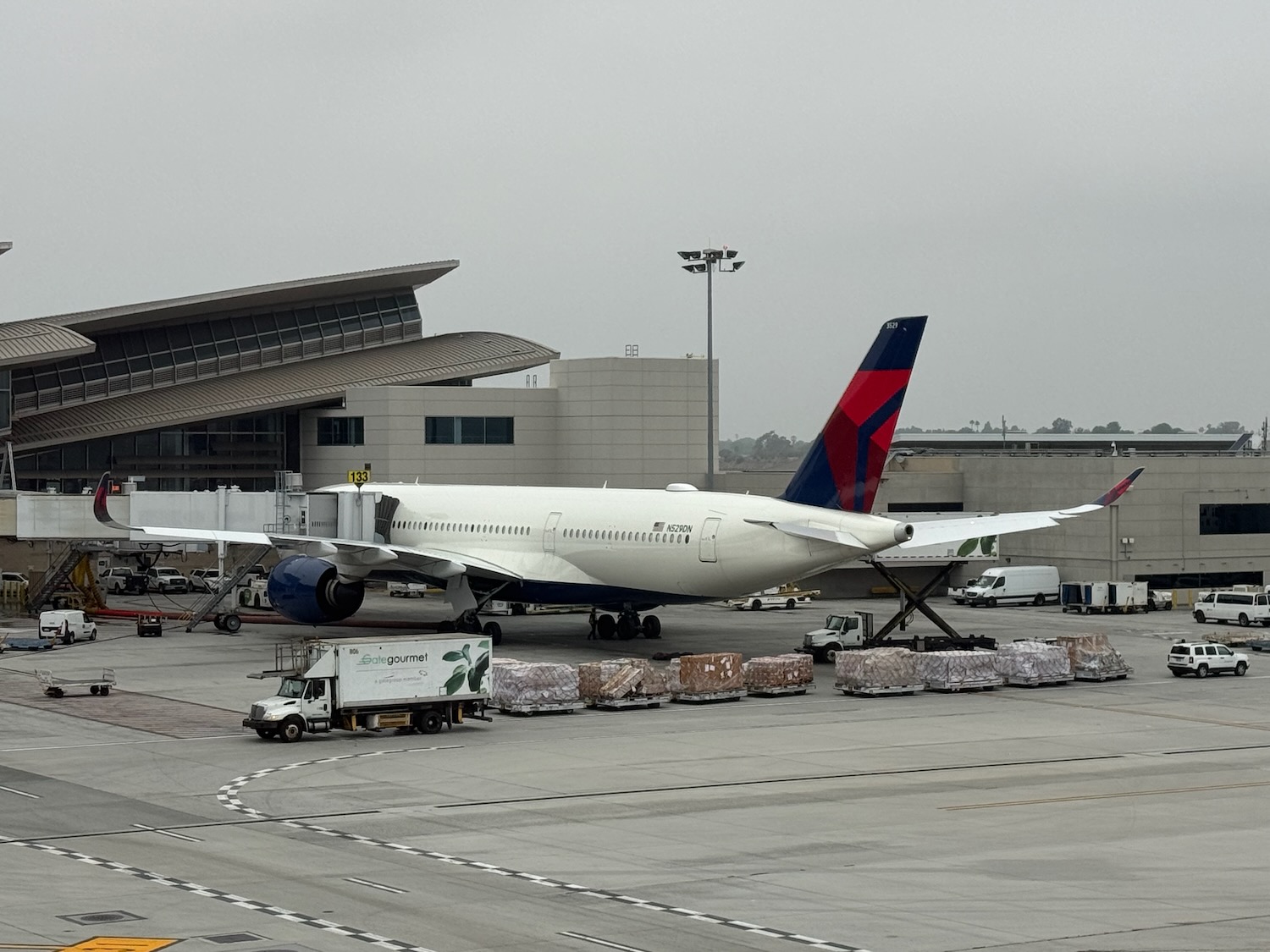
Delta Air Lines is rebuilding its Pacific network, but early financial data suggests the expansion may be expensive. A United Airlines executive is already taunting Delta over weak fares and empty seats, though declaring victory after one quarter would be very premature.
United Taunts Delta Over Costly Pacific Expansion, But The Battle Has Just Begun
United Airlines has spent years building the most extensive Pacific network of any U.S. carrier. Delta Air Lines now wants a much larger piece of that market, but early results suggest catching United will not be cheap.
Delta increased its Pacific capacity by 8% during the second quarter of 2026, while passenger yield rose by 7%.
By comparison:
- United increased Pacific capacity by 4.1%, while yield rose 10.9%
- American increased Pacific capacity by 8.2%, while yield rose 17.3%
- Delta increased Pacific capacity by 8%, while yield rose 7%
Delta also reported that Pacific passenger revenue rose 15%, while its load factor declined by 1%.
Those numbers do not prove Delta’s new flights are losing money. Yield measures passenger revenue per revenue passenger mile, not route profitability, and quarterly regional figures blend mature routes with new ones.
But the contrast is notable.
United and American achieved substantially stronger pricing growth than capacity growth across the Pacific. Delta added slightly more capacity than its yield growth could match.
That is exactly the sort of result United hoped to see.
United Executive: Delta Is “Unable To Fill Up Their Airplanes”
Delta recently returned to Hong Kong with daily nonstop service between Los Angeles and Hong Kong, directly challenging United on a route the Chicago-based carrier already serves twice daily.
United also uses Hong Kong as an intermediate point for its connecting service from Los Angeles and San Francisco to Bangkok and Ho Chi Minh City.
Per JonNYC, during an internal employee event, United Chief Commercial Officer Andrew Nocella reportedly said:
“The LA-HKG route is quite successful now as a result of the BKK/SGN tags. We face new competition now from another airline based in ATL, and I know they’re not going to do very well there. I can already tell from their pricing. They’re unable to fill up their airplanes.”
Nocella is always so subtle…
Actually, Nocella has never been shy about discussing United’s competitors, and he may have access to enough fare and booking data to support that assessment.
Certainly, low introductory fares can indicate that an airline is struggling to fill a new flight. United’s ability to carry passengers beyond Hong Kong to Bangkok and Ho Chi Minh City also gives its Los Angeles-Hong Kong service a broader base of demand than a simple local route.
But Delta’s Hong Kong service only launched in June.
It would be remarkable if a new ultra-longhaul route entered one of the world’s most competitive markets, immediately achieved mature pricing, and filled every seat at premium fares.
New routes require time…Delta hopes that steady wins the race.
Delta Is Attempting To Rebuild What It Once Abandoned
The irony is that Delta inherited a powerful Pacific franchise when it merged with Northwest Airlines.
Northwest had spent decades building a network connecting the United States with Japan and the rest of Asia through Tokyo Narita. Delta gradually dismantled that operation as Narita lost its strategic value and more nonstop flights became possible.
Delta then shifted much of its connecting traffic to Seoul Incheon through its joint venture with Korean Air.
That strategy made sense.
Rather than operating its own aircraft to every destination in Asia, Delta could funnel passengers through Seoul and rely on Korean Air to provide onward connectivity. Seoul remains a strong hub, Korean Air is an excellent partner, and the joint venture gives Delta access to a vast network without requiring Delta to fly every segment itself.
But there is a tradeoff.
United controls far more of its own Pacific network. From San Francisco, it operates an enormous schedule to Japan, China, South Korea, Singapore, Australia, the Philippines, and other destinations. It also uses hubs in Tokyo Narita and Hong Kong to reach smaller or more distant markets that cannot economically support nonstop service from the United States.
Delta now appears to have decided that relying so heavily on Seoul is not enough.
It has returned to Hong Kong, announced Los Angeles-Manila service for 2027, and has discussed adding Singapore. Delta executives have also made clear that the carrier intends to challenge United’s Pacific leadership.
That is an ambitious strategy…but certainly an expensive one, especially early on.
United Has Structural Advantages Delta Cannot Quickly Replicate
United’s greatest Pacific advantage is that it has spent decades developing the infrastructure, customer base, partnerships, sales relationships, and brand recognition needed to support them.
San Francisco is the strongest U.S. gateway to Asia. The Bay Area has deep business, cultural, and family ties throughout the Pacific, while United operates a large domestic hub capable of feeding passengers from across the United States onto its international flights.
Delta does not have an equivalent West Coast fortress hub.
It has substantial operations at both Los Angeles and Seattle, but neither offers the same combination of local demand, connecting feed, and market dominance that United enjoys at San Francisco.
Seattle is geographically well-positioned for Asia but remains a highly competitive hub where Alaska Airlines is much larger domestically. Los Angeles offers enormous local demand, but it is fragmented among many airlines and notoriously difficult for any carrier to dominate.
Delta must therefore stimulate demand through pricing while it builds awareness and establishes new routes.
United, meanwhile, can spread the economics of its Pacific network across a broader schedule.
A customer flying from Los Angeles to Hong Kong may prefer United because it offers onward connections to Bangkok or Ho Chi Minh City. Likewise, a corporate contract may favor United because it offers multiple daily frequencies to major Asian markets..
Network breadth creates its own momentum. Delta simply cannot manufacture that overnight.
But Delta Can Afford To Play The Long Game
United’s early numbers are stronger, but I am not dismissing Delta. No way.
Delta remains one of the most profitable airlines in the world and has the financial capacity to invest in routes that may take several years to mature. It also has a strong premium brand, a huge corporate customer base, an excellent joint venture partner in Korean Air, and a growing fleet of capable Airbus A350 aircraft.
There is also value in offering nonstop flights even when a connecting alternative already exists.
A passenger traveling from Los Angeles to Hong Kong may prefer a nonstop Delta flight over connecting through Seoul. The same will be true for Manila, and perhaps eventually Singapore.
The question is not whether Delta can fill these airplanes by offering attractive fares. Almost any airline can fill seats if the price is low enough. Far more importantly, can Delta eventually attract enough high-yielding passengers to justify the aircraft, fuel, crews, airport costs, and opportunity cost of deploying those widebody jets elsewhere?
That answer will take more than one quarter…it may take a couple years.
Delta’s Pacific yield still increased 7% year-over-year despite 8% capacity growth. Revenue grew, and the airline is not recklessly flooding the market with dozens of new routes at once.
The results are weaker than United’s, but they are not disastrous.
CONCLUSION
Delta is mounting its most serious Pacific expansion in years, adding Hong Kong, announcing Manila, and considering further growth to destinations like Singapore.
The early numbers show the challenge.
Delta increased Pacific capacity by 8% in the second quarter, but yield rose only 7% and load factor declined one point. United increased capacity by just 4.1% while producing 10.9% yield growth.
United’s Andrew Nocella is already taunting Delta, claiming its new Los Angeles-Hong Kong flight is priced poorly and that Delta cannot fill its airplanes. For now, United has every reason to be confident. It possesses the stronger hub, larger network, deeper customer base, and better Pacific economics.
But Nocella must be careful not to get too over-confident. Delta’s expansion will be costly, and some routes may fail. Yet Delta has the financial strength and strategic patience to absorb early losses while it builds a network.
United is winning the Pacific battle today, but Delta is a very serious contender.



Novella would do well to realize that United didn’t grow their own Pacific network very much. They had a great deal of help from PanAm & Continental.
Former Delta Platinum. I travel 6 times a year from Vietnam to USA. I used to fly Delta and Korean and Vietnam Airlines. Domestically I still fly Vietnam Airlines for token skymiles. Both United and Jal have a much better product on this route. Premium economy for JAL includes lounge access 3 hours before flight. Delta lounge access rules are like an act of congress. Why would anyone who is about to fly near 20 hours deal with sky lounge reps on access. Also Korean is a great airline but their lounge at Seoul is too basic. It doesn’t help that the rest of the airport is also very good, you really wouldn’t pay extra for lounge access anyway
Delta did everything they could to abandon the Asia market when they inherited it from Northwest. I’m not surprised that the loyalty and brand recognition that Northwest spent years building won’t be easily recovered when those customers went elsewhere.
What American doing?
Oh yeah, failing.
When that garbage airline finally shuts down at least delta will get DFW back and United can get into Miami and the southeast via CLT, everything else about American is worthless, including the dysgenic employees.
Ok, so, this is did not expect. Is @Tim Dunn moonlighting as Walter? Like, oof, Tim, I get it, go-Delta, etc., but, like, can you tone-down the overt racism and pro-Putin stuff?
don’t channel the mental midets.
Fair enough. Walter really isn’t worth much time. You know what is worth it? Finally found confirmed RUCs for JFK-LAX to D1. Looking forward to that. Great route when you get D1 lounges at both start and finish. Haven’t checked out the mini-D1 at LAX T2 yet. (At some point, I need to route via SEA to finally see it there. For now, I’ve just been relying on Matthew’s reviews of it!)
Well it’s my regular route and I’ve noticed United has had to cut its business fares from HKG to the west coast by about 20% this quarter since delta entered the market so I’m happy. They’re down to HKD$35k from at least $45-50k. But at least they’re filling the plane which until they launched Manila/Bangkok was half empty back in economy.
I don’t know what Delta were doing with their SEA-HKG route, the A-330 they were flying out there back in 2018 was regularly payload restricted on the return and offloading 12-30 passengers. I understood they were making money on cargo but passenger economics must have been abysmal.
Hopefully delta sticks around HKG and launches ORD-HKG as they first floated.
AMT, “Hopefully delta sticks around HKG and launches ORD-HKG as they first floated.”
DL ORD-HKG would make the following look good for DL.
Q2 ’26 Pacific PRASM growth YOY
AAL: 15%
UAL: 14%
DAL: 7% (Yikes!)
“United Taunts Delta”… yeah, ever day on here, apparently (@MaxPower, @rebel, @UA-NYC, etc.) Bah!
Remarks made during a private employee’s only meeting can hardly be considered taunting.
this.
it is more telling that UA has done absolutely nothing “in retaliation” given that DL now has added LAX-ORD and LAX-HKG and announced LAX-EWR all of which are very high profile UA routes.
and that is before DL’s announcement of LAX-MNL which is not a directly competitive UA route but DL will siphon off some revenue from UA’s SFO-MNL flights.
If UA thought they neeeded to do something, they would do it, not “taunt” the competition in employee only sessions.
Isn’t going into JFK-SFO/LAX with flights through the day and a true premium product (as opposed to the DL domestic product twice a day on LAX-EWR) while also expanding the TPAC lead with better yields considered “doing something”?
Once Russian airspace opens and UA resumes all those TPAC flights from NYC they’ll really be off to the races.
and that is happening exactly when?
got schedules to share?
Tim, you think since the JFK schedules aren’t released yet that there won’t be any service there? Interesting.
Never interrupt your adversary when they are digging their own hole. 😉
Q2 ’26 Pacific PRASM growth YOY
AAL: 15%
UAL: 14%
DAL: 7%. (Yikes!)
Q2 2026 Pacific
ASM/PRASM/Yield/Load factor (% growth YOY)
AAL: 8.2/15.0/17.3/?
UAL: 4.1/14.0/10.9/2.3
DAL: 8.0/7.0/7.0/-1.0
you forgot DOT data that shows DL’s profit per seat mile over the Pacific is higher than UA’s or that DL’s cargo revenue is growing faster than UA’s.
Given that DL uses a near exclusive fleet of A350s over the Pacific while UA uses a few teeny tiny 787s and a whole bunch of fuel inefficient 777s (if UA can find enough parts to keep them going)
UA’s advantage is PRESENT TENSE.
DL’s advantage IS COMING which means UA will no longer have an advantage.
“UA’s advantage is PRESENT TENSE. DL’s advantage IS COMING.”
With equal added ASMs & 50% less PRASM growth? Whatever you say ‘analyst’.
Tim, did you not listen to the latest Air Show, where they talked about all of DL’s challenges and why they’re playing a game of catch up now?
They said the A350s are part of DL’s problem since they’re too big, while UA’s 787s are part of the reason behind their success.
Their A350s are good for trunk routes like DL hub to ICN, now for newer and smaller markets. DL will need to lower fares to fill up those A350s, adding to their yield issues.
If a large plane is the solution to everything, as you seem to think, why doesn’t DL fly A350s on every route or, better yet, A380s? You know the answer.
So far, the yield data backs up Brett Snyder’s assertions. But don’t try to reach out to him as he has publicly stated he ignores you. lol
Both airlines should be quiet and focus on themselves, because there are Asia-based airlines providing superior service at better prices.
This is one reason why Delta should have kept the Northwest name. Northwest is a well recognized name in Japan and several Asian countries. America West didn’t have a fat head and insist on using its name, instead of US Airways or American. Neither did Continental.
“United is winning the Pacific battle today, but Delta is a very serious contender.”
Love most of the level-headed analysis on your site Matt, but I don’t think Delta can be taken seriously as a contender until they are flying a route network and have the economics to back it up across the Pacific. In fact, I would argue that DL deciding to try and grow TPAC flying on their own metal to destinations other than ICN suggests an implicit acknowledgement that dismantling the NW legacy and brand loyalty they acquired was a mistake. Furthermore, barring AS disappearing so that DL can own SEA, there is simply no way to replicate UA’s TPAC fortress at SFO. Building a sturdy LAX hub built on TPAC demand is basically impossible because of the same factors that afflict JFK, which is that all the international carriers (many with better hard and/or soft product) fly there with ample supply such that it becomes nearly impossible to own pricing power that can earn a meaningful profit.
UA should by no means assume DL will back down, but let’s be realistic – SFO’s standing means that UA is going to be the domestic top dog in the TPAC market now, in the near-to-medium future, and very likely in the long run as well.
PsiFighter37, “UA should by no means assume DL will back down, but let’s be realistic – SFO’s standing means that UA is going to be the domestic top dog in the TPAC market now, in the near-to-medium future, and very likely in the long run as well.”
Well said. The latest episode of “The Air Show” podcast lays this out well.
https://podcasts.apple.com/us/podcast/the-air-show/id1735858856?i=1000778014432
LATE WEATHER FLASH: The competition winds in the Pacific are still blowing in favor of UA and DL.
It is worth adding that UA’s network across Japan, mainland China, Australia, Singapore, and the Philippines is deeply mature and paired with a powerful Star Alliance network feed.
For aviation enthusiasts → The DL aircraft in the article photo is a 1.1-year-old A350-900. It is currently parked at MEL.
This childish taunting, led by Crazy Uncle Scott, really is unbecoming in a global airline. United’s brass needs to put on some big boy pants and grow up.
The loud mouthed, MAGA coded CEO of United aside, he is absolutely on to something. Delta’s TPAC network is an expensive failure. LAX does not generate the type of yield to make these routes work. Delta will be forced to cut HKG and abandon plans for MNL. Only HND and SYD work for DL and that’s likely to remain the case. I’d expect PVG to be cut as well. Delta poured billions into LAX facilities and now has to cover those costs. It is learning the lesson that AA and UA already know. You have to be big in LAX, but you don’t need to (or want to) dominate it.
As to Delta’s SEA TPAC gateway, it is deeply in the red, subsidized by other hubs. It simply doesn’t work and AS will ultimately win that battle.
you do realize that DL makes more money per seat mile flying the Pacific than United and that DL is the largest TPAC airline not only outside of CA but also east of the Rockies?
It is precisely UA’s hyperfocus on SFO for its TPAC network that makes them vulnerable to DL’s TPAC buildup not just at LAX but from its hubs in the eastern US.
UA has precisely TWO flights to E. Asia from the Midwest while DL has FIVE from MSP and DTW ALONE.
DL has UA’s SFO hub circled and DL will use its far more capable and efficient A350 TPAC fleet to pick off everything OUTSIDE of SFO.
Good for SFO. Really.
You will see how much DL can do from the US to Asia by letting UA have SFO all to its little self.
TD “UA’s hyperfocus on SFO for its TPAC network that makes them vulnerable”
TD”DL has FIVE from MSP and DTW ALONE”
Is DL not “hyperfocus(ed)” on MSP & DTW? Too funny.
Wait till we talk about Kirby approaching Bastian about a merger tomorrow! I’m writing the story now.
Matthew delivered!!
Tim, “profit per seat mile” isn’t a term and you know that.
It’s yield that even DL themselves put out and it shows them trailing.
Whatever metric DL puts out, you know that new HKG route isn’t helping, much less the bloodbath of SEA-TPE. lol
Why did nobody mention the dominant airlines serving LAX-HKG non-stop? During summer Cathay Pacific (CX) has three non-stop flights between HKG & LAX. Many Asian Airlines, like Eva Air, Korean Air and Philippines Airlines operate two or more daily flights between their hub and LAX. It is not easy for Delta to compete with CX or BR or PR with only one daily flight from LAX to either HKG, MNL or TPE.
Also, Delta’s Airbus A350 is a nice plane but it is too large to be profitable, at least for new long-haul route. It will be easier to fill up passengers with Airbus 330 neo, which Delta owns.
UAL double daily LAX-HKG flights uses B787-9, which slighter smaller than Airbus A350, and with continuous service either SGN or BKK.
I guess UAL achieve breakeven financially on LAX-HKG route on year round basis. Delta would likely lose quite a lot of money on LAX-HKG route.
I agree. I fly to Asia multiple times a year from the West Coast. I would never fly any of the US carriers when there are so many great Asian carriers available with multiple daily flights: SQ, CX, JAL, ANA, EVA, China Airlines. Even if the Asian carriers were to cost more I would still choose them over the US carriers. Good luck Delta!
Let’s be honest here. On the pacific routes airlines make more money with cargo than passengers. Those planes could leave empty and still make $1M every time they go wheels up just by carrying cargo.