
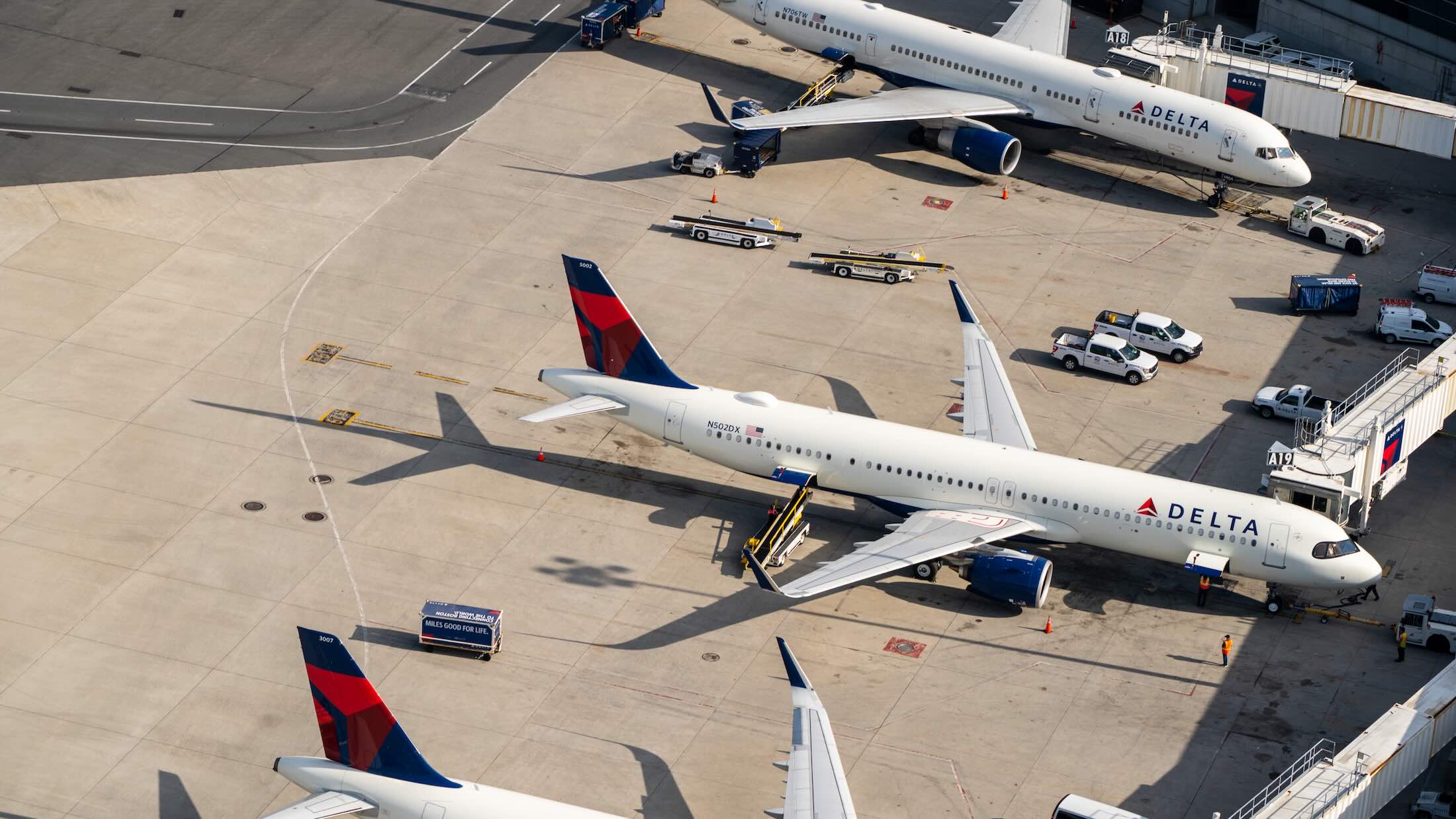
Delta Air Lines CEO Ed Bastian says airfare will come down when airlines can fly more. He is not wrong, but passengers may reasonably wonder why fares rise so quickly when costs go up and seem to fall so slowly when those costs ease.
Delta CEO Says Airfares Will Fall When Airlines Can Fly More
Delta Air Lines CEO Ed Bastian says airline ticket prices will come down when airlines are able to add more supply. My response is, “Yes, but…”
Speaking to Fox Business, Bastian was asked what it would take for airfare to fall. His answer was straightforward: more flying.
“Prices will come down when we can fly more, when there’s more supply, it’s a supply and demand. Right now we’re kind of logjammed.”
He pointed specifically to air traffic control congestion, arguing that airlines cannot simply add all the capacity they would like when the system itself is constrained.
“There’s not a lot of supply we can bring in because the air traffic control system is congested. As you open up the skies, and you bring more flow, that’s going to help bring pricing down and enable us to bring more people to more places.”
That is a fair theoretical point.
At a macro level, airline pricing is supply and demand. If flights are full and airlines cannot add more seats, fares stay high. If more seats enter the market and demand does not rise at the same pace, fares should fall.
But that is not the whole story.
Airlines Are Very Good At Raising Fares When Costs Rise
Bastian also said that fuel costs had a major impact on Delta, with rising energy prices hitting the airline’s bottom line by nearly $2 billion. He said fare increases across the industry after the Iran conflict and oil price shock were roughly 10-15%, calling that “probably the right level.”
He also noted that oil prices have since come down and said Delta is now “in a pretty good spot.”
Yes, I’m sure it is…
Airlines are quick to point to fuel when fares rise. They are less quick to point to fuel when fares should fall.
At United Airlines, CEO Scott Kirby has said that he intends to keep fares high, even if fuel drops, if conditions allow. It sounds like Bastian is saying the same thing.
To be fair, fares do move constantly. Airline pricing is not a simple surcharge that gets added and removed in a clean way. Revenue management is dynamic, demand varies by market, and not every route responds the same way. But from the passenger perspective, the pattern often feels familiar: costs go up, fares go up; costs come down, fares remain sticky.
The good news is that inflation-adjusted fares are still at historic lows compared to past decades. But the bad news is that this whole Iran conflict has shown U.S. carriers that they can raise prices and demand has held steady, begging the question…why would they lower fares?
The Air Traffic Control Argument Is Real
Bastian is certainly correct when he talks about the need to modernize air traffic control and improve the flow of air traffic.
We have seen what happens when the system is strained, though thankfully have been spared from the worst of that so far this summer. It’s true that more reliable airspace can support more flying and more flying can support lower fares.
Bastian also praised recent progress on removing bottlenecks, saying the industry has seen more movement in the last year and a half than in prior decades. I am glad to hear that, but the system still has a long way to go.
The United States should have the best air traffic control system in the world. Instead, we still have aging infrastructure, staffing shortages, and too many days where weather in one region sends delays across the country.
Investing in air traffic control is primarily about safety, but it’s also about creating functioning conduit for air travel that helps airlines be more operationally efficient. If Bastian wants to argue that better ATC flow will ultimately lower fares, I think he is right.
But Will Airlines Really Pass Savings Along?
If air traffic control constraints ease, more aircraft are delivered, fuel prices stabilize, and capacity rises, then yes, fares should moderate in markets where competition remains healthy.
But it is only competition that forces fares down and we’re seeing less competition with the folding of Spirit Airlines and cutbacks by others. If Delta can charge more for a seat because customers are willing to pay for Delta’s schedule, reliability, app, loyalty program, or premium cabin experience, it will do so. American and United would do the same.
And so it may be that if fuel drops and remains low, we still might not see airline fare retreat to Q1 2026 levels.
CONCLUSION
Ed Bastian says airline ticket prices will come down when airlines can fly more, and that requires easing air traffic control congestion and adding supply back into the system. Sure, but that is not a given in the current environment and the resiliency of U.S. carriers to pass on multiple fare increases this spring may spell bad news for U.S. flyers.
As always, we notice that fare increases tied to fuel shocks tend to arrive quickly, while fare relief after costs drop often takes longer. Lower fuel prices help airlines immediately but lower fares require competitive pressure that we might not see this year, at least not as in the past.
image: Delta





I would suggest that it’s not an increase in supply that will bring airfares down, but rather a decrease in demand. Nothing brings airfares down like empty seats.
Delta CEO essentially arguing for the easing of FAA restrictions on operations in the competition’s hubs, like SFO, ORD, and EWR. Interesting.
DL is acknowleding that increased capacity reduces fares. There is no reduction in demand and that has been proven.
and, no, DL isn’t arguing for increasing capacity at competitor hubs but across the entire US airline network. Major hubs are increasingly becoming bottlenecks. DL is in by far the the best position of US airlines in its abililty to add capacity w/o triggering greater ATC delays.
AA says its CLT, DCA and DFW hubs are its most profitable and yet DCA and DFW regularly have ATC delays.
The FAA has imposed caps on 3 of UA’s largest hubs while DEN now regularly sees ATC delays comparable to what other large airports have in multi-airport metro areas.
the US air transportation system handles more traffic than any other system in the world – even counting the EU’s as one – and also handles more general aviation traffic.
Better technology can improve the amount of traffic the system can handle but it will be years before capacity can increase because of ATC improvements
No, Tim, this is just Ed being an opportunist; he’d like further consolidation of the market to a duopoly, protected by forms of regulatory capture, and other supply constraints (lots, gates, aircraft, engines, pilots, etc.) Lately, there’s just been an attempt at sleight-of-hand with energy costs (Oh no! Oil! *doubles prices*…but never brings them down). Yet, when there’s the next downturn, Ed will be front-of-the-line begging for a bailout with no stipulations. Can we at least agree that next time taxpayers pay billions to these for-profit companies, we at least get a EU261-equivalent in-return? That’s all I ask…
no, DL is in by far the best position to continue to grow its position in the US’ largest markets without consolidation.
and DL has succeeded by taking share from AA and WN and is focusing on UA and will use the one advantage UA has – its international network including across the Pacific and to Asia to grow.
rebel’s comment below is pretty on point. Bravo to him. Airfares aren’t likely to come down and Bastian is simply telling the government that if they care about low fares, they need to increase the capaicyt of the US air transportation system.
The big 4 have already all but finished off the rest of the industry except for AS and might not give up any share even if capaicty is added to the US carrier system.
but it is certain that the US airline system will quickly move to a no-growth system if capacity is not added and that only means that fares will go up.
Tim and rebel, really? *sigh* Pointing to single-digit profit margins while ignoring the structural barriers that protect Delta and United is quite the distraction. By all means, legacy carriers can operate “efficiently,” pay outsized executive bonuses, and absorb massive overhead: BUT… they can also engage in opportunistic pricing. Using the convenient excuse of fuel prices or capacity shortages to jack up fares, and then refusing to lower them when those costs subside, is the definition of rocket-and-feather pricing (like I’ve been debating over at VFTW recently.)
In a truly healthy, competitive market, low profit margins spark fierce price wars. A hungry player will instantly undercut the field the second input costs drop to snatch up market share. But the U.S. domestic market is a tight oligopoly. Tim, blaming it entirely on ATC bottlenecks is incredibly convenient corporate PR. The physical bottlenecks at LGA, JFK, or EWR aren’t just organic, unavoidable constraints; they are protected moats. The DOT and FAA routinely grant slot waivers that allow legacy airlines to hoard capacity and starve out the low-cost entrants who would break the fare gridlock.
When fuel goes up, consumers pay instantly. When fuel drops, consumers wait months for a “trickle-down” that never comes because carriers are completely insulated from the threat of new market entry. It’s a heads-they-win, tails-the-consumer-loses system, backed by the implicit knowledge that taxpayers will bail them out the second the economic cycle turns. Have we learned nothing? These neoliberal economic defenses only work for those at the top, while the traveling public gets squeezed. Maybe, next time, taxpayers won’t bailout; or, we’ll finally get my wish of meaningful consumer protections. Time will tell…
the problem w/ your theory is that airlines worldwide are not high margin businesses. There are no other players that are going to step in to provide price discipline.
DL has been more successful in limiting and shrinking LCCs and ULCCs through its massive pay raises post covid. It is unbelievable that you spout socialistic non-sense given that there is abundant evidence that US airline workers have improved financially far faster than US workers as a whole including other unonized employees.
as for Matthew’s feedback for a future article, bring it on. I strongly disagree.
I love it when aviation bloggers tackle major strategic issues rather than the endless pi78ong wars that some see as their success cards.
I am happy to help Matthew grow his business.
“In a truly healthy, competitive market, low profit margins spark fierce price wars.”
Low profit margins don’t spark price wars. Please go review Econ 101.
rebel, nice attempt at cherry-picking, but, no, it is you who need to go back to school. In a real ‘free’ market, when your raw costs (like jet fuel) plummet, someone always cuts prices to steal customers and grab volume. The fact that airlines are collectively keeping fares high despite falling fuel costs proves my point: this market isn’t healthy or competitive. It’s an insulated oligopoly. You don’t need a degree in economics to see that when costs drop and prices stay high, the consumer is getting squeezed.
Tim, thank you for at least saying the quiet part out loud. You admit that Delta used its cash reserves to hike labor rates specifically to ‘limit and shrink’ low-cost competitors. That’s no working-class victory; it’s a corporate strategy by starve out the budget airlines that tend to keep fares honest for the average customer. Calling consumer advocacy “socialistic nonsense” is yet another a lazy trope and distraction. Nah, I see what’s going on here, and others should, too. Airlines love using slots to lock out competition; they jack up fares the second fuel spikes; and they refuse to lower them when fuel drops. It’s rigged; airlines win, and the traveling public pays the tab. At some point, folks are going to have had enough of this. I hope that day comes sooner than later.
““In a truly healthy, competitive market, low profit margins spark fierce price wars.”
“In a real ‘free’ market, when your raw costs (like jet fuel) plummet, someone always cuts prices to steal customers and grab volume. ”
Two completely different assertions, and the 2nd is only slightly less inane than the 1st.
rebel,
They aren’t different at all. You’re just playing word games to avoid the actual point.
When your business has low profit margins, you need high volume to survive. And when your biggest cost (jet fuel) suddenly plummets, that is the perfect opportunity for a hungry competitor to slash fares, steal customers, and grab that volume. Low margins are the incentive; dropping costs are the trigger.
The fact that airlines aren’t doing this right now proves my point: they are a cozy, protected oligopoly. Calling a real-world market failure “inane” isn’t an argument; it’s proof you can’t defend a rigged system where consumers seem to often lose.
Low profit margins do not spark fierce price wars. Different profit margins among competitors do like when NWA would never go along with fare hikes because they had the lowest costs among the network carriers. They thought they could weaken the competition over time and steal share. What you said is false. Sorry.
Nice trip down memory lane, rebel, but that’s not what’s happening here. The entire industry’s biggest variable cost (jet fuel) suddenly drops. The fact that none of the Big 4 are dropping prices now proves my point: this is an insulated oligopoly. The Big 4 don’t need a smoke-filled room to collude; they use algorithmic pricing to maintain uniform high fares because they know consumers have near zero alternatives.
And why don’t we see those lower-cost disruptors like Northwest anymore? Because, as Tim admitted, legacy carriers used their massive cash reserves and slot-hoarding to deliberately starve out and shrink the budget airlines that used to keep fares honest. RIP Spirit.
You can try to reframe anti-consumer market coordination as an Econ 101 victory all you want. But at the end of the day, costs dropped, fares stay high, and the flying public deserves to be livid if that continues.
Spirit is gone because the majors used basic economy to compete on price on the low end while using premium, loyalty and credit cards to make money at the top end which Spirit didn’t have. Fares are staying higher because the weakest airlines are hanging on by a thread and they need every $ they can get. With no hedging by US carriers jet fuel is a pass through expense. Sorry, your premises are flawed and your reasoning is unconvincing.
rebel, you are hiding behind industry talking-points to sanitize what is, plain and simple, a corporate cash-grab.
You proved my point: AA, DL, UA executed a “predatory squeeze” through Basic Economy to eliminate the nation’s largest pricing anchor (Spirit). Now that the domestic market has been consolidated and the low-cost threat is nearly gone, your oligopoly faces near-zero competitive pressure to pass falling jet fuel savings down to the public.
So, please do enjoy the extra profits at consumers’ expense, for now. But, I think you ignore the aftermath and backlash of these choices. Some day, perhaps soon, the regulatory climate will change… and, Airlines for America won’t be able to buy-off enough corrupt politicians to keep receiving bailouts and preventing consumer protection. And, when that day happens, I look forward to whatever EU261-equivalent we will begin enforcing.
Your point was “low profit margins spark fierce price wars.”
From the Harvard Business Review. Low profit margins generally deter rather than spark price wars, because companies operating on thin margins lack the financial cushion needed to sustain a prolonged downward pricing spiral. Instead, price wars are typically triggered by industries with high profit margins, low variable costs, or severe market stagnation.
Sorry, you are obviously and demonstrably wrong.
rebel, yikes, you’re really that desperate? “What you said is false. Sorry.”
See, I can also copy-paste quotes from you, too. Here’s one: “With no hedging by US carriers jet fuel is a pass through expense.” If jet fuel is a direct, unhedged “pass-through expense,” then changes in that cost are meant to flow directly to the consumer, regardless of how thin the airline’s overall profit margins are.
My consistent point on here (and elsewhere) is that there is a captured market by an oligopoly, and they are abusing those unfair conditions to do rocket-and-feather price-gouging.
So, you can’t have it both ways. You can’t argue on one hand that fuel is a direct pass-through expense, and then argue on the other hand that airlines can’t lower fares because their overall corporate cushions are too thin. The fact that the pass-through only works when it hurts the consumer proves exactly what I’ve been saying all along: this is an insulated oligopoly engaging in opportunistic pricing. Thanks for making my case for me.
Keep it going. Quintuple down. “Sorry, your premises are flawed and your reasoning is unconvincing.”
It’s OK. You can admit you were completely wrong. Are you and LTD related?
Now you’re just projecting your own defeat. Take the L.
Bastian and Kirby are simply pointing out the laws of supply and demand. Air travel has been a bargain since deregulation with an incredible safety record to boot. Consolidation was inevitable and the surviving airlines are finally being run well. This competition has led to some limited pricing power and a realization that some people will pay more for premium. The endless bitching by people who rarely pay for their own tickets is as amusing as their need for some form of status. A special shout out to those who patronize the Kafala carriers and then in their next breath play their tired victim song and dance. Pathetic.
Newsflash for all the financial naives, businesses charge as much as they can for their product. That is how capitalism works, and if you think a single digit margin by the two most valuable airlines on earth is predatory then your cluelessness knows no bounds.
I don’t think anyone is crying out “predatory” or saying that airlines should not be allowed to make double-digit profit margins…I’m certainly not. As I stated, “…this whole Iran conflict has shown U.S. carriers that they can raise prices and demand has held steady, begging the question…why would they lower fares?”
In thinking about an upcoming piece, though, I wonder what your thoughts are on the following. U.S. carriers promised a “permanent” elimination of change fees, led by United in 2020, which seemed a small token of gratitude for the massive taxpayer bailout during the pandemic with no payback mechanism, unlike European bailouts. Basic economy fares, now spreading to premium economy and business class, do not lower fares…they have replaced the lowest fares and come with stringent restrictions that, in my view, undercut the deal that US carriers made with US taxpayers. I find these massive change fees criminal…Thoughts on that?
Kirby led and AA & DL among others quickly followed suit in eliminating change fees, but it was for competitive reasons with Southwest which never had change fees. It had nothing to do with the bailouts IMO. Feel free to provide any evidence otherwise.
Basic economy is the culmination of a myriad of mostly unsuccessful attempts to compete with the LCCs and ULCCs. If the restrictions are too complicated then don’t buy them. Once again, a solution in search of a problem.
Let’s recall that historically, airlines implement fare hikes instantly during fuel spikes but delay lowering them when fuel costs fall.
Thank you! I’ve referring to this as rocket-and-feature pricing, yet, the biases of our pro-industry commenters (*cough* Tim *cough* rebel) would rather celebrate expected profits instead of recognizing the very real harms to consumers…
Naturally, no rational traveler wants to find themselves without airlines, but I wish they were a little less demanding.
I may have differing opinions and biases, but rest assured I still believe in and want the aviation industry to thrive, continue to be a viable career path for many, and reliably, comfortably, and relatively affordably operate for its countless consumers around the world. (I just happen to think the balance is in favor of shareholders and management over workers or consumers in the US at the moment, and a few additional guardrails, like an EU261-style consumer protection, would level the playing field, here.)
Says the guy who patronizes Kafala carriers. See cognitive dissonance.
So, rebel, you’ve run out of substantive arguments, and are resorting to ad hominem attacks to deflect from your failures above. Oof. Thanks for the confirmation of your total surrender. “Please go review Econ 101.”
I have to confess it is tough to argue about business with someone with such fundamental misunderstandings about basic economics. Feel free to rationalize your professed support of labor and patronizing Kafala carriers. Too funny.
You couldn’t even come up with a better ad hominem deflection for the third time in fifteen minutes? Sad.
It’s telling that you think simply retelling what you say you do is an ad hominem attack. The CD must be excruciating.
Back at you, sir. Back. At. You. Whoosh.
Wicked comeback.
You from Boston, now? Wicked smaaat.
Ultimately, even if Bastian is correct about the theoretical mechanics of flight capacity, experts point out that consumers should expect high airfares to persist until the end of 2026.
For aviation enthusiasts → The middle of the three DL aircraft shown in the article’s photo is an A321neo (age: 4.2 years). It is currently parked at SLC.