

Delta Air Lines intends to keep growing, but not by adding more standard economy seats.
Delta Plans More Growth, But Not More Main Cabin Seats
Delta has spent years shifting its aircraft toward premium seating, and that trend will continue in 2027.
During Delta’s second-quarter earnings call, Chief Commercial Officer Joe Esposito revealed that the carrier will not grow its Main Cabin seat count next year.
“We’re not growing Main Cabin seats. This is a multiyear, several years in a row that we haven’t grown this cabin. We won’t be growing it next year either.”
Delta is not retreating from growth. Rather, it is increasingly directing that growth toward premium cabins, larger aircraft, and international markets while holding the supply of standard economy seats flat.
If the trend continues, that is good news for Delta’s margins. It may be less welcome news for travelers hoping that additional capacity will produce cheaper economy fares.
Delta’s Main Cabin Strategy Is Working
Delta’s Main Cabin capacity is currently down 2% to 3%, while premium capacity is up by low single digits.
Ordinarily, reducing capacity might be viewed as a sign of weakness. In this case, it has helped Delta strengthen pricing in the back of the aircraft. Esposito said Main Cabin unit revenue actually exceeded premium unit revenue growth during the second quarter, helped by Delta’s own capacity restraint and a sharp reduction in low-cost competition.
“The industry has removed a significant amount of unprofitable capacity. If you look at the ultra-LCC category, that capacity is down about 30%. So Main Cabin has gotten significantly healthier this year.”
In other words, Delta does not need to add more economy seats when the existing ones are becoming more valuable.
Low-cost carriers once placed pressure on legacy airlines by flooding markets with inexpensive seats. But with ultra-low-cost capacity down sharply, Delta has greater pricing power in Main Cabin even as it directs more of its own investment toward premium products.
More Premium Seats, Not More Economy Seats
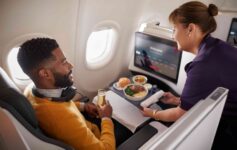
Delta says premium revenue rose 17% during the second quarter, with premium capacity growing in the high single digits over the broader period discussed by management.
The airline is also seeing stronger paid load factors in premium cabins, underscoring that the new seats are not being filled with complimentary upgrades…Delta, like its competitors, has been aggressive in upselling premium cabin seats.
As I discussed earlier, Delta’s incoming Boeing 787-10 aircraft will feature more than 50% premium seating under Delta’s broad definition, compared to roughly 30% on the Boeing 767s they will eventually replace. Delta is also upgauging domestic flying with larger aircraft while continuing to add more premium seating.
Of course, Delta’s definition of “premium” includes Delta Comfort, not merely First Class, Delta Premium Select, and Delta One. Even so, the direction is clear: a larger share of Delta’s future aircraft will be devoted to passengers paying more than a standard Main Cabin fare.
Fewer Cheap Seats Across The Industry
Delta’s decision not to grow Main Cabin seats comes as the airline industry becomes more disciplined about capacity.
High fuel prices have forced carriers to focus on profitability rather than market share, while struggling budget airlines have cut routes and reduced flying. Delta CEO Ed Bastian said during the same earnings call that low-cost carriers may still need to raise fares another 5% merely to break even at current fuel prices.
That environment allows Delta to keep economy capacity constrained without surrendering pricing power to cheaper competitors.
There will still be plenty of Main Cabin seats on Delta aircraft, and holding the total flat does not necessarily mean that every route will lose economy capacity. Delta can move aircraft around, add seats in one market, and remove them from another.
But systemwide, Delta’s growth plan is not about creating more standard economy seats.
CONCLUSION
Delta’s Main Cabin is performing better precisely because the airline and its competitors are offering fewer cheap seats. It may be the real reason why Delta boasts it can keep fares high even if gas prices fall.
The carrier will continue growing its premium cabins next year, but its overall Main Cabin seat count will remain flat for yet another year. Delta calls that a better balance between Main Cabin and premium seating. From a business perspective, it makes perfect sense. For travelers waiting for a flood of new economy capacity to push fares down, it seems to me those days are over.
image: Delta




This is the trend in all industries: cater only to the top, ignore everyone else. Forget K-shaped; it’s an ‘F the poors’ economy. In the past, new entrants would scoop up that neglected market share; however, for commercial aviation, lately it doesn’t seem to be happening again yet, perhaps, because the current barriers to entry are high (regulatory capture, slots, lack of airframes, pilot and ATC shortages, oligopoly of the Big 3), or, perhaps, because costs (mostly fuel) are too high. This will likely ‘correct’ during the next recession (bailouts for nothing!), or we’ll just further devolve into modern serfdom (no more airlines, just private jets for the trillionaires). Walk or swim!
we agree on this.
DL led the industry in raising labor costs specficially because it recognized that LCCs and ULCCs cannot afford to pay higher labor costs and that is playing out.
From a competitive standpoint, it also means that DL is in, by far, the best position of the big 4 with a robust, functional and competitively strong group of interior US hubs at ATL, DTW, MSP and SLC – so DL in well-positioned to serve all of the US both domestically and internationally – while it is close to locking in its position as the largest airline at BOS, LGA, JFK and LAX and as the largest international carrier at SEA.
AA carries way too much domestic traffic at higher costs and lower yields due to too many hubs and too little international traffic, UA’s domestic network is undersized but they have been trying to grow their domestic system but knows they cannot get the domestic size that AA, DL or WN has and WN is similar to AA w/ far less premium traffic and even less focus on international and premium traffic.
DL has the best US network carrying the best balance or premium vs. leisure and domestic vs. international traffic and DL’s opportunity to grow is in the longhaul international market with efficient and larger aircrafts to the top global markets from the US.
DL has one against proven that it recognizes where the US airline industry needs to go to be sustainably profitable and executes the plan that other airlines will follow while giving DL the first mover advantage that competitors can never fully copy.
Delta says it will grow, but not by adding more aircraft should be the title.
except that is not true.
DL is adding aircraft including larger aircraft than it already has.
DL is not trying to add small regional jets even in fake premium configurations since DL is willing to fly a higher percentage of its fleet on mainline aircraft – which are not only more premium but also allow for lower costs.
DL has a robust domestic network so does not need to play games trying to build a domestic network -as UA is doing – or carry them on more regional jet than mainline flights – as AA does.
DL is growing its international fleet both in terms of number of aircraft and size and capability and efficiency of those aircraft.
It is precisely the international market – esp. TPAC and to Africa and E and S. Asia as well as Latin America – that is DL’s opportunity and where DL’s growth will come at the expense of AA and UA in those regions.