
US Airports suffer a poor reputation but comparatively to their European counterparts, they are a shining beacon to the world.
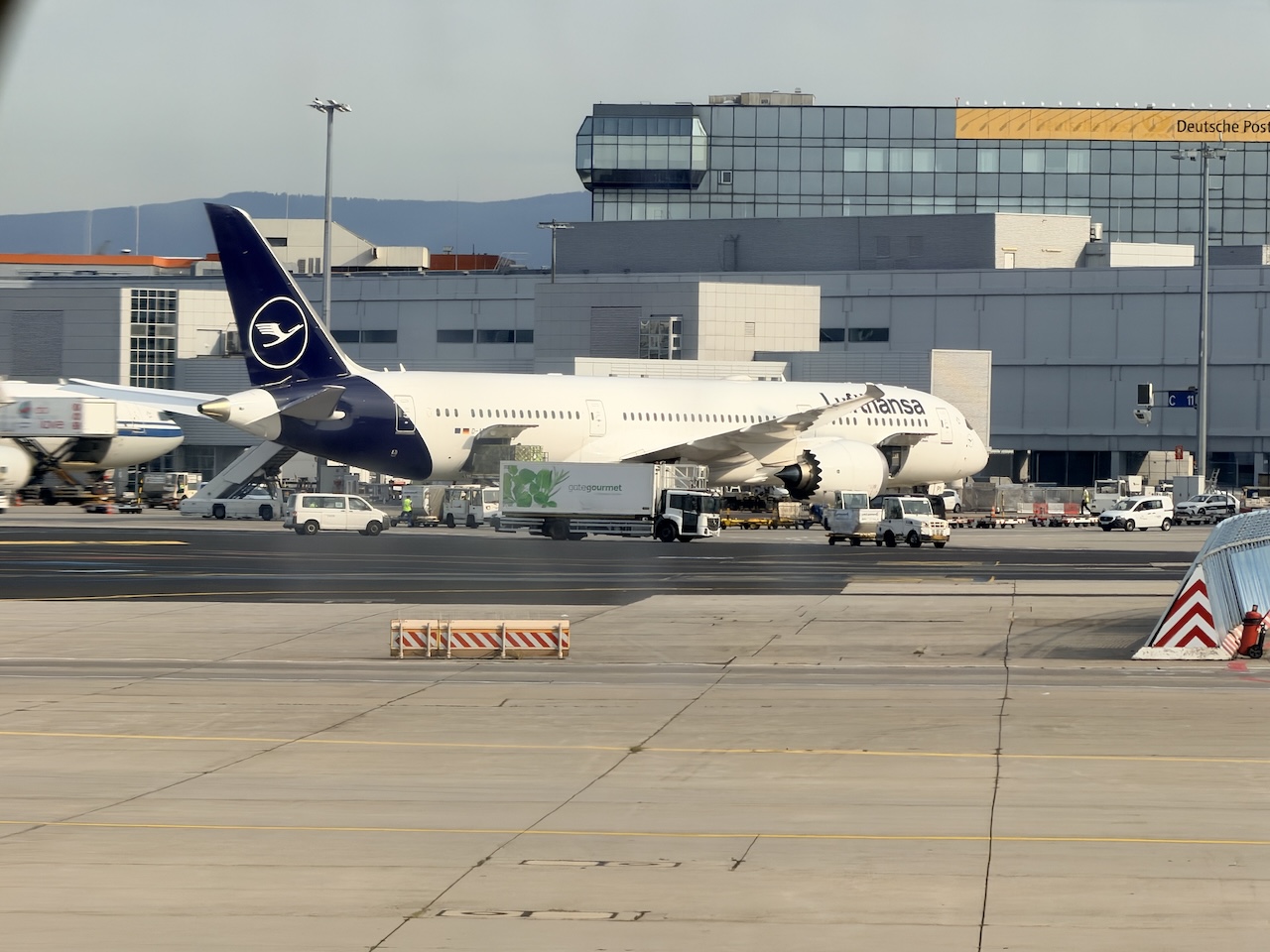
Matthew Klint, the principal writer of this site, and I were having a debate via text message about the complete absurdity of Frankfurt Main Airport – he was defending the albatross around European aviation’s neck while I blasting it. In a fun twist, we both happened to be in Frankurt airport at opposite ends while text debating. Yet due to the nature of the airport, meeting in person on this kismet occasion to argue in person remained impossible, thus proving my point entirely. I expect a rebuttal, but if my arguments here suffice, no rebuttal will be possible. For what it’s worth, Matthew and I both love Europe, both lived there, and both visit several times a year – we aren’t novices but have differing opinions. Here are mine.
Environmental Boondoggles
This site has written about the numerous aspects of European environmental measures as they relate to travel. Just recently, I covered yet another type of SAF powering our flights one flush at a time. Then I came across this ironic sign in the terminal at Frankfurt:
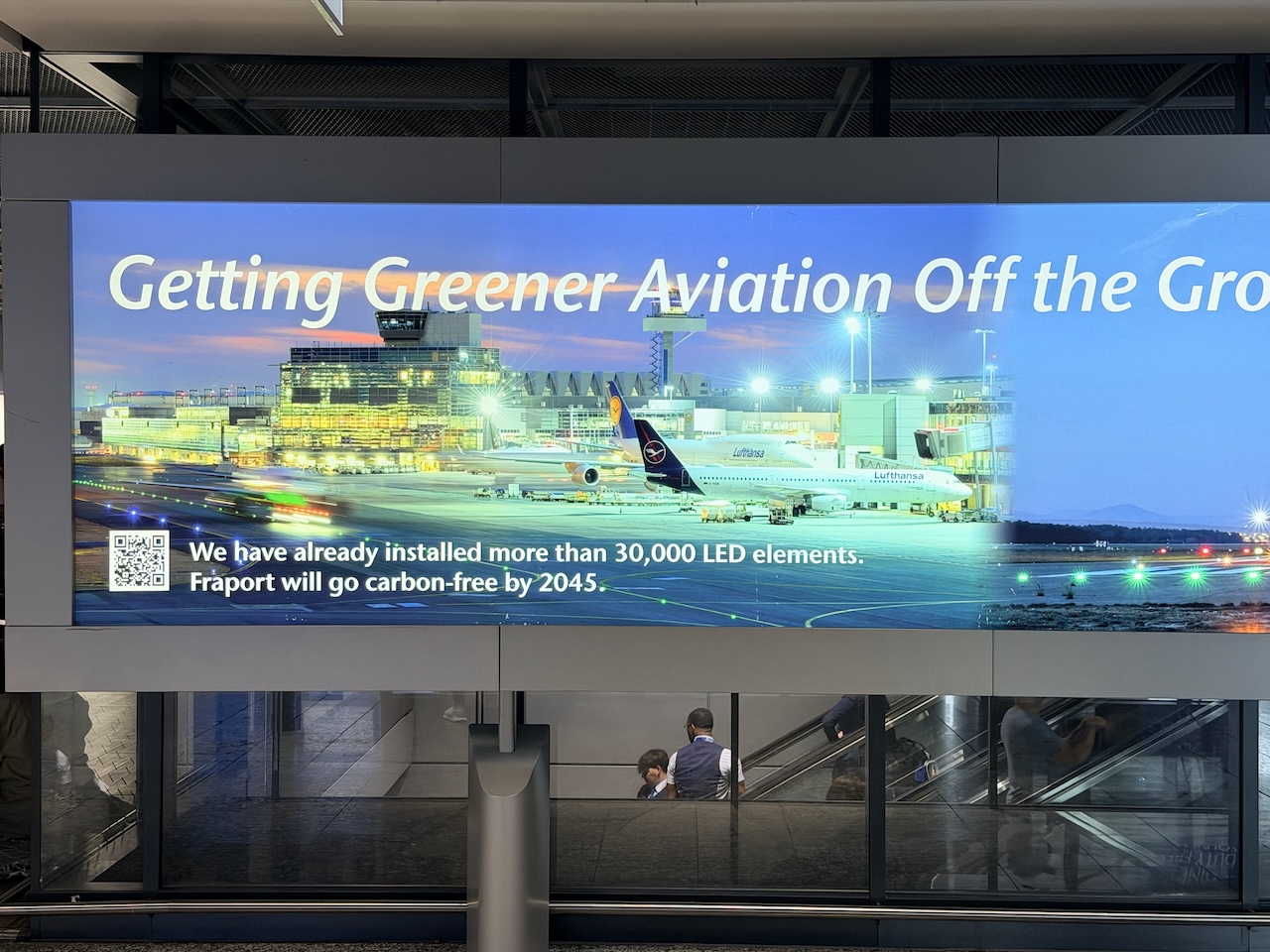
Yes, of course, 30,000 LED lights will go a long way in making Fraport carbon-free by 2045. But what about the busses?
I don’t mean in between cities, I mean when an aircraft pulls into D2 as ours did, aligns with the jet bridge, and then disembarks to a series of buses. I know someone can explain the economics behind it – and let’s just ignore that at least two people have to move the airstairs into place, one at the front and one at the back. Ignore two more vehicles (at minimum) to ferry us into the terminal, and then a few more people have to set cones and marshal tourists on the tarmac away from the incredibly hot engines, wheels, and sensitive equipment. Ignore the staff waiting at the underbelly terminal entrance ensuring no one starts walking around sensitive areas by mistake, or the people employed along the stairways telling tourists to go up the stairs but not providing any meaningful instructions. How is any of that better for the environment? Even if the busses were electric (they weren’t) electricity comes from somewhere and in Germany, it’s unlikely to be a highly efficient nuclear reactor, there’s not enough wind and solar to power efficiently. You know what emits nearly no carbon at all? The jet bridge.
Airlines, and the airports together are choosing revenue over the environment every day while lighting signs that pretend the opposite is true. And it’s not a lack of space or infrastructure, we parked not at a stand somewhere out in the middle of nowhere, we parked at the gate next to the jet bridge. And it’s not just Frankfurt, of course, in Manchester it was the same (though England is not part of the EU or on the continent – it’s European without a doubt.) The same environmental initiatives adorn the halls of the powers that be throughout the continent but in practice, airports are choosing to charge more for the most environmentally-friendly option and airlines are choosing not to pay for it.
All of this, of course, ignores the disabled who have a far harder time getting onboard through these methods. In Naples, a disabled man was brought through the R2 door behind business class on a lift because he couldn’t make the stairs. That machine also was gas powered. The one area where the US might lead the world, at least in a travel sense, is the American Disability Act which is why most American carriers and airports use a jet bridge by default in the US.
It used to be that a traveler would avoid Ryan Air in part because of these absurd cost-saving measures, but with Lufthansa and others participating in the same farce, why fly the alliance airlines?
If we agree that the world is getting warmer, avoiding air conditioning is also no longer an option. In the Naples, Italy terminal it exceeded 85 degrees indoors. Standing on the bus outside of our aircraft for 15 minutes with no air conditioning whatsoever had to push it even higher than that. Europeans and Americans alike were sweating through their clothes. If we assume that air conditioning is an environmental hazard (I disagree on this point), there’s a real health risk to not offering a reasonable temperature environment, especially for the elderly. More Europeans die from heat than Americans from gun-related homicide by nearly a 4:1 ratio. Gun violence is obviously horrible and should be as close to zero as possible, but it’s not a “cultural difference” to avoid air conditioning that kills far more human beings. And would putting up fans help? Probably, but we have no idea because they seem as outlawed as climate controlled environments.
Navigation Is A Joke
The Schengen area complicates things immensely, but this can be solved with signage. Here’s an example of what we found in Frankfurt.
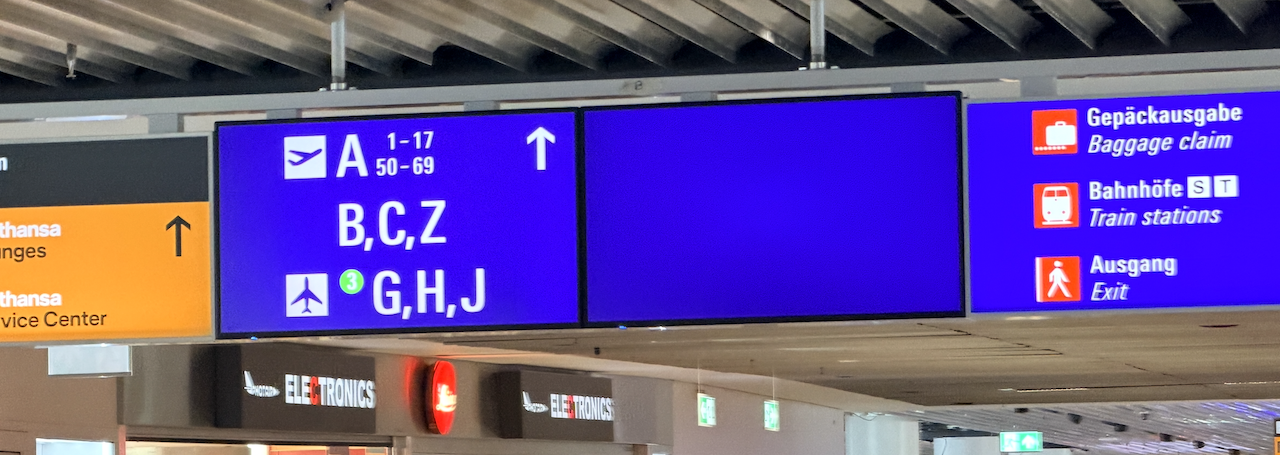
The above sign would suggest that carrying on forward in this direction would lead you to gates A1-17, 50-69 and all B, C, and Z gates before eventually running into Terminal 3 for G, H, and J gates. But that’s patently false. Underneath the A gates are the Z gates (can’t you tell from this sign?) One has to enter the Schengen area first (because we came from outside the EU, Manchester) except there’s no forced entry point to those gates. There’s nothing to show that they are beneath you right now in corresponding gate numbers. Just carry on walking forward into oblivion and eventually you’ll reach an unmarked security checkpoint (more on that shortly) to access the Schengen Area. In other airports, like Vienna, guests are herded into lanes that pass through checkpoints to unlock the part of the airport they need to be in too – they just mark them. Amsterdam is also far better at this than Frankfurt.
Exit Customs, Not Security
The US is often derided for its difficulty for connections from inbound flights. I won’t dispute this especially as travelers need to claim luggage and recheck. Delta and American are trialing ways to fix this where reclaim is unnecessary and honestly, this would be a game changer. But from a security standpoint, the Exit customs, which might prevent nefarious travelers from entering secure zones is not a terrible idea in and of itself, execution at Frankfurt was deplorable.
For my family, we had already submitted our fingerprints, photo scan, and documents earlier in the terminal but still needed to clear exit customs. We still stood in a line of other travelers from across the world, some of whom had registered as we had, some who had not. The staff in their glass boxes took turns leaving a little earlier than their 10am shift change and arriving a little later moving at a glacial pace. People throughout the line were missing flights, our own was boarding (another bus gate, of course) while we stood there. Reasonably experienced travelers should be able to make an in-terminal connection in under 90 minutes, many in our line missed or were razor thin in making their connections. The line was only 20-30 deep when we arrived, it took more than 30 minutes to clear, many of those travelers were in pairs or more.
But security is very important, and we understand that fully. However, it wasn’t that important when we cleared exit customs to find that there was no security on the other side. While I welcomed the ability to expedite our run to the gate after this point, it still struck me as an incongruous conflict. How important is security really if you don’t trust the inbound country to flag or stop potential risks on a passport basis, but do trust them against prohibited items?
Shining Cities On The Hill
Thanks to the infrastructure bill – perhaps the most lasting and impactful COVID initiative approved by both houses of congress and championed by former President Biden – radically overhauled many of our nation’s airports. While we can all debate later the Oprah-esque approach of “you get a billion dollars, and you get a billion dollars” to every airport infrastructure project, it went a long way in updating some very important yet tired facilities. While Pittsburgh probably did need a billion-plus redesign, did Omaha only to add two gates and a new bridge terminal facility? Probably not. New York LaGuardia is a stunning symbol of what American airports can and should be, JFK though more expensive is even more important on a global stage and is worth every penny.
There’s less theater in the US. Bussing passengers is on a need-only basis and no one is pretending that updating the lighting is leading to a carbon neutral footprint. And should the models with Delta and American of passing checked bags straight through to the final destination lead to policy change (as Delta’s security process did in Atlanta trials for screening passenger luggage), the US could for the first time become a viable transit option for travelers revolutionizing the world’s largest air market.
The US keeps international passengers in specific areas of the airport so that secure portions remain sterile with easy signs that lead to customs. And while customs lines can be long anywhere, most major US airports have many, many more agents processing passengers than what we experienced in Frankfurt.
Conclusion
Americans have long accepted that the airport process in the United States is broken, and to some extents that remains true. But our facilities are now among the best in the world. Our use of environmentally-friendly (and for the mobility-challenged) of jet bridges is reason enough to place them far above European competitors. European airports need updates badly, but so do stereotypes about US airports.
What do you think?






Leave a Reply