
Emirates’ 615-seat A380 was the densest jet in commercial service. They just ripped out 46 seats. The premium economy math finally beat volume.
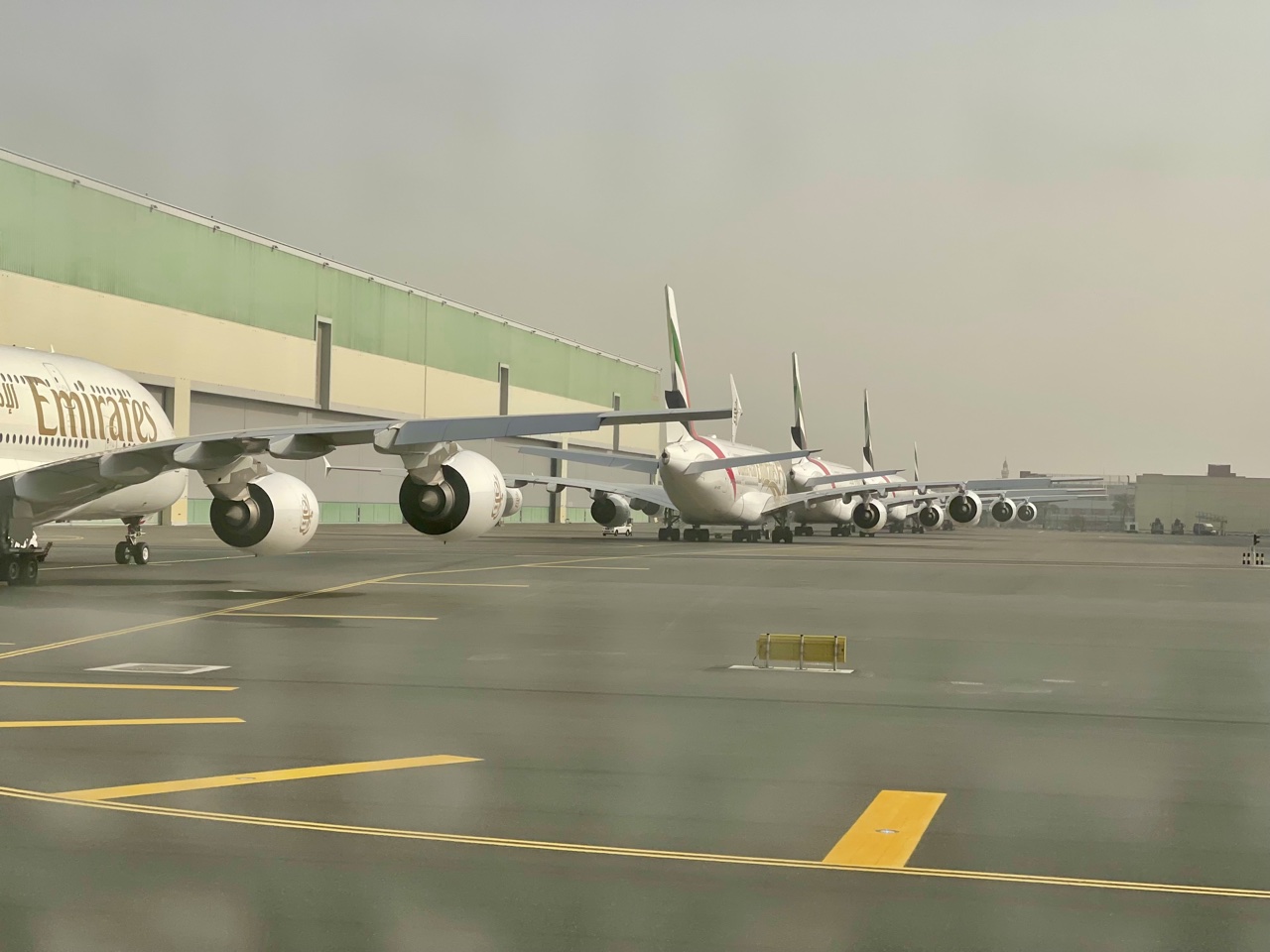
The 615-Seat A380 Was An Outlier Even For Emirates
For the last two decades, Emirates has flown two different A380 configurations. The flagship version had 14 First Class suites, 76 Business, and economy in the back, capping around 489 to 517 seats depending on tweaks. The other version, the one nobody outside the industry talks about, was the dense two-class layout: 58 Business, 557 Economy, 615 seats total. It was the highest-capacity commercial aircraft flying anywhere, by a meaningful margin.
The dense A380 was Emirates’ volume weapon on price-sensitive leisure routes. Bangkok, Bali, Mauritius, Kuala Lumpur, and a rotating cast of secondary European cities ran the 615-seater. The math was simple: pack as many bodies as physically possible onto a long-haul widebody and ride the per-seat operating cost down. For two decades, that math worked but that appears to no longer be the case.
The Math On 46 Removed Seats
Emirates announced in February it would convert all 15 of its two-class A380s (a sliver of the fleet already) into a three-class configuration: 76 Business, 56 Premium Economy, and 437 Economy. That is 569 seats per jet, down from 615. The airline is voluntarily removing 46 revenue seats per aircraft, on a long-haul widebody, in a market where every other carrier is squeezing more bodies into the same tube. This appears to be in lock-step with other carriers globally (like Delta, United, and American) in a general shift to premium.
Emirates premium economy on a Dubai-Bangkok or Dubai-Mauritius itinerary sells for two to three times the price of economy in the same row of the aircraft, but the seat takes roughly 1.4 times the floor space. The trade is plus 56 seats at 2 to 3 times the fare, minus 102 economy seats at base fare. The revenue per square meter goes up, even though the absolute seat count goes down. Emirates’ own framing in the announcement was “optimize revenue per square meter rather than maximize seat count,” which is corporate-speak for we finally ran the numbers on premium economy and the dense layout lost.
This is a reversal of two decades of dense-pack dogma, holding the line, though just on this small subfleet. The industry has been postured for years that premium economy is a niche product for North Atlantic. Emirates has come to the conclusion this is global. Perhaps it is. Premium economy has come a long way since its first iterations, now more akin to domestic first class and with its own cabin rather than situated at the front of economy.
Why Emirates Started With Amman
The first retrofitted aircraft entered service on the Dubai to Amman rotation, EK903/904, on a six-week run from April 14 through May 31. The second deployment moves the aircraft to Dubai-Prague starting June 1. Dubai-Guangzhou follows in October. The full 15-aircraft fleet conversion finishes in November.
The Amman opener is interesting. It is a short route, about 3.5 hours, with a heavy mix of expat and corporate traffic and a meaningful luxury leisure layer to the Dead Sea and Petra. It is not a route where you would test a new cabin if you needed to fail quietly. It is, however, a strong test case with eyes to Prague six weeks later if the numbers work. They clearly did.
Prague in June is the larger leisure test. Guangzhou in October is the long-haul Asia test on a tougher operational profile and passenger mix. By November, all 15 aircraft will be converted and the question is no longer “does the three-class A380 work” but “which 30 routes do we put it on next.” Unless, of course, it doesn’t go to plan. All Emirates knows now is that in the case of Amman it has worked as designed but representing just 13-15% of Emirates superjumbo fleet, the benefits of commonality alone will probably be worth any adverse effects.
What This Tells You About Premium Economy’s Trajectory
Five years ago, premium economy was an industry experiment. Twenty-four months ago, it was a product feature. As of this spring, it is a structural reallocation of widebody floor space, and Emirates is not the only carrier doing it. Emirates expanded premium economy to 10 new cities earlier this year and is targeting 99 destinations by year-end. Singapore Airlines, Japan Airlines, and Virgin Atlantic are running similar retrofits on A350s and 787s. Delta is doing it on its A350 fleet, United on the 787. The premium economy cabin has even made for further segmentation with Delta moving to a basic premium economy fare class.
The Emirates move is one of the highest visibility signals yet because it involves giving up the highest-capacity commercial aircraft in history. If the densest layout in passenger aviation is no longer the highest-yield layout, the era of squeezing margins out of seat count may be over.
Conclusion
Emirates does not give up density without a reason. The 615-seat A380 was a symbol of an entire commercial aviation philosophy: more bodies, lower per-seat costs, higher overall margins. Emirates was the only carrier to truly build their business around it and it’s done wonders for both the carrier and Dubai. By November, the dense A380 will not exist anywhere in passenger service. It’s a statement for the future and putting the past behind them.
What do you think? Is this a statement about passenger traffic for the future?




You have it off a bit. 615 seats was to maximize volume not yield. Yield comes from higher fares. 6-5 seats was a realization at the time that fares in certain markets were low so pack “em in. Get the volume. Now the realization is yield up. There is willingness to pay a little more. Give up the volume for the yields as now people will pay more. That’s not what emirates is doing here. They’re going after yield. Not volume
615 or 569… and yet, In an all-economy layout, a380 is certified to carry up to 853 passengers. It is a beast of an aircraft. And yet… May 24, 1991: The World Record for the Most Passengers on a Commercial Airplane is achieved when 1,122 refugees are lifted from Ethiopia on an El Al Boeing 747.
Does anybody really think premium economy is a “North Atlantic” thing? Both Japanese carriers, all major Chinese carriers, Starlux, Qantas, CX etc offer it.