
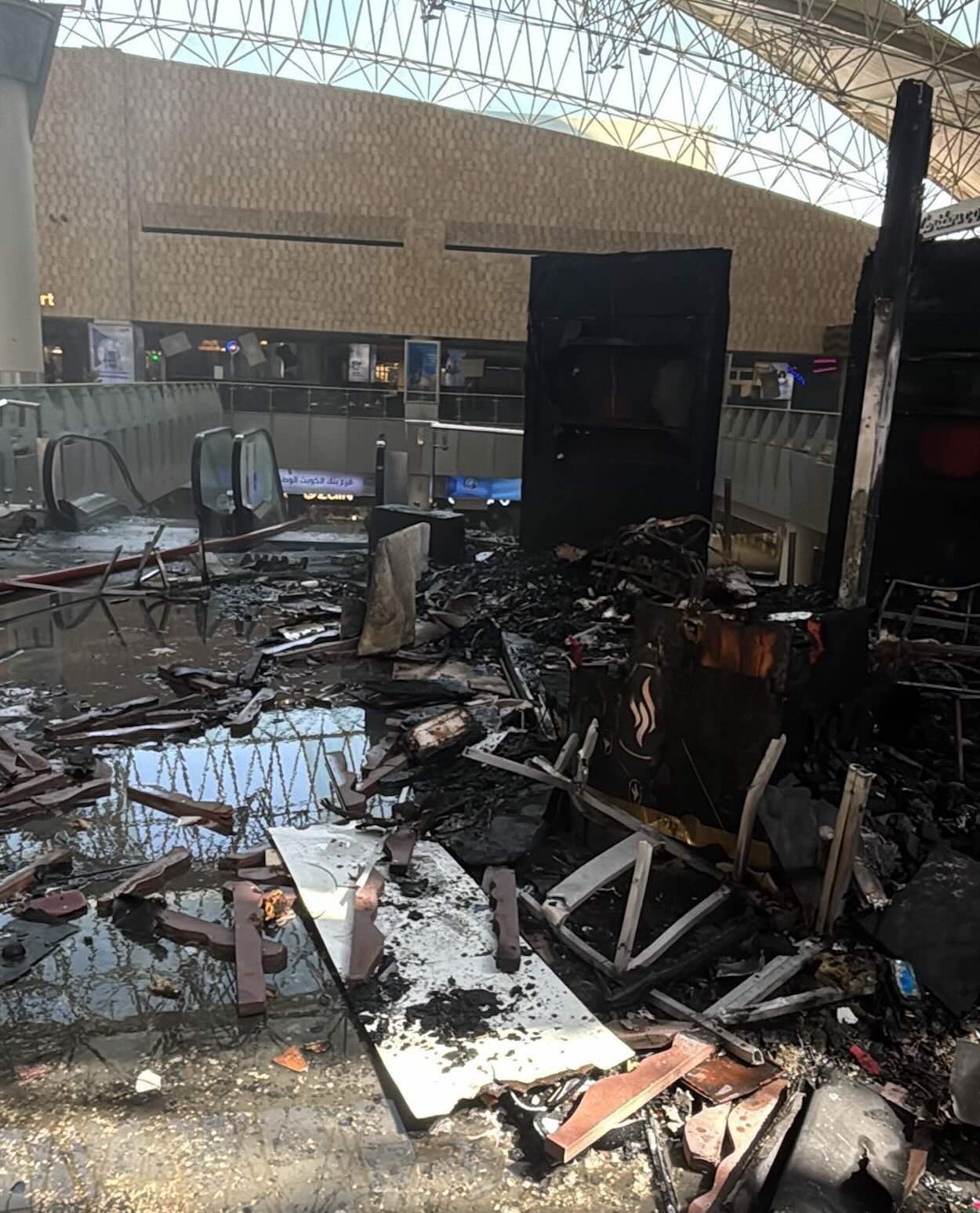
Kuwait International Airport was struck by drones in a deadly attack attributed by Kuwait and the United States to Iran, damaging Terminal 1 and briefly halting flights. Operations are now resuming, but the larger question is whether Kuwait can remain a reliable aviation gateway if civilian airport infrastructure keeps becoming a target.
Kuwait Airport Reopens After Deadly Drone Strike, But Aviation Risk Remains
Kuwait International Airport (KWI) was hit by drones on Wednesday morning, killing one person and injuring dozens more in what Kuwaiti officials have described as an Iranian attack on civilian infrastructure.
The strike damaged Terminal 1, with video released by Kuwait’s civil aviation authority showing what appears to be a drone slamming into the terminal and causing a large explosion. Tragically, one Indian national was killed and 63 people were injured. Kuwait Airways temporarily halted flights before resuming operations through Terminal 4 after safety assessments.
Iran has denied responsibility and claimed that the damage was caused by a failed U.S. interceptor missile, but U.S. Central Command rejected that account, calling the strike a deliberate Iranian drone attack. Kuwait has responded by expelling two Iranian diplomats. Earlier, Iran had said that the airport attack was justified because U.S. forces were using it as a launch site for attacks against the Islamic Republic.
The attack ironically came the day after Terminal 1 reopened after an earlier Iranian strike:
https://twitter.com/lovin_kuwait/status/2061771786862071912
Flights Are Resuming, But Terminal 1 Closed Again
The good news is that Kuwait International Airport does not appear to be closed indefinitely. Kuwait Airways resumed flights from Terminal 4, and local/regional reporting indicates that Kuwait Airways and Jazeera Airways have resumed operations, though passengers should still expect disruption and check with their airline before traveling.
But Terminal 1 was severely damaged. IndiGo suspended flights to and from Kuwait after the attack, and other carriers will certainly reassess their schedules depending on security conditions.
So the practical answer to “how long will the airport be closed?” appears to be: the airport itself is not fully closed, but Terminal 1 may remain disrupted while authorities repair and secure the facility (and there may be no way to actually secure the facilities if Iran strikes it every time it is rebuilt).
That’s the key question, isn’t it? If Kuwait International Airport can be struck days after reopening, airlines must ask a basic question: is the risk acceptable?
That calculus differs by airline. Kuwait Airways and Jazeera have national and commercial reasons to keep operating. But foreign carriers have more flexibility to suspend service, reduce frequencies, or wait for clearer security assurances, similar to what we’ve seen in Israel as carriers like American Airlines and Delta Air Lines continue to delay the resumption of service.
This attack goes beyond the borders of Kuwait. A direct strike on a Gulf airport raises fear across the region. The Gulf has built its global aviation model on safe, reliable hubs. Once airport terminals become targets (we’ve seen similar attacks in Dubai), will customers have the confidence to travel through them?
Will these attacks continue? We have absolutely no way of knowing and nothing undermines airport and airline operations like such a high degree of uncertainty.
CONCLUSION
Kuwait International Airport was hit by a deadly drone strike that damaged Terminal 1, killed one person, and injured dozens. Flights are now resuming through other terminals, so this does not appear to be a long-term total airport closure at this stage.
But the bigger issue remains unresolved.
A civilian airport was struck. Iran denies responsibility, while Kuwait and the United States blame Iran. Either way, the result is the same for travelers: more uncertainty, more disruption, and more reason for airlines to think carefully before operating into the region.
Kuwait may keep flights moving, but confidence is harder to restore than schedules. And as far as Iran is concerned, civilian airports seem to be easy targets, making me fear such attacks will continue.






Having spent my formative years in Kuwait, this is sad to see. We were last there in December 2023 and January 2024, so I have good memories of KWI. We were heading to AUH, so BA had great CW fares to KWI.
As a kid, I was a regular on the BA 156/157 (4 round trips a year), and used to even take the 5th freedom route on BA from KWI to MAA (on the Tristar).
The Waldorf Astoria in Kuwait probably ranks as one of my favourite hotels in the world, with outstanding service. Granted, not much to see in Kuwait.
I saw Ben from OMAAT routed via ME in April. That was waaaay too close for comfort for my tastes. I’ve transited through DOH and DXB countless times, but I’m not gonna book an itinerary through there for a while. Nope. This is exactly what can/has happened. Choose life. Connect in Europe or even Addis.
Damage takes only moments to cause, but can take a lifetime to heal. This makes me incredibly sad.
“civilian airports seem to be easy targets, making me fear such attacks will continue.”
Yep. And with the current US administration (perfectly described recently by Bruce Springsteen as a “ship of fools”), I have zero confidence in this getting back to anything-like-normal soon. This is going to kill commercial aviation across the Gulf region for years.
I’ve got flights via DOH on QR next winter and doubt I’ll be going through there (looking at Plan B and Plan C backups currently).
You are wise to secure back-ups. I had to do the same for a trip in June, and no regrets. Lost about $500 between P2 and I, but you cannot put a price on safety/security.