
Delta Air Lines appears increasingly serious about building up Los Angeles, but LAX has humbled many airlines before. The opportunity is real, but so are the limits.
Delta’s LAX Ambitions Grow, But Can It Make Los Angeles Work?
Yesterday, I wrote about Delta’s plan to open a second Delta One Lounge at LAX, noting that it was not just a lounge story but a broader sign of Delta’s growing ambitions in Los Angeles.
Now we have a bit more “color” as industry analysts would say.
Aviation insider JonNYC shared the following memo about Delta’s thinking at LAX:
“Delta has a once in a generation opportunity to accelerate leadership position at LAX. American, historically the leader, stepped back in recent years. AA has shed 10 points of corporate share and has a disruptive six-year terminal renovation underway. Meanwhile, Southwest is pulling back, JetBlue has shrunk to half its former size, and Alaska is shifting its focus to San Diego.
United is the only remaining viable competitor but is limited by gate constraints and sub-par facilities for the foreseeable future.”
That is a very interesting framing, and I think much of it is correct.
American Airlines has certainly pulled back in Los Angeles, and we just saw it cut six California routes, including four LAX routes served by United Airlines. JetBlue is a shell of what it once tried to be at LAX. Southwest remains large, but is not a premium competitor (at least not yet). In California, Alaska is now more focused on San Diego than Los Angeles.
That leaves United, which as the Delta memo points out has a strong LAX operation but remains constrained by facilities and gates. United’s Los Angeles operation is useful, but just a shell of its domestic and international operation in SFO.
So yes, Delta logically sees an opening.
What Actually Works At LAX?
The hard question is not whether Delta can grow at LAX. It can.
The hard question is what kind of growth actually makes sense.
Los Angeles is one of the most important air travel markets in the world, but it is also fragmented, expensive, hypercompetitive, and difficult to dominate. Airlines have tried to “win” LAX for decades. Usually, they end up losing money and retreating to something more modest.
American tried to build a much larger international operation at LAX and failed. East Asia did not work well. South America did not work well. American had the gates, the brand, and the oneworld and joint venture partners, yet it still struggled to make the economics work.
United also has its limits. It was unable to make 2x daily London Heathrow service from LAX work, and it has been many years since United served Frankfurt from Los Angeles. While United has built an enormous transatlantic network from San Francisco, LAX remains London-only for United metal to Europe.
You have to figure that there would be more transatlantic growth if it made financial sense.
Maybe the answer for United is to leave most Europe flying from LAX to Star Alliance joint venture partners like Lufthansa, SWISS, Austrian, ITA and others. And maybe the same logic applies to Delta: let Virgin Atlantic, Air France, KLM, and other SkyTeam partners carry much of the Europe load while Delta focuses its own metal where it has a better chance of making money.
That does not mean Delta cannot or should not fly LAX – London. It appears Delta metal on LAX – LHR is coming back, and that is symbolically important. But Europe from LAX is not where I see the most obvious opportunity for Delta, though it gets the most attention.
Domestic Growth Is Where Delta Can Shine
Where I find Delta’s LAX growth more interesting is domestic.
We are already seeing this with Delta adding Los Angeles – Chicago O’Hare service on June 7. That is a major business market and a route dominated by American and United, with United especially strong on the premium side.
Will Delta stop there?
I doubt it.
American just dropped four LAX routes that United serves: Cleveland, Columbus, Pittsburgh, and Washington Dulles. I am not suggesting Delta will immediately jump into all of those markets, but this is exactly the sort of opening Delta is studying. If American is pulling back and United is the only serious competitor, Delta may decide that some of these routes are worth testing, particularly if they support corporate contracts and loyalty growth in Los Angeles.
Delta needs routes that help make LAX more relevant to local premium customers. That means business markets, high-yield leisure markets, and routes that support Delta’s growing premium proposition at the airport. A second Delta One Lounge, more Delta One-branded domestic flights, and a broader domestic network all fit together.
Delta already offers or markets domestic Delta One on routes like LAX – JFK, Boston, Atlanta, and Washington National. It would not shock me to see more expansion of that concept if the lounge infrastructure and aircraft availability support it. And yes, people will pay for that (I’m raising my hand too).
International Growth Is Trickier
Delta is also growing internationally from LAX, including Hong Kong and Manila. Those are bold moves, though they are certainly more questionable in an era of elevated oil prices.
I understand the logic. Los Angeles is a huge Asian gateway. Delta has lost relevance in much of the Pacific over the years, and LAX gives it a chance to rebuild some of that presence. With Seattle increasingly contested by Alaska and its partners, Delta may see LAX as the better long-term West Coast growth platform (or it may grow in both places as it takes more aircraft deliveries…that remains to be seen).
But longhaul international growth is difficult in the current fuel environment. It is even harder when foreign competitors often have lower cost structures and stronger local brand loyalty.
A route like LAX – Hong Kong may be strategically useful, but will it be profitable? Delta can afford to take some strategic swings, but Los Angeles has a long history of punishing airlines that try to grow too aggressively.
CONCLUSION
Delta clearly sees a major opportunity at LAX. American has pulled back, JetBlue has shrunk, Southwest is not a premium threat, Alaska is focused elsewhere, and United is constrained. That gives Delta room to grow.
But LAX is not easy. American tried and failed to make a much bigger LAX international gateway work. United has built a huge transatlantic network at SFO, but not at LAX. The economics of Los Angeles can be brutal.
I think Delta’s best opportunity may be less about trying to dominate every longhaul market and more about building a stronger premium domestic and selective international network around Los Angeles. More Delta One routes, stronger business markets, and better lounges make sense. Asia is another story…
Can Delta make LAX work where others have struggled?
Maybe.
But LAX has a way of humbling airlines that believe the opportunity is “too good to pass up.”






Almost as if actual competition is good, and fortress hubs are bad. Huh.
Still wild how DL neglects ATL. Open a D1 there already! Lacking one at HQ is insulting at this point.
It makes sense to me. ATL is such a fortress hub, it doesn’t need a Delta One Lounge. Folks in ATL are going to fly DL because they have no other viable choice and the connectivity outweighs the lack of the lounge, which is so much more important in markets like JFK or LAX that are so competitive.
I still feel for those stuck in Atlanta… *sniff*
LH Group and UA have a gentlemen’s agreement that LH only flies LAX Germany. They want to serve those high premium pax on their own LH metal. This goes back years.
But I do recall LAX-FRA on UA back around 2010.
In my 1K based at LAX days (2011-2014) LHR was the only Europe route on UA metal, so it must have been 2010 at the latest. In fact, the last flight I took as a Los Angeles resident was when I moved away, and I flew LAX-LHR-FRA-JNB. I routed that way because I could clear a GPU to LHR at booking.
Matt I was stunned that the LAX T5 project commenced prior to the completion of the T4 project. This created a HUGE capacity hit, but AA seems to be fine with mainly just frequencies to AA’s big hubs from L.A. LAX must work in tandem with the other local airports, due the dynamics of that market. Like, JFK can’t do what LGA does & vice-versa. So LAX cannot be a full regional hub AND global hub at the same time. AA recognizes this and has thus retreated accordingly.
The article overlooked AA’s recent comments on medium term growth out of LAX. Once AA’s terminal construction is wrapped up, they will have 35 gates versus 23 or 24 for Delta and only 17 for United (guessing from memory and can’t look up citations at the moment.). AA execs have said they intend to grow into their gate infrastructure and regain or retain their traditional leadership at LAX. Your article just focused on AA routes suspended in the weak September period. Two other things about LAX that went unmentioned. The CPE (cost per emplaned passenger) continues to rise towards $40+ per passenger) which is a drag on airline financial performance out of the airport. United is already up gauging 175 flight to larger mainline planes to try and cope with this cost increase. Second, actual route profitability has become less important if it drives credit card sign ups in a premium market. No airline except maybe Allegiant actually makes money from flight revenue, relying on their multi-billion dollar revenue from Amex, Chase, or Citi. Having a solid market share to attract these credit card signups is becoming as much or more important than if a flight turns a profit. LA is one of the largest and most important markets for this loyalty revenue and has changed the economics of how airlines approach LAX.
Great comment. Good color.
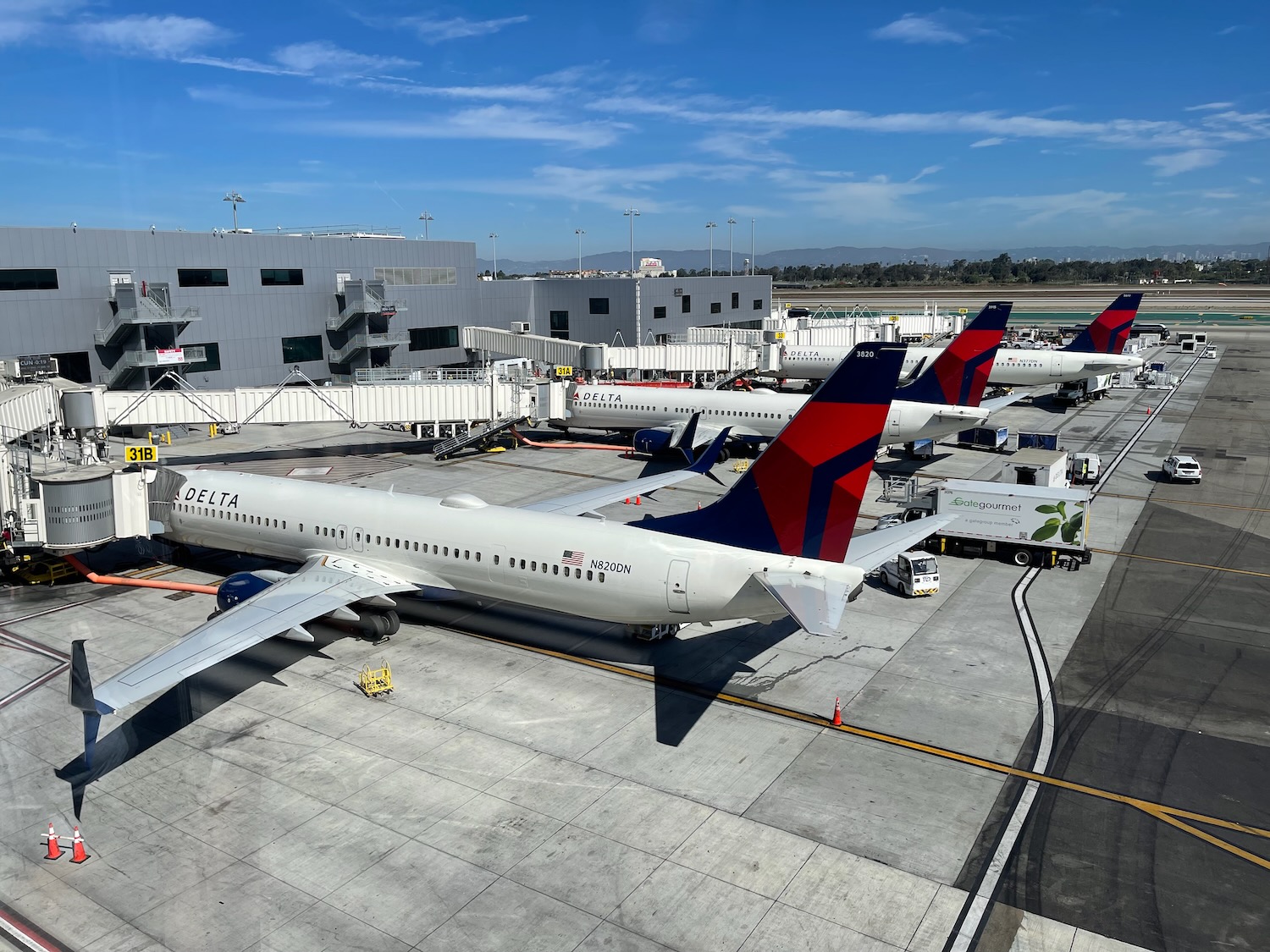
For aviation enthusiasts → The DL aircraft featured in the article is an B737-900ER (age: 12.2 years). It is currently en route from PHL to SLC.
While competitors like AA scale back their operations in Southern California, it appears that DL has positioned itself as UA’s primary viable rival in the region.
Ed Bastian & Co. are leaning heavily into luxury to capture LAX’s high-end corporate traffic. Let’s remeber that DL operates a Delta One Lounge in Terminal 3 and is constructing a second exclusive Delta One Lounge in Terminal 2.
DL has great leverage at JFK, LGA, and BOS because they can route travellers through convenient DTW or ATL if they don’t have a nonstop. At LAX their only backup is fairly weak and geographically suboptimal SLC, and then a whole lot of nothing until MSP or ATL. They are going to struggle to offer LAX travellers good options to lots of places west of the MSP-ATL line (including Latin America). The routing advantage DL has on the East Coast (DTW+ATL) is the advantage UA has on the West Coast (SFO+DEN+IAH). Even AA can offer PHX and the almighty DFW, plus the Alaska alliance. UA will also get JFK flights from LAX next year. I expect UA to hold serve against anything DL throws at them at LAX.