
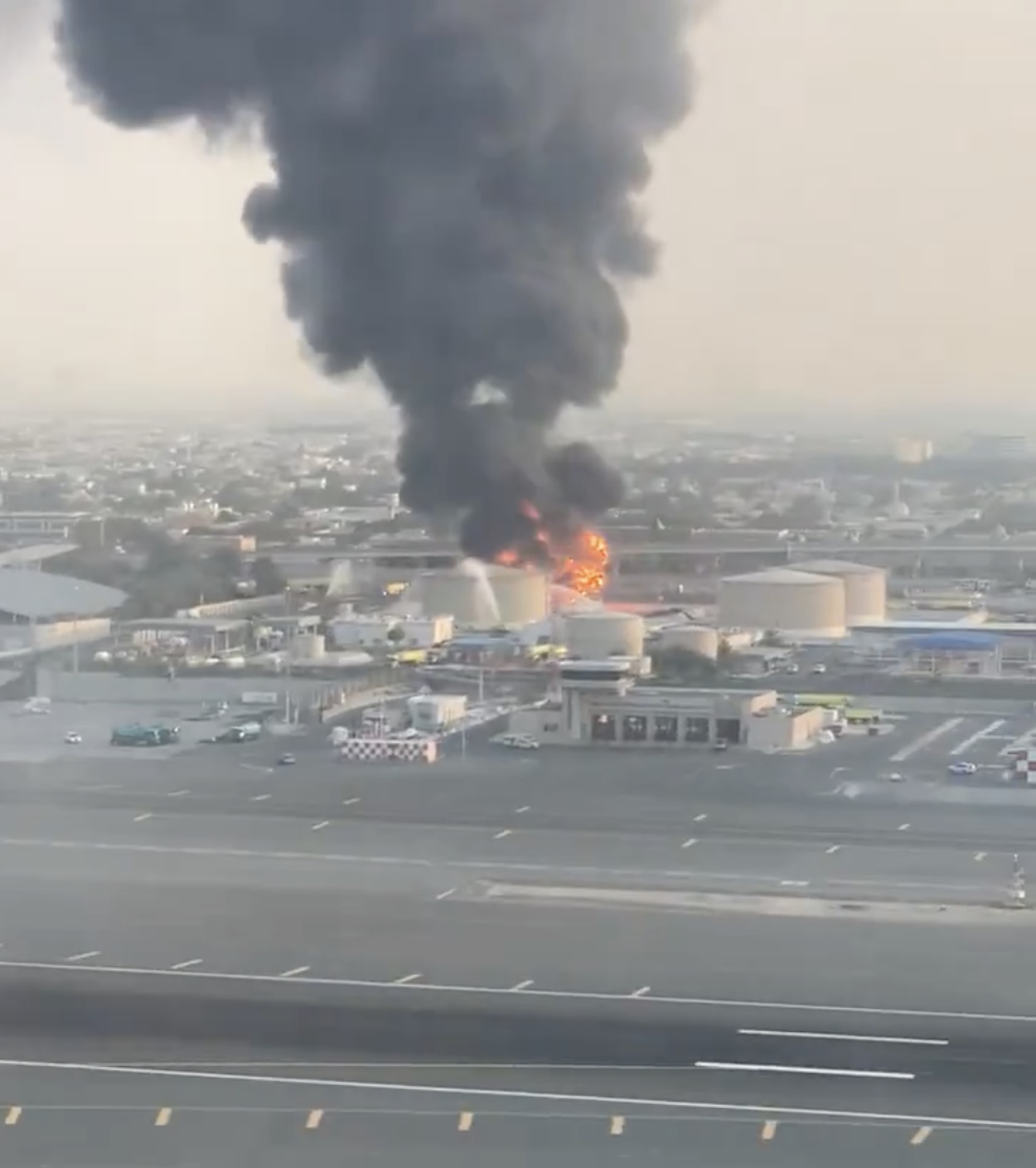
A drone attack near Dubai International Airport has disrupted one of the world’s most critical aviation hubs, briefly shutting down airspace and prompting authorities to suspend operations for foreign carriers.
Dubai Airspace Closed After Drone Attack Sparks Airport Fire
Dubai International Airport (DXB), the world’s busiest airport for international travel, briefly suspended flights once again after a drone strike ignited a fire near a fuel tank in the airport area.
The incident forced aviation authorities in the United Arab Emirates to temporarily close national airspace as a precaution while security forces assessed the threat and intercepted additional incoming drones and missiles.
Check out this video of the fire taken by a Canadian passenger landing at DXB:
https://twitter.com/AENMAD/status/2033573666458567136?s=20
Emergency crews quickly contained the fire and authorities said no injuries were reported at the airport itself. However, the attack caused significant disruption to airline operations as aircraft were diverted, delayed, or forced to turn back mid-flight. Flights to and from Dubai were temporarily suspended, while several aircraft were rerouted to nearby airports including Al Maktoum International Airport (DWC).
As of late as this morning, the UAE’s General Civil Aviation Authority (GCAA) imposed a temporary closure of the country’s airspace “amid rapidly evolving regional security developments,” but the space has now re-opened.
Latest Attack In Escalating Regional Conflict
The strike near Dubai airport is the latest in a series of drone and missile attacks targeting the United Arab Emirates since the escalation of the broader regional conflict involving Iran and its rivals earlier this year.
Since late February, the UAE has faced hundreds of drone and missile launches targeting infrastructure, oil facilities, and military sites across the country. Most have been intercepted by air defenses, though falling debris and occasional impacts have damaged civilian areas.
Authorities say the attack near Dubai airport was one of several recent incidents affecting aviation infrastructure in the Gulf. Earlier strikes in the region have also damaged buildings in Dubai, sparked fires in Fujairah’s industrial zone, and caused casualties in Abu Dhabi after a missile struck a civilian vehicle.
Global Aviation Feeling The Impact
Following the fuel tank strike, Dubai authorities reportedly suspended landing permissions for foreign airlines entirely, allowing only local carriers to continue operating. That is a remarkable step for one of the world’s most important global hubs and has me wondering whether it is more for commercial reasons than simply logistical reasons. I tend to be jaded these days, but there are certainly valid logistical reasons to restrict flights.
Even for flights that are operating, the disruption is visible. Several Emirates flights have been forced to make technical stops shortly after departure, likely due to fueling constraints following the damage to airport infrastructure. The ban on foreign airlines could simply be a reality of scarce fuel.
Any way you look at it, it is really a mess. With ongoing drone and missile activity across the region, airlines are being forced to reroute flights, cancel service, or operate under constantly changing restrictions. The result is a cascading effect: longer flight times, higher operating costs, disrupted cargo flows, and uncertainty for passengers traveling between Europe, Asia, and beyond. Fuel prices are also rapidly rising.
What happens in Dubai does not stay in Dubai! When a hub of this scale is disrupted, the entire global aviation network feels it. I may be naively optimistic, but I think demand will bounce right back once the war ends (inshallah…), yet that could be a long way away.
CONCLUSION
The latest drone strike near Dubai International Airport underscores how the UAE has increasingly found itself on the front lines of a widening regional conflict. While the broader war may center on Iran, Israel, and the United States, the spillover is being felt across the Gulf, with civilian infrastructure and global aviation hubs now caught in the crossfire.
For now, operations have resumed at DXB, but with repeated drone and missile activity across the region, it is becoming increasingly clear that this is not an isolated incident, but part of a broader pattern that airlines and passengers will have to contend with in the days ahead…
image: @AENMAD / X





* maybe we shouldn’t even be there at all. *
– Donald Trump
This is the Middle East airlines’ equivalent of 9/11 and they are desperately trying to project the image that all is ok.
It will take quite some time for demand through ME hubs to return to normal even if the war ended tomorrow – which is not likely to happen
I appreciate how disruptive this is, but I wouldn’t invoke 9/11, though it feels like the early days of the Russia-Ukraine war (March 2022) or the pandemic (March 2020), where flights for particular regions are now off-limits, and everyone needs to adapt.
That said, it is shocking how unprepared this administration is for the foreseeable fallout on our Gulf allies, shattering their image as relative safe-havens. The expats are exiting; the sovereign wealth funds are wondering why they invested billions in Jared’s businesses if his father-in-law’s gonna let ‘em get droned like this.
Delta is fortunate to have not invested much in the region, ironically. Meanwhile, United and American had their respective flights and codeshares to DXB/DOH. Time for Delta to start flying nonstop US-India, since a lot of demand for that now that ME is mostly off-limits.
On a planet whose future is becoming increasingly and dangerously uncertain, it’s truly thought-provoking that wars are still raging at full speed!
Am not sure demand will be right back from this war is over, though I agree people tend to forget quickly.
However, I personally feel it will a long time before European, on their way to S.E. Asia, Australia, or other destination, will take the risk to fly via the Middle-East. What has happened since Feb. 28th has changed dramatically the perception of million of people in regards to the ‘safety’ of the region. Millions of people have seen their travel disrupted due to this war, and I guess we will see again people choosing ‘direct’ flights instead of making a stop-over in Dubai, Doha or Abu Dhabi.
No doubts that prices will be very attractive for some time to fly Emirates, Quatar and others, but will it be enough?
Those carriers may have to change drastically their economic models.
Only time will tell!
My personal feeling is that demand will not bounce right back when the war is over, and it will take months if not years before people choose to make a stop-over in the M.E. on their way to S.E. Asia, Australia or other destinations.
Non-stop flights from Europe (which were the norm before the M.E. carriers became popular) will become again more popular despite higher fares.
Millions of people have seen their travel plans disrupted since Feb. 28th, and we may see a real change the way people fly in the next few months (or even years?).
The carriers from the M.E. may to change their business models?
But it is true that people tend to forget quickly. And I feel confident there will be some incredible fare to grab.
Well, only time will tell.
Sorry, my comment was published twice!
There were three mass shootings in the US over the weekend and 14 people were shot. Since the war in Iran began, there have been 17 mass shootings in the US with 108 people shot.
0 people connecting at DXB have been injured at since the war began, but yes, Dubai is dangerous.
Yay! They deserve it. The UAE will never prosper and their fag belongs in the toilet.